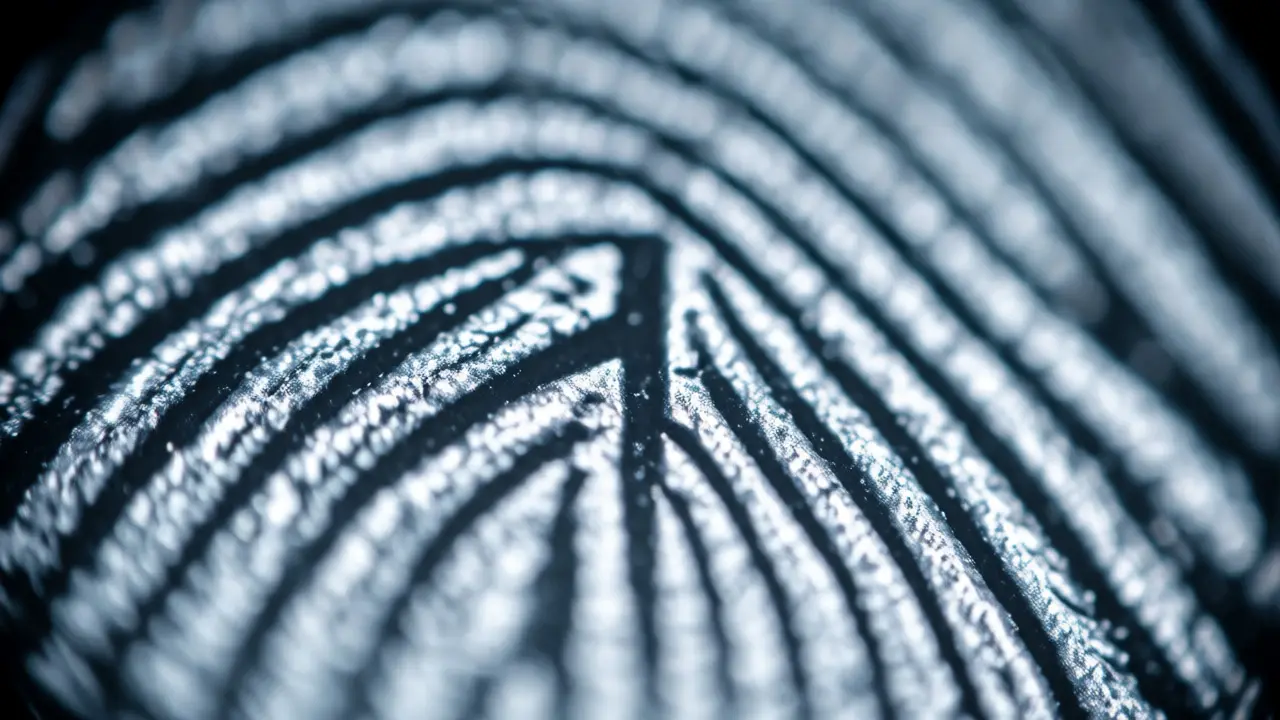
Imagine you are looking at a smudge on a glass. To the naked eye, it is just dirt or oil. But under a forensic microscope, that smudge becomes a map of identity. The secret isn't the overall shape of the loop or whorl; it is in the tiny, specific breaks and forks in the lines. These are called ridge characteristics, or more commonly, minutiae. If you want to understand how modern fingerprint analysis actually works, you have to stop looking at the big picture and start obsessing over the details.
Most people think fingerprints are matched by comparing whole patterns. That is a myth. Two fingers can have the exact same pattern type-say, both are left slanted loops-and still belong to completely different people. What makes them unique are the minutiae. These are the specific points where a ridge ends, splits, or changes direction. When forensic examiners compare two prints, they aren't asking "Do these look alike?" They are asking "Do these share enough identical ridge characteristics in the correct spatial relationship?" This article breaks down exactly what those characteristics are, how we identify them, and the rigorous process used to compare them.
The Anatomy of a Ridge Detail
To identify minutiae, you first need to know what you are looking for. In the world of biometrics and forensics, there are dozens of recognized features, but only a handful matter for reliable identification. The core concept here is that ridges are not continuous lines; they are dynamic structures that break, fork, and island out. Each of these events creates a coordinate point (x, y) and an angle ($\theta$).
The most common feature is the ridge ending. This happens when a friction ridge stops abruptly. It’s like a road hitting a dead end. Next is the bifurcation, where a single ridge splits into two. Think of this as a highway splitting into two lanes. Then there are dots (very short ridges), islands (a ridge that splits and rejoins quickly), and spurs (a small branch coming off a main ridge).
Why do these matter? Because they are stable. Your skin regenerates every few weeks, but the underlying dermal papillae-the layer that shapes your ridges-stay put. Unless you suffer a deep scar that reaches the dermis, your ridge endings and bifurcations remain in the same relative positions throughout your life. This stability is what allows us to use them for identification decades later.
Identifying Minutiae in Practice
Identification is harder than it sounds. In a clean, inked print taken at a police station, minutiae are clear. But in a crime scene latent print, they are often distorted by sweat, pressure, or surface texture. So, how do examiners find them?
- Locate the Core and Delta: Before counting minutiae, you need a reference frame. The core is the center of the pattern; the delta is the triangular intersection of ridge systems. These provide the orientation.
- Trace the Ridges: You don't just glance. You trace each ridge from the edge inward. As you trace, you mark every time a ridge ends or splits.
- Filter Noise: Not every break is a real minutia. Smudges, dry skin cracks, or debris can look like a bifurcation. Experienced analysts learn to distinguish true anatomical features from artifacts. For example, a "fake" bifurcation might lack the smooth curvature of a real split.
- Record Coordinates: In digital systems like AFIS (Automated Fingerprint Identification System), each minutia is assigned an x-y coordinate and an angle. This turns a biological image into a mathematical dataset.
A common mistake beginners make is over-counting. Just because you see ten dots doesn't mean you have ten valid minutiae. Quality matters more than quantity. A blurry dot near a heavy ridge line is less reliable than a sharp, isolated dot in open space.

The Logic of Comparison
Once you have identified the minutiae on two prints-one known (from a suspect) and one unknown (from the scene)-you enter the comparison phase. This is where science meets logic. You are looking for correspondence. Do the features match in type, location, and direction?
Let's say Print A has a bifurcation at coordinate (10, 20) with an angle of 45 degrees. Print B must have a bifurcation at roughly the same relative position and angle. If Print B has a ridge ending there instead, that's a discrepancy. Discrepancies are deal-breakers unless they can be explained away by distortion, such as the finger being bent during the print capture.
Examiners use a method called "point-to-point comparison." They draw imaginary lines between corresponding minutiae. If the distance between Point 1 and Point 2 in Print A is 5mm, and in Print B it is also 5mm, that strengthens the match. If the distances vary wildly, the prints likely don't come from the same source. This geometric consistency is key. It proves that the entire pattern is aligned, not just random coincidences.
How Many Minutiae Do You Need?
This is the million-dollar question in forensics. How many matching points prove identity? There is no universal number. Unlike DNA, which has strict statistical thresholds, fingerprint comparison relies on examiner judgment based on quality.
Historically, some countries required 12 matching points. Today, most jurisdictions follow the ACE-V methodology (Analysis, Comparison, Evaluation, Verification) without a fixed numerical threshold. However, practical experience shows that fewer than six high-quality minutiae rarely provide sufficient confidence. Most experts feel comfortable declaring an identification with eight to twelve clear, consistent matches. If the print is low quality, you might need fifteen or more to overcome the uncertainty.
| Feature Type | Description | Reliability Level | Detection Difficulty |
|---|---|---|---|
| Ridge Ending | A ridge that terminates abruptly. | High | Low (Clear cut-off) |
| Bifurcation | A ridge that splits into two separate ridges. | High | Medium (Requires tracing) |
| Dot | A very short ridge, usually less than 1mm long. | Medium | High (Easily confused with noise) |
| Island | A ridge that bifurcates and immediately rejoins. | Medium | Medium |
| Hook | A ridge that curves back on itself slightly. | Low-Medium | High (Subjective interpretation) |

Distortion and Its Impact on Matching
If you press your finger hard on a piece of paper, the ridges spread out. If you roll it lightly, they compress. This is distortion. It changes the coordinates of your minutiae without changing their actual existence. A good analyst knows how to account for this.
When comparing prints, you never expect perfect pixel alignment. Instead, you look for topological consistency. Does the sequence of features hold up? If Feature A is always to the left of Feature B in multiple prints from the same person, that relationship should persist even if the absolute distances change due to pressure differences.
Scars are another factor. A scar acts as a permanent, unique landmark. If a latent print shows a scar cutting across three ridges, and the known print shows the same disruption, that is powerful evidence. Scars are often treated as super-minutiae because they are so distinctive. However, you must ensure the scar hasn't healed differently over time, though significant scars tend to remain stable.
From Manual Analysis to Algorithmic Precision
While human eyes are great at spotting anomalies, computers are better at speed. Modern biometric systems use algorithms to extract minutiae automatically. These systems convert the grayscale image into a binary map (black ridges, white valleys) and then apply filters to detect endpoints and junctions.
But algorithms aren't perfect. They struggle with wet or dry fingers. That's why the final decision often rests with a human expert who reviews the machine's suggestions. The computer might flag 50 potential matches; the human confirms which 10 are genuine. This hybrid approach leverages the speed of technology with the contextual understanding of humans.
For anyone studying forensics, mastering minutiae is non-negotiable. It is the foundation upon which the entire field stands. Without these tiny details, fingerprints would just be pretty patterns, not proof of presence.
What is the minimum number of minutiae needed for a positive ID?
There is no legal minimum in most modern jurisdictions. While older standards suggested 12 points, today's standard is qualitative. An examiner declares an ID if the number of matching minutiae is sufficient to exclude all other possibilities, considering the quality of the print. Typically, 8-12 high-quality matches are considered robust.
Can fingerprints change over time?
The overall pattern and minutiae locations remain stable throughout adulthood. However, the skin surface wears down and regenerates. Deep cuts or burns that reach the dermis layer can permanently alter ridge flow, creating new scars or destroying existing minutiae. Superficial scratches heal and disappear.
What is the difference between a loop and a minutia?
A loop is a macro-level pattern classification describing the general flow of ridges (entering and exiting on the same side). A minutia is a micro-level detail, such as a ridge ending or bifurcation, found within that pattern. Loops help orient the print; minutiae provide the unique identifying data.
How does AFIS handle poor quality prints?
AFIS systems assign a quality score to each minutia. Low-confidence points may be ignored or weighted less heavily in the matching algorithm. If a print is too noisy, the system may fail to extract any usable minutiae, requiring manual enhancement or re-collection of the sample.
Are twins' fingerprints identical?
No. While identical twins share DNA and similar physical traits, their fingerprints are formed by random developmental factors in the womb, such as blood flow and pressure. Their ridge patterns may look similar, but their minutiae will differ significantly.