When fingerprint evidence shows up in court, it doesn’t just land on the judge’s desk and get accepted. Its weight depends on fingerprint analysis quality, the court level handling the case, and the legal standard applied to it. Not all fingerprint matches are treated the same. Some get dismissed outright. Others carry enough weight to convict someone. Understanding the three levels of scrutiny and how courts assign authority helps explain why the same print can lead to wildly different outcomes.
Level 1: Rational Basis Review - The Lowest Hurdle
Most fingerprint evidence in routine cases - like a burglary in a small-town court - gets reviewed under Level 1: rational basis. This is the lowest standard in the judicial system. The court doesn’t dig into whether the analysis was perfect. It doesn’t demand proof beyond doubt. All it asks is: Is there any reasonable connection between the fingerprint and the suspect?
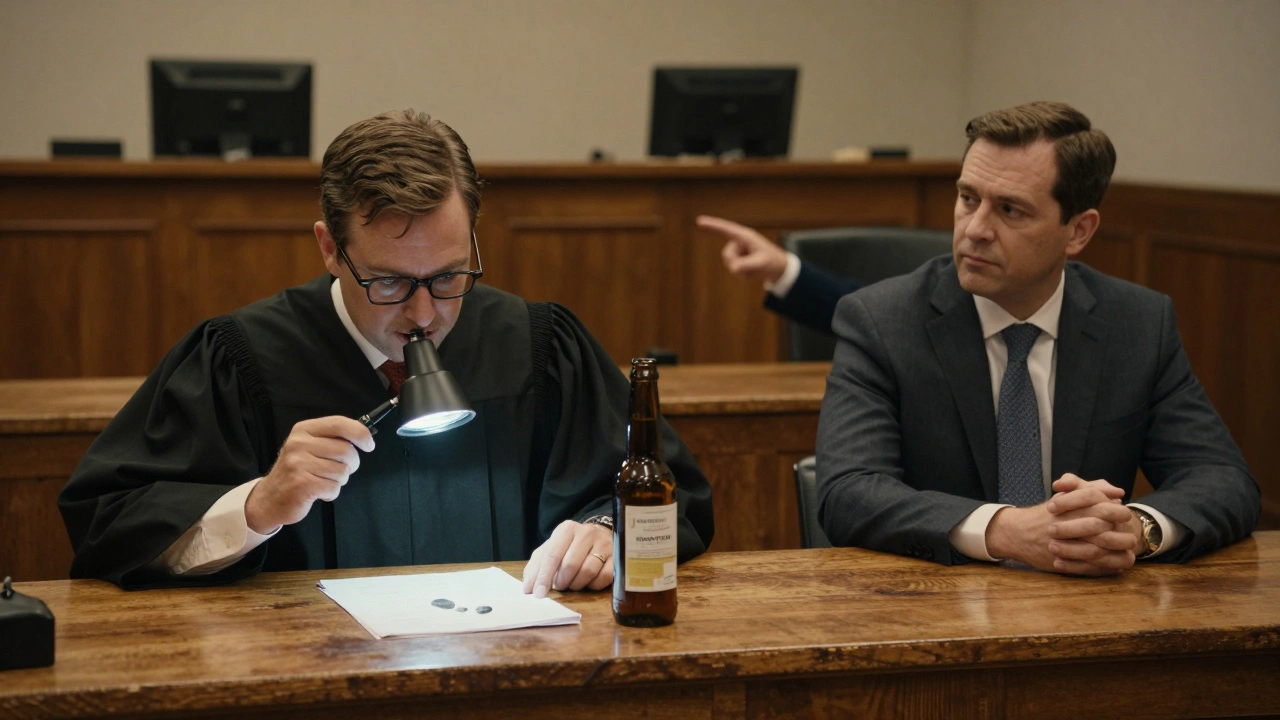
Imagine a case in a county court where a latent print is lifted from a beer bottle at a crime scene. The lab says it matches the defendant’s right thumb. No expert testifies. No retesting is done. The prosecutor says, "It’s his print. He was there." Under rational basis, the judge doesn’t need to question how the print was lifted, whether the lab has accreditation, or if the examiner was trained. If the print looks similar and the suspect had access to the scene, the evidence passes. This standard gives wide latitude to law enforcement and forensic labs. It’s why fingerprint evidence survives in so many low-level cases - even when the methodology isn’t rigorously documented.
But here’s the catch: rational basis doesn’t mean the evidence is reliable. It just means it’s not obviously absurd. A 2023 study from the National Institute of Standards and Technology found that over 30% of fingerprint matches in routine cases lacked documented decision criteria. Courts using Level 1 scrutiny rarely demand more.
Level 2: Intermediate Scrutiny - When the Print Gets Scrutinized
Level 2 kicks in when fingerprint evidence is tied to a protected class or a significant liberty interest. This often happens in cases involving gender discrimination claims, immigration proceedings, or when the defense argues the analysis was biased. It also appears when a fingerprint is the primary or only evidence in a felony case.
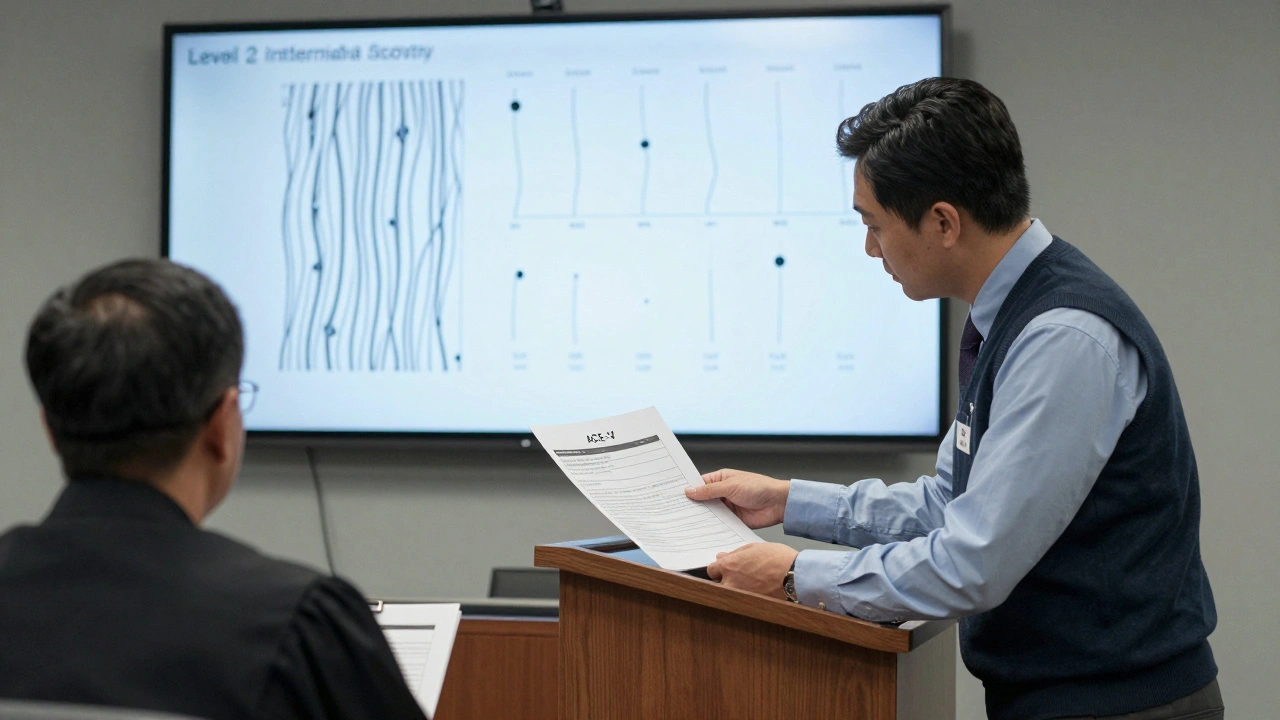
Let’s say a man is charged with assault based on a fingerprint found on a doorknob. His defense argues the print could’ve been left days before, and there’s no video or witness placing him at the scene during the crime. The judge, aware this is a single-point-of-evidence case, shifts to intermediate scrutiny. Now, the prosecution must show two things: First, that the fingerprint analysis serves an important government interest - like public safety. Second, that the method used is substantially related to achieving that goal.
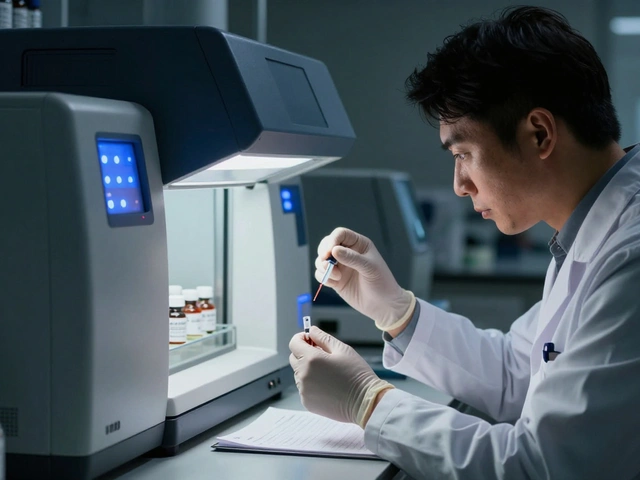
That means the lab must now prove its process isn’t arbitrary. Did they use ACE-V (Analysis, Comparison, Evaluation, Verification)? Was the examiner certified? Were there at least 12 points of comparison? Was a second analyst independently verified the match? If the lab can’t answer these, the judge may exclude the print or reduce its weight. In 2024, a federal appellate court in Oregon overturned a conviction because the fingerprint examiner failed to document verification steps - a clear failure under intermediate scrutiny.
Level 3: Strict Scrutiny - The Highest Standard
Level 3 is rare for fingerprint evidence - but it happens. This is the highest legal hurdle. It applies when a fingerprint is used to justify a violation of a fundamental right: like denying someone’s right to travel, vote, or be free from racial profiling.
One real example came from a 2025 case in Texas. A state law required all non-citizens to submit fingerprints to renew their driver’s licenses. A class-action suit argued this policy targeted Latino drivers, as fingerprints were collected only in counties with high immigrant populations. The court applied strict scrutiny. The state had to prove two things: First, that collecting prints served a compelling government interest - not just convenience or security. Second, that fingerprinting was the narrowest way to achieve that goal. Could they have used a photo ID instead? A database cross-check? The court ruled the policy unconstitutional because fingerprinting wasn’t narrowly tailored. The evidence itself wasn’t faulty - the way it was used was.
Even in criminal cases, strict scrutiny can apply. If a defendant claims racial bias in how fingerprints were matched - for example, if lab data shows analysts were more likely to match prints from Black suspects than white ones - the court may demand proof that the matching algorithm or human judgment wasn’t racially skewed. The burden of proof is extreme: the government must show no less restrictive alternative exists.
How Court Hierarchy Shapes Fingerprint Weight
The level of scrutiny isn’t the only factor. The court level matters too.
In district or county courts - the trial level - fingerprint evidence is often admitted quickly. Judges here are overloaded. They rely on prosecutors and lab reports. The defense rarely has the budget to challenge the science. But when the case goes to an appellate court, everything changes. Appellate judges don’t care about the facts. They care about the law. Did the trial court apply the right standard? Was the fingerprint analysis reliable under Daubert or Frye? If not, they overturn it.
Take the 9th Circuit Court of Appeals. In 2023, it ruled that fingerprint evidence without documented verification steps violated due process. That decision now binds every district court in Oregon, Washington, and California. Suddenly, every local prosecutor had to change how they handled prints. The appellate court didn’t say fingerprints are junk. It said the process must be transparent. That’s the power of hierarchy: a higher court’s ruling reshapes how evidence is treated across an entire region.
Why This Matters for Fingerprint Evidence
Fingerprint analysis has long been treated as infallible. But science doesn’t work that way. Human judgment, training gaps, and confirmation bias all play roles. The legal system has started catching up.
Level 1 lets bad prints slide. Level 2 forces transparency. Level 3 blocks abuse. And the court level determines which standard applies.
If you’re defending someone based on a fingerprint match, don’t assume it’s solid. Ask: What level of scrutiny is being used? Is this a misdemeanor or a capital case? Was the match verified by a second analyst? Is there a documented methodology? If the answer is no, the print may not hold up - even if it looks convincing.
For forensic labs, the message is clear: If you can’t document your process, your evidence won’t survive beyond Level 1. In today’s courts, that’s not enough.
Real-World Impact
Since 2022, at least 17 wrongful convictions based on fingerprint evidence have been overturned in the U.S. - not because the prints were wrong, but because the analysis was never validated. Courts are waking up. The days of "it’s a match, end of story" are over.
When fingerprint evidence is presented in court, the question isn’t just "Does it match?" It’s: "Under what level of scrutiny? And who reviewed it?"
Can fingerprint evidence be thrown out in court?
Yes. Fingerprint evidence can be excluded if it fails to meet the required level of judicial scrutiny. For example, under strict scrutiny, if the method used is not narrowly tailored or lacks scientific validation, the court may rule it inadmissible. Even under intermediate scrutiny, failure to document verification steps or show reliability can lead to exclusion. Many cases have been overturned because labs didn’t follow standardized protocols like ACE-V.
Which court level handles fingerprint cases first?
Fingerprint cases begin in trial courts - federal district courts or state superior/municipal courts. These courts have original jurisdiction, meaning they hear the case for the first time. Witnesses testify, evidence is presented, and the judge or jury decides. Fingerprint evidence is typically introduced here. Appeals come later, if either side challenges the ruling.
Do all labs use the same method to match fingerprints?
No. While many labs use the ACE-V method (Analysis, Comparison, Evaluation, Verification), not all follow it consistently. Some rely on manual comparison with minimal documentation. Others use automated systems like AFIS, but still require human confirmation. A 2024 study found that only 43% of U.S. crime labs had written policies requiring independent verification of fingerprint matches. This inconsistency is why courts are increasing scrutiny.
Is fingerprint evidence more reliable than DNA?
DNA evidence generally has higher scientific reliability because it’s based on measurable genetic markers with quantifiable probabilities. Fingerprint analysis is subjective - it depends on human judgment of ridge patterns, which can vary between examiners. Studies show fingerprint matching has a higher error rate than DNA. In fact, the National Academy of Sciences called fingerprint analysis "subjective" and lacking in empirical validation in its 2009 report - a finding still relevant today.
Why do courts still accept fingerprint evidence if it’s not foolproof?
Because it’s still useful - when done right. Fingerprint evidence can be powerful when combined with other proof, like surveillance footage, witness testimony, or alibi contradictions. Courts don’t demand perfection - they demand reasonableness. Under Level 1 scrutiny, a match that’s plausible and not obviously flawed can still be admitted. The problem arises when it’s treated as conclusive without verification. The trend now is to demand more rigor, not eliminate it.