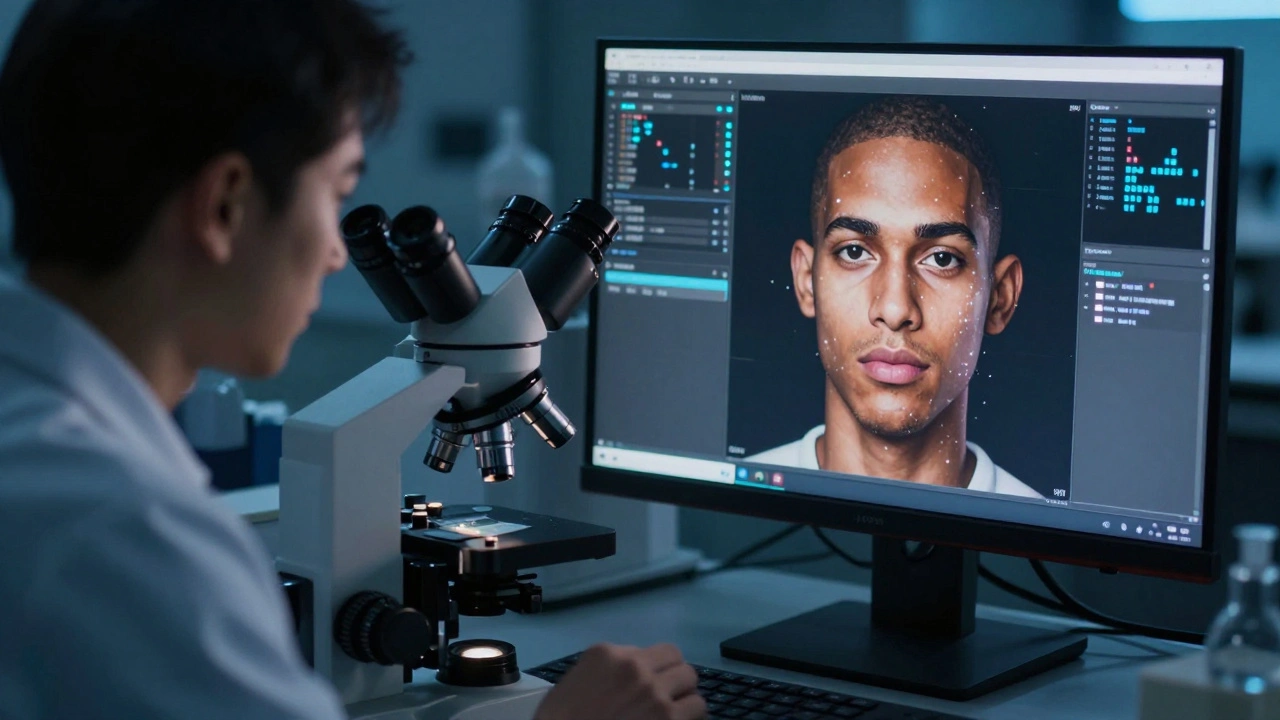
When police find a drop of blood, a strand of hair, or a smudge of skin at a crime scene, they don’t just get a name from DNA anymore. They get a face. A guess at skin tone. A prediction of eye color. Even a hunch about where someone’s ancestors came from. This isn’t science fiction. It’s happening right now in forensic labs across the U.S. and Europe, thanks to SNP panels.
What Are SNP Panels, and Why Do They Matter?
SNP stands for Single Nucleotide Polymorphism. Think of them as tiny variations in your DNA - a single letter change in the genetic code that’s common across populations. While traditional forensic DNA tests look at STRs (Short Tandem Repeats), which are great for matching known suspects, they fall apart when samples are old, damaged, or mixed with DNA from multiple people.
SNP panels fix that. They’re designed to work on tiny, degraded pieces of DNA. A single SNP might not tell you much, but when you look at thousands of them together - like a 5,422-marker panel called FORCE - you start getting real answers. These panels don’t just identify people. They help build a biological profile of someone who’s never been in a database.
Three Types of SNPs That Solve Crimes
Not all SNPs are created equal. Forensic scientists group them into three categories, each serving a different investigative purpose.
- Ancestry-Informative SNPs (AISNPs): These markers vary widely between populations. One SNP might be present in 90% of people from West Africa but only 5% in Northern Europe. By analyzing dozens of these, labs can estimate whether a suspect’s ancestors came from Africa, East Asia, Europe, or the Americas. The FORCE panel includes markers that can distinguish between more than 100 global populations.
- Phenotype-Informative SNPs (PISNPs): These predict physical traits. Some SNPs are strongly linked to blue vs. brown eyes. Others determine whether someone is likely to have black, brown, or red hair. Skin pigmentation is trickier, but modern panels can predict it with over 80% accuracy. These aren’t guesses - they’re based on large studies of thousands of people with confirmed traits and genotypes.
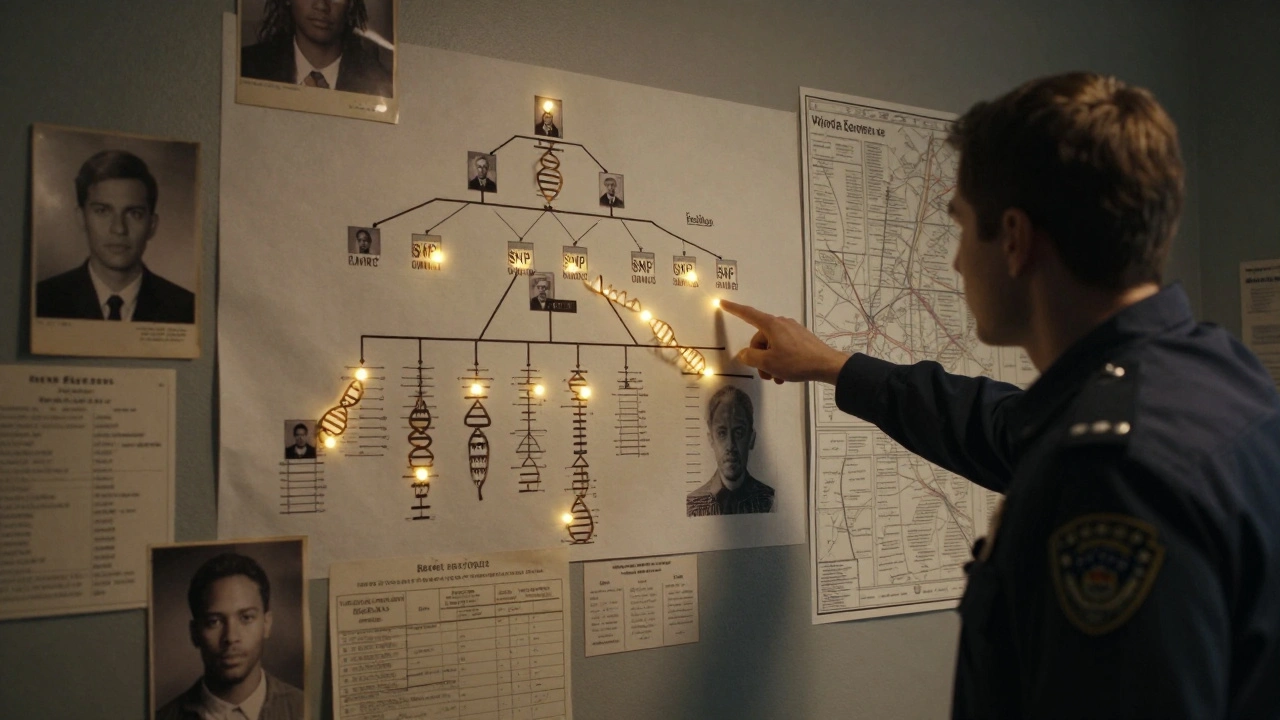
- Lineage-Informative SNPs (LISNPs): These are the game-changers for cold cases. Instead of looking at single SNPs, these panels analyze small clusters of SNPs called microhaplotypes. These clusters behave like inherited blocks - passed down through families. This lets investigators find distant relatives, even 4th or 5th cousins, in public DNA databases like GEDmatch or FamilyTreeDNA. Once they find a match, genealogists build family trees backward until they land on a common ancestor. Then they work forward to find living relatives who might be suspects.
The FORCE Panel: A Breakthrough in Forensic Genetics
The most advanced SNP panel in use today is the FORCE panel, developed under funding from the National Institute of Justice. It’s not just big - it’s smart. With 5,422 markers, it covers identity, ancestry, phenotype, and kinship all in one test. But here’s the key: it was designed to avoid clinical markers. No disease risk, no drug metabolism genes. Just forensic-use-only data.
Validation tests showed something remarkable. When researchers tested the FORCE panel on DNA from World War II-era remains, it could confidently link individuals to relatives up to the fifth degree. Likelihood ratios exceeded 10,000. Posterior probabilities hit 99.99%. That’s not just strong - it’s court-ready.
Why does this matter? Because in many cold cases, the only DNA left is from a single skin cell on a doorknob, or a hair that’s been buried for decades. STRs can’t read that. But SNPs? They can. And that’s why more labs are switching.
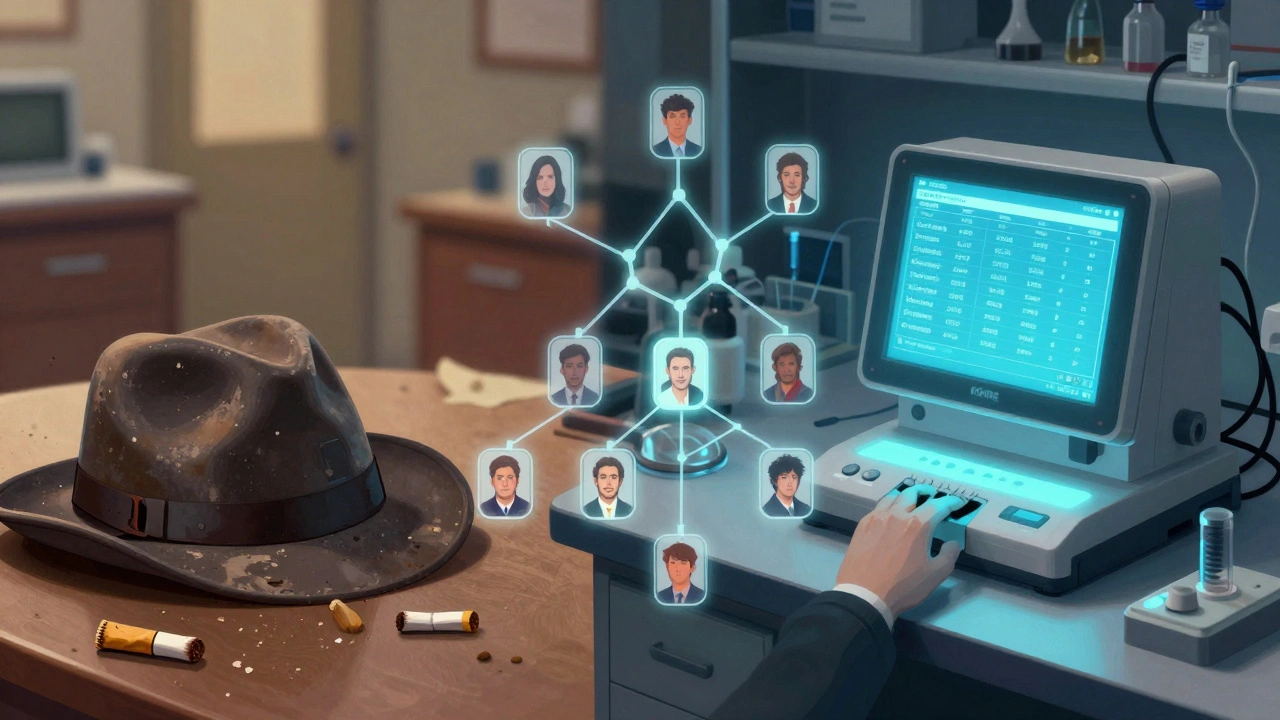
How Genetic Genealogy Works - Step by Step
Here’s how it plays out in real investigations:
- A crime scene sample is collected - maybe a cigarette butt or a hat left behind.
- Lab technicians use the FORCE panel or a similar high-density SNP array to genotype the sample.
- The SNP profile is uploaded to public genealogy databases, where millions of people have shared their DNA for ancestry research.
- Software finds distant relatives who share significant DNA segments with the unknown suspect.
- A forensic genealogist builds a family tree using public records, obituaries, and social media.
- They narrow down possible suspects based on age, location, and family connections.
- Law enforcement obtains a DNA sample from a suspect - say, a discarded coffee cup or a trashcan.
- That sample is tested using the standard forensic STR panel. If it matches the crime scene STR profile? Case closed.
Notice something? The SNP data gives you the lead. The STR data gives you the proof. Courts still require STR confirmation because it’s been validated for decades. SNP data doesn’t replace it - it finds the person who needs to be tested.
Limitations and Ethical Boundaries
This isn’t a magic bullet. SNP panels have limits.
First, accuracy isn’t perfect. Eye color prediction? Around 90% reliable. Skin tone? About 75-80%. Hair color? Better for black and red, less so for blonde. And ancestry? It’s probabilistic. You can say someone likely has West African ancestry, but you can’t say they’re 100% from Ghana. These are estimates based on population averages.
Second, mixed samples are still hard. If two people’s DNA are blended - say, from a handshake or a shared glass - SNP panels can help separate them better than STRs, but it’s not foolproof. Newer panels now combine SNPs with insertion/deletion markers (InDels) and microhaplotypes to improve mixture resolution.
Third, there’s privacy. Using public genealogy databases to track suspects has sparked debate. Some argue it’s a powerful tool for justice. Others worry about consent. That’s why most agencies only use SNP data to generate leads - not as direct evidence. The final match still comes from a court-admissible STR test.
What’s Next? Integration and Expansion
Forensic labs aren’t stopping at SNPs. The next generation of panels combines SNPs with InDels, microhaplotypes, and even mitochondrial DNA markers. Some kits now include 94 identity SNPs, 56 ancestry markers, and 22 phenotype markers - all in one workflow.
Companies like Illumina and Thermo Fisher (formerly LifeTech) have already baked the most reliable SNP panels into their commercial forensic kits. That means smaller labs can now run these tests without building their own tech from scratch.
Researchers are also expanding the reference databases. Early panels were based on data from 55 populations. Today, they’re adding samples from Indigenous communities, Pacific Islanders, and Central Asian groups - populations that were previously underrepresented. Better data means better predictions.
Real-World Impact
This isn’t theoretical. SNP panels helped solve the Golden State Killer case. They identified the suspect in the 1987 murder of Lynda Mann in the UK. They’ve matched unidentified remains from the Vietnam War to families. In 2024, a 30-year-old cold case in Oregon was closed after a SNP analysis pointed investigators to a third cousin - a connection no STR test could have made.
These tools don’t just solve crimes. They give closure. To families who waited decades. To victims who never got justice. To communities haunted by unsolved violence.
Why SNP Panels Are the Future of Forensic DNA
STRs were revolutionary in the 1990s. But they’re stuck in a box. They need fresh, high-quality DNA. They can’t predict appearance. They can’t find distant relatives.
SNP panels break that box. They work on old samples. They guess what someone looks like. They connect you to family trees you didn’t know existed. And when paired with STR confirmation, they turn cold cases into solved ones.
The science is solid. The data is growing. The applications are expanding. And for investigators working on cases that seemed lost forever - SNP panels aren’t just useful. They’re essential.