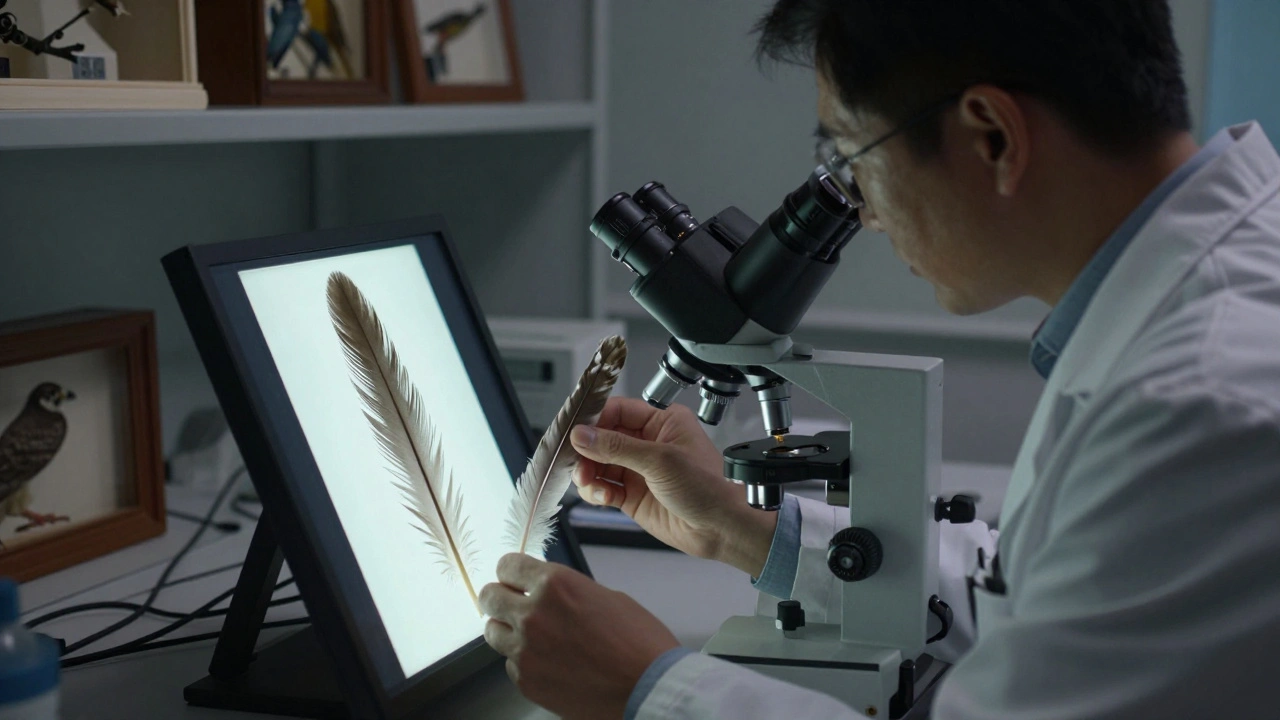
When a feather is found at a crime scene or a strand of hair clings to a victim’s clothing, it might seem like just debris. But to forensic experts, these tiny samples can tell a detailed story - which species they came from. Whether it’s a bird strike that brought down a plane, a poaching case involving protected feathers, or a murder where animal hair links a suspect to the scene, identifying the source isn’t guesswork. It’s science - built on decades of detailed observation, reference collections, and cutting-edge lab techniques.
Feathers: More Than Just Color and Pattern
Not all feathers are created equal. A whole flight feather from a hawk looks completely different from a fluffy down feather plucked from a pillow. Forensic examiners start by asking: Is this an intact feather or just a fragment? If it’s whole, they compare its size, color, banding, and shape directly to vouchered specimens in museum collections. The U.S. Fish and Wildlife Service’s Feather Atlas - a database of 438 North American bird species - is one of the most used tools. You can search it by color, pattern, or even the bird’s order. A dark, barred feather with a hooked tip? That’s likely a raptor. A white feather with a distinct black tip? Could be a gull. But what if the feather is broken, washed, or burned? Then you move to microscopic analysis. Under a light microscope at 100-400x magnification, examiners look at the plumulaceous (downy) region. Here, the barbules - tiny branches off the main shaft - form patterns unique to bird orders. A duck’s down has a different texture than a pigeon’s. This won’t always pinpoint the exact species, but it can narrow it down to a group: passerines, waterfowl, raptors. That’s often enough to guide further investigation. One common mistake? Assuming all feathers from the same bird look identical. They don’t. A feather from a bird’s wing behaves differently than one from its chest. And feathers change as birds molt. Examiners must account for this natural variation - otherwise, you risk misidentifying a crow as a raven, or vice versa.Hair: The Three-Layer Blueprint
Mammalian hair has a built-in fingerprint: a three-layer structure. The outer layer, the cuticle, is made of overlapping scales. The middle layer, the cortex, holds pigment and strength. And inside, the medulla - a central core - tells you a lot about whether it’s human or animal. The key metric? The medullary index. That’s the diameter of the medulla divided by the diameter of the whole hair shaft. Human hair usually has a medullary index around 0.32 - thin or absent. Animal guard hairs, the coarse outer hairs used for identification, often have an index over 0.5. That’s a red flag. A hair with a thick, continuous medulla? Almost certainly not human. Scale patterns on the cuticle are another giveaway. Human hair has an imbricate pattern - like shingles on a roof. But a cat’s hair? It’s coronal - like a crown of spikes. A dog’s? Often spinous - jagged and pointed. Even the tip matters. Pig hairs often have a frayed, split end. Beaver hairs are blunt and thick. These aren’t just textbook descriptions - they’re used daily in labs to compare evidence against reference slides. And don’t forget: not all hair is useful. Underhairs - the fine, wavy ones underneath the guard hairs - are too variable to use for identification. Only guard hairs give reliable results. And damaged ends from handling? Those are common. Examiners must learn to tell real features from accidental breaks.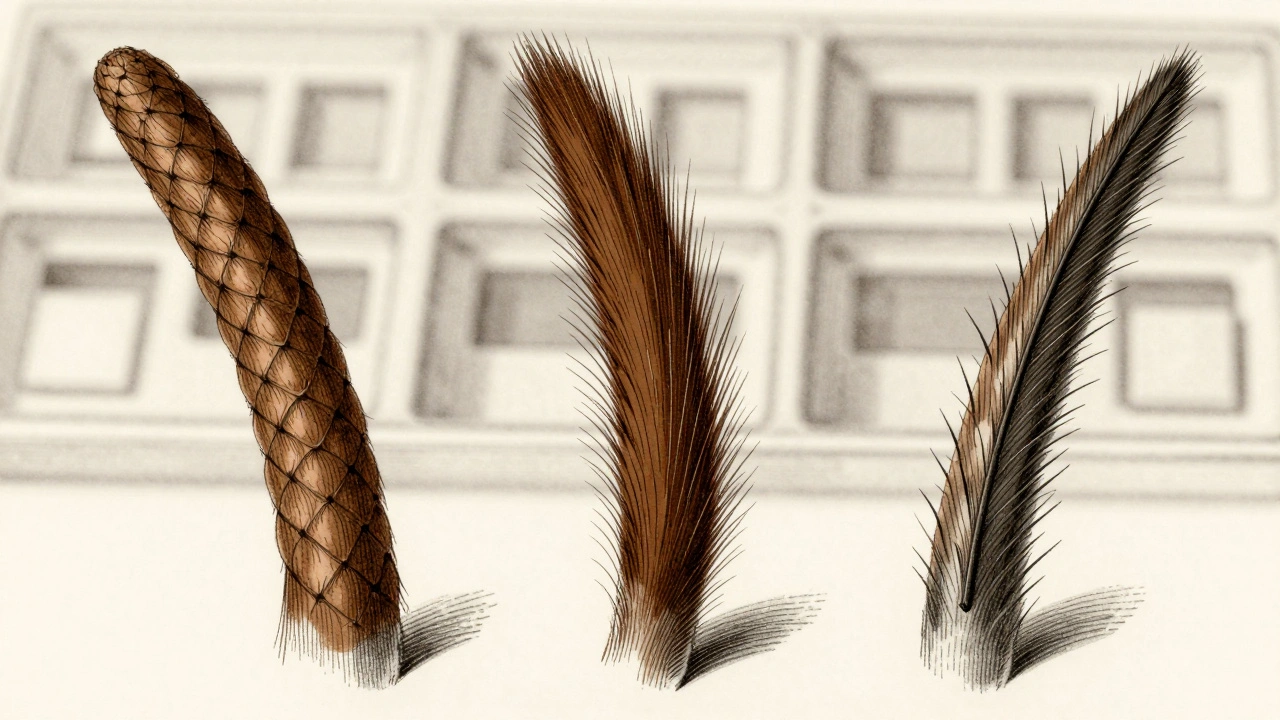
When Microscopy Isn’t Enough: DNA and Proteins
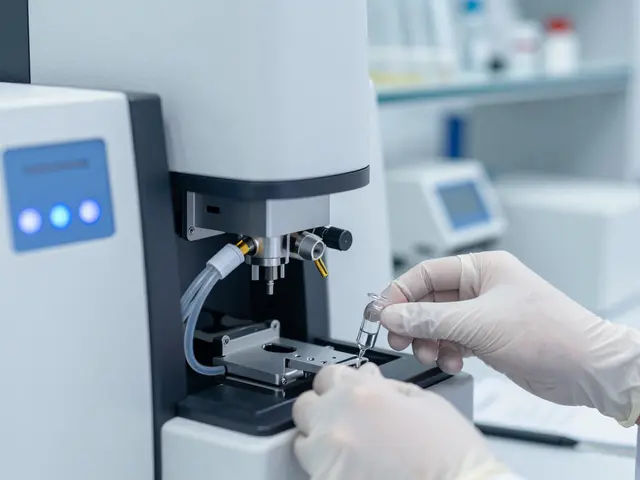
Sometimes, feathers are dyed. Hair is bleached. Or the sample is too small. That’s when molecular methods step in. Nuclear DNA (nDNA) analysis is the gold standard. If you get a clean sample - a root on a hair, or a feather follicle - you can match it to a specific individual. In criminal cases, that means linking a suspect to a scene. If no suspect exists, the profile can be run through CODIS, the national DNA database. It’s not foolproof - identical twins share the same DNA - but it’s as close to certainty as science gets. For degraded or processed samples, mitochondrial DNA (mtDNA) is a backup. It’s less specific than nDNA (it’s passed down maternally), but it’s more abundant. A single strand of hair can yield enough mtDNA to confirm it came from a wolf, not a coyote. Then there’s MALDI-TOF mass spectrometry. This technique doesn’t look at DNA at all. Instead, it breaks down proteins in the sample using enzymes, then analyzes the protein fragments. Each species has a unique protein “fingerprint.” Even if a feather is bleached or a fur coat has been chemically treated, the protein profile remains. This method works on mixed samples too - say, a coat with both rabbit and fox fur. The machine can quantify the percentage of each. One real-world example: In 2023, a fur-lined jacket seized in Oregon was suspected of containing protected lynx fur. Morphology alone couldn’t confirm it. MALDI-TOF analysis showed protein peaks matching Canadian lynx - not domestic cat. That led to a federal violation charge.What You Can’t Do - And What You Need
There are limits. You can’t identify a feather to the exact individual bird. Just like you can’t say which specific dog shed that hair. You can only say it came from a species - and sometimes, a subspecies. And you need references. Without a comparison collection, you’re guessing. The Feather Atlas, the Smithsonian’s bird specimen vaults, and forensic labs’ hair slide libraries are not luxuries - they’re necessities. Many small agencies don’t have them. That’s why regional forensic centers exist: to share resources. Synthetic fibers? Easy to spot. Under the microscope, they look like plastic tubes - smooth, uniform, no scale pattern. Real animal hair has texture. Real feathers have natural variations in pigment. If it looks too perfect? It’s probably fake.
Why This Matters Beyond Crime Scenes
This isn’t just about solving murders. Feather identification helped ground a commercial airline after repeated bird strikes were traced to a specific migratory flock. Hair analysis exposed a company selling dog fur as “luxury rabbit” in luxury coats. Archaeologists used microscopic feather analysis to confirm the ritual use of eagle feathers in a 1,000-year-old Native American site. In fact, the same tools used to convict a poacher are used to protect endangered species. The legal framework is strict: in the U.S., possessing feathers from most native birds is illegal without a permit. That means finding a feather at a crime scene isn’t just evidence - it’s a potential crime in itself.What’s Next?
The field is getting smarter. Portable DNA sequencers are now being tested in field labs. AI is being trained to match feather patterns faster than human eyes. But the core hasn’t changed: it still starts with a microscope, a reference slide, and a trained eye. For investigators, the lesson is simple: Never ignore a feather or a hair. It’s not trash. It’s a clue written in biology.Can you identify a species from just one hair?
Yes - if it’s a guard hair from a mammal. Guard hairs have diagnostic features like medulla structure and scale patterns that can be matched to reference collections. A single hair from a deer, bear, or dog can often be identified to species level. However, underhairs or damaged hairs are much harder to classify.
Can DNA analysis identify the bird species from a feather?
Absolutely. If the feather has a follicle or a portion of the shaft with tissue, nuclear DNA can pinpoint the species. Even without a root, mitochondrial DNA from the shaft works well. This is especially useful for identifying feathers from protected or endangered birds.
Is microscopic hair analysis still used today?
Yes, and it’s still essential. While DNA is powerful, it’s expensive and requires intact biological material. Microscopy is fast, cheap, and works on processed or degraded samples. Most forensic labs use both: microscopy first to screen, then DNA if needed.
Why can’t you match a feather to a specific bird?
Because feathers don’t have unique identifiers like human fingerprints. Two birds of the same species can have nearly identical plumage. Plus, feathers molt, fade, and vary by body location. You can identify the species, but not the individual bird - just like you can’t tell which dog shed a hair from its coat.
Are synthetic fibers ever mistaken for animal hair?
Rarely, if examined properly. Synthetic fibers look smooth and uniform under a microscope - no scales, no medulla, no natural variation. Real animal hair has texture, pigment bands, and structural irregularities. Forensic labs routinely test suspicious fibers to confirm whether they’re natural or synthetic.