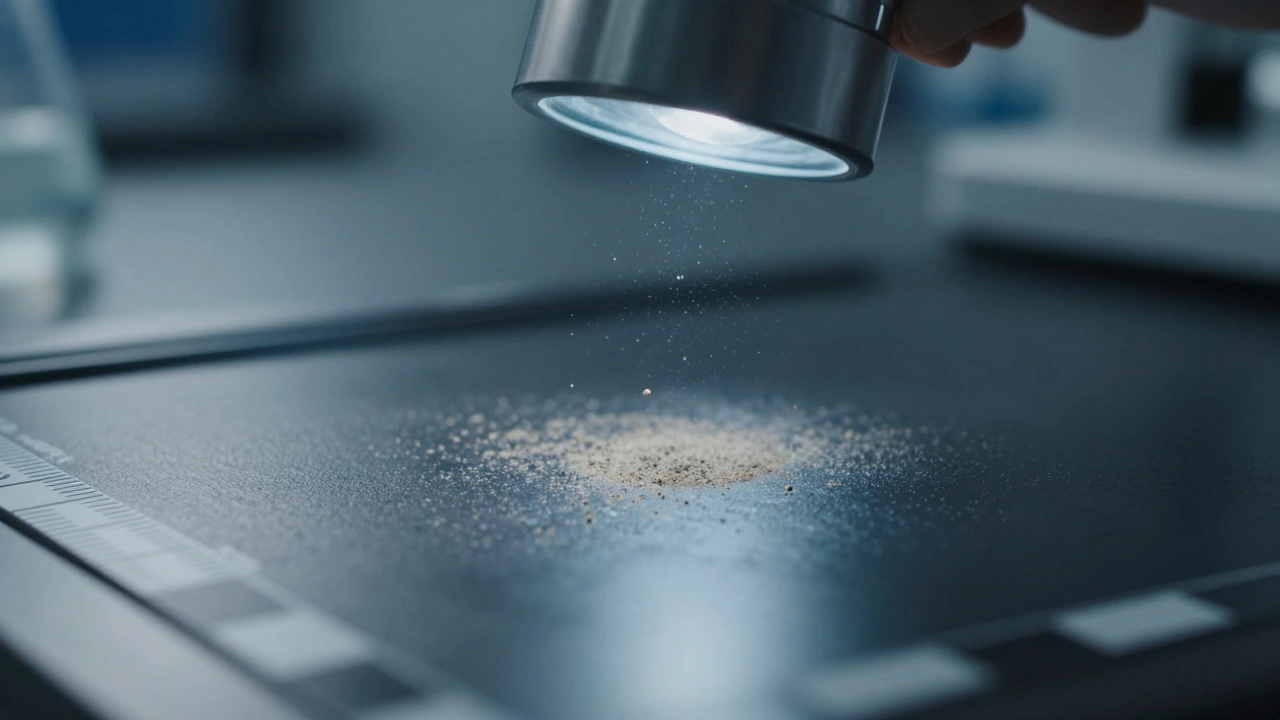
You have probably heard that every criminal leaves something behind at a crime scene. A fiber, a drop of blood, a smudge of paint. But for decades, forensic labs ignored the invisible world. They looked for the threads the eye could see, missing the billions of microscopic particles hiding in plain sight. That is changing. By March 2026, the integration of Nanoparticles into trace evidence analysis has become one of the most significant shifts in modern policing.
Imagine being able to link a suspect to a location based on dust particles smaller than a single cell. That is the promise of nanotechnology in forensics. We are moving past the era where a 'missing piece' meant the case was lost. Now, those missing pieces exist, but they require a new set of keys to unlock their secrets. This guide breaks down exactly how these tiny tools work, why they matter for investigations, and what challenges remain before they hit the courtroom.
The Invisible World of Trace Evidence
When we talk about trace evidence, we aren't just talking about hair or glass shards. We are talking about the smallest units of material that transfer between people, objects, and places. In the old days, labs focused on anything larger than 100 micrometers. That is roughly the width of a human hair. Anything smaller was often considered background noise or too difficult to collect.
However, Nanoparticles occupy a range between 10 nanometers and 100 micrometers. To put that in perspective, 10 nanometers is 10,000 times smaller than the thickness of your fingernail. These particles include fragments of paint, tire wear, industrial pollutants, and gunshot residue. Historically, standard microscopes couldn't resolve them well enough to tell them apart. If two particles looked identical under a standard lens, investigators had no way to distinguish which came from the source and which was just random dirt.
This limitation changed with the advent of systematic research funded by organizations like the National Institute of Justice (NIJ). Their early grants in the mid-2010s established a fundamental roadmap. The goal wasn't just to "see" these particles, but to characterize them. Think of it like upgrading from a blurry snapshot to a detailed 4K video. You can now identify the chemical makeup of a speck of dust found on a glove, proving it originated from a specific car part or factory floor.
Tools for Seeing the Unseen
Most forensic labs already possess powerful machinery, but using it for nanoparticles requires a different approach. Let's look at the heavy hitters used in this field.
- Stereomicroscopes: These are the basics, used for looking at larger evidence like fibers. They can find subvisible particles, but they cannot analyze the chemical composition of a 50-nanometer object.
- Polarized Light Microscopy (PLM): Great for identifying natural materials like starch or plant fibers, but struggles with synthetic polymers found in modern consumer goods.
- Scanning Electron Microscopy (SEM): This is where the magic happens. SEM uses electrons instead of light to create images with incredibly high magnification. When paired with Energy-dispersive X-ray Spectroscopy (EDS), the lab can map out exactly which elements are present in the particle.
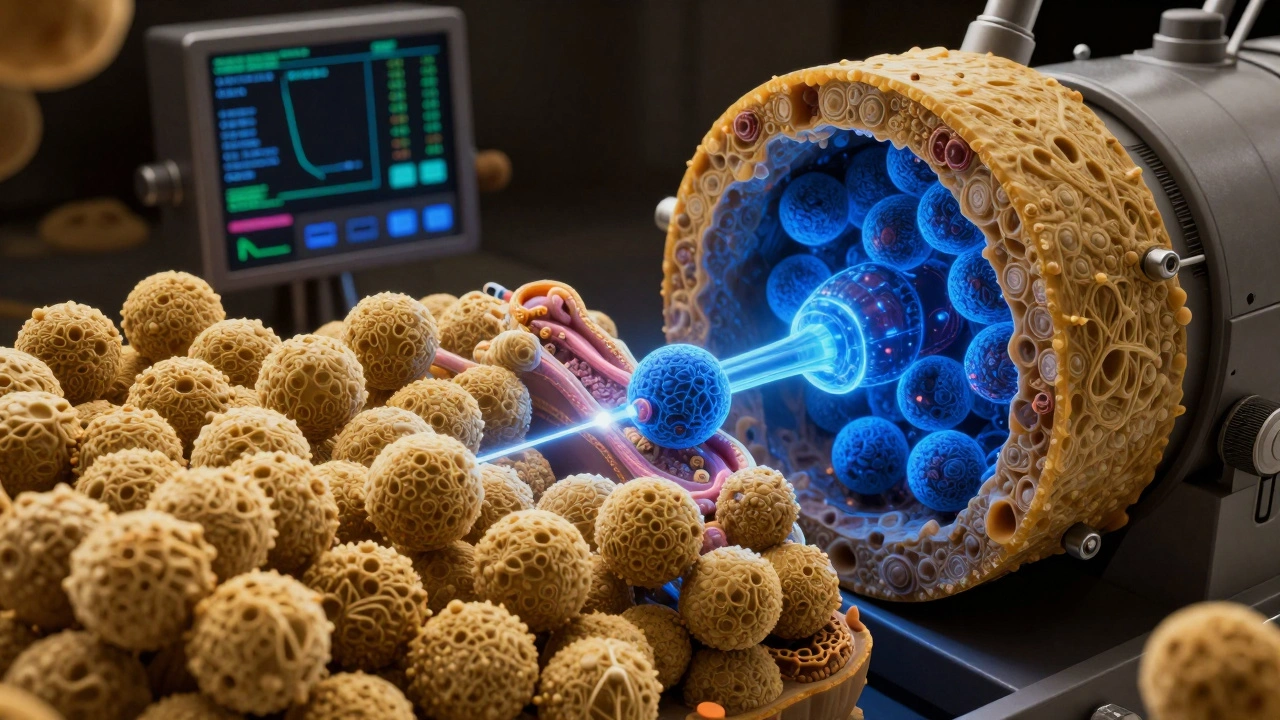
For truly advanced work, we move to Transmission Electron Microscopy (TEM) and Field Emission SEM. These instruments allow us to see the structure of the nanoparticle itself, not just its shape. A gold nanoparticle might act differently than a carbon nanoparticle when exposed to a specific chemical. Understanding this physical structure allows scientists to create functionalized sensors-tiny devices designed to catch only specific targets, like traces of explosives or drugs.
Critical Applications in Crime Scenes
Why does this granularity matter to a case investigator? Because the sensitivity of the test directly impacts the reliability of the verdict. Here are three critical areas where nanoparticle analysis changes outcomes.
| Evidence Type | Traditional Limitation | Nanotech Advantage |
|---|---|---|
| Gunshot Residue (GSR) | Mixed with environmental dust; hard to distinguish from weathered samples. | Nano-sensors detect specific metal signatures even after washing or aging. |
| DNA Analysis | Degraded samples may fail amplification. | Nanoparticles aid in enrichment and signal amplification of genetic material. |
| Explosives | Requires large sample sizes for gas chromatography. | Carbon-based nanostructures capture traces at parts-per-billion levels. |
Consider Gunshot Residue (GSR). Traditionally, if a suspect washed their hands hours after firing a weapon, the classic lead-barium-antimony triad might disappear. Using nanoparticle-based sensors, however, examiners can still find distinct chemical markers that cling to skin oils or clothing textures. The high surface-to-volume ratio of nanoparticles makes them excellent magnets for these residues. Even tiny amounts of GSR on a jacket collar can now be pinpointed chemically rather than just visually.
In the realm of DNA Analysis, nanoparticles are acting as boosters. Sometimes, biological stains are so old or small that standard testing yields nothing. New techniques use functionalized gold or magnetic nanoparticles to bind specifically to DNA strands. This pulls the genetic material out of a complex mixture, concentrating it so that machines can read it. It turns a faint whisper of biological data into a readable profile.
Collecting Nanoscale Evidence
Finding the evidence is only half the battle. You have to capture it without destroying it or contaminating it. Standard collection kits often fail here because they are designed for bulk samples. Tape lifts, commonly used for picking up hairs or fibers, can miss particles smaller than 100 micrometers if the pressure isn't right.
New methods focus on specialized substrates. Nanofibers and structured surfaces mimic the texture of the evidence itself, allowing fine particles to stick more effectively. Think of it like using velcro to pick up lint versus trying to use smooth paper. During the investigation process described by the NIJ, researchers evaluated four stages:
- Recognition: Identifying what particles might be there beforehand.
- Isolation: Choosing the right tool (tape, swab, filter) to separate the target from the background dirt.
- Characterization: Running the isolated particle through microscopy or spectroscopy.
- Interpretation: Deciding if the particle links the suspect to the scene significantly.
One major hurdle remains background contamination. Your own clothes carry nanoparticles. Air conditioning systems pump out microscopic plastic bits everywhere. To interpret evidence correctly, labs must run control samples from the investigator's uniform alongside the crime scene samples. This ensures that a particle found on a victim didn't just come from the officer who processed the body.
Challenges and Legal Hurdles
Despite the technology advancing rapidly by 2026, admissibility in court remains a slow-moving process. Judges want to know if the method produces consistent results. Nanotechnology is highly sensitive, which is great for detection but sometimes leads to false positives if not handled carefully. If the same technique yields different results in two different laboratories, lawyers will argue it isn't scientific enough.
Reproducibility is the core issue. Every lab needs to follow the exact same protocols for cleaning equipment and calibrating sensors. Furthermore, training is expensive. Not every county sheriff's department can afford a million-dollar transmission electron microscope. This creates a gap between high-tech urban labs and smaller rural facilities. The National Institute of Justice has been working to provide shared resources and electronic databases, helping smaller labs access reference libraries of known particle signatures.
There is also the issue of stability. Some nanomaterials degrade over time when exposed to air or humidity. Storage conditions for evidence must be tighter than ever before. If a suspect's shoe print contains a unique polymer particle that oxidizes after six months, that link to the crime vanishes forever.
The Road Ahead
We are witnessing a transition period. The tools are ready, but the regulations are catching up. Portable nano-sensors represent the next frontier. Imagine a device that fits in a backpack, allowing a detective to scan a wall at a bombing site and instantly confirm the presence of specific explosive compounds. This would drastically reduce turnaround time.
As we settle into the late 2020s, the expectation will shift. Currently, nanoparticle analysis is supplementary-it strengthens a case. Soon, courts may expect it as a baseline requirement for serious physical evidence review. The paradigm has shifted from looking for big chunks of evidence to understanding the molecular conversation happening at the point of contact. For investigators, staying updated on these emerging tools is no longer optional; it is the difference between a conviction and an open file.
What size particles are considered trace evidence nanoparticles?
Forensic nanotechnology focuses on particles ranging from 10 nanometers to 100 micrometers. Particles below this range are typically categorized strictly as molecules or atoms, while those above 100 micrometers are easily visible to the naked eye.
How do nanoparticles improve DNA recovery?
Functionalized nanoparticles can bind specifically to DNA strands, separating them from debris. This concentration step enriches degraded samples, making it easier for sequencing machines to amplify and read the genetic code.
Can any lab perform nanoparticle analysis?
Not immediately. High-resolution tools like Transmission Electron Microscopy require specialized training and expensive equipment. Many labs currently use existing SEM/EDS setups but are adding new protocols to handle subvisible particles safely.
Is nanoparticle evidence admissible in court?
It varies by jurisdiction. Courts require proof of reproducibility and standardized procedures. While scientifically valid, defense attorneys often challenge new technologies until validation standards are fully established across multiple labs.
What is the biggest risk in collecting this evidence?
Contamination is the primary risk. Investigators themselves carry microscopic particles on their clothing. Strict protocol regarding clean zones and control samples is essential to prevent false associations.