
Running a lab is about more than just having the latest equipment; it is about the people operating that equipment. If your team isn't proven to be competent, your results are essentially meaningless in the eyes of an auditor. Whether you are chasing ISO accreditation or maintaining CLIA standards, personnel competency is the bedrock of your quality management system. It is not enough to simply hire someone with a degree; you have to prove, through a documented trail, that they can actually perform the specific tasks required for their role without making critical errors.
The Core of Competency: More Than Just Training
There is a common mistake in lab management where "training" and "competency" are used interchangeably. They aren't the same. Training is the process of providing knowledge-reading a manual, watching a demo, or attending a seminar. Competency, however, is the demonstrated ability to apply that knowledge to get a correct, reproducible result. Personnel Competency is the verified ability of a staff member to perform specific job functions based on a combination of education, training, skills, and professional experience.
Think of it like driving a car. You can spend ten hours reading the driver's manual (training), but you aren't a competent driver until someone sits in the passenger seat and watches you parallel park without hitting the curb (competency assessment). In a lab setting, this means moving beyond a signed attendance sheet and actually observing the technician pipetting a sample or calibrating a complex instrument.
Navigating the Regulatory Landscape
Different accrediting bodies have different ways of asking for the same thing: proof that your people know what they are doing. One of the most influential standards is ISO 9001, which in its 2015 update, explicitly requires organizations to determine the necessary competence of people doing work under its control. This involves four specific steps: identifying the required skills, evaluating current competence, providing training to fill gaps, and keeping a paper trail of it all.
If you are in the clinical space, the CLIA (Clinical Laboratory Improvement Amendments) standards are your primary guide. CLIA views training as the preparatory phase and competency assessment as the mandatory follow-up. You cannot let a staff member begin independent testing until this loop is closed. Similarly, the Joint Commission requires leadership and HR to collaborate on identifying job responsibilities and then assessing those responsibilities through direct observation within a set timeframe.
| Standard/Body | Primary Focus | Verification Method | Key Requirement |
|---|---|---|---|
| ISO 9001 | Quality Management | Performance reviews & documentation | Clause 7.2 Competence |
| CLIA | Clinical Testing | Direct observation & PT samples | Post-training assessment |
| Joint Commission | Healthcare Org | Observation & timeframe-based checks | HR & Leadership collaboration |
| AAFCO | Feed/Animal Lab | Education & experience records | Authorized staff lists |
Building a Competency Matrix
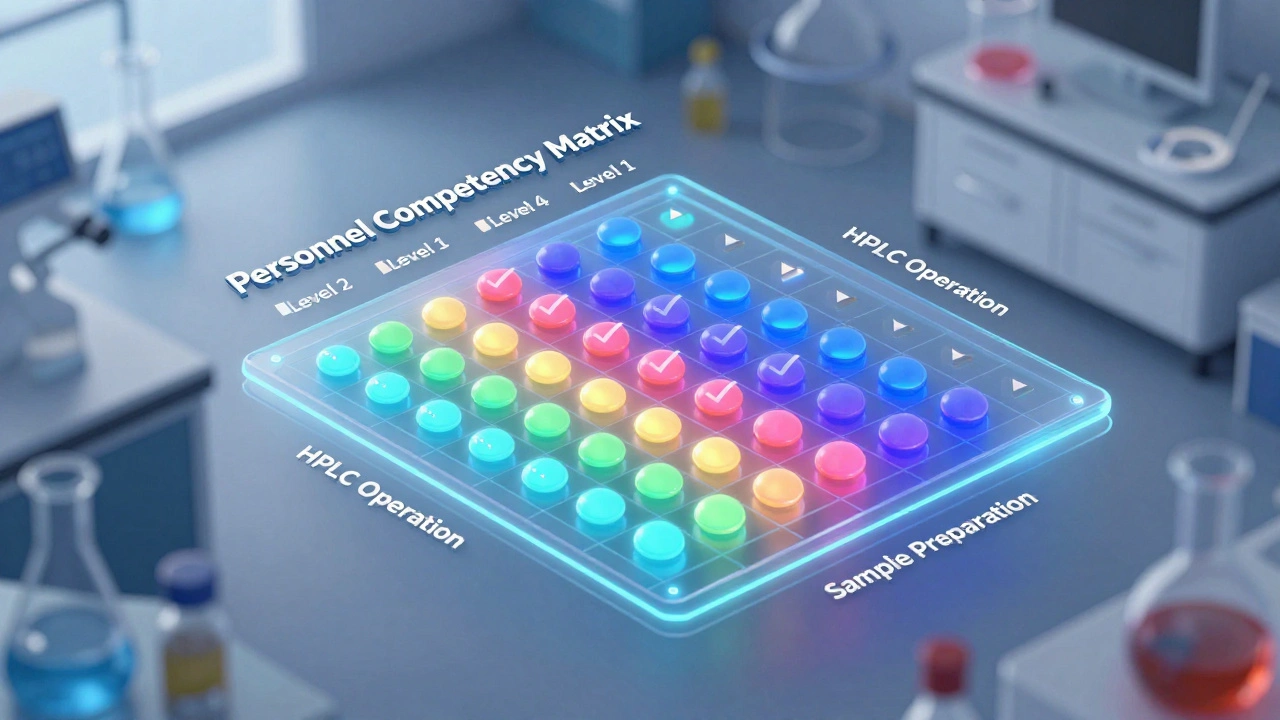
How do you keep track of who can do what? A skill-competency matrix is your best friend here. Instead of digging through individual folders, a matrix gives you a birds-eye view of your lab's capabilities. You list every single critical task (e.g., "HPLC Operation", "Sample Preparation", "Internal Auditing") on one axis and your staff names on the other.
Don't just use a checkmark. Use a scale of proficiency. For example:
- Level 1: Trainee (observing only).
- Level 2: Supervised (can perform task with guidance).
- Level 3: Competent (can perform task independently).
- Level 4: Expert (can train others).
Implementing the Training Pipeline
Training should be a structured journey, not a random series of events. I recommend a three-tiered approach: initial orientation, method-specific training, and ongoing proficiency.
First, new hires should undergo a general orientation. This covers the big-picture items: the quality manual, safety protocols, and the company's quality objectives. They shouldn't even touch a sample until they understand the safety and quality framework of the lab.
Next comes method-specific training. This is where On-the-Job Training (OJT) comes into play. The trainee reads the Standard Operating Procedure (SOP), watches a qualified trainer perform the task, and then performs the task under supervision. The final step of this stage is a competency sign-off, where the supervisor confirms the trainee can consistently produce accurate results.
Finally, you have ongoing training. Competency isn't a "one and done" event. It can degrade over time. You need triggers for retraining, such as:
- The implementation of a new test procedure.
- A change in a current SOP.
- An unsatisfactory result in a proficiency testing sample.
- A biennial rotation (e.g., refresher training every two years).
Verifying Competence: The Proof is in the Data
When an auditor asks, "How do you know this person is competent?", saying "They have a Master's degree" will not satisfy them. You need concrete evidence. There are several ways to verify competence, and the most robust systems use a mix of these:
- Direct Observation: A supervisor watches the technician perform the task from start to finish. This is the gold standard for catching "bad habits" that don't show up in the final data.
- Proficiency Testing (PT): Giving the staff member a "blind" sample with a known value. If they get the value right, their competency is confirmed.
- Review of Worksheets: Checking the logs and data outputs of a technician to ensure they are following the SOP and documenting correctly.
- Quizzes and Tests: Useful for theoretical knowledge, but should always be paired with a practical demonstration.
All of these activities must be documented in a personnel file. If it isn't written down, it didn't happen. This is why many labs are moving toward centralized document management systems. Using software like Greenlight Guru or similar quality management tools allows you to link training records directly to the version of the SOP the employee was trained on, creating an airtight audit trail.

Common Pitfalls in Competency Management
Many labs fall into the trap of "pencil-whipping" their training logs-signing off on training that didn't actually happen or was rushed. This is a massive risk. During an audit, if a technician cannot explain the process they signed off on, the auditor may invalidate all the data that person produced for the last six months.
Another mistake is neglecting the "soft" side of competency. Communication and customer service might seem irrelevant in a hard-science lab, but they are critical for the overall quality management system. If a technician can't communicate a critical value to a client accurately, the technical accuracy of the test doesn't matter.
How often should competency assessments be performed?
While it varies by standard, most high-quality labs perform comprehensive assessments annually. However, some specific tasks may require biennial (every two years) refreshers, while others need immediate reassessment if a quality failure occurs or an SOP is updated.
Can I use a degree as the sole proof of competency?
No. Education is a prerequisite (a qualification), but competency is the demonstrated ability to perform a specific task in your specific lab environment. You must supplement degrees with internal training and verified assessments.
What is the difference between training and qualification?
Qualification refers to the baseline requirements (like a PhD or a certification) needed to be eligible for a role. Training is the process of learning specific lab procedures. Competency is the proof that the training worked and the person is now qualified to work independently.
What happens if a staff member fails a competency test?
The individual should be immediately removed from that specific task. You must document the failure, provide corrective training to address the gap, and then re-assess them. They cannot return to the task until they pass the assessment.
Do external consultants need to be assessed for competency?
Yes. Anyone performing work that affects the quality of your results-including contractors and consultants-must have their competency verified and documented according to your quality system.
Next Steps for Lab Managers
If you aren't sure where your lab stands, start with a gap analysis. Review your current personnel files and ask: "If an auditor walked in today, could I prove that every person performing a test is competent to do so?"
For those with a small team, a simple spreadsheet matrix might suffice for now. But as you scale, look into automated training tracking systems. The goal is to move from a reactive state (scrambling for papers during an audit) to a proactive state where you know exactly who is trained on what, and who is due for a refresher, at any given second.