
Imagine trying to find a single grain of sand in a swimming pool. That is essentially what forensic scientists do when they analyze biological samples for trace drugs. In the world of drug analysis, the ability to detect minute concentrations without interference from complex biological matrices is everything. This is where Liquid Chromatography-Tandem Mass Spectrometry (LC-MS/MS) shines. It has become the gold standard in laboratories because it solves two critical problems simultaneously: it sees things that are incredibly small (sensitivity) and it ignores things that look similar but aren't the target (selectivity).
Why LC-MS/MS Changed the Game
Before tandem mass spectrometry became widespread, analysts relied heavily on Gas Chromatography-Mass Spectrometry (GC-MS). While GC-MS is robust, it requires samples to be volatile or chemically modified to become volatile. Many modern pharmaceuticals, biologics, and endogenous metabolites are too polar or unstable for this process. LC-MS/MS removed that bottleneck. By using liquid chromatography as the separation front-end, you can handle non-volatile, thermally labile, and highly polar compounds directly.
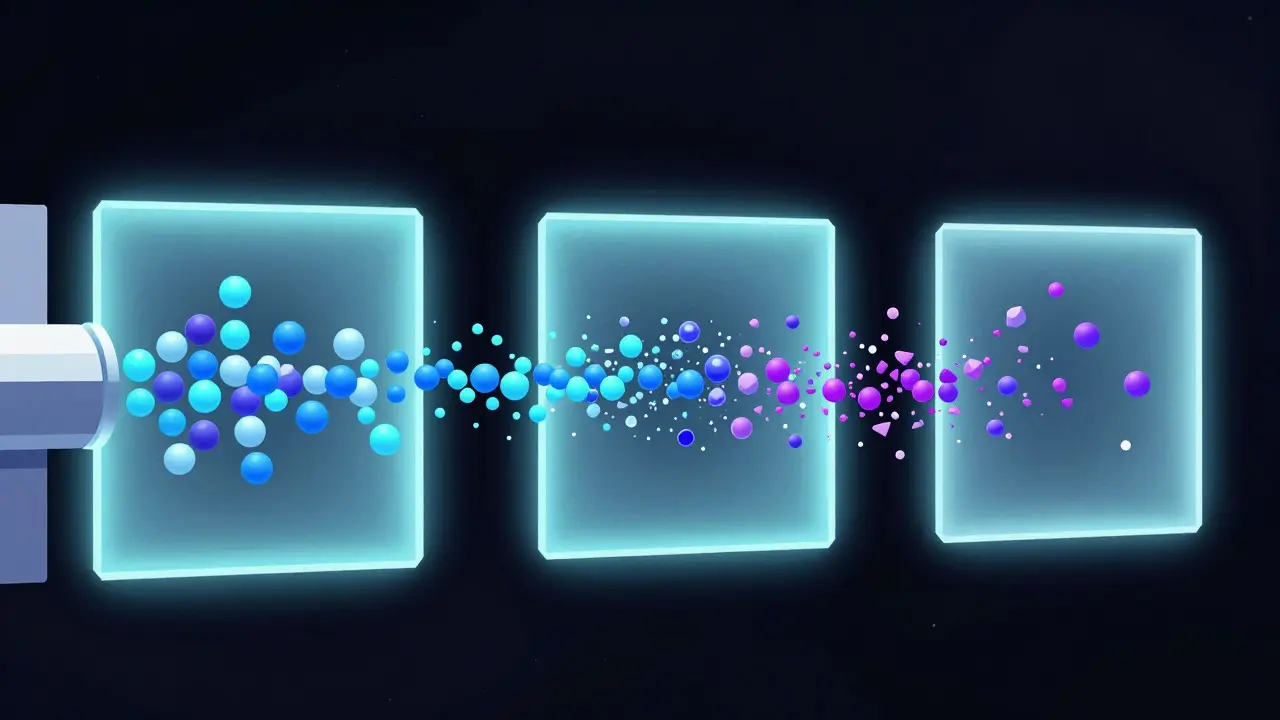
The "tandem" part refers to having two mass analyzers in series. The first stage isolates ions based on their mass-to-charge ratio (m/z). The second stage fragments those specific ions. This two-step verification process is the core of its power. You aren't just looking for a molecule with a certain weight; you are looking for a molecule that breaks apart into specific pieces. This dramatically reduces false positives compared to single-stage MS.
Understanding Sensitivity: Seeing the Invisible
Sensitivity in analytical chemistry isn't just about how loud the signal is; it's about the limit of detection (LOD) and the limit of quantification (LOQ). In forensic toxicology, you might need to detect a drug at picogram levels per milliliter of blood. For example, detecting fentanyl in post-mortem blood often requires an LOD below 10 pg/mL. If your instrument noise floor is higher than that, the drug is effectively invisible.
LC-MS/MS achieves high sensitivity through several mechanisms:
- Ionization Efficiency: Electrospray Ionization (ESI) is the workhorse here. It gently ionizes molecules in solution, preserving their structure better than harsher methods like Electron Impact (EI) used in GC-MS. This means more intact molecular ions reach the detector.
- Signal Amplification via Fragmentation: By selecting a precursor ion and monitoring a specific product ion, you filter out background noise. The signal-to-noise ratio improves significantly because you are only listening to the frequency of interest.
- Low Background Interference: Modern triple quadrupole instruments have very clean backgrounds in the low m/z range, allowing for the detection of small molecules like cocaine or amphetamines without significant chemical noise.
Selectivity: Distinguishing the Target from the Noise
If sensitivity is about seeing faint signals, selectivity is about ignoring distractions. Biological fluids like plasma, urine, and hair are messy. They contain proteins, salts, lipids, and thousands of other metabolites. Some of these interferents have masses very close to your target drug. A generic mass spectrometer might confuse them. LC-MS/MS uses two layers of selectivity to prevent this confusion.
- Chromatographic Separation: The LC column physically separates compounds based on their chemical properties (polarity, size, charge). Even if two drugs have the same mass, they usually elute at different times. If the target drug elutes at 3.5 minutes and an interferent elutes at 3.6 minutes, the LC step already helps isolate the target.
- Tandem Mass Filtering: This is the killer feature. Suppose Drug A and Metabolite B both have a molecular weight of 300 Da. In the first quadrupole, you set the instrument to pass only m/z 300. Both enter the collision cell. However, Drug A fragments to produce a unique daughter ion at m/z 150, while Metabolite B fragments to m/z 220. By setting the third quadrupole to monitor only m/z 150, you completely ignore Metabolite B. This transition-specific monitoring provides near-absolute specificity.
The Role of Method Validation
Having a powerful instrument doesn't guarantee accurate results. The method must be validated according to guidelines from organizations like the American Association of Forensic Sciences (AAFS) or the International Organization for Standardization (ISO). Key parameters include:
| Parameter | Definition | Typical Acceptance Criteria |
|---|---|---|
| Linearity | Relationship between concentration and response | R-squared > 0.99 over working range |
| Accuracy | Closeness of result to true value | 85-115% for QC samples |
| Precision | Reproducibility of results | Coefficient of Variation (CV) < 15% |
| Matrix Effect | Suppression/enhancement by co-eluting substances | 80-120% ion recovery |
Matrix effects are a major concern in selectivity. If a lipid in the blood suppresses the ionization of your drug, your result will be artificially low. Validating matrix effects ensures that the LC-MS/MS method remains reliable even in complex biological samples.
Practical Applications in Forensic Toxicology
Where does this technology actually get used? Everywhere you need definitive proof of drug presence or absence.
- Post-Mortem Toxicology: Determining cause of death in overdose cases. The speed and sensitivity allow for rapid screening of hundreds of drugs in a single run.
- Doping Control: Athletes are tested for banned substances. LC-MS/MS can detect steroids at nanogram levels in urine, well below therapeutic doses.
- Therapeutic Drug Monitoring: Hospitals use it to adjust dosages for narrow-therapeutic-index drugs like lithium or tacrolimus, ensuring patients stay within safe ranges.
- Metabolite Profiling: Identifying not just the parent drug, but its breakdown products. This helps distinguish between recent ingestion and chronic use, or even natural production versus exogenous administration.

Common Pitfalls and How to Avoid Them
Even with such a powerful tool, errors happen. Here are the most common issues labs face:
Ion Suppression: As mentioned, co-eluting impurities can block the target ion. To fix this, optimize your LC gradient to ensure the drug elutes in a clean window, away from major UV-absorbing peaks.
Isobaric Interferences: Two different compounds having the exact same m/z. Tandem MS handles this well, but if their fragment patterns overlap, you still have a problem. Using multiple reaction monitoring (MRM) transitions helps confirm identity. At least two distinct MRM transitions should be monitored for each analyte to confirm identity in unknown samples.
Sample Preparation Errors: LC-MS/MS is sensitive to dirty samples. Proteins precipitated during extraction can clog columns or foul the ion source. Proper protein precipitation or solid-phase extraction (SPE) steps are non-negotiable for long-term instrument health and data integrity.
Future Directions: High-Resolution MS
While triple quadrupoles remain the workhorse for targeted quantitation, High-Resolution Mass Spectrometry (HRMS) using Orbitraps or QTOFs is gaining traction. These instruments provide accurate mass measurements (within parts per million), which adds another layer of selectivity. You don't just match a nominal mass; you match the exact elemental composition. This is particularly useful in untargeted screening, where you don't know what drug you're looking for. However, for routine, high-throughput drug confirmation, the speed and ruggedness of LC-MS/MS keep it firmly in the driver's seat.