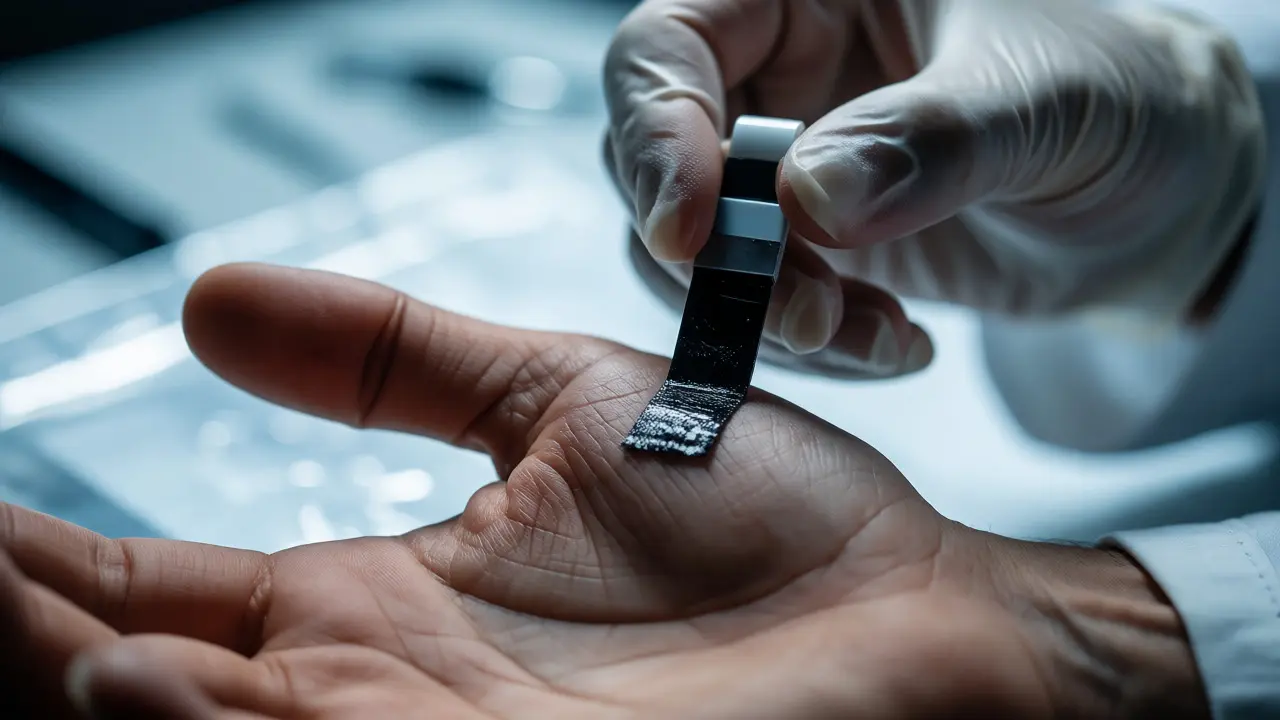
Imagine a suspect claims he never touched the gun found at the scene. He says he was just walking by when it went off. How do you prove he pulled the trigger? You look for Gunshot Residue (GSR). But here is the catch: finding GSR isn't enough. You need to identify it correctly. Two main methods dominate this field: Scanning Electron Microscopy with Energy Dispersive X-ray Spectroscopy (SEM-EDS) and traditional color tests. One gives you definitive proof; the other gives you a quick hint. Choosing between them can make or break a case.
The Reality of Gunshot Residue
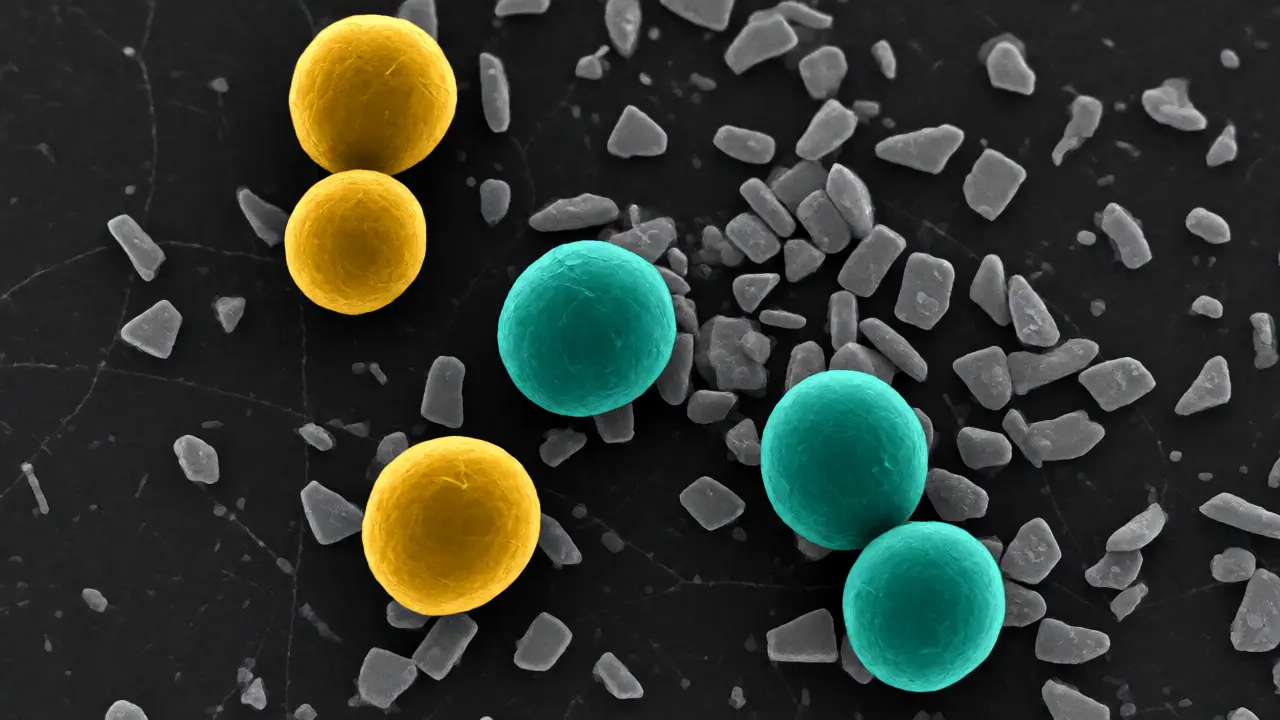
GSR forms when a firearm discharges. The primer ignites, creating a cloud of particles that settles on everything nearby. This includes the shooter's hands, face, and clothing. These particles are tiny, often less than 10 micrometers wide. They consist mainly of lead, barium, and antimony. When these three elements fuse together during firing, they create unique spherical particles. These are called "characteristic" particles. Finding one is strong evidence. Finding only "indicative" particles-those containing two of the three elements-is weaker. Finding single-element particles is often inconclusive because environmental contamination is rampant.
You might think any test will do. That's a dangerous assumption. If you use a method that can't distinguish between real GSR and industrial dust, you risk false positives. This happens frequently in urban environments where brake dust from cars contains similar metals. So, how do we separate signal from noise?
Why SEM-EDS Is the Gold Standard
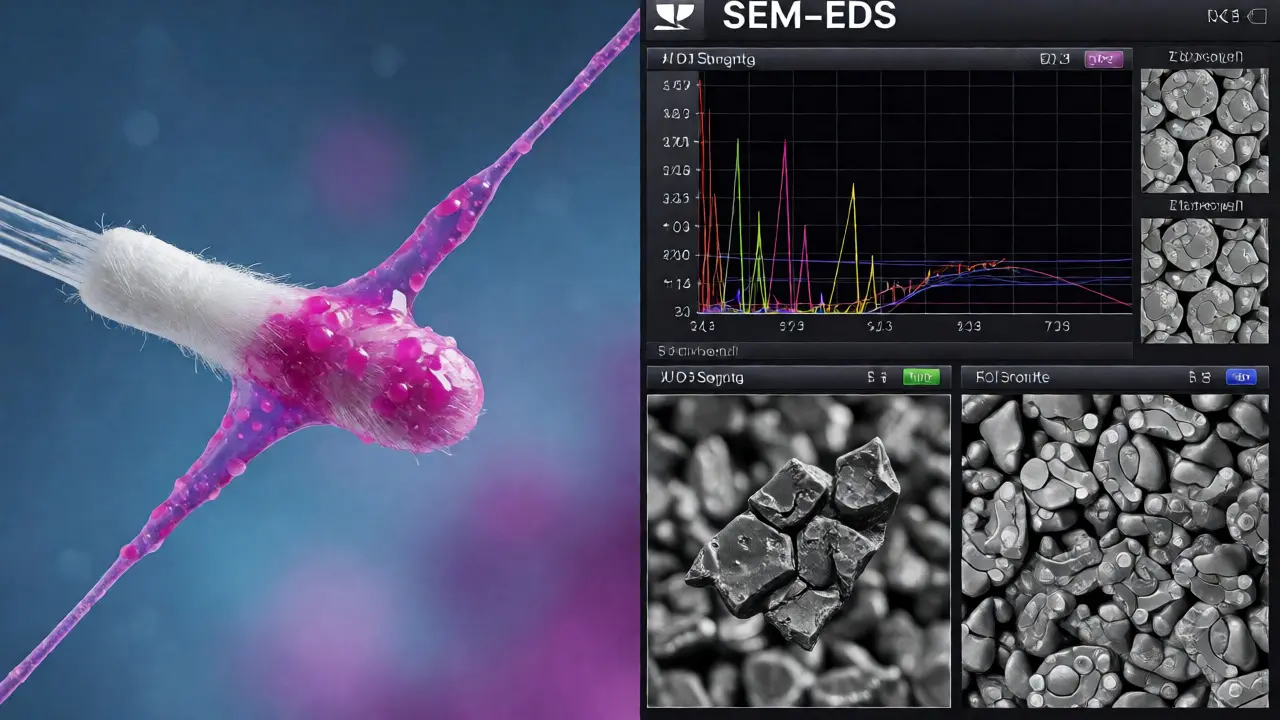
SEM-EDS is not just a microscope. It is a powerful analytical tool. It scans surfaces with an electron beam. When electrons hit the sample, they knock out inner-shell electrons from atoms. As outer-shell electrons drop down to fill the gaps, they emit X-rays. Each element emits X-rays at specific energies. The detector reads these energies to tell you exactly what elements are present. Crucially, SEM provides high-resolution images. You don't just know the chemistry; you see the morphology. Real GSR particles are spherical and fused. Industrial particles are often irregular or angular.
This visual confirmation is vital. A color test might turn blue if it detects nitrites, but it won't show you the shape of the particle. SEM-EDS does. It allows analysts to count characteristic particles accurately. Most labs require finding at least one characteristic particle to report a positive result. Some stricter standards require three. This precision reduces ambiguity in court. Jurors understand pictures better than chemical equations. Showing them a spherical particle composed of lead, barium, and antimony is compelling.
The Role of Color Tests
Before SEM-EDS became widespread, color tests were the primary screening tool. The most common is the sodium rhodizonate test. It reacts with lead, turning pink or purple. Another common test targets nitrites using Griess reagents, producing a red color. These tests are cheap, fast, and easy to perform in the field. Police officers can swab a suspect's hands immediately after arrest.
But speed comes at a cost. Color tests lack specificity. Lead is everywhere. Brake pads, fishing weights, and old paint all contain lead. A positive rhodizonate test doesn't mean the person fired a gun recently. It means they touched something with lead. Nitrites also appear in cured meats and certain vegetables. Eating a ham sandwich before being swabbed could theoretically trigger a positive nitrite test, though hand washing usually mitigates this. Because of these flaws, color tests are rarely used as standalone evidence today. They serve as preliminary screens to decide if expensive lab work is warranted.
Comparing Accuracy and Cost
Let's look at the practical differences. If budget is tight, color tests seem attractive. But consider the downstream costs. A false positive leads to wrongful accusations, legal challenges, and wasted resources. A false negative lets a guilty party walk free. SEM-EDS has higher upfront costs due to equipment maintenance and skilled personnel requirements. However, its accuracy minimizes litigation risks.
| Feature | SEM-EDS | Color Tests |
|---|---|---|
| Specificity | High. Distinguishes elemental composition and particle shape. | Low. Reacts to specific ions regardless of source. |
| Sensitivity | Can detect particles down to 1 micrometer. | Requires larger concentrations of target elements. |
| Cost per Sample | $50-$150+ depending on lab fees. | $5-$20 for kits. |
| Time to Result | Days to weeks (lab queue). | Minutes (field application). |
| Evidentiary Weight | Strong. Admissible as expert testimony. | Weak. Often inadmissible alone. |
Collection Matters More Than Testing
No matter which test you choose, bad collection ruins good science. GSR disappears quickly. Sweating, washing hands, or even putting hands in pockets can remove particles. Studies show significant loss within two hours post-firing. Therefore, timing is critical. Officers must collect samples immediately. Use specialized stubs coated with carbon adhesive. Do not touch the sticky side. Swab gently over the thumb webbing, index finger, and palm. For clothing, cut sections near the muzzle contact area or sleeve cuffs. Bag each item separately to prevent cross-contamination.
Contamination is the enemy. If an officer handles a suspect's hands without gloves, his own GSR transfers. If the suspect works in a battery factory, environmental lead contaminates the sample. Documenting the suspect's occupation and recent activities helps contextualize results. A mechanic might have high background levels of lead. A chef might have nitrates from food. Analysts need this context to interpret data fairly.
Interpreting Results in Court
Juries often misunderstand GSR. They think presence equals guilt. It doesn't. Presence indicates proximity to a discharge. It doesn't prove who held the gun. Defense attorneys exploit this gap. They argue environmental exposure. They point out that GSR persists on hands for hours, sometimes days. If the suspect didn't wash his hands, old residue remains. Conversely, if he washed them thoroughly, new residue might be gone despite recent firing.
Expert witnesses play a crucial role here. They must explain the limitations clearly. Don't say "He shot the gun." Say "The findings are consistent with having been near a discharged firearm." Precision in language protects credibility. Using SEM-EDS allows experts to back up statements with hard data. They can show the exact number of characteristic particles found. With color tests, they can only say "lead was detected," which opens the door to endless speculation about sources.
Modern Trends and Automation
Labs are moving toward automation. Manual SEM-EDS analysis is time-consuming. Technicians scan grids looking for particles. New software automatically identifies candidate particles based on size and elemental thresholds. This speeds up processing significantly. It also reduces human error. Some systems integrate with databases to compare particle signatures against known ammunition types. While not yet standard everywhere, this technology promises greater efficiency.
Another trend is combining methods. Some protocols use color tests for initial screening. Only positive samples go to SEM-EDS. This saves money. However, many agencies now skip color tests entirely. They send all samples directly to SEM-EDS. Why? Because a negative color test might miss low-level residue. Direct SEM-EDS ensures nothing is overlooked. Given the stakes in criminal cases, missing evidence is worse than overspending.
Frequently Asked Questions
How long does GSR stay on hands?
GSR can remain on hands for several hours, typically up to 4-6 hours under normal conditions. However, this varies widely based on activity. Washing hands removes most particles immediately. Sweating and friction accelerate loss. In some cases, trace amounts may persist for longer if the person avoids touching surfaces.
Can GSR transfer from person to person?
Yes, secondary transfer is possible. If someone shakes hands with a shooter, they might pick up GSR. Holding a weapon handled by another person can also cause transfer. This makes interpretation complex. Contextual clues like witness statements help determine if direct firing or indirect contact caused the residue.
Are color tests still used in modern forensics?
They are used primarily as preliminary screening tools in the field. Due to low specificity and high false-positive rates, color tests are rarely sufficient for courtroom evidence alone. Positive results usually trigger confirmatory testing via SEM-EDS.
What causes false positives in GSR analysis?
Environmental contamination is the main culprit. Sources include vehicle brake dust, fireworks, flares, ammunition manufacturing facilities, and certain industrial jobs involving lead or antimony. Even cosmetics and hair products can contribute to background levels, though rarely produce characteristic particles.
Is SEM-EDS always necessary?
For serious criminal charges, yes. Its ability to confirm both chemical composition and particle morphology provides the highest evidentiary value. For minor incidents or administrative reviews, simpler methods might suffice, but legal defense teams often demand SEM-EDS confirmation to challenge prosecution claims.