Every time you touch a coffee cup or scroll through your phone, you leave behind a unique map of skin ridges. While we often think of fingerprints as just smudges on glass, they are actually complex biological structures that forensics experts use to identify individuals with high accuracy. Understanding the three main fingerprint pattern types-loops, whorls, and arches-is the first step in decoding how our hands tell our stories. It’s not just about matching dots; it’s about recognizing distinct architectural designs that vary from person to person.
You might wonder why these specific shapes matter so much. The answer lies in probability. If everyone had the same pattern, fingerprint analysis would be impossible. But because the distribution of these patterns is uneven and specific to each individual, they serve as reliable identifiers. Whether you’re a student of criminal justice, a curious hobbyist, or someone who just got their hand inked for a fun portrait, knowing what you’re looking at changes how you see your own hands.
The Big Three: Defining the Core Patterns
In the world of dermatoglyphics (the study of skin friction ridges), scientists classify fingerprints into three primary categories. These categories account for nearly all human fingerprint variations. Let’s break down exactly what defines each one.
Loops: The Most Common Design
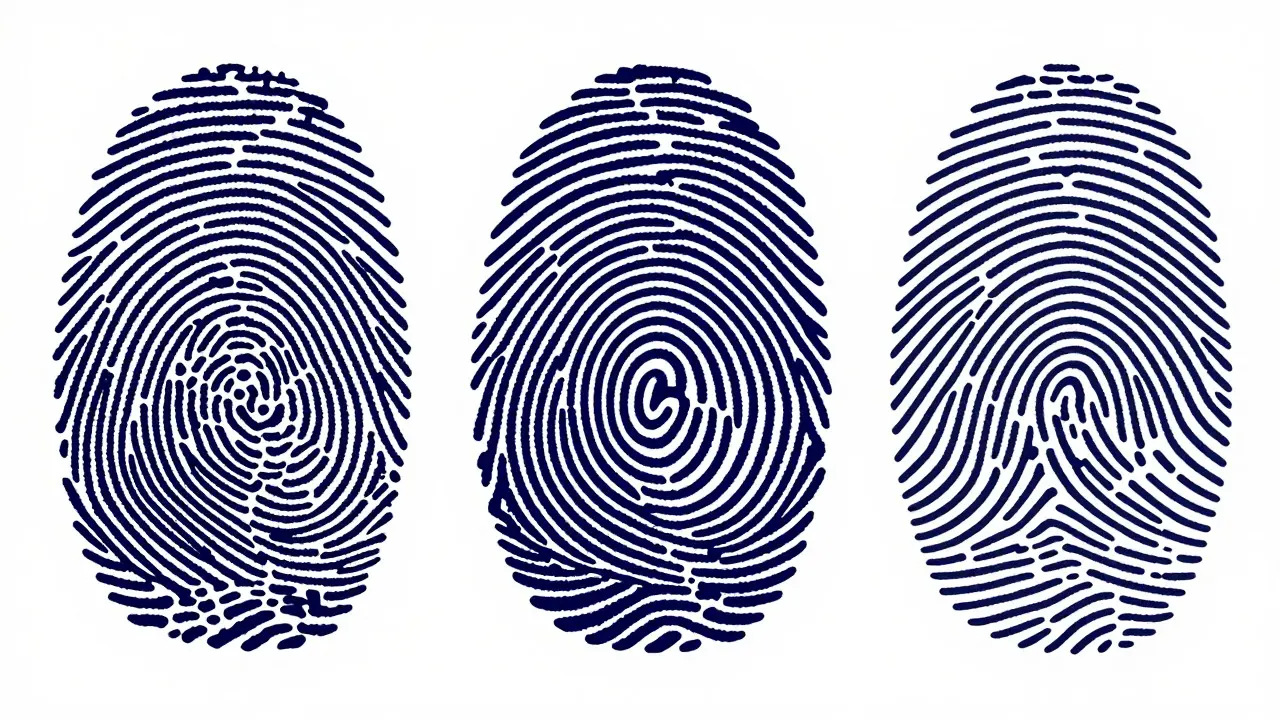
Loops are fingerprint patterns where ridges enter from one side, curve around a central area, and exit from the same side they entered. This is by far the most common pattern found in humans. Roughly 60% to 65% of the population has at least one loop on their ten fingers. A loop requires two "trifurcations" (points where three ridges meet) to be valid. If there aren't enough branching points, it might be classified differently. Loops can flow from left to right or right to left, which adds another layer of detail for analysts.
Whorls: The Circular Complexity
Whorls are fingerprint patterns characterized by circular or spiral ridge formations that enclose a central core. About 30% to 35% of people have at least one whorl. Unlike loops, whorls typically have two delta points (triangular areas where ridges converge). You can visualize a whorl like a bullseye or a hurricane eye. They are structurally more complex than loops because the ridges form closed circles rather than open curves. This complexity makes them highly distinctive in database searches.
Arches: The Rare Straight Lines
Arches are fingerprint patterns where ridges enter from one side, rise slightly in the center, and exit on the opposite side without looping or spiraling. Arches are the rarest category, appearing in only about 5% of the population. They lack the complex branching points found in loops and whorls. Most arches are simple waves, but some exhibit a sharper peak known as a tented arch. Because they are less common, finding an arch in a partial print can significantly narrow down the search pool in forensic databases.
How Analysts Count Ridges: The Science Behind Identification
Knowing the general shape isn’t enough for positive identification. Two people can both have a right-looping loop on their right thumb. So, how do experts distinguish between them? They look at minutiae-specific details within the pattern.
The most critical metric is the ridge count. For loops, analysts count the number of ridges between the triangle (delta) and the center point (core). This number is unique to the individual. For example, if Person A has a ridge count of 14 and Person B has a ridge count of 18, they are different people, even if both have the same loop type. For whorls, the counting method differs slightly, often involving counting ridges from the outer edge to the inner circle. This numerical data provides a statistical weight to the match, making false positives extremely unlikely.
| Pattern Type | Prevalence | Key Structural Feature | Delta Points |
|---|---|---|---|
| Loop | ~60-65% | Ridges enter and exit same side | 1 |
| Whorl | ~30-35% | Circular/spiral formation | 2 |
| Arch | ~5% | Ridges enter and exit opposite sides | 0 |
Subtypes and Variations: It’s Not Just Black and White
While the three main categories cover the basics, real-world fingerprints are messier. Experts recognize subtypes that add precision to the classification.
- Plain Arch: The simplest form, resembling a gentle wave or hill. No sharp peaks.
- Tented Arch: Looks like an arch but has a sharp, upward spike in the center. It’s a hybrid feature that can sometimes confuse automated systems.
- Double Loop Whorl: Contains two separate loop-like cores within the whorl structure. This is the most common subtype of whorl.
- Central Pocket Loop: A loop that contains a small whorl-like pocket in its center. It’s tricky to classify because it has features of both loops and whorls.
These subtypes matter because automated fingerprint recognition (AFR) software uses them to filter candidates. If the software detects a central pocket loop, it ignores standard loop templates, speeding up the search process. This granularity is crucial when dealing with millions of records in national databases.
Why Do We Have Different Patterns?
You might ask, why does my thumb have a whorl while my index finger has a loop? The formation of fingerprints happens in the womb, specifically during the second trimester of pregnancy. The exact genetic code for a fingerprint doesn’t exist in a single gene. Instead, it’s influenced by a combination of genetics, random cellular growth, and environmental factors inside the uterus.
This means that identical twins do not have identical fingerprints. Even though they share the same DNA, the microscopic differences in pressure and growth rates in the womb create unique ridge patterns. This biological randomness is what makes fingerprints such powerful evidence. They are not inherited directly like eye color; they are generated uniquely for each individual body.
Practical Applications Beyond Crime Scenes
We usually associate fingerprint analysis with solving crimes, but its applications are broader. In medicine, certain fingerprint patterns are linked to genetic conditions. For instance, a higher prevalence of arches or specific whorl counts can be associated with Down syndrome or other chromosomal abnormalities. Doctors use dermatoglyphics as a non-invasive screening tool in some contexts.
In technology, your smartphone likely uses optical or capacitive sensors that read these patterns. The sensor doesn’t care if it’s a loop or a whorl; it maps the minutiae. However, understanding the pattern type helps engineers design better algorithms. For example, arches are harder to capture if the finger is placed flat, while loops require precise alignment. Knowing the distribution of patterns helps in designing user-friendly authentication systems.

Common Misconceptions About Fingerprints
A lot of people believe that fingerprints change drastically as we age. While the skin surface wears down and heals, the underlying ridge pattern remains stable throughout life. Burns or deep scars can destroy a fingerprint, but minor cuts heal without altering the fundamental architecture. Another myth is that fingerprints disappear after death. In reality, they remain visible for a long time, which is why post-mortem identification is often possible using fingerprints.
Also, don’t assume that having rare patterns makes you easier to catch. An arch is rare, yes, but if you have four arches, your profile is still statistically significant. The key is the combination of all ten prints, not just one. Forensic analysts always consider the full set to build a complete identity profile.
Frequently Asked Questions
What is the most common fingerprint pattern?
The loop is the most common fingerprint pattern, found in approximately 60% to 65% of the population. It is characterized by ridges entering and exiting from the same side of the finger.
Do identical twins have the same fingerprints?
No, identical twins do not have the same fingerprints. Although they share the same DNA, the random developmental processes in the womb result in unique ridge patterns for each twin.
Can fingerprints be changed permanently?
Generally, no. Fingerprints are formed in the womb and remain stable throughout life. Only severe injuries like deep burns or surgical removal of the dermis can permanently alter or destroy a fingerprint pattern.
What is a delta in fingerprint terminology?
A delta is a triangular region where three sets of ridges meet. Loops typically have one delta, whorls have two, and arches have none. Deltas are crucial reference points for measuring ridge counts.
Why are arches considered rare?
Arches are rare because they represent a simpler structural development compared to loops and whorls. Only about 5% of the population has an arch pattern, making it a distinctive feature in forensic identification.