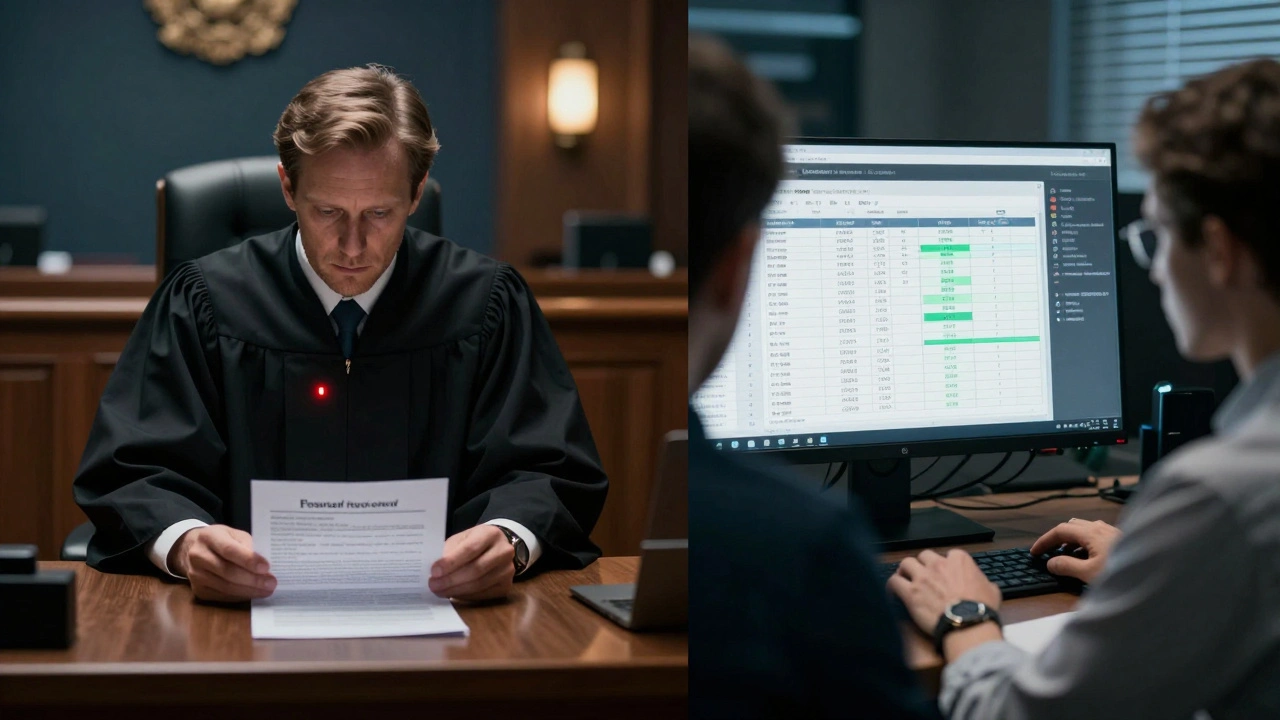
When a forensic report goes out the door, it doesn’t just sit on a desk-it becomes evidence. It might be used in court, influence a sentencing, or even determine whether someone walks free or spends years behind bars. That’s why quality assurance review isn’t just paperwork. It’s a checkpoint that separates reliable science from costly mistakes.
Think about this: a single decimal point error in a toxicology report could turn a 0.08% blood alcohol level into 0.8%. That’s not a typo. That’s a life-altering misstatement. And it happens more often than you’d think. According to a 2024 analysis by the Quality Assurance Institute, over 60% of forensic report errors stem from simple data misalignment-not fraud, not incompetence, but overlooked details. That’s why independent QA reviews exist: to catch those mistakes before they become legal disasters.
What a Quality Assurance Review Actually Checks
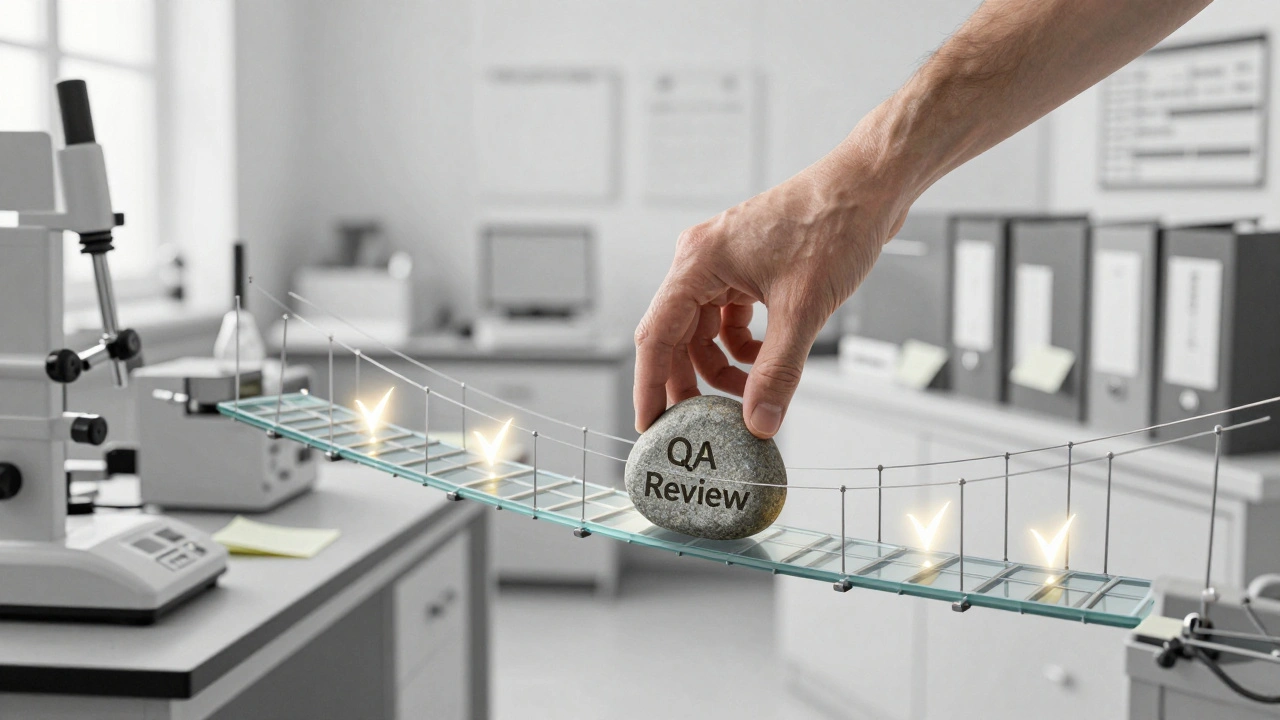
A QA review for forensic reports isn’t about rewriting conclusions. It’s about verifying the foundation. The process is built on seven core criteria, as defined by the Lawrence Berkeley National Laboratory and adopted by federal audit teams:
- Factual accuracy: Every claim must trace back to raw data. Was the DNA sample labeled correctly? Did the chain of custody log match the lab report? If not, the report fails.
- Methodological soundness: Did the lab use validated techniques? Were instruments calibrated to NIST standards? Was the method within its certified working range? These aren’t optional.
- Root cause identification: If a discrepancy is found, the review doesn’t stop at “something’s wrong.” It asks: Why? And more importantly, what can management fix to prevent it next time?
- Corrective action planning: Fixes must be SMART-Specific, Measurable, Achievable, Relevant, and Time-bound. “Train staff better” isn’t enough. “Conduct monthly calibration audits with documented sign-offs by March 30” is.
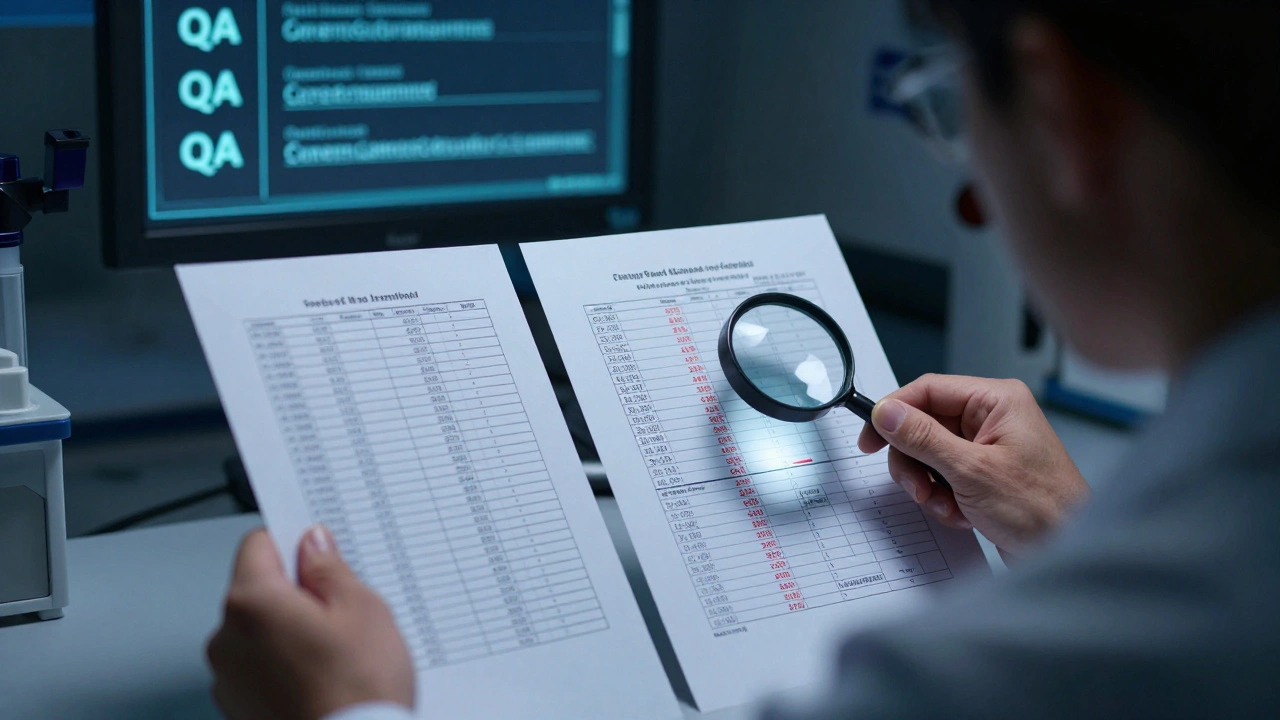
- Consistency in data: Numbers in tables must match source files. Percentages must add up. Dates must align across chain-of-custody logs, lab notes, and final reports.
- Clarity and presentation: Jargon shouldn’t obscure meaning. A jury doesn’t need to know “gas chromatography-mass spectrometry”-they need to know “the substance found was cocaine, detected at 1.2 mg/mL.”
- Documentation trail: Every decision, every verification step, every correction must be recorded. No handwritten notes on sticky pads. No verbal approvals. Everything is logged.
These aren’t suggestions. They’re requirements. The EPA’s 1998 guidelines on forensic reporting still hold weight today: significant figures must be correct, methods must be traceable, and all measurements must fall within the instrument’s validated range. Miss one of these, and the entire report becomes vulnerable.
How QA Reviews Differ From Peer Reviews
Many people confuse QA reviews with peer reviews. They’re not the same-and mixing them up is dangerous.
A peer review asks: “Does this make sense scientifically?” It’s about whether the conclusion fits with existing literature. Did the analyst interpret the fingerprint pattern correctly based on current forensic science? That’s peer review.
A QA review asks: “Did they do what they said they did?” It’s about execution. Did they record the sample ID correctly? Did they use the right calibration curve? Did they report the result with the right number of decimal places? It doesn’t care if the conclusion is groundbreaking. It cares if the numbers are right.
The distinction matters because peer reviewers often come from the same field, same lab, even same team. QA reviewers don’t. They’re independent. They report outside the chain of command. That’s not bureaucracy-that’s protection. As Dr. Norman H. Adams wrote in his seminal 1998 EPA paper: “QA reviews must maintain organizational separation from the original analysis team to prevent confirmation bias.”
Real-World Consequences of Skipping QA
There are horror stories. And they’re not fiction.
In 2023, NASA’s Artemis program delayed its launch by 87 days because QA reviewers caught inconsistent thermal protection system data in documentation. The original team thought the numbers matched. They didn’t. A decimal error in a spreadsheet cascaded into a safety review that halted everything.
Or take the pharmaceutical case from 2024: a major company avoided a $47 million FDA fine because a QA review flagged undocumented assumptions in clinical trial reports. The team had assumed a control group’s data was stable. It wasn’t. The error would have skewed efficacy results. QA caught it. The company fixed it. The fine never came.
On the flip side, a 2025 Reddit thread from r/auditing shared how one user spent 22 hours fixing a single QA finding: inconsistent date formatting across 17 reports. Sounds trivial? That error meant a $1.2 million financial discrepancy was misreported as $12 million. Imagine the legal fallout if it had gone unnoticed.
Who Does the Review-and How
QA reviewers aren’t just anyone. They need:
- Certified technical expertise in the specific forensic discipline (DNA, ballistics, toxicology, etc.)
- Formal QA training (minimum 16 hours, per LBL standards)
- No prior involvement in the case or report being reviewed
Most government agencies assign QA roles to dedicated units-like OIAI (Office of Independent Audit and Inspection)-to ensure independence. Private labs often outsource to firms like KPMG, PwC, or Deloitte’s QA divisions, especially when handling high-stakes cases.
The process usually follows eight steps:
- Identify preliminary findings from the draft report
- Gather supporting documentation
- Hold exit meetings with the original team
- Issue draft QA review report
- Collect management responses
- Issue final QA-reviewed report
- Track corrective actions
- Monitor annually for recurrence
It’s not fast. On average, a QA review adds 3-5 business days to a report’s timeline. But it cuts post-delivery corrections by 82%, according to Decision Analyst’s internal metrics. That’s not just efficiency-it’s risk reduction.
Technology Is Changing QA Reviews
Manual checks are still the backbone, but tools are stepping in. Since 2022, 40% more organizations have adopted automated QA tools. AI now handles routine tasks:
- Spotting mismatched decimal places
- Flagging inconsistent sample IDs
- Verifying that tables match source files
- Checking for units of measurement errors
In January 2025, the AASHE STARS framework rolled out blockchain-based verification for forensic data submissions. Pilot results showed a 63% reduction in verification time. No more chasing down old Excel sheets. The data is timestamped, immutable, and traceable.
And in March 2025, ISO published ISO 10012:2025-the first global standard for QA review processes. It doesn’t just say “do a review.” It says: Here’s how to do it right. From documentation formats to reviewer certification, it’s setting a baseline.
Still, tech can’t replace judgment. AI can’t tell if a root cause is truly fixable by management. It can’t assess whether a conclusion is overreaching. That’s why human reviewers remain essential. The best systems combine automation for consistency with human expertise for context.
Why This Matters Now More Than Ever
The global QA services market is projected to hit $18.3 billion by 2027. Why? Because regulators are cracking down.
- The EU’s 2023 Data Accuracy Directive requires independent QA verification for all environmental impact reports.
- The U.S. SEC’s 2024 Climate Disclosure Rule demands documented QA processes for financial disclosures.
- The FDA now requires QA reviews for all forensic reports tied to drug safety.
And it’s not just government. A 2024 survey of 452 organizations found that 73% implemented formal QA reviews because of regulatory pressure. The alternative? Fines, lawsuits, lost credibility, and in some cases, criminal liability.
Organizations with QA processes report 63% fewer post-publication corrections. That’s not just cost savings. It’s trust. Families trust the system. Judges trust the evidence. Juries trust the testimony. That trust starts with a QA review.
Common Pitfalls and How to Avoid Them
Not all QA reviews work. Here’s what goes wrong-and how to fix it:
- Reviewers lack expertise: 52% of practitioners cite this as a major issue. Solution: Require certification in the specific forensic field-not just “general QA.”
- Too slow: 38% of users complain of delays averaging 14.7 business days. Solution: Use automated tools for routine checks. Save human review for complex anomalies.
- Inconsistent application: 68% say QA standards vary between teams. Solution: Adopt ISO 10012:2025. Standardize everything.
- Resistance from report authors: 78% of organizations face pushback. Solution: Frame QA not as criticism, but as protection. “We’re not doubting you. We’re protecting your work.”
The most successful teams treat QA as a partnership. They hold monthly feedback sessions. They celebrate when QA catches an error before it goes public. They don’t punish the team-they thank them.
What’s the difference between a QA review and a factual accuracy review?
A factual accuracy review checks whether the report correctly states what happened-dates, names, measurements, events. It’s done by subject matter experts or management. A QA review checks whether the report was produced correctly: Was the method valid? Was the data handled properly? Was the documentation complete? It’s done by independent personnel with no prior involvement in the case.
Can a QA review catch fraud?
Not directly. QA reviews aren’t designed to detect intentional deception. Their job is to catch errors-mistakes in data entry, calculation, formatting, or methodology. But if a pattern of errors emerges, or if data is clearly manipulated, a QA review can flag it for further investigation. In that sense, it’s a red flag system, not a fraud detector.
How often should QA reviews be done?
Every report should go through a QA review before final release. There’s no exception. Even if a report seems simple, the stakes are too high. The American Society for Quality recommends reviewing at least 10-20% of data points independently, but full QA is the standard for forensic reporting.
Is it expensive to implement a QA review process?
It depends. Internal reviews cost $5,000-$15,000 per year for training and staffing. External audits run $15,000-$50,000. But compared to the average $2.7 million cost of a single reporting error, it’s a bargain. For small labs, outsourcing is often more cost-effective than hiring full-time QA staff.
What happens if a QA review finds an error?
The report is sent back for correction. The original team must fix the error, document the fix, and submit proof. The QA team then verifies the correction. If the fix is valid, the report is reissued. If not, the review process repeats. No report leaves the lab without QA sign-off.