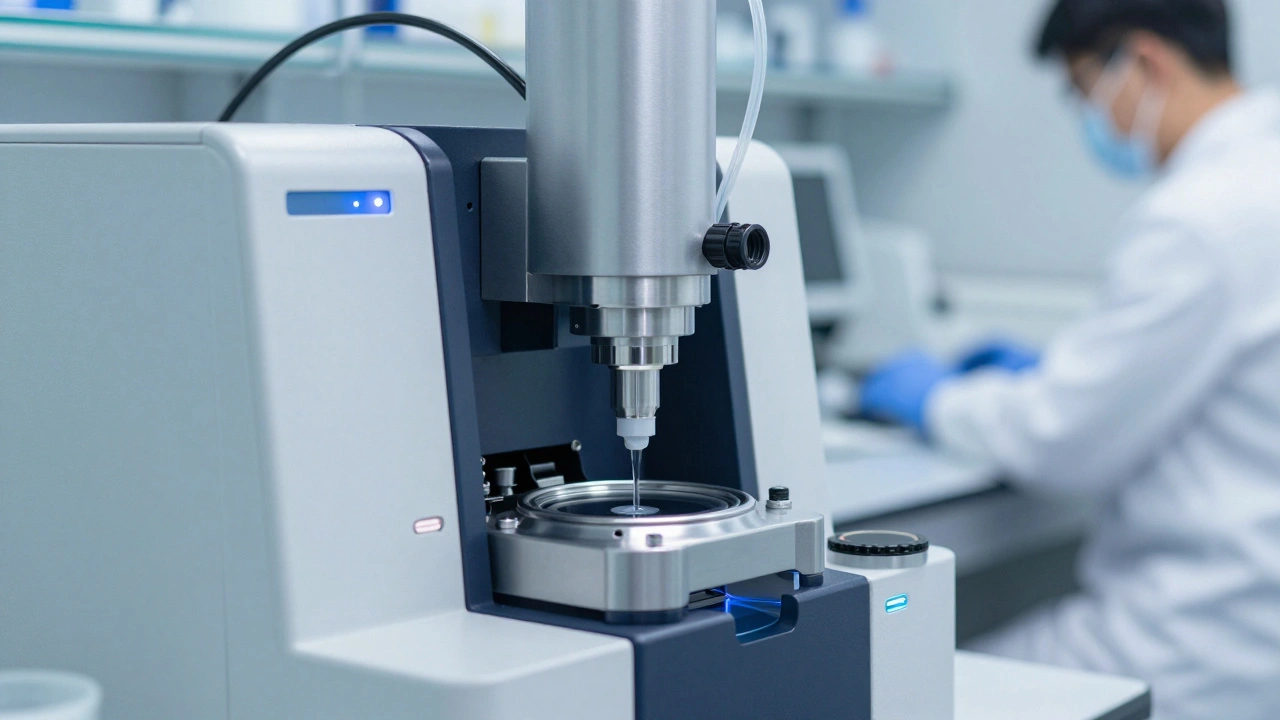
In the world of forensic toxicology, the difference between a clear conviction and a dismissed case often comes down to a few femtograms of a substance. When you're dealing with complex biological matrices-think blood, urine, or vitreous humor-the noise can be deafening. You need a tool that doesn't just see the molecule, but proves exactly what that molecule is without any doubt. That is where LC-MS/MS is Liquid Chromatography-Tandem Mass Spectrometry, a powerhouse technique that combines the physical separation capabilities of liquid chromatography with the mass analysis of two sequential mass spectrometers. It is the gold standard for quantifying small and large molecules because it offers a level of specificity that single-stage instruments simply can't match.
The Specificity Engine: How MRM Works
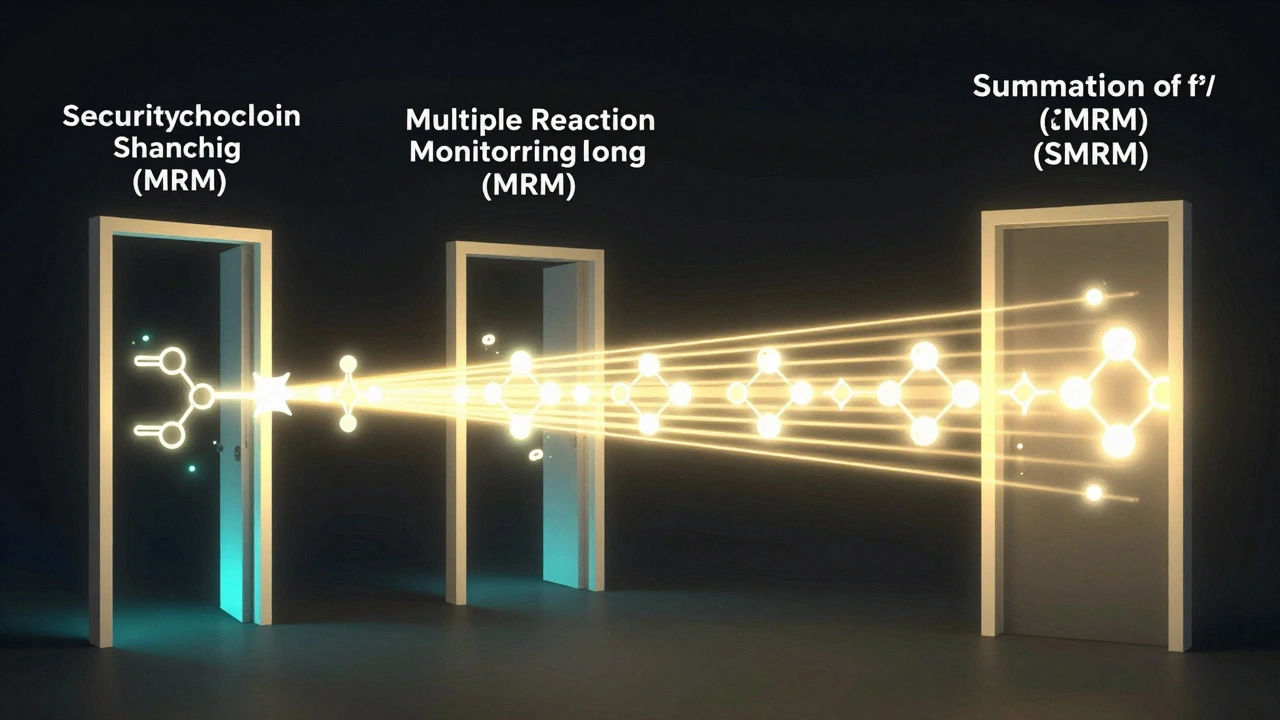
To understand how we gain specificity, we have to look at Multiple Reaction Monitoring (also known as MRM), a targeted scan mode that monitors a specific precursor ion and its resulting product ion fragment. Think of it like a security checkpoint with two doors. The first door only lets through ions of a specific mass (the precursor). Once inside, those ions are smashed into pieces, and the second door only lets through a specific fragment (the product). If a molecule passes both doors, the chance that it's an impurity or a random biological protein is incredibly low.
But here is the catch: this extreme specificity comes at a cost. By filtering out everything except one specific transition, you're throwing away a huge amount of your signal. For small molecules, this is usually fine. But for large biomolecules, which naturally split into multiple charge states, focusing on just one transition can make your detection limits climb dangerously high, potentially missing a critical analyte in a forensic sample.
Breaking the Sensitivity Ceiling with SMRM
Since conventional MRM can be too restrictive for large molecules, researchers developed Summation of MRM (or SMRM), an advanced analytical approach that sums the intensities of multiple precursor-to-product transitions to increase the total signal. Instead of picking one "door," SMRM monitors several possible transitions and adds them together.
The results are significant. In studies involving teriparatide analysis, SMRM showed about a 4-fold increase in signal intensity compared to the best single MRM setups at higher concentrations. It essentially captures more of the molecule's available "energy," allowing for much lower limits of quantification (LOQ). This is a game-changer for forensic labs that need to detect trace amounts of large peptide-based toxins or proteins in degraded samples.
| Feature | Conventional MRM | SMRM Method |
|---|---|---|
| Signal Intensity | Lower (Single transition) | Higher (Summed transitions) |
| Dynamic Range | Standard | Wider / Linear |
| Best For | Small molecules/drugs | Large biomolecules/peptides |
| Noise Risk | Low | Higher (Accumulates impurities) |
Expanding the Linear Dynamic Range
In toxicology, you might be dealing with a sample that has a tiny amount of a drug, or one that is completely saturated. Most Ligand Binding Assays (LBA) struggle here because they have a narrow dynamic range-they saturate quickly. SMRM fixes this by leveraging the combined signal. Because it can handle a wider variety of charge state distributions, it stays linear across a much broader range of concentrations.
This means you spend less time re-running samples and diluting them. You get a stronger total ion signal at high concentrations without losing the sensitivity needed for the low end. However, you have to be careful. Since you're summing multiple signals, you're also potentially summing noise. This makes your chromatographic separation the most important part of the process. If your peaks aren't clean, SMRM can actually make your background noise worse.
Hardware Hacks for Maximum Sensitivity
You can have the best software method in the world, but if your hardware is leaking or poorly configured, your data will be garbage. One of the most overlooked factors is Dead Volume, the total volume of all system parts from the injector to the detector cell, excluding the column. When you have too much dead volume in your tubing or connectors, your peaks broaden and tail. A broad peak is a weak peak, which kills your sensitivity.
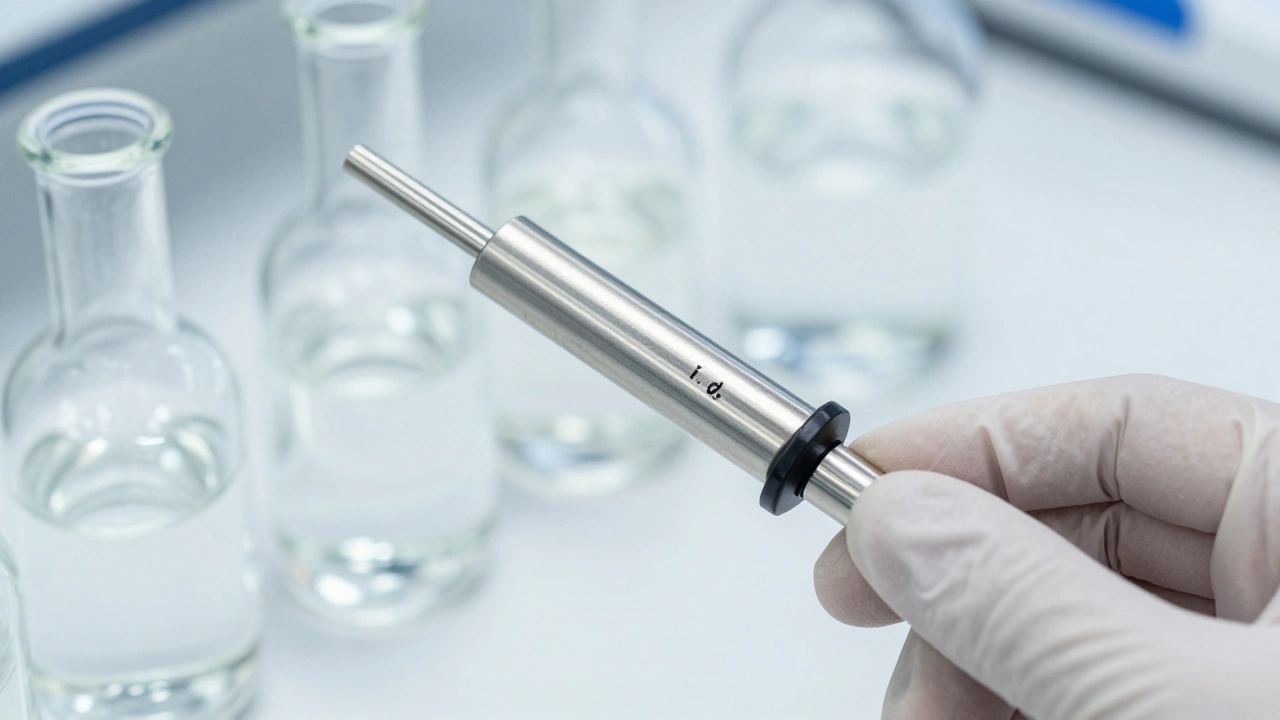
Then there is the column choice. There is a strong shift toward using 1mm i.d. columns. Compared to the traditional 2.1mm or 3mm columns, these narrow-bore columns can boost sensitivity by 1.5 to 3 times. By concentrating the analyte into a smaller volume, the detector sees a much more intense signal, which is vital for detecting femtogram-level concentrations.
The War on Contamination
Mass spectrometry is so sensitive that it can detect the residue from a plastic tube you used three days ago. To maintain high specificity and low background noise, you must use ultrapure solvents-water, acetonitrile, methanol, and isopropanol-and high-grade additives like formic acid.
Every piece of the workflow is a potential point of failure. Using low-grade reagents leads to adduct formation and signal suppression, where the "junk" in your solvent competes with your analyte for ionization. If you want a clean baseline and a low limit of detection, your contamination prevention has to be obsessive. This isn't just about clean glassware; it's about the purity of every single drop of solvent moving through the HPLC system.
What is the main difference between MRM and SMRM?
Conventional MRM monitors one specific transition from a precursor ion to a product ion, which is great for specificity but loses signal. SMRM sums multiple transitions together, significantly increasing the signal intensity and sensitivity, especially for large molecules like peptides.
Why do narrow-bore columns increase sensitivity?
Columns with a 1mm internal diameter concentrate the analyte into a smaller area compared to 2.1mm columns. This results in a higher concentration of the analyte reaching the mass spectrometer at once, creating a sharper, taller peak that is easier to detect against the background noise.
Does SMRM increase the risk of false positives?
Potentially, yes. Because SMRM sums multiple transitions, it can also sum impurity ions that happen to share those same transitions. This is why high-quality chromatographic separation is required to ensure that impurities are separated from the target analyte before they hit the detector.
What is 'dead volume' and why does it matter in LC-MS/MS?
Dead volume is the internal volume of the tubing and fittings between the injector and the detector. Too much dead volume causes peak broadening and tailing, which spreads the analyte signal over a wider time frame and lowers the peak height, directly reducing the sensitivity of the analysis.
How does LC-MS/MS compare to Ligand Binding Assays (LBA)?
LBAs often have better raw detection sensitivity for certain very large molecules. However, LC-MS/MS, especially when using SMRM, provides a much wider linear dynamic range and superior specificity, meaning it can accurately quantify a wider range of concentrations without needing as many sample dilutions.
Next Steps for Method Optimization
If you are struggling with high detection limits, start by auditing your hardware. Check for any oversized tubing or loose fittings that could be introducing dead volume. If your hardware is tight, experiment with narrow-bore columns to sharpen your peaks. For those working with peptides or large proteins, transitioning from a single-MRM transition to an SMRM approach can provide the 4-fold jump in sensitivity needed to hit your LOQ targets. Finally, never underestimate the impact of solvent purity; switching to an LC-MS grade solvent can often remove "ghost peaks" that are masking your analytes.