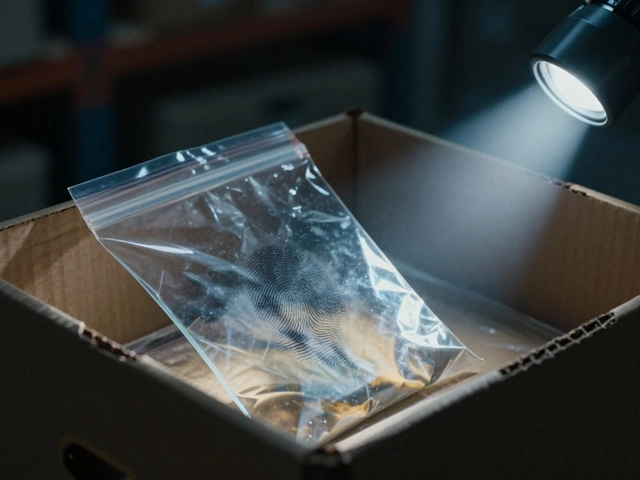
Imagine a sexual assault case where the victim and suspect are related, or a cold case from decades ago where only a tiny amount of degraded evidence remains. Standard autosomal DNA tests often hit a wall here. They mix everyone’s genetic data together, creating a confusing soup of profiles. This is where Y-Chromosome DNA Analysis becomes the detective’s secret weapon. Unlike regular DNA that shuffles every generation, the Y chromosome passes down almost unchanged from father to son. It acts as a genetic surname, tracing a direct paternal line through centuries.
If you’re working in forensics, law enforcement, or just curious about how science cracks tough cases, understanding this tool is non-negotiable. It doesn’t replace standard DNA testing; it solves specific problems that standard methods can’t touch. Let’s break down exactly how it works, when to use it, and what its limits are.
The Science Behind the Male Lineage
To grasp why Y-STR analysis is so powerful, you have to look at human genetics. Humans typically have 46 chromosomes. Two determine sex: XX for females and XY for males. The X chromosome swaps parts with its partner during reproduction, but the Y chromosome? It mostly sits alone. It doesn’t recombine with the X. This means the Y chromosome is passed from father to son with very few changes, except for occasional mutations.
Forensic scientists focus on specific regions of the Y chromosome called Short Tandem Repeats (STRs). These are short sequences of DNA that repeat themselves. The number of repeats varies between unrelated men. By analyzing these repeats, labs create a unique profile known as a Y-haplotype. Because all males in a direct paternal line share the same Y-haplotype, finding a match doesn’t identify one specific man-it identifies his entire family line.
This distinction is crucial. If you find a Y-DNA match, you haven’t found the suspect. You’ve found a group of men who share a common grandfather, great-grandfather, or further back ancestor. In a population like the US, a single Y-haplotype might be shared by thousands of men. But in a small, isolated community, that number could be much smaller. Context is everything.
When Standard DNA Fails: The Power of Separation
The biggest headache in forensic biology is mixture interpretation. Think about a rape kit. It contains cells from the victim (female) and the suspect (male). Autosomal DNA tests analyze both sets of markers simultaneously. If the suspect contributed little biological material, his signal gets drowned out by the victim’s massive contribution. Or worse, if two males were involved, their signals blend into an unreadable mess.
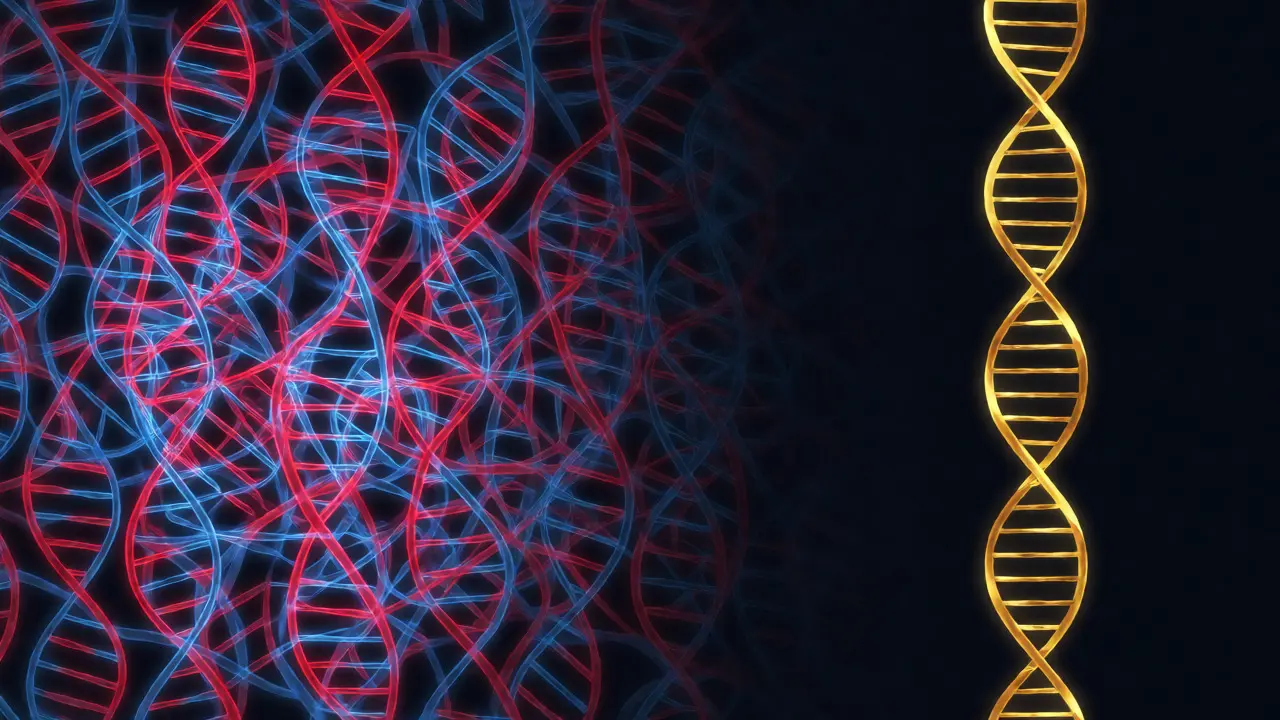
Y-chromosome analysis cuts through this noise instantly. Since women don’t have a Y chromosome, their DNA simply disappears from the test results. You get a clean, single-source profile of the male contributor(s). No mixing, no guessing. If there was more than one male attacker, you’ll see multiple distinct haplotypes, clearly separating them without needing complex statistical deconvolution software.
| Feature | Autosomal DNA | Y-Chromosome DNA |
|---|---|---|
| Inheritance Pattern | Mixed from both parents | Direct paternal line only |
| Sex Specificity | Analyzes both male and female contributors | Male-specific (ignores female DNA) |
| Mixture Resolution | Difficult; requires complex math | Easy; separates male contributors cleanly |
| Identification Level | Individual (unless identical twins) | Lineage/Family Group |
| Degraded Samples | Often fails with low quantity | More robust due to high copy number in some contexts |
Real-World Applications in Criminal Justice
So, when do prosecutors actually pull this card out of the deck? There are three main scenarios where forensic Y-DNA shines brightest.
First, sexual assault cases involving relatives. Suppose a woman reports being assaulted by her husband, but her ex-boyfriend also had access to the scene. Or consider a case where the victim’s father and brother are suspects because they live in the house. Their autosomal DNA might be too similar to distinguish easily in a low-template sample. But wait-if the father and son share the same Y, this doesn’t help distinguish *them*. However, if the suspect is the victim’s uncle (brother of the father), he shares the Y with the father but not necessarily with the victim’s brother if the brother has a different father? No, let's correct that logic. The classic example is distinguishing between brothers. Brothers share the same Y. So Y-DNA won't tell you which brother did it. But it will tell you if the perpetrator was male at all, and if he was from a specific family line. A better example: Distinguishing between a male suspect and a male relative who is not in the direct line (like a cousin from a different branch). Or, more commonly, using it to exclude innocent males who do not share the lineage.
Second, mass disasters and missing persons. When bodies are fragmented or burned beyond recognition, recovering enough nuclear DNA for a full profile is hard. Y-DNA is often more stable and easier to recover from bone fragments. If you have reference samples from living paternal relatives (fathers, sons, uncles), you can confirm identity even if the direct parent-child link is broken. For instance, identifying a soldier’s remains by matching his Y-profile to his nephew’s.
Third, historical and genealogical mysteries. The most famous case is the identification of Thomas Jefferson’s descendants. Researchers used Y-DNA to link the Carr family line to Jefferson’s male heirs, solving debates about paternity that had lasted for centuries. In criminal terms, police use public genealogy databases (like GEDmatch) to upload Y-DNA profiles from crime scenes. They look for partial matches in the database. If a distant cousin matches, investigators build a pedigree chart backward until they find a common ancestor, then forward to identify potential suspects.
Limitations You Must Know
Don’t treat Y-DNA as a magic bullet. It has serious blind spots. The most obvious is that it cannot identify a single individual. As mentioned, all male relatives in the direct paternal line share the same profile. If your suspect list includes a father and son, Y-DNA won’t separate them. You need autosomal DNA or other evidence for that.
Another issue is population frequency. Some Y-haplotypes are extremely rare, while others are common. In certain ethnic groups, specific haplogroups dominate. A match might have a random match probability of 1 in 100 in one population but 1 in 10,000 in another. Forensic statisticians must calculate likelihood ratios carefully, accounting for the suspect’s ethnic background. Ignoring this can lead to overstating the strength of the evidence in court.
Also, mutation rates matter. While the Y chromosome is stable, it does mutate. Over many generations, differences accumulate. If a suspect is a distant cousin, his Y-profile might differ slightly from the crime scene sample. Labs account for this by allowing for one-step mutations in their comparisons, but it adds uncertainty. If the difference is larger, it might rule out a relationship entirely.
The Process: From Swab to Profile
How does the lab actually do this? The workflow is similar to standard DNA testing but with targeted amplification.
- Extraction: DNA is pulled from the evidence-blood, semen, hair roots, or bone powder.
- Quantitation: Scientists measure how much DNA is available. Y-DNA tests require less input than autosomal tests because they target fewer loci.
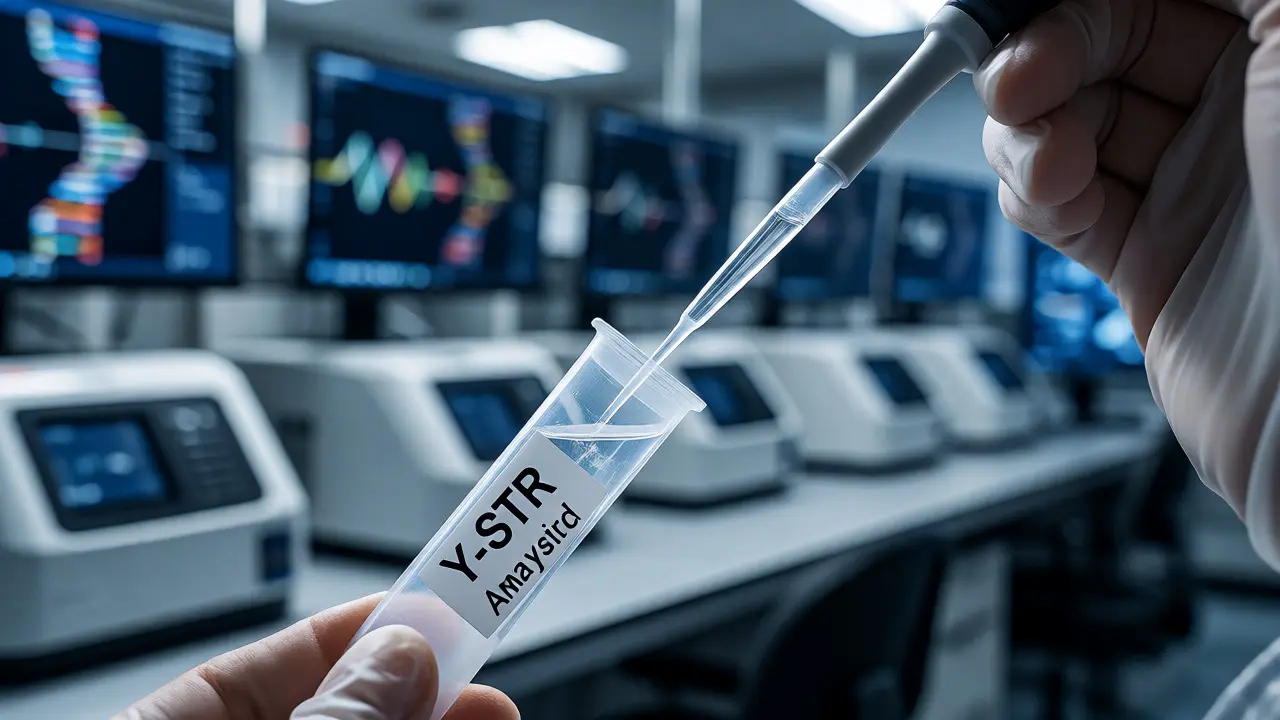
- Amplification: Using PCR (Polymerase Chain Reaction), the lab copies specific Y-STR regions. Modern kits, like the PowerPlex® Y23 System, amplify up to 27 different STR markers.
- Separation: The copied fragments are separated by size using capillary electrophoresis.
- Analysis: Software reads the peak heights and assigns allele numbers. These numbers form the haplotype string (e.g., DYS390=24, DYS391=10).
- Database Search: The profile is compared against national databases like CODIS Y-STR Database or private genealogy sites.
Quality control is strict. Contamination is a huge risk because Y-DNA is everywhere-in sweat, skin cells, and handling. Labs use negative controls and process blanks to ensure no external male DNA sneaks into the sample.

Ethical and Legal Considerations
Using Y-DNA raises privacy questions. Because it traces family lines, a match implicates relatives who never gave consent. If a suspect’s Y-profile hits a database entry from his third cousin, police can investigate the whole family tree. Critics argue this violates Fourth Amendment rights, while proponents say it’s just a clue, not proof.
Courts generally accept Y-DNA evidence under Daubert or Frye standards, provided the lab follows validated protocols. Expert testimony must clearly explain the limitations: "This evidence places the perpetrator in the [Surname] family line, but it does not prove he was the one present." Juries sometimes misunderstand this, thinking a match equals guilt. Lawyers must hammer home the difference between exclusion and identification.
Future Trends: Next-Gen Sequencing
We are moving beyond simple STR counting. Next-Generation Sequencing (NGS) allows analysts to read the actual DNA sequence of the Y chromosome, not just the length of repeats. This reveals Single Nucleotide Polymorphisms (SNPs) that define deep ancestral haplogroups.
Why does this matter? SNPs are more stable than STRs. They provide higher resolution for distant relationships. In the future, we might see Y-DNA phenotyping-predicting physical traits or geographic origins based on Y-markers. Imagine a crime scene yielding only a Y-profile. With advanced SNP panels, investigators could predict the suspect’s likely ethnicity or regional ancestry before ever checking a database. This narrows the search field dramatically, saving time and resources.
For now, Y-STR remains the gold standard for male-specific forensics. It’s reliable, well-validated, and legally accepted. But as sequencing costs drop, expect hybrid approaches combining STRs and SNPs to become routine. Keep an eye on developments from the National Institute of Standards and Technology (NIST) regarding new marker sets.
Can Y-DNA distinguish between brothers?
No, brothers inherit the same Y chromosome from their father, so their Y-STR profiles will be identical. To distinguish between brothers, you must use autosomal DNA analysis, which looks at the mixed genetic contributions from both parents.
Is Y-DNA testing more expensive than standard DNA testing?
Generally, yes. Y-DNA testing is specialized and often requires additional processing steps to isolate male DNA or run specific kits. Costs vary by lab and jurisdiction, but it is typically priced higher than routine autosomal profiling.
Does Y-DNA work on female victims?
Yes, but indirectly. Since females lack a Y chromosome, Y-DNA analysis ignores the victim’s DNA. This is highly beneficial in sexual assault cases because it isolates the male perpetrator’s profile without interference from the female victim’s abundant DNA.
How long does it take to get Y-DNA results?
Turnaround times depend on the lab’s backlog and the complexity of the sample. Typically, results take 2 to 6 weeks. Degraded samples or those requiring extensive cleanup may take longer. Expedited services are often available for urgent cases.
Can Y-DNA identify a suspect if he has no male relatives?
Not directly through familial searching. If no male relatives are in the database, the system relies on direct matches in CODIS or genealogical uploads. However, even without relatives, the Y-profile can still exclude innocent suspects who do not share the lineage, narrowing the pool significantly.