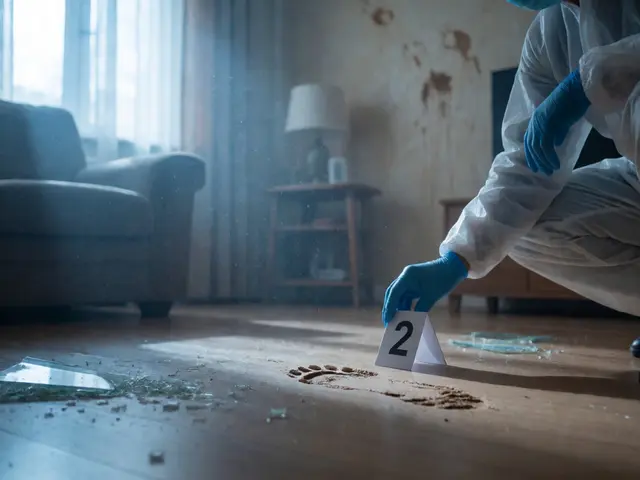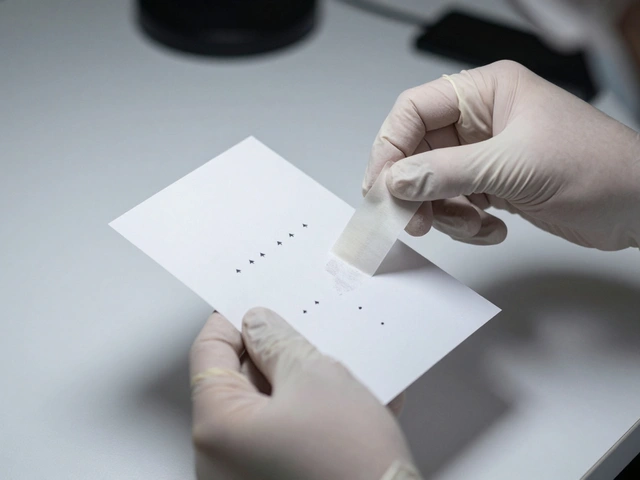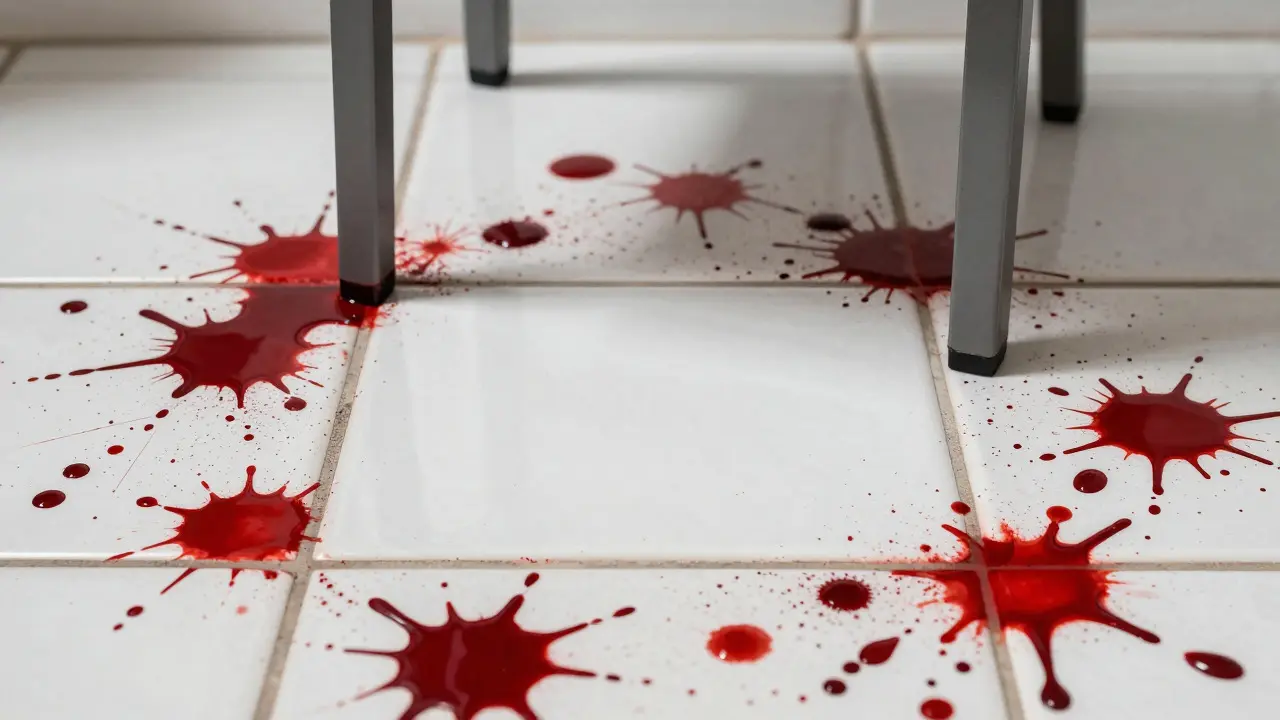
Imagine standing in a kitchen where a fight just ended. You see splatter on the walls and pools on the floor. But what catches your eye isn't the red-it's the white rectangle on the tile where a chair used to be. That empty space is not nothing. In forensic science, that gap is a void pattern is a distinct area at a crime scene devoid of blood or other biological material, indicating the presence of an object or person that was subsequently removed. It acts as a negative fingerprint, preserving the shape of whatever blocked the spray. Most people think evidence is what you find. But experienced investigators know that evidence is also what you don't find. When blood hits a surface, it spreads based on physics and gravity. If something stands in the way, the blood doesn't hit the wall behind it. Once that object moves, the clean spot remains. This article breaks down how these missing pieces help reconstruct events, identify objects, and even place suspects at the scene.
The Physics Behind the Gap
To understand why a void matters, you have to understand how blood moves. Blood is a non-Newtonian fluid, meaning its viscosity changes under stress. When a force-like a punch, a gunshot, or a falling body-hits a blood source, it creates droplets. These droplets travel through the air and strike surfaces. The angle, speed, and volume of the impact determine the stain's size and shape.
A void occurs when an object interrupts this trajectory. Think of it like holding your hand up against a garden hose. The water sprays everywhere except where your palm blocks it. When you pull your hand away, the dry patch on the ground tells you exactly where your hand was. In forensics, this principle allows analysts to reverse-engineer the position of objects at the moment of impact.
- Directionality: Blood travels in straight lines until it hits a surface. Voids align with these trajectories.
- Volume: Higher velocity impacts (like gunshots) create wider voids because the spray cone is broader.
- Surface Texture: Porous surfaces absorb blood differently than smooth glass or metal, affecting how clearly a void appears.
Types of Void Patterns
Not all voids look the same. Their shape depends entirely on the object that created them. Recognizing these shapes helps investigators identify what was present without finding the object itself.
| Shape Description | Likely Source Object | Typical Context |
|---|---|---|
| Rectangular with rounded corners | Chair back, table leg, or door frame | Furniture moved after incident |
| Oval or elliptical | Human head, torso, or limb | Victim or suspect positioned near impact |
| Irregular jagged edges | Clothing folds, bags, or soft goods | Personal items left at scene |
| Linear strip | Long thin objects like broom handles or pipes | Tools or structural elements |
For example, if you see a series of small circular voids on a wall behind a victim, it might indicate the holes in a mesh screen or a netted bag. If the void is large and amorphous, it could be the shadow of a person crouching. Each shape narrows down the possibilities significantly.
How Investigators Identify and Document Voids
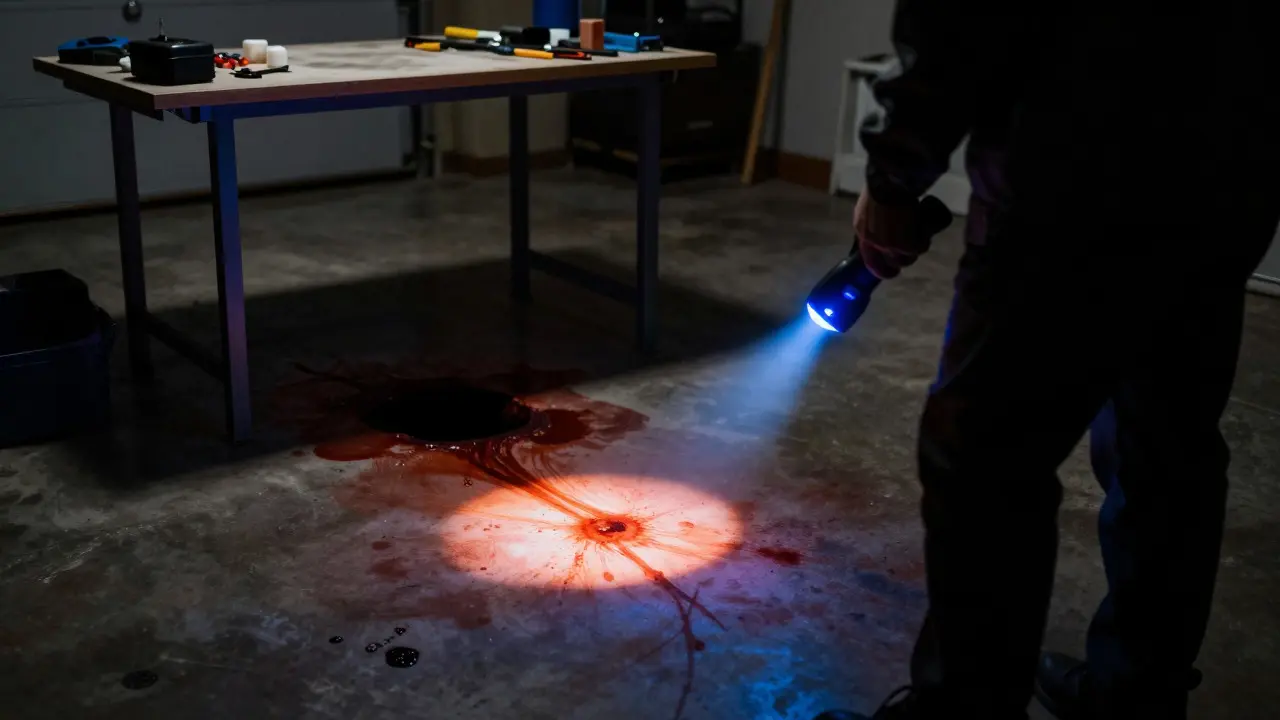
Finding a void requires a keen eye for contrast. Investigators often use alternate light sources or UV light to enhance the difference between stained and unstained areas. On dark carpet, a void might appear as a slightly lighter patch where the fibers are cleaner. On a white wall, it’s simply the absence of red.
Documentation is critical. A void is ephemeral; once the scene is cleaned or the weather changes, it’s gone forever. Therefore, the process follows strict protocols:
- Photograph from multiple angles: Include scale bars and reference points to measure the void’s dimensions accurately.
- Measure the boundaries: Use laser rangefinders or tape measures to map the exact perimeter.
- Identify potential sources: Look for matching objects nearby. Does the void match the footprint of a shoe? The outline of a car tire?
- Test the hypothesis: If a chair is suspected, place it back in the void location and take comparative photos. If the alignment is perfect, the hypothesis gains weight.
This step-by-step approach ensures that the void isn’t mistaken for a cleaning artifact or a pre-existing stain. Context is king here. A void on the floor near a broken window suggests someone jumped over it. A void on a ceiling fan blade suggests someone stood directly underneath during a high-velocity event.

Case Studies: Real-World Applications
Theoretical knowledge is useful, but real cases show the power of void analysis. Consider a case in Portland where a dispute turned violent in a garage. The victim was struck while leaning against a workbench. After the move, the family cleared the room. Investigators found a rectangular void on the concrete floor behind the workbench. By measuring the void and comparing it to the workbench’s footprint, they confirmed the victim had been pinned against the bench, limiting their ability to flee. This detail changed the narrative from a random attack to a controlled ambush.
In another scenario, a shooter fired into a room. The bullet impacted a bookshelf, creating a secondary spatter. However, there was a clean vertical strip on the wall behind the shelf. Further inspection revealed a narrow gap between the shelf and the wall. The void proved that the bullet traveled through that specific gap, confirming the shooter’s line of sight and distance. Without noticing the missing blood, the trajectory would have been misjudged by several feet.
Common Mistakes and Pitfalls
Even seasoned professionals can misinterpret voids. One common error is assuming every clean spot is a void. Sometimes, blood simply didn’t reach that area due to low volume or angle. To distinguish a true void from a lack of spatter, look for surrounding stains that form a coherent pattern around the gap. A true void is surrounded by consistent directional flow.
Another pitfall is ignoring environmental factors. Rain, wind, or cleaning agents can erase or distort voids. If a scene was exposed to rain, the void might bleed into the surrounding area, making edges fuzzy. In such cases, digital enhancement tools become essential to restore clarity.
Finally, don’t overlook the time factor. Blood dries and shrinks. As stains dry, they contract slightly, which can make adjacent voids appear larger than they were initially. Keeping track of the time since the incident helps adjust for this natural change.
Tools and Techniques for Enhanced Analysis
Modern forensics goes beyond the naked eye. Several tools help visualize and analyze void patterns more effectively:
- Alternate Light Sources (ALS): Using blue or green light can make dried blood fluoresce, highlighting the boundary between stained and unstained areas.
- Digital Imaging Software: Programs like Adobe Photoshop or specialized forensic software allow analysts to overlay images, measure angles, and simulate object placement.
- 3D Scanning: LiDAR scanners can create a 3D model of the scene, allowing virtual placement of objects to test void hypotheses without moving physical items.
These technologies don’t replace human judgment, but they provide objective data. For instance, a 3D scan can prove that a specific chair fits the void perfectly, leaving little room for doubt in court.
Legal Implications and Admissibility
Can void patterns hold up in court? Yes, provided they are documented correctly. Like all forensic evidence, voids must meet standards for reliability and reproducibility. The investigator must explain the method clearly, showing how the void was identified, measured, and matched to a specific object.
Juries often find visual evidence compelling. Showing a photo of the void next to a photo of the object placed in that spot creates a powerful visual argument. However, defense attorneys may challenge the interpretation, arguing that the void could have been caused by something else. To counter this, experts should present multiple lines of evidence-such as witness statements, physical matches, and trajectory analysis-that all converge on the same conclusion.
The key is transparency. If the void is ambiguous, say so. Overstating certainty can undermine credibility. A balanced presentation, acknowledging limitations while highlighting strong correlations, tends to win trust in the courtroom.
FAQ
What is a void pattern in bloodstain analysis?
A void pattern is an area at a crime scene where no blood is present, indicating that an object or person blocked the blood spray before being moved. It serves as a negative impression of the blocking object.
How long does a void pattern last?
The duration depends on the surface and environment. On porous surfaces like carpet, voids may fade quickly as blood seeps in. On smooth surfaces like tile or glass, they can remain visible for days or weeks if protected from cleaning or weather.
Can void patterns identify specific individuals?
Generally, no. Voids usually identify objects or general body positions rather than unique individual traits. However, if the void matches a unique feature of a person’s clothing or posture, it can support identification when combined with other evidence.
What tools are best for detecting void patterns?
Alternate light sources (ALS), UV lights, and high-resolution digital cameras are standard. 3D scanning technology is increasingly used for precise measurement and virtual reconstruction of the scene.
Are void patterns admissible in court?
Yes, if properly documented and explained by a qualified expert. The evidence must show a clear methodology for identifying and interpreting the void, supported by photographic and measurement records.