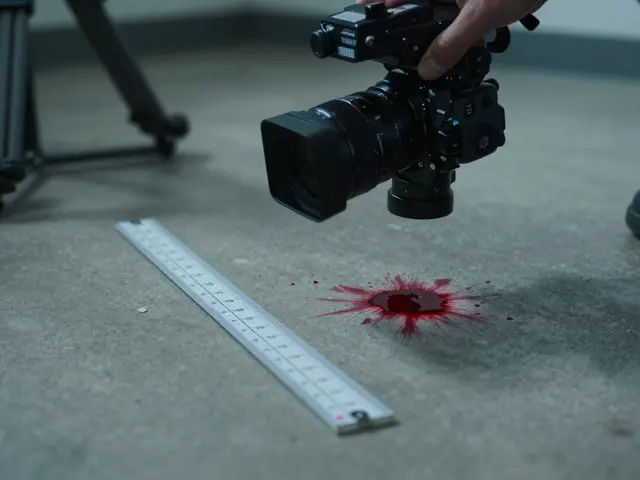
You walk into a room and the air feels heavy. There is blood on the floor, splattered across the wall, and perhaps dripping from a piece of furniture. To an untrained eye, it looks like chaos. But to a forensic specialist, that chaos tells a story. It answers the questions that DNA cannot: what happened, where people were standing, and how the violence unfolded. This is where the stringing method comes in.
The stringing method is not magic; it is physics applied to a messy reality. It is a manual, three-dimensional technique used within Bloodstain Pattern Analysis (BPA) to reconstruct attack patterns. While modern labs often rely on computer software, many investigators still prefer pulling strings through a crime scene because it forces you to engage with the physical space. You see the limitations of the room, the height of the victims, and the trajectory of the blows in real-time.
Why Use Strings When Computers Exist?
If you have high-end software like BackTrack™ or Hemospat, why bother with elastic bands and protractors? The answer lies in context. Computer programs are excellent at calculating angles based on digital photos. However, they can sometimes detach the evidence from the environment. When you use the stringing method, you are working inside the actual crime scene. You feel the constraints of the room. You realize that a table might have blocked a spray of blood, or that the victim was sitting in a chair rather than standing.
This tactile approach helps investigators role-play scenarios. By physically pulling the strings back to their point of convergence, you can test hypotheses. Did the attacker stand here? Could the victim have moved there without disturbing the pattern? This hands-on visualization is harder to achieve staring at a 2D screen in a lab. Furthermore, presenting this method in court can be powerful. Showing jurors how the strings converge to pinpoint a location makes the abstract concept of trajectory tangible and easier to understand.
The Physics Behind the Spatter
To use the stringing method, you need to understand the basic physics of blood. Blood behaves according to gravity, momentum, and surface tension. When a drop hits a surface, its shape reveals its angle of impact. A round drop usually indicates a 90-degree impact (straight down). An elongated drop indicates a lower angle. The more stretched the drop, the shallower the angle.
By measuring the width and length of these drops, analysts calculate the angle of impact using trigonometric functions-specifically the sine function. For example, if a drop is twice as long as it is wide, the angle of impact is roughly 30 degrees. Once you know the angle for several drops in a single spatter event, you can trace their paths backward in three-dimensional space. The point where these paths intersect is called the area of origin. This is the spot in space where the blood source-the victim's wound-was located when the injury occurred.
Step-by-Step: Performing the Stringing Method
The process is systematic and requires precision. Here is how forensic professionals execute the stringing method at a scene:
- Identify and Isolate: First, you must identify the specific bloodstains that belong to the same event. Not every drop is useful. You look for a coherent pattern, such as an arterial spurting or an impact spatter from a blunt force blow. You circle or mark these specific droplets to include them in your analysis.
- Determine Directionality: Look at the shape of each stain. The tail of the drop points in the direction the blood was traveling. Draw straight lines through the center of these drops to indicate their path. These lines represent the two-dimensional trajectory on the surface.
- Calculate Angles: Measure the width and length of each selected stain. Use the formula (Sine of Angle = Width / Length) to determine the angle of impact. Let’s say one drop hit at 22 degrees, and another at 45 degrees. Write these numbers down clearly.
- Position the Strings: Take an elastic string or a colored cord. Anchor one end at the bloodstain on the surface. Using a protractor held against the surface, pull the string away from the wall or floor at the exact calculated angle of impact. For the 22-degree drop, the string should rise gently. For the 45-degree drop, it should rise steeply.
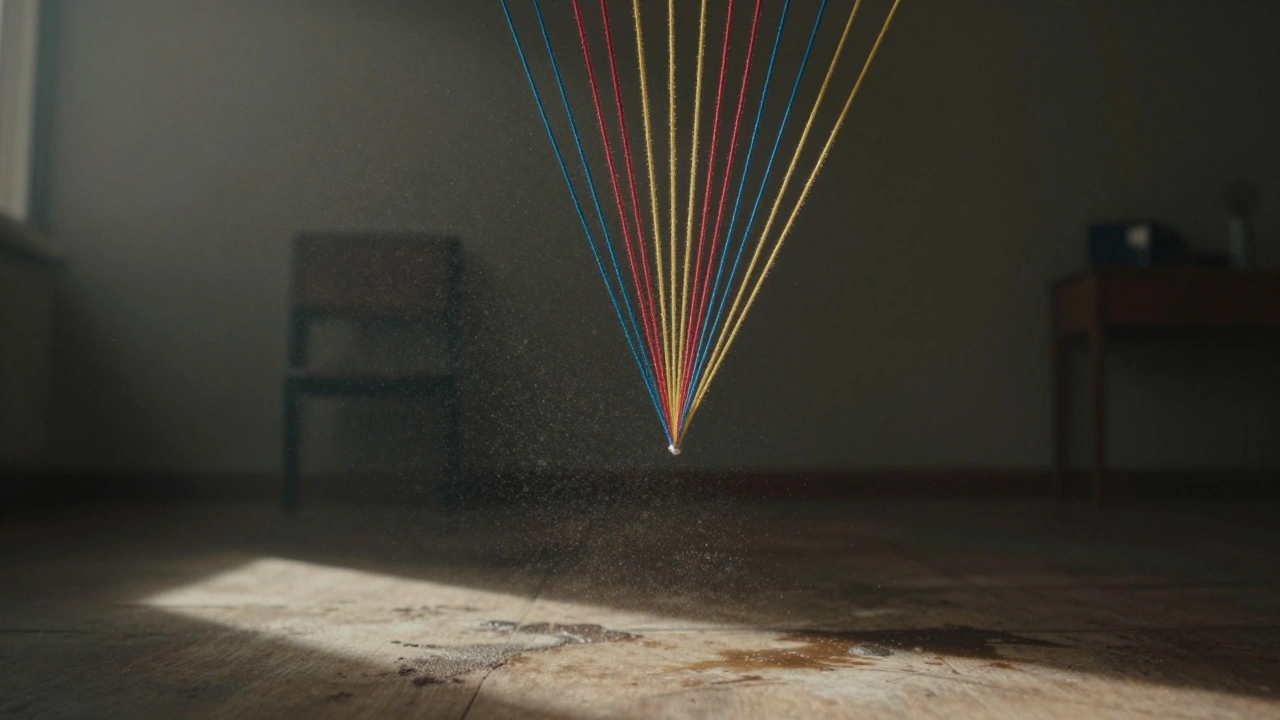
- Find the Convergence: Repeat this for multiple stains in the pattern. As you pull more strings back along their trajectories, they will begin to cross each other in mid-air. The cluster where most strings intersect is your estimated area of origin.
This intersection point is crucial. It tells you exactly where the bleeding person was positioned. If the strings converge at knee-height, the victim was likely kneeling or sitting. If they converge at head-height, the victim was standing. This detail can confirm or refute statements made by suspects or witnesses.
Interpreting the Results: What Does the Origin Tell Us?
Once you have established the area of origin, the real investigative work begins. The location of this point provides critical context about the assault.
- Victim Positioning: If the area of origin is low to the ground, it suggests the victim was seated, lying down, or kneeling during the attack. This contradicts claims that the victim was standing and fighting back upright.
- Weapon Type and Force: The spread of the pattern helps determine the force of the blow. A tight cluster might indicate a sharp instrument, while a wide spray could suggest a blunt object swung with significant velocity. Research dating back to Dr. Eduard Piotrowski in 1895 showed that subsequent blows often create different patterns than the first, helping analysts sequence events.
- Attacker Location: By understanding where the blood came from and where it landed, you can infer where the attacker stood. If the blood sprayed forward, the attacker was likely behind the victim. If it sprayed upward, the attacker may have been below or striking upwards.
- Movement Detection: If the area of origin shifts between different sets of stains, it indicates movement. The victim may have staggered, or the attacker may have repositioned. This helps build a timeline of the assault.
Limitations and Challenges
The stringing method is powerful, but it is not infallible. Several factors can introduce error. One major issue is the curvature of the blood drop. The tangent method assumes a straight-line trajectory, but blood drops follow a parabolic arc due to gravity. For drops traveling short distances, this error is negligible. For long-distance travel, the horizontal position of the origin might be slightly off.
Another challenge is the quality of the stains. Smearing, wiping, or secondary transfer can distort the original shape, making angle calculations inaccurate. Additionally, the texture of the surface matters. Blood hitting carpet behaves differently than blood hitting tile. Analysts must account for surface absorption and texture when interpreting shapes.
There is also the human element. Different analysts might select different drops for inclusion, leading to slightly varying convergence points. To mitigate this, rigorous documentation is essential. Photographs, measurements, and clear notes ensure that the reconstruction can be reviewed and challenged objectively.

Stringing vs. Digital Reconstruction
In today’s forensic landscape, the choice between manual stringing and digital reconstruction often depends on resources and case complexity. Digital tools offer speed and the ability to simulate thousands of trajectories instantly. They are ideal for complex scenes with hundreds of stains. However, they require high-quality photographs and precise input data. If the initial photos are poor, the digital model fails.
The stringing method, by contrast, works directly with the physical evidence. It does not depend on camera resolution or lighting conditions in the same way. It allows for immediate feedback. If a string doesn’t make sense-perhaps it passes through a solid object-you know immediately that your assumption is wrong. This iterative process of testing and adjusting is invaluable for building a robust theory of the event.
| Feature | Stringing Method | Digital Software (e.g., BackTrack™) |
|---|---|---|
| Environment | Physical crime scene | Computer laboratory |
| Visualization | 3D, tangible, immersive | 2D/3D, graphical, abstract |
| Speed | Slower, manual calculation | Faster, automated processing |
| Error Source | Human measurement, string tension | Photo quality, input data accuracy |
| Court Presentation | Highly demonstrative, interactive | Visual, but less tangible |
Integrating with Other Forensic Evidence
Bloodstain pattern analysis never stands alone. The stringing method provides the spatial framework, but other evidence fills in the details. DNA profiling identifies who the blood belongs to. Toxicology reports reveal if drugs or alcohol affected the victim’s movements. Autopsy findings confirm the type of wounds that created the spatter. When combined, these pieces form a complete picture. For instance, if the stringing method places the victim’s head at a certain height, and the autopsy shows a defensive wound on the hand, you can reconstruct the moment of impact with greater confidence.
The goal is always to verify statements and resolve uncertainties. Did the suspect lie about where they were standing? Did the victim fall before or after being struck? The stringing method provides the physical proof needed to answer these questions. It turns a static scene into a dynamic narrative, allowing investigators to see the past as it truly happened.
What is the primary purpose of the stringing method in forensics?
The primary purpose of the stringing method is to determine the area of origin and area of convergence of bloodstains in three-dimensional space. It helps investigators reconstruct the positions of victims and attackers during an assault, providing insights into what happened, where, and how.
How does the stringing method differ from computer-based bloodstain analysis?
The stringing method is performed manually at the physical crime scene using elastic strings and protractors, allowing for immediate, tangible interaction with the environment. Computer-based analysis uses software to calculate trajectories from photographs, which is faster but relies heavily on the quality of the initial images and lacks the immersive context of the physical scene.
Can the stringing method prove whether a victim was standing or sitting?
Yes. By calculating the area of origin, investigators can determine the vertical height of the blood source. If the convergence point is near the floor, it suggests the victim was sitting, kneeling, or lying down. If it is at head-height, it indicates the victim was standing.
What tools are required to perform the stringing method?
The essential tools include elastic strings or colored cords, protractors for measuring angles, rulers or tape measures for determining stain dimensions, and markers to identify specific bloodstains. Some analysts also use plumb bobs to ensure vertical accuracy.
Are there limitations to the accuracy of the stringing method?
Yes. Accuracy can be affected by the curvature of blood drops (parabolic arcs), surface textures that alter stain shapes, smearing or wiping of evidence, and human error in measurement. Additionally, the method assumes straight-line trajectories, which may introduce slight errors for long-distance spatter.
Who developed the foundational principles for bloodstain pattern analysis?
Dr. Eduard Piotrowski conducted early experiments in 1895 that laid the groundwork for understanding bloodstain patterns. His work demonstrated how different types of blows create distinct patterns, forming the basis for modern trajectory analysis techniques like the stringing method.
Is the stringing method still used in modern forensic investigations?
Yes, it remains a valuable tool alongside digital methods. Many forensic experts prefer it for its ability to provide a physical, three-dimensional reconstruction that integrates seamlessly with the crime scene environment, making it particularly effective for courtroom demonstrations and complex scene interpretations.