
Imagine you’re a jury member. The defense presents a photo of the defendant’s face, bruised and angry, taken three days after the incident in question. It’s dramatic. It makes you feel something. But does it actually prove what happened? Or is it just there to make you dislike the person standing in front of you? This is the exact tension that Federal Rule of Evidence 403 is designed to manage.
In American legal proceedings, not all relevant evidence gets into the courtroom. Even if a piece of information connects directly to the case, a judge might exclude it if its potential to confuse the jury or waste time outweighs its actual usefulness. This isn’t arbitrary; it’s a calculated risk assessment performed by the judge before the jury ever sees the exhibit. Understanding this balance helps demystify why certain facts are kept out of trial, even when they seem highly relevant on the surface.
The Core Conflict: Relevance vs. Distraction
To understand Rule 403, we first have to look at its sibling, Rule 401. Rule 401 defines relevance simply: evidence is relevant if it has any tendency to make a fact more or less probable than it would be without the evidence, and if that fact is consequential to the determination of the action. In plain English, if it helps prove or disprove something important, it’s relevant.
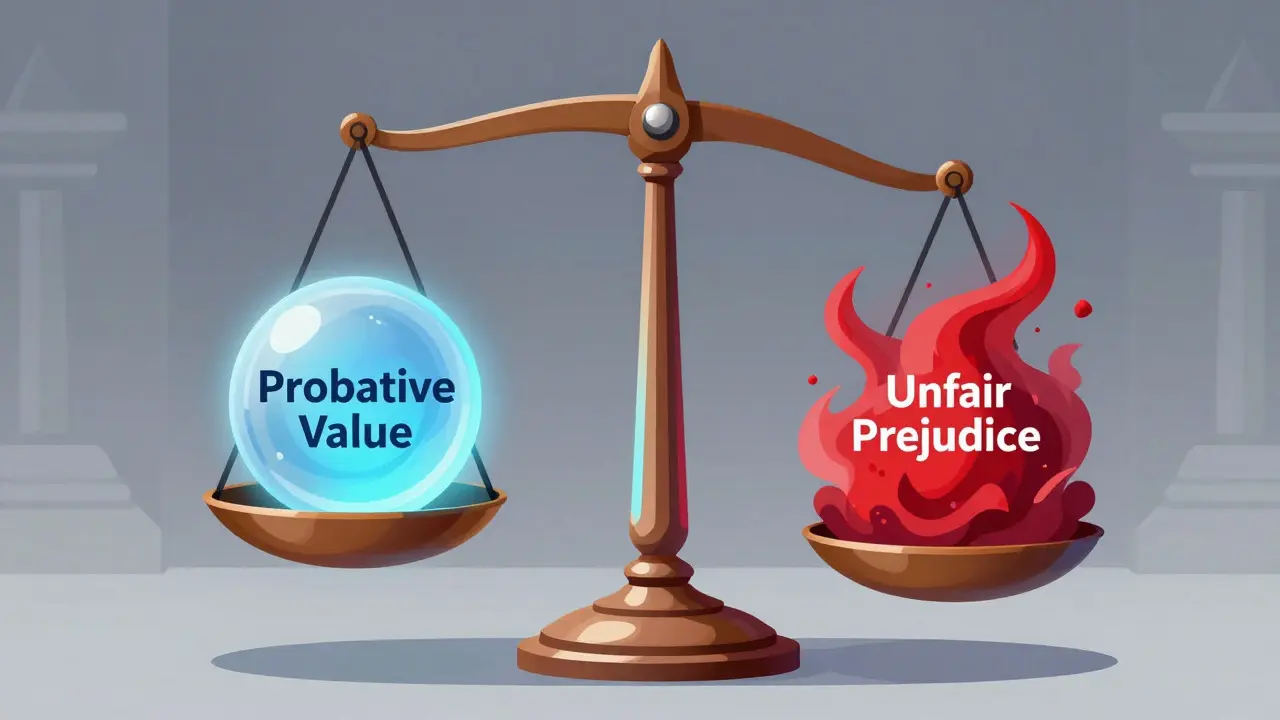
However, relevance is the floor, not the ceiling. Rule 403 acts as the gatekeeper. It allows a judge to exclude relevant evidence if its probative value is substantially outweighed by the danger of one or more specific harms. These harms include:
- Unfair prejudice
- Confusing the issues >Misleading the jury
- Undue delay
- Waste of time
- Needlessly presenting cumulative evidence
The key phrase here is "substantially outweighed." This is a high bar for exclusion. If the evidence is slightly prejudicial but very helpful in proving guilt or innocence, it usually stays. Exclusion happens when the emotional impact or confusion significantly distorts the jury’s ability to weigh the facts objectively.
Defining Unfair Prejudice in Practice
Many people assume "unfair prejudice" means bias against the defendant. While that can happen, the legal definition is broader and more specific. It refers to the tendency of evidence to provoke an emotional response in the jury that leads them to decide the case on gut feeling rather than logical deduction from the facts presented.
Consider a murder trial where the victim was a child. Showing a video of the child playing happily with their parents two weeks before death is highly relevant to establishing identity and relationship. However, if the video is long, overly sentimental, and shown repeatedly, the jury might become so emotionally invested in the loss that they convict based on sympathy rather than forensic proof. That is unfair prejudice.
Conversely, showing the crime scene photos is often considered having high probative value because they show the physical state of the body and the environment. Unless the photos are grotesquely detailed without adding new factual information beyond what a witness described, they typically survive a Rule 403 challenge.
How Judges Perform the Balancing Test
Judges don’t use a mathematical formula. Instead, they apply a qualitative assessment based on precedent and the specific context of the trial. The process generally follows these steps:
- Identify the Purpose: What exactly is the party trying to prove with this evidence? Is it to show motive, intent, identity, or a pattern?
- Assess Probative Value: How strong is the connection between the evidence and the fact it seeks to prove? Is it direct proof or circumstantial? Does it fill a gap in the narrative?
- Identify the Danger: What specific harm could result? Will the jury get stuck on a single dramatic detail? Will they be confused by complex timelines?
- Weigh the Scales: Does the danger *substantially* outweigh the value? If the value is high, the prejudice must be severe to trigger exclusion. If the value is low, even mild prejudice can lead to exclusion.
This discretion is broad. Appellate courts rarely overturn a trial judge’s decision to admit or exclude evidence under Rule 403 unless the ruling was an "abuse of discretion." This means the trial judge has significant leeway to manage the flow of the trial and protect the integrity of the verdict.
Common Scenarios Where Rule 403 Applies
Certain types of evidence frequently land in the gray area of Rule 403. Here are three common examples that illustrate how the balancing act plays out in real courtrooms.
1. Prior Bad Acts (Character Evidence)
Generally, you can’t bring up a defendant’s past crimes to suggest they committed the current one. This is governed by Rule 404(b). However, if the prior acts are similar enough to suggest a unique modus operandi or plan, they might be admissible. But even then, Rule 403 kicks in. If the prior acts are too shocking or distant in time, the jury might think, "He did it before, so he must have done it again," ignoring the specific evidence of the current charge. In such cases, judges often issue limiting instructions, telling the jury to consider the evidence only for a specific purpose (like motive) and not as character proof. If the instruction seems insufficient to curb the prejudice, the evidence may be excluded entirely.
2. Expert Testimony on Causation
In personal injury or medical malpractice cases, experts often testify about cause. Sometimes, an expert’s testimony relies on assumptions that aren’t fully supported by other evidence. If the expert says, "Based on X, Y happened," but X is disputed, the testimony might be confusing. Under Rule 403, a judge might limit the scope of the testimony to prevent the jury from accepting the expert’s word as absolute truth without scrutinizing the underlying facts. This prevents the "halo effect" where a credible expert’s opinion drags along unsupported conclusions.
3. Cumulative Evidence
If three witnesses testify to the same basic fact-e.g., "The defendant was seen leaving the store at 9 PM"-the third witness’s testimony adds little new information. Its probative value is low because the fact is already established. However, it takes time, which risks boring the jury or causing them to tune out later, more critical testimony. Therefore, the third witness might be excluded under Rule 403 for "needlessly presenting cumulative evidence." This keeps trials efficient and focused on contested issues.
| Evidence Type | Probative Value Factor | Prejudice/Danger Factor | Likely Outcome |
|---|---|---|---|
| Crime Scene Photos | High (shows physical reality) | Medium (graphic nature) | Admitted, possibly with redactions |
| Prior Similar Crimes | Variable (depends on similarity) | High (character inference) | Admitted with limiting instruction or Excluded |
| Third Witness on Same Fact | Low (redundant) | Low-Medium (waste of time) | Excluded |
| Emotional Victim Statement | Medium (identity/context) | High (sympathy appeal) | Admitted if brief, Excluded if prolonged |
Strategies for Attorneys Navigating Rule 403
For lawyers, mastering Rule 403 is about presentation as much as substance. You can increase the likelihood of your evidence being admitted by framing it correctly during pre-trial motions and cross-examinations.
- Offer Specific Foundation: Don’t just say "this proves guilt." Explain exactly what fact it proves. The more specific the probative purpose, the easier it is for the judge to see the value.
- Propose Limiting Instructions: If the evidence is potentially prejudicial, proactively suggest a clear instruction to the jury. This shows the judge you are managing the risk, making them more comfortable admitting the evidence.
- Prepare for Objections: Anticipate the opposing counsel’s Rule 403 argument. Have a backup plan if the judge excludes the primary exhibit. Maybe a document summary is less prejudicial but still conveys the same core fact.
- Use Demonstratives Wisely: Complex data can be confusing. Simplifying charts or diagrams can reduce the danger of misleading the jury, thereby increasing the net probative value relative to the danger of confusion.
Conversely, if you are objecting to evidence, focus on the specific harm. Saying "it’s unfair" is weak. Saying "this video will cause the jury to base their verdict on sympathy for the victim rather than the DNA match" is a stronger Rule 403 argument because it identifies the mechanism of prejudice.
Appellate Review and Standard of Care
If a party disagrees with the judge’s ruling on Rule 403, they can raise it on appeal. However, winning on appeal is difficult. The standard of review is "abuse of discretion." This means the appellate court asks: Did the trial judge consider the relevant factors? Was the decision within the range of reasonable choices? If yes, the ruling stands, even if the appellate judges might have made a different choice.
This deference exists because trial judges are in the best position to gauge the jury’s reaction in real-time. They see the faces in the gallery, hear the tone of the room, and understand the local context. Appellate judges work from a cold record. Therefore, preserving the error on appeal requires a timely objection at trial, clearly stating the Rule 403 basis for the objection.
Frequently Asked Questions
Does Rule 403 apply to all types of evidence?
Yes. Rule 403 applies to any relevant evidence, whether it is documentary, testimonial, demonstrative, or physical. The balancing test is universal across all forms of proof in federal and most state court systems.
What is the difference between 'prejudice' and 'unfair prejudice'?
All relevant evidence has some degree of prejudice because it favors one side over the other. 'Unfair' prejudice specifically refers to an emotional or psychological distortion that prevents the jury from weighing the evidence logically. It is not about who wins, but about how the decision is reached.
Can a judge exclude evidence that is clearly true?
Can a judge exclude evidence that is clearly true?
Yes. Truthfulness is not the only criterion for admissibility. If a true fact is so inflammatory or confusing that it hinders the fair resolution of the case, a judge can exclude it under Rule 403. The goal is a fair trial, not necessarily a complete transcript of every true fact known.
How do limiting instructions help with Rule 403 issues?
Limiting instructions tell the jury to consider evidence only for a specific purpose (e.g., to show intent, not character). By narrowing the lens through which the jury views the evidence, the judge reduces the danger of unfair prejudice, often allowing the evidence to be admitted despite its potentially distracting nature.
Is Rule 403 the same in state and federal courts?
Most states have adopted rules modeled on the Federal Rules of Evidence, including a version of Rule 403. While the wording may vary slightly, the core concept of balancing probative value against dangers like unfair prejudice is consistent across jurisdictions in the United States.