Imagine you’re reviewing a case file where the only clue to how an injury occurred is a smear on the floor. If the report says "smear present," you’re stuck guessing. But if it details the directionality, velocity, and surface interaction, you can reconstruct the event. This is the core challenge in bloodstain pattern analysis: translating complex physical phenomena into a narrative that holds up in court and makes sense to investigators who aren’t experts in fluid dynamics.
The goal isn’t just to document what happened; it’s to communicate *how* we know it happened. Poor reporting leads to ambiguity, which leads to defense challenges, wasted lab time, and sometimes, missed leads. Let’s break down how to create reports that are visually precise and linguistically unambiguous.
Why Clarity Matters in Forensic Documentation
In the field of forensic science, the report is the final product. The examiner does the work, but the report does the talking. When dealing with bloodstains, the margin for error is slim because these patterns are often transient or destroyed during cleaning. Your written record becomes the permanent truth.
Clear language serves two audiences: the investigator who needs to understand the implications for their search strategy, and the jury who needs to understand the scientific basis without getting lost in jargon. If you use terms like "passive drip" without defining the context, you risk misinterpretation. Precision reduces cognitive load. It allows the reader to focus on the significance of the finding rather than decoding the terminology.
The Power of Visual Evidence
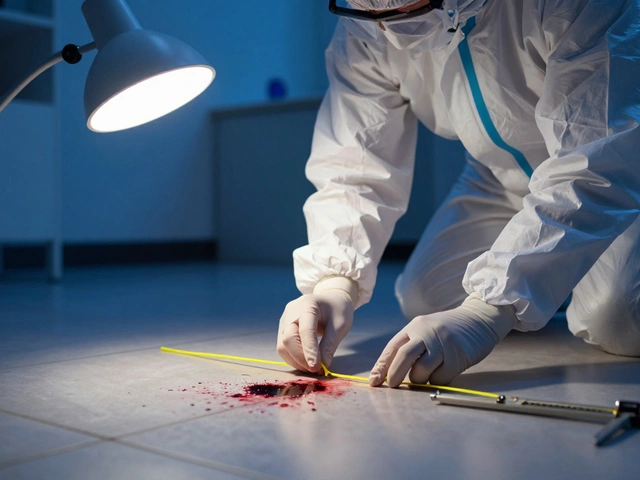
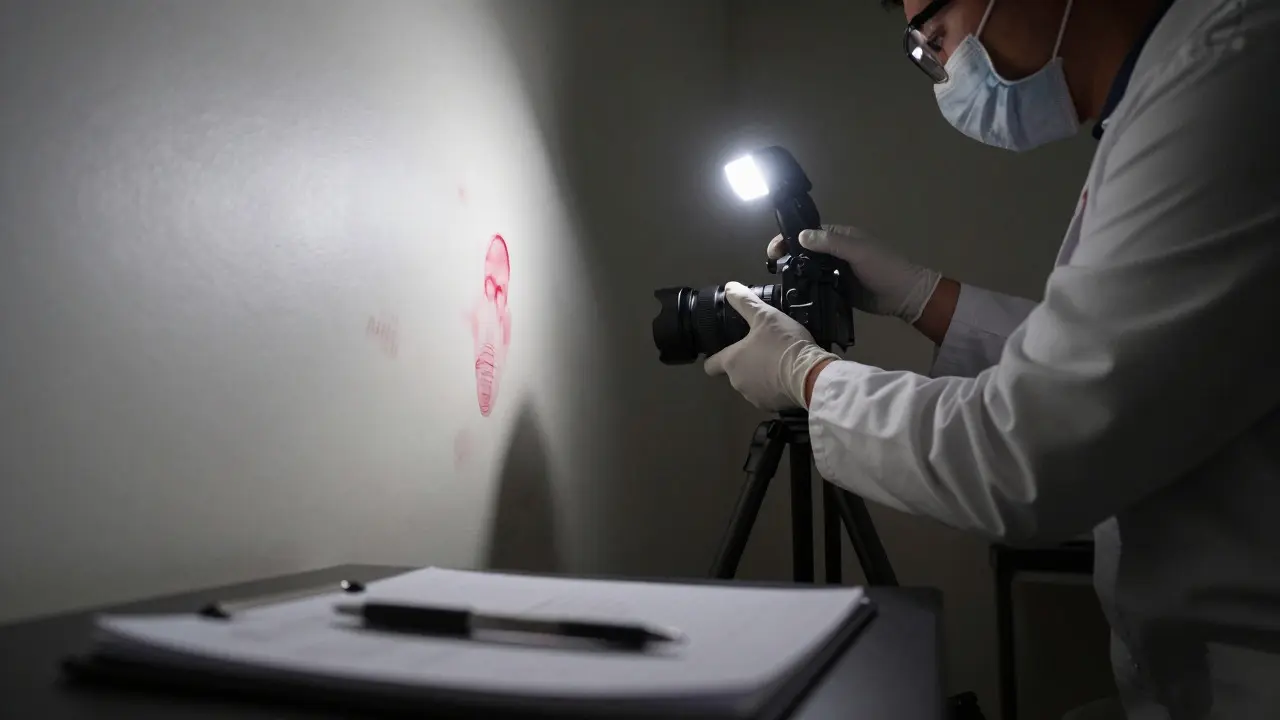
A photo is worth a thousand words, but only if it’s taken correctly. In BPA, visual documentation is not optional; it is the primary data source. However, many reports fail because they rely on generic photos that lack context.
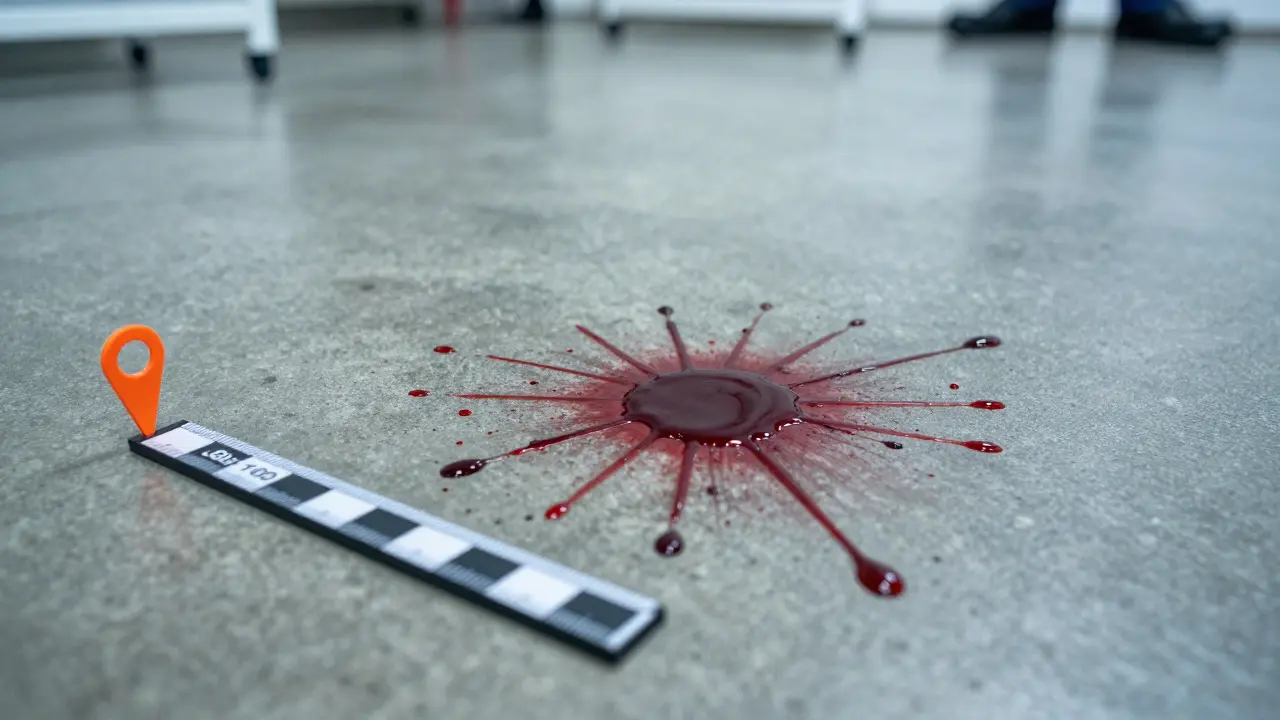
- Scale is non-negotiable: Every close-up shot must include a standard scale bar (like a LRU-100) placed in the plane of the stain. Without it, you cannot verify dimensions later.
- Orientation matters: Use a camera position indicator or a distinct marker to show the angle of the lens relative to the surface. A stain viewed from above looks different than one viewed from the side due to perspective distortion.
- Context shots: Before zooming in, take wide-angle shots showing the stain’s relationship to furniture, walls, and other evidence. This helps establish the trajectory and origin.
When writing the report, reference these specific photos by number. Instead of saying "there was a spatter near the bed," say "see Photo 45, which shows a high-velocity impact spatter cluster located 12 inches from the headboard, with a scale bar indicating individual drops ranging from 1mm to 3mm." This anchors your text to verifiable visual proof.
Mastering Descriptive Language
Language in forensic reports should be objective, specific, and standardized. Avoid subjective adjectives like "large," "small," "messy," or "clean." These terms mean different things to different people. Instead, use measurable descriptors.
Here is a quick comparison of weak versus strong phrasing:
| Aspect | Ambiguous Phrasing | Precise Phrasing |
|---|---|---|
| Size | Large blood pool | Elliptical pool measuring 15cm x 8cm |
| Pattern Type | Spattered blood | Medium-velocity impact spatter with elongated droplets |
| Location | Near the door | Located 2.5 feet from the left door frame, at a height of 36 inches |
| Condition | Fresh blood | Non-dried, wet blood exhibiting no coagulation |
Standardized terminology comes from organizations like the International Association for Identification (IAI). Using their glossary ensures that when you write "impact spatter," every reader understands the exact physical mechanism involved. It removes guesswork and aligns your findings with national standards.

Structuring the Report for Logical Flow
A good BPA report follows a logical narrative arc. It shouldn’t just be a list of stains; it should tell the story of the event. Here is a recommended structure:
- Scene Overview: Briefly describe the environment, lighting conditions, and any potential contamination risks. This sets the stage for reliability.
- Methodology: State that you used standard BPA techniques, including photography, measurement, and geometric analysis. Mention any tools used, such as protractors or digital analysis software.
- Findings by Area: Break down the report by room or zone. For each area, describe the stains, their types, and their measurements. Group related stains together (e.g., all transfer patterns in the kitchen).
- Analysis and Interpretation: This is where you connect the dots. Explain how the directionality lines converge to form an area of convergence and, subsequently, an area of origin. Discuss the force applied based on drop size and shape.
- Conclusion: Summarize the likely sequence of events. Be careful to distinguish between fact (what you measured) and opinion (what it means). Use phrases like "consistent with" or "suggests" rather than absolute statements unless the evidence is irrefutable.
This structure helps the reader follow your logic step-by-step. It mirrors the way you actually analyzed the scene, making it easier for them to validate your conclusions.
Common Pitfalls to Avoid
Even experienced examiners make mistakes in reporting. Here are the most common traps and how to dodge them:
- Over-interpreting single stains: One small dot doesn’t prove a gunshot. Look for clusters and patterns before drawing conclusions. Always state the limitation if the sample is sparse.
- Ignoring background surfaces: Porous vs. non-porous surfaces affect stain appearance. Note the material (carpet, tile, wood) as it influences absorption and edge definition.
- Mixing facts and opinions: Keep them separate. "The stain is 2cm long" is a fact. "The stain indicates a swing from left to right" is an interpretation. Label them clearly.
- Poor grammar and typos: They undermine credibility. Run your report through a spell-checker and have a colleague review it for clarity. A typo in a critical measurement can be disastrous.
Enhancing Credibility with Specifics
Credibility in court comes from specificity. Vague reports invite cross-examination attacks. Specific reports withstand scrutiny. For example, instead of saying "the blood was thrown backward," say "the bloodstains exhibit a tail pointing toward the north wall, indicating a forward vector of travel consistent with a blow to the chest while facing south."
Include calculations where applicable. If you determined the area of origin using trigonometry, briefly mention the angle of impact and the stringing method used. You don’t need to show every calculation step, but acknowledging the mathematical basis adds weight to your opinion.
Also, consider the timeline. Did the stains dry? Was there secondary movement? Documenting the state of the blood (wet, drying, dried) helps establish the timing of events relative to other actions in the scene.
Final Thoughts on Effective Communication
Reporting bloodstain findings is less about being a scientist and more about being a translator. You are translating the silent language of fluids into the spoken language of justice. By combining high-quality visuals with precise, standardized language, you create a report that is not only scientifically sound but also accessible and persuasive.
Remember, the best report is the one that requires no clarification. If an investigator reads your findings and immediately knows where to look next, you’ve done your job. If a juror reads your conclusion and understands why it happened, you’ve succeeded. Aim for that level of clarity in every single case.
What is the difference between passive drips and impact spatter?
Passive drips occur when blood falls under gravity alone, typically resulting in round or slightly elliptical stains. Impact spatter occurs when an external force strikes a blood source, creating smaller, often elongated droplets that indicate directionality and velocity.
How important is the scale bar in bloodstain photography?
It is critical. Without a scale bar in the same plane as the stain, you cannot accurately measure the dimensions of the bloodstain from the photograph. This makes it impossible to verify size-based interpretations later in the lab or during trial.
Should I use technical jargon in my BPA report?
Use standardized technical terms, but define them if they are complex. Avoid colloquial slang. The goal is precision, not obscurity. Terms like "area of convergence" are acceptable if they are part of the recognized glossary, but ensure the context makes their meaning clear.
How do I handle ambiguous bloodstain patterns in a report?
Acknowledge the ambiguity explicitly. State what the pattern could represent based on the available evidence, list alternative hypotheses, and explain why one might be more likely than others. Honesty about limitations strengthens credibility.
What role does surface type play in bloodstain interpretation?
Surface texture and porosity significantly affect stain morphology. Porous surfaces absorb blood, blurring edges and reducing visible detail. Non-porous surfaces retain sharper edges and may show satellite spatter more clearly. Always document the surface material.