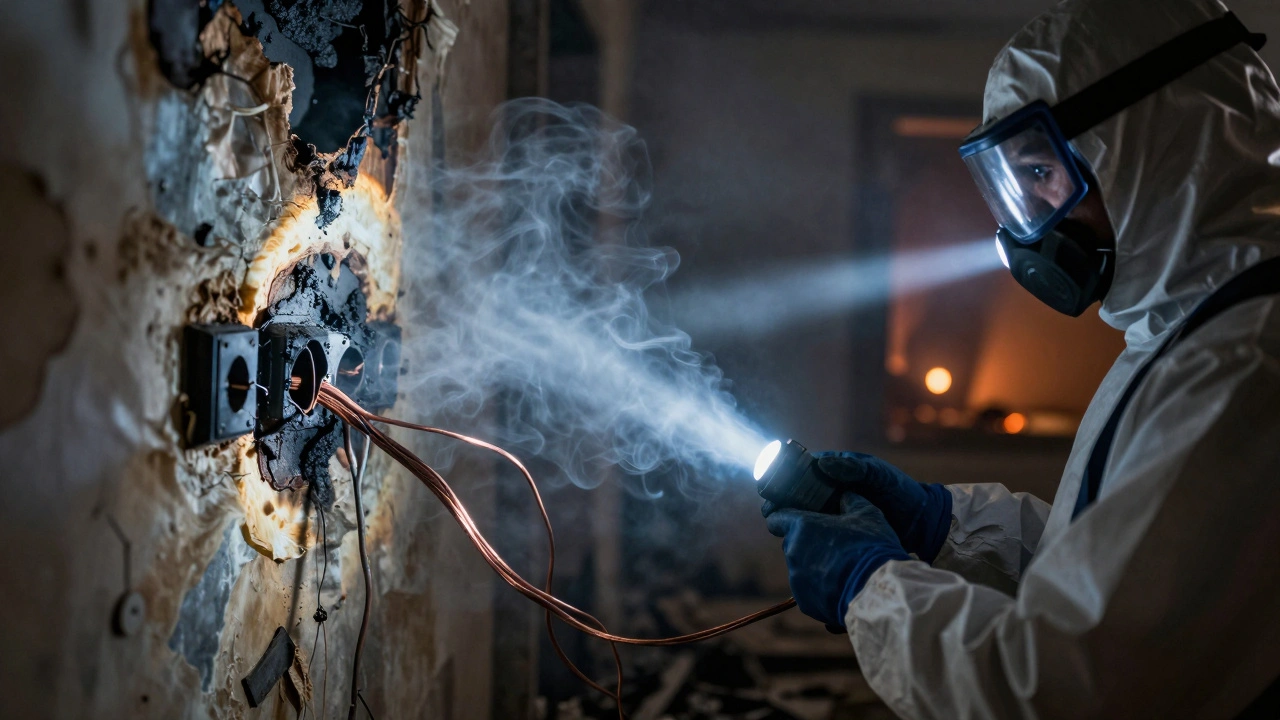
Walking into a burned building, you see melted copper wires and blackened outlets. It’s tempting to immediately blame the electricity. But here is the hard truth: just because a wire is damaged doesn’t mean it started the fire. In fact, decades of research show that investigators have historically over-attributed fires to electrical causes simply because wiring was present in the area of origin. To get it right, you need more than a visual inspection; you need a rigorous forensic process.
Electrical fire investigation is a specialized discipline that applies electrical engineering principles and forensic science to determine if electricity caused a fire. It relies heavily on standards like NFPA 921, the guide for fire and explosion investigations. This isn't about guessing; it's about proving whether an electrical fault existed before the flames took hold or if the heat from the fire simply destroyed the wiring.
The Scientific Method in Fire Origin
You cannot jump straight to looking at breakers. The first step is always establishing the area of origin using traditional fire pattern analysis. You look for V-patterns, depth of char, and ventilation clues. Only after you know where the fire started do you ask what started it.
If the origin points to an electrical device, you then apply the scientific method outlined in NFPA 921. This involves collecting data, developing hypotheses, and testing them. For example, if you hypothesize that a loose connection caused overheating, you must find physical evidence of high-resistance heating that predates the main body of the fire. If the evidence only shows damage consistent with exposure to flame, your hypothesis fails. This disciplined approach prevents false conclusions that can ruin insurance claims or lead to wrongful lawsuits.
Distinguishing Cause from Effect
The biggest trap in this field is confusing pre-fire electrical damage with post-fire thermal damage. When a room burns at 1,000 degrees Fahrenheit, everything melts-including live circuits. So how do you tell the difference?
- Internal vs. External Heating: If a wire overheated due to current flow (internal), the insulation often shows uniform discoloration or bubbling along its entire energized length. If it melted from the fire (external), you’ll see "shadowing"-areas protected by clamps or walls remain intact while exposed sections are destroyed.
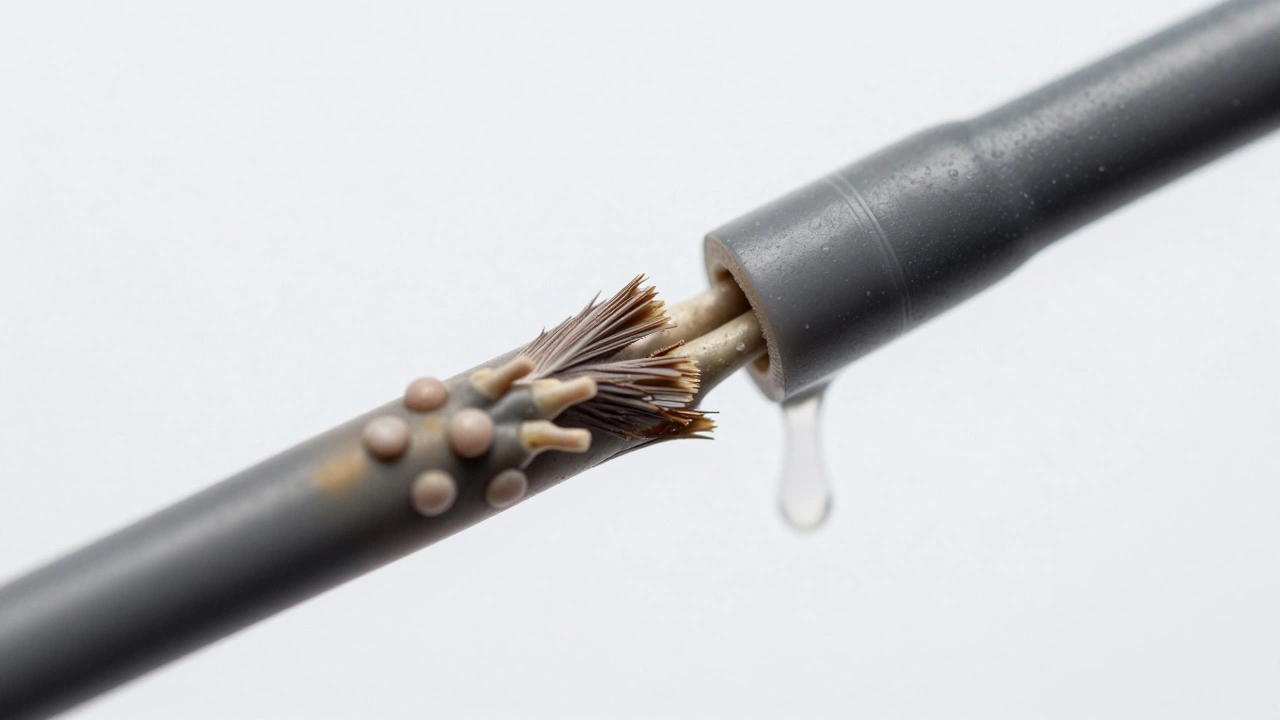
- Arc Beads: True arcing creates sharp, spherical beads with dendritic (feathered) edges visible under magnification. Post-fire melting creates smooth, gravity-driven drips without these striations.
- Conductor Condition: Look for fraying or improper installation that suggests a pre-existing defect, rather than clean breaks caused by structural collapse during the fire.
Remember, finding a bead on a wire is not proof of causation on its own. Laboratory tests have shown that non-energized conductors can form similar beads when exposed to intense flame and mechanical disturbance. You need corroborating evidence.
Common Electrical Ignition Mechanisms
When electricity does start a fire, it usually happens through one of four specific mechanisms. Understanding these helps you know what to look for.
- Overcurrent and I²R Heating: When current exceeds a conductor’s ampacity, resistive heating occurs. For example, running 20 amps through a 14 AWG wire (rated for 15 amps) generates heat proportional to the square of the current ($P = I^2R$). This can melt insulation and ignite nearby combustibles.
- High-Resistance Connections: Loose terminal screws, corroded lugs, or poor crimps create localized hot spots. A loose connection in a standard 15-amp circuit can reach temperatures above 400°C, easily igniting dust or wood.
- Arc Faults: Series arcs (in line with the load) and parallel arcs (between conductors) produce plasma columns exceeding 5,000°C. These can ignite materials instantly. Standard breakers often fail to trip on series arcs because the current may stay below the breaker’s rating.
- Equipment Failures: Motor winding shorts, transformer failures, or power supply faults can overheat internal components beyond their design limits, acting as ignition sources.
Arc Mapping: Tracing the Sequence
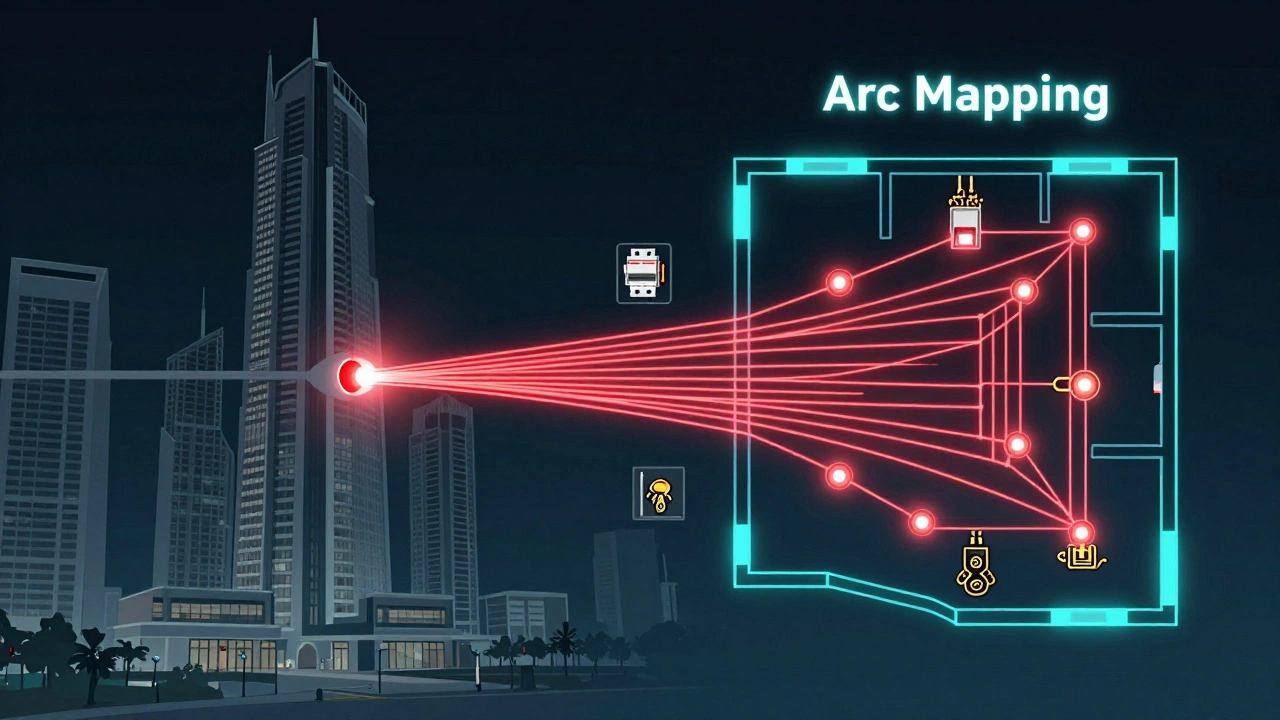
One of the most powerful tools in your kit is Arc mapping. This technique involves systematically documenting every electrical arc site and conductor damage throughout the scene. You plot these locations on a plan view or 3D diagram.
Why does this matter? Because arcs happen in sequence. The earliest arcs are usually near the initial fuel source-the true point of origin. Later arcs occur as the fire spreads and compromises other wiring runs. By mapping them, you can reconstruct the timeline of electrical events relative to the fire spread. However, be cautious: arcs can also be produced secondarily by structural collapse or firefighter activity. Context is king.
Role of Protective Devices
Circuit breakers and fuses provide critical clues, but they require careful interpretation. A tripped breaker alone does not prove the electrical system caused the fire. Intense heat from a fire can cause insulation breakdown, leading to a short circuit that trips the breaker after the fire has already started.
To determine timing, you need to examine the internals of the breaker. Look for contact welding or deformation consistent with high fault currents. Correlate this with witness statements. Did residents hear popping noises or see lights dimming before smoke appeared? If so, the electrical event likely preceded the fire. If the breaker tripped only when firefighters broke down doors or used hoses, it’s likely a secondary effect.
| Indicator | Pre-Fire Electrical Fault | Post-Fire Thermal Damage |
|---|---|---|
| Arc Beads | Sharp, spherical, dendritic edges | Smooth, gravity-driven drips |
| Insulation Damage | Uniform discoloration/bubbling along run | Localized damage with shadowing |
| Connection Points | Localized charring at terminals | Generalized melting of all components |
| Breaker Status | Tripped with signs of internal fault welding | Tripped due to external heat or water exposure |
Advanced Analytical Tools
When visual inspection isn’t enough, you turn to the lab. Modern investigations use several advanced techniques to confirm findings:
- Stereomicroscopy: Initial assessment at 10-50x magnification to identify arc sites and melting patterns.
- Metallographic Cross-Sectioning: Optical microscopy at 50-200x reveals grain structure and oxide layers characteristic of arcing versus bulk melting.
- Scanning Electron Microscopy (SEM): Combined with Energy-Dispersive X-ray Spectroscopy (EDS), this analyzes elemental composition of beads and surface oxides.
- Hardness Testing: Quantifies overheating in copper or aluminum conductors, showing if the metal was subjected to extreme temperatures before the fire.
These methods can cost hundreds to thousands of dollars per case, but they provide definitive evidence that holds up in court. They help distinguish between beads formed during live arcing and those formed during post-fire melting.
Challenges and Best Practices
Electrical fire investigations are complex. Cases involving industrial facilities can require 40 to 200 hours of work, including circuit tracing and lab analysis. One major challenge is incomplete scene preservation. Firefighters and contractors often remove panels or appliances before investigators arrive, destroying critical evidence.
To mitigate this, document everything early. Use 3D laser scanning and photogrammetry to capture the scene digitally. Also, recognize the limitations of your expertise. If you lack access to specialized lab analysis or electrical engineering support, consult experts. Over-attributing fires to electrical causes based on limited evidence can obscure real hazards like smoking materials or open flames, misdirecting prevention efforts and legal accountability.
Finally, stay updated with code changes. The National Electrical Code (NEC) continues to expand requirements for Arc-Fault Circuit Interrupters (AFCIs). Understanding where AFCIs were required and installed helps you evaluate whether a failure was due to equipment malfunction or code violation.
Can a tripped circuit breaker prove that an electrical fault started the fire?
No, a tripped breaker alone is not proof of causation. Breakers can trip due to the heat of the fire causing insulation breakdown and subsequent short-circuiting. To infer causation, you must examine the breaker’s internals for signs of pre-fire fault currents (like contact welding) and correlate this with witness testimony regarding pre-fire symptoms like flickering lights or popping noises.
What is the difference between a series arc and a parallel arc?
A series arc occurs in line with the load, such as at a loose connection, and may not trip a standard breaker because the current stays low. A parallel arc occurs between two conductors or between a conductor and ground, typically drawing high current and tripping breakers quickly. Both produce extremely high temperatures capable of igniting materials.
How does arc mapping help determine the origin of a fire?
Arc mapping involves plotting all electrical arc sites on a diagram. Since arcs occur sequentially as the fire spreads, the earliest arcs are typically located near the initial ignition source. This helps narrow down the area of origin by distinguishing primary arcs from secondary arcs caused by later fire damage or structural collapse.
Why is it important to distinguish between internal and external heating of wires?
Internal heating indicates that current flowed through the wire before the fire, suggesting an electrical fault. External heating results from the fire itself burning the wire. Internal heating often shows uniform damage along the wire’s length, while external heating shows localized damage with "shadowing" where objects shielded the wire from direct flame.
What role do laboratory analyses play in electrical fire investigations?
Laboratory analyses, such as SEM/EDS and metallography, provide microscopic evidence to distinguish between pre-fire electrical arcing and post-fire melting. They analyze grain structures and elemental compositions of arc beads, offering definitive proof that supports or refutes hypotheses formed during scene investigation.