
When a medical record is disputed, a financial transaction is questioned, or a legal document is challenged, the truth doesn’t just live in the content-it lives in the metadata and the audit trail. These aren’t fancy IT buzzwords. They’re the digital fingerprints and time-stamped logbooks that tell you who did what, when, and why. In forensic reporting, where evidence must hold up in court or during regulatory scrutiny, missing or weak metadata can mean the difference between a case being proven or dismissed.
What Metadata Really Does in Electronic Reports
Metadata isn’t just ‘data about data.’ It’s the backbone of trust. Think of it like the label on a crime scene photo: it doesn’t show the bloodstain, but it tells you exactly where the photo was taken, who took it, what time, and which device was used. In electronic reports-whether they’re patient records, financial statements, or lab results-metadata includes:
- Descriptive metadata: Who created the file? What’s the title? When was it last modified?
- Administrative metadata: Who accessed it? Was it shared? Was there a chain of custody?
- Structural metadata: How does this report connect to other files? Is it part of a larger case file or linked to lab data?
For example, in an Electronic Medical Record (EMR) system like Epic, each clinical note carries over 17 metadata fields. That includes the provider’s unique ID, the exact time the note was saved, the IP address used, and even the version history showing edits. Without this, you can’t prove a note was written by Dr. Lee-or that it was altered after the fact.
Audit Trails: The Unbreakable Log
An audit trail is what happens when metadata gets logged with precision. It’s not a simple access log that says ‘user opened file.’ Real audit trails capture:
- User ID: Not ‘John,’ but ‘JL-4821-EMP,’ tied to a specific employee in Active Directory.
- Timestamp: To the millisecond. Not ‘around 3 PM,’ but ‘2026-02-05T14:32:18.742Z’.
- Action: Did they view, edit, delete, or print? ‘Deleted’ is different from ‘modified’-and both matter.
- Context: What did the data look like before and after? If a patient’s dosage was changed from 10mg to 50mg, the trail shows the original value.
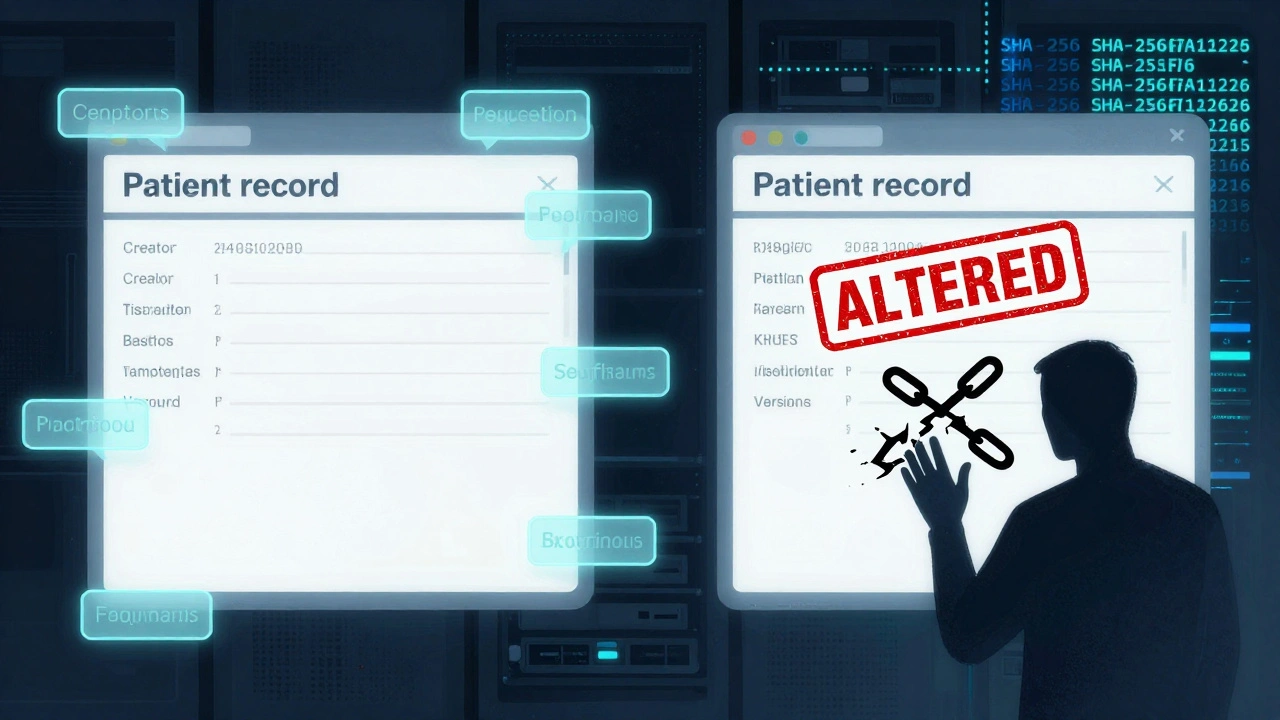
According to NIST SP 800-92, audit trails must be tamper-evident. That means they’re protected with cryptographic hashing-usually SHA-256. If someone tries to alter the log, the hash changes, and the system flags it as compromised. This isn’t optional in healthcare or finance. FDA 21 CFR Part 11 and HIPAA require it.
Why They Work Together
Metadata without an audit trail is like having a fingerprint but no camera recording the crime. You know who touched it, but you don’t know when or how. An audit trail without rich metadata is like having a security camera with no labels-you see someone entering a room, but you don’t know whose room it was or what they did inside.
Dr. Jane Smith from NIST put it plainly: “Metadata without audit trails creates blind spots in data provenance, while audit trails without rich metadata lack contextual understanding necessary for meaningful analysis.” In forensic investigations, context is everything. A doctor accessing a patient’s record at 2 a.m. might be routine-if they’re on call. But if that same access happened after the patient filed a complaint, and the record was altered 12 minutes later? That’s a red flag. Only when metadata and audit trails are linked can you tell that story.
Real-World Impact: Cases That Hinged on Audit Trails
It’s not theoretical. In 2023, a hospital in Oregon faced a malpractice lawsuit after a patient claimed their surgical consent form was signed without their knowledge. The EMR audit trail showed:
- The form was generated on January 12, 2026, at 10:15:03 AM.
- It was electronically signed by the patient at 10:22:17 AM via a tablet in the pre-op room.
- Two minutes later, the attending physician accessed the file and added a note confirming verbal consent.
- No one else accessed it until the lawsuit was filed.
The defense team pulled this log into court. The case was dismissed within 48 hours. No witnesses needed. Just the trail.
Another case in a financial firm involved a $2.3 million wire transfer flagged as fraudulent. The audit trail showed:
- The transaction was initiated by an employee with proper credentials.
- The approval came from a manager whose credentials were compromised-but the system flagged the login as anomalous because it came from a different city.
- The metadata showed the manager’s last login was 48 hours earlier in Portland. This one came from a public library in Boise.
The fraud was caught before funds left the country. The audit trail didn’t just prove misconduct-it proved how it happened.
How Organizations Get It Right
Successful implementations follow three steps:
- Define your metadata standards. Use ISO 15489-1:2016 as a baseline. Decide which fields are mandatory for every report: creator, timestamp, version, location, access level.
- Configure audit parameters. Don’t log everything. Log the critical actions: creates, edits, deletes, exports, and access from unusual locations or times. 94% of successful implementations capture at least 12 metadata elements per document.
- Integrate with identity systems. Your audit trail is only as good as your user IDs. If you’re using Active Directory or LDAP, make sure every login is tied to a real person-not a shared account.
Storage is a common surprise. Audit trails can grow 15-20% faster than your primary data. A hospital with 50,000 patient records might need 12 terabytes of audit storage-not because they’re storing files, but because they’re logging every click. Time-series databases like InfluxDB or purpose-built platforms like Immuta handle this better than traditional SQL servers.

What Goes Wrong
Most failures come from three mistakes:
- Using access logs instead of audit trails. An access log says ‘user X opened file.’ An audit trail says ‘user X opened file, copied the content, emailed it to an external address, then deleted the original.’ One is a summary. The other is a narrative.
- Not isolating audit data. If audit logs are stored on the same server as your main data, a hacker who breaches your system can delete both. Best practice: store logs on a separate, write-once system with read-only access.
- Ignoring anomalies. If a user logs in 20 times in 30 seconds from three different countries, your system should alert you. NIST recommends setting alerts for behavior that’s more than 5 standard deviations from the norm.
One financial services firm skipped the anomaly detection because ‘it was too noisy.’ Six months later, an insider stole client data over 11 months. The audit trail was there-but no one looked at it. They paid a $4.2 million fine.
The Future: AI and Blockchain
By 2027, 65% of audit systems will use AI to predict risks before they happen. Microsoft’s Purview now analyzes 2.3 million audit events per hour to spot patterns humans miss-like a user who suddenly downloads 10x more files than usual, or accesses records outside their job role.
Blockchain is also making headway. IBM’s patent for an immutable audit trail uses distributed ledger tech to create a timestamped record that can’t be altered, even if your internal system is hacked. This matters most in cross-organizational cases-like when a hospital shares records with a lab and a insurer. Each party gets a verified copy.
And regulation is catching up. The European Commission’s Data Governance Act, effective January 1, 2026, now requires immutable audit trails and comprehensive metadata for all public sector data exchanges. If you’re handling data from Europe, you’re already under this rule.
Where You Stand Today
68% of Fortune 500 companies have full systems in place. But only 32% of mid-sized businesses do. It’s not because they don’t see the value-it’s because they think it’s too expensive or too complex. The truth? The cost of not having it is far higher.
Organizations with full metadata and audit trail systems see:
- 63% faster incident response times
- 41% fewer compliance penalties
- 78% reduction in internal data tampering (per hospital case studies)
If you’re in healthcare, finance, legal, or law enforcement-this isn’t a nice-to-have. It’s your first line of defense.
What’s the difference between an audit trail and an access log?
An access log only records that someone opened or viewed a file. It doesn’t show what they did. An audit trail records every action: who made a change, what changed, when, and what the data looked like before and after. For example, an access log might say ‘user edited report.’ An audit trail says ‘user J.L. modified Section 3 on January 10 at 14:22:08, changing the dosage from 5mg to 15mg, and added a note explaining the change.’ Only the audit trail gives you forensic value.
Do I need to log every single action?
No. Logging everything creates too much noise and storage cost. Focus on high-risk actions: creates, edits, deletes, exports, prints, and access from unusual locations or times. For most organizations, capturing 10-15 key events per document is enough for compliance and forensic use. NIST recommends prioritizing actions that affect data integrity or legal standing.
Can audit trails be tampered with?
If they’re not built properly, yes. But modern systems use cryptographic hashing (SHA-256) and write-once storage. Once a log entry is written, it can’t be altered without breaking the hash. If someone tries, the system flags it. Regulatory standards like FDA 21 CFR Part 11 and ISO/IEC 27001 require this tamper-evidence. If your system doesn’t have it, it’s not compliant.
How much storage do audit trails need?
Plan for 15-20% more storage than your primary data volume. For example, if you have 10 terabytes of patient records, expect 1.5-2 terabytes of audit logs. Time-series databases handle this efficiently. Some organizations use tiered storage: recent logs on fast SSDs, older logs on cheaper tape or cloud storage. The key is never to delete logs before your legal retention period ends-usually 6-7 years in healthcare and finance.
What if my system doesn’t support audit trails?
You’re at serious risk. If your EMR, accounting software, or document system can’t generate detailed audit trails, you’re relying on manual logs or memory-which won’t hold up in court or during an audit. The fix isn’t always a full system swap. Many vendors offer add-ons or APIs to enable audit trail functionality. If your current system can’t do it, start planning a migration. Regulatory fines and legal liability far outweigh the cost of upgrading.