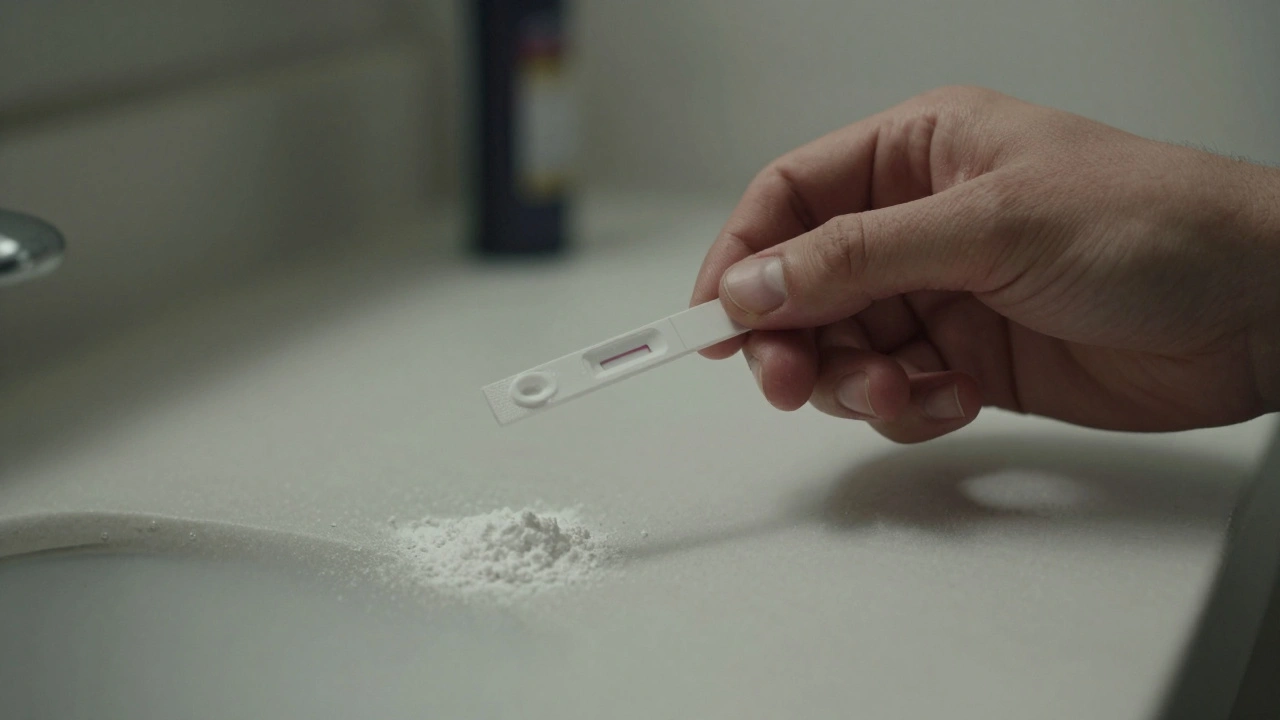
Every year, more than 70,000 people in the U.S. die from overdoses involving synthetic opioids-almost all of them from fentanyl. It’s not just powerful; it’s terrifyingly easy to accidentally ingest. A single grain of powder can kill. And because it’s mixed into heroin, cocaine, meth, or even fake pills that look like Xanax or OxyContin, users often have no idea they’re taking it. That’s where fentanyl detection comes in. But testing for it isn’t as simple as it sounds. Even with tools on the market, the challenges are real, messy, and sometimes deadly.
What Fentanyl Test Strips Can-and Can’t-Do
Fentanyl test strips (FTS) are the most widely used tool for harm reduction. They cost about a dollar each, work in under five minutes, and can detect fentanyl at levels as low as 0.25 micrograms per milliliter. That’s enough to catch contamination in a tiny amount of powder. Companies like BTNX Inc. make these strips, and they’re accurate 96-100% of the time when used correctly. In a 2020 study published in PMC, researchers found they outperformed portable Raman and FTIR devices in sensitivity and specificity.
But here’s the catch: a negative result doesn’t mean safe. Test strips don’t detect all fentanyl analogs. Carfentanil, which is 100 times stronger than fentanyl, often slips through. So does alfentanil and other lesser-known variants. And if your sample has methamphetamine, MDMA, or diphenhydramine-common adulterants-the test can give a false negative. The CDC warns this happens frequently. People think they’re safe because the strip says “no fentanyl,” then use-and overdose.
Another issue? Interpretation. A faint line isn’t always clear. In a 2022 survey of harm reduction programs, 78% of users reported confusion over faint lines. Some thought “barely visible” meant “safe.” Others threw out the whole batch because of a smudged line. Training helps, but most people get a one-page guide, not a full manual. BTNX provides a 12-page instruction sheet. Most community programs don’t.
Portable Spectroscopy: Better, But Not Perfect
Devices like the Thermo Fisher TruScan RM use Raman spectroscopy to analyze drugs without touching them. You can scan through plastic bags, which reduces exposure risk. These machines can even tell the difference between fentanyl and its isomers-like butyryl fentanyl or isobutyryl fentanyl-because each has a unique spectral fingerprint. In 2023, Thermo Fisher published data showing how tiny structural changes create clear, detectable differences.
But sensitivity drops when fentanyl is mixed with other strong substances. A 2019 study at European music festivals found Raman devices identified MDMA and cocaine accurately but missed fentanyl in samples later confirmed positive by test strips. Why? Because fentanyl is often present in tiny amounts-sometimes less than 1% of the total sample. Raman struggles with trace components when they’re drowned out by louder signals.
And cost is a barrier. These devices run $15,000 to $30,000. Training takes 8-16 hours. That’s not practical for street outreach workers or peer educators. They need something cheap, fast, and easy. Raman is great for labs or fixed checkpoints-but not for handing out at a needle exchange.
The Lab-Grade Tools: Accurate, But Not Accessible
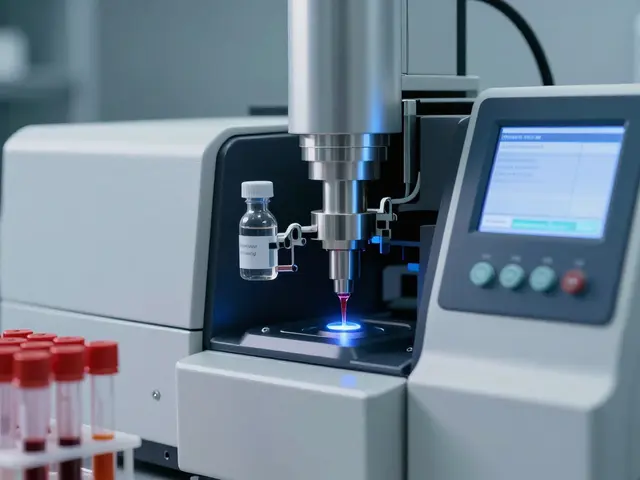
Gas chromatography-mass spectrometry (GC-MS) and liquid chromatography-mass spectrometry (LC-MS) are the gold standard. They can quantify exactly how much fentanyl is in a sample, down to the picogram. They can identify dozens of analogs at once. But they cost $100,000 to $500,000. Each test takes 20-30 minutes. You need trained chemists, clean rooms, and electricity. They’re useless for someone holding a bag of powder on the sidewalk.
Paper spray-mass spectrometry is a promising middle ground. It’s portable, costs $5,000-$10,000, and hits 95% sensitivity. But it’s still mostly in research labs. No commercial version is widely available. The same goes for laser-induced breakdown spectroscopy (LIBS), which Pacific Northwest National Laboratory is testing. It can detect fentanyl from 20 meters away-no contact needed. Phase 2 trials are underway. If it works, it could change how we monitor public spaces. But it’s not ready for 2026.
Legal and Social Barriers Are Just as Dangerous
In 28 states, fentanyl test strips are still classified as “drug paraphernalia.” Possessing one could get you arrested. Even though the 2022 SUPPORT Act allows federal funding for fentanyl test strips, it doesn’t protect state-level enforcement. In places like Texas, Florida, or Tennessee, people are still being ticketed for carrying them.
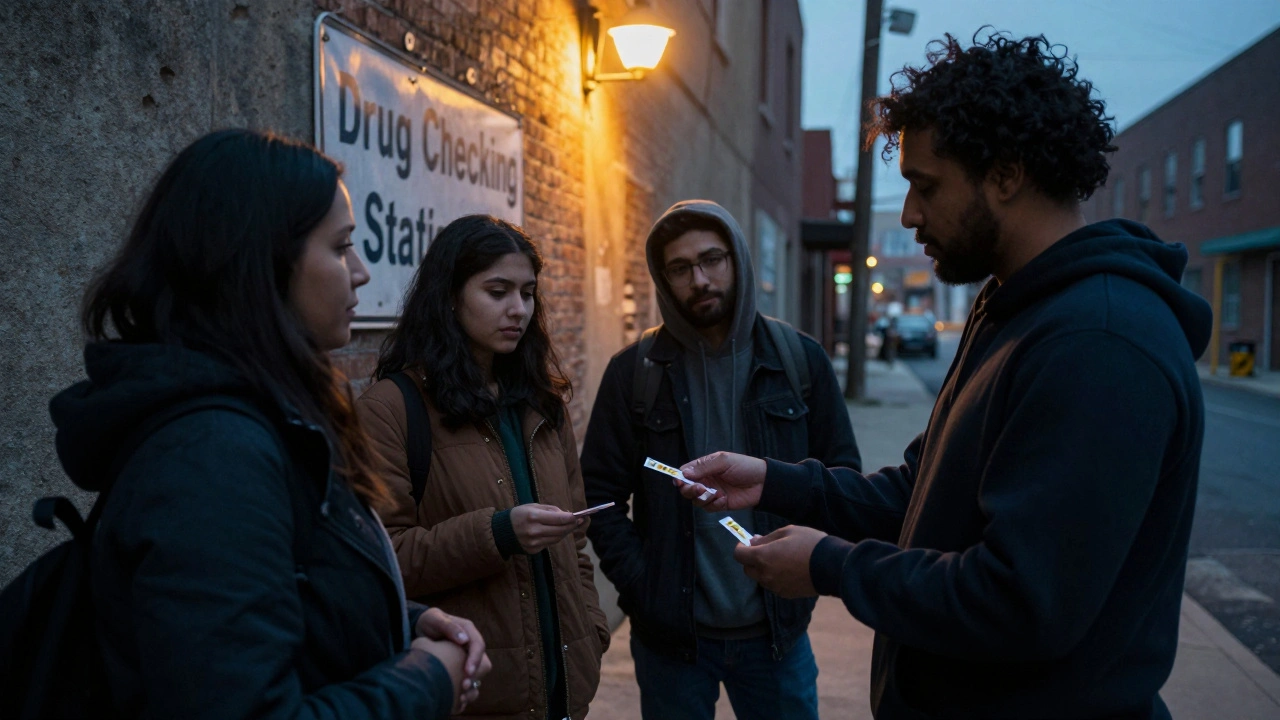
Meanwhile, the market is growing. Over 1.2 million strips were distributed in the U.S. in 2022-up 300% since 2019. Harm reduction programs are expanding. But they’re fighting outdated laws. A 2023 policy brief from the Drug Policy Alliance called for the “Drug Checking Promotion Act,” which would remove legal barriers to all drug checking tools-not just fentanyl strips. So far, it’s stalled in Congress.
And even when people test positive, they often still use. A 2022 study of 1,247 drug users found that 63% changed their behavior after a positive result: used less, didn’t use alone, kept naloxone nearby. But 22% kept using anyway. Why? Because they had no alternative. Addiction doesn’t care about risk. If you’re dependent, and you can’t get clean heroin or pills, you’ll take what’s available-even if you know it’s laced.
The Real Problem: Detection Isn’t Enough
Experts agree: testing tools are lifesaving-but they’re not solutions. Dr. Brandon Marshall from Brown University put it bluntly: “Detection technologies alone cannot solve the overdose crisis.” In Vancouver, an 85% engagement rate with drug checking services only reduced overdose deaths by 12% over three years. Why? Because people still didn’t have safe housing, stable income, or access to treatment.
Testing tells you if fentanyl is there. It doesn’t fix the system that puts it there. It doesn’t replace decriminalization. It doesn’t fund methadone clinics. It doesn’t stop the flow of illicit manufacturing. It’s a bandage on a hemorrhage.
Still, in the absence of better options, test strips save lives. A user in Portland told a harm reduction worker last year: “I tested my pills. Saw the line. I didn’t take them. I called my sister. She drove me to detox.” That’s what this is for. Not to eliminate risk. But to give someone a moment to choose differently.
What’s Next?
Thermo Fisher plans to release a new portable Raman device in late 2024 that can detect 15+ fentanyl analogs with 95% accuracy. NIST is developing standardized reference materials to help calibrate field devices. BTNX announced a dual-strip in October 2023 that detects both fentanyl and xylazine-a new, dangerous sedative now showing up in drug supplies.
But none of this matters if we keep treating users like criminals instead of people in crisis. Until laws change, funding expands, and treatment becomes accessible, detection tools will keep doing what they do: giving people a chance to survive one more day.
Can fentanyl test strips detect all types of fentanyl analogs?
No. Fentanyl test strips are designed to detect fentanyl and some of its common analogs like carfentanil and alfentanil, but they don’t catch every variant. New analogs are constantly being synthesized, and many evade detection because they’re chemically different enough to avoid the antibodies in the test. This is why a negative result doesn’t guarantee safety-especially with methamphetamine or MDMA samples, where false negatives are common.
Why do fentanyl test strips sometimes give false negatives with methamphetamine?
Methamphetamine and similar stimulants like MDMA can interfere with the immunoassay chemistry in test strips. These substances can bind to the test antibodies or alter the chemical environment in the sample, preventing the fentanyl-specific reaction from showing up. The CDC specifically warns that high concentrations of these drugs can mask fentanyl detection. Users are advised to use more sample (at least 10mg) and mix thoroughly with water to reduce interference.
Are portable Raman devices better than test strips for detecting fentanyl?
Not for most users. While Raman devices can identify specific isomers and analyze drugs through packaging, they’re far less sensitive to trace amounts of fentanyl. A 2020 study found fentanyl test strips had 97.5% sensitivity, while portable Raman devices only reached 85.3%. Raman also requires expensive equipment and hours of training. Test strips are cheaper, faster, and more accurate for detecting low-concentration contamination-making them the better tool for harm reduction settings.
Is it legal to carry fentanyl test strips in all U.S. states?
No. As of 2026, 28 states still classify fentanyl test strips as “drug paraphernalia,” making possession illegal under state law. While federal law allows funding for test strips under the 2022 SUPPORT Act, it doesn’t override state statutes. Legal advocates are pushing for the Drug Checking Promotion Act to remove these barriers nationwide, but progress has been slow.
Can testing prevent overdose deaths?
Yes-but only if paired with other supports. Studies show that 63% of users change their behavior after a positive test: using less, not using alone, or having naloxone ready. But testing alone doesn’t stop overdoses. Without access to treatment, housing, or safe supply, people still use contaminated drugs. The most effective programs combine testing with peer support, medical care, and policy reform-not just strips in a box.
When it comes to fentanyl detection, there’s no perfect tool. But there are tools that work-and they’re saving lives right now. The challenge isn’t just scientific. It’s legal, social, and deeply human.