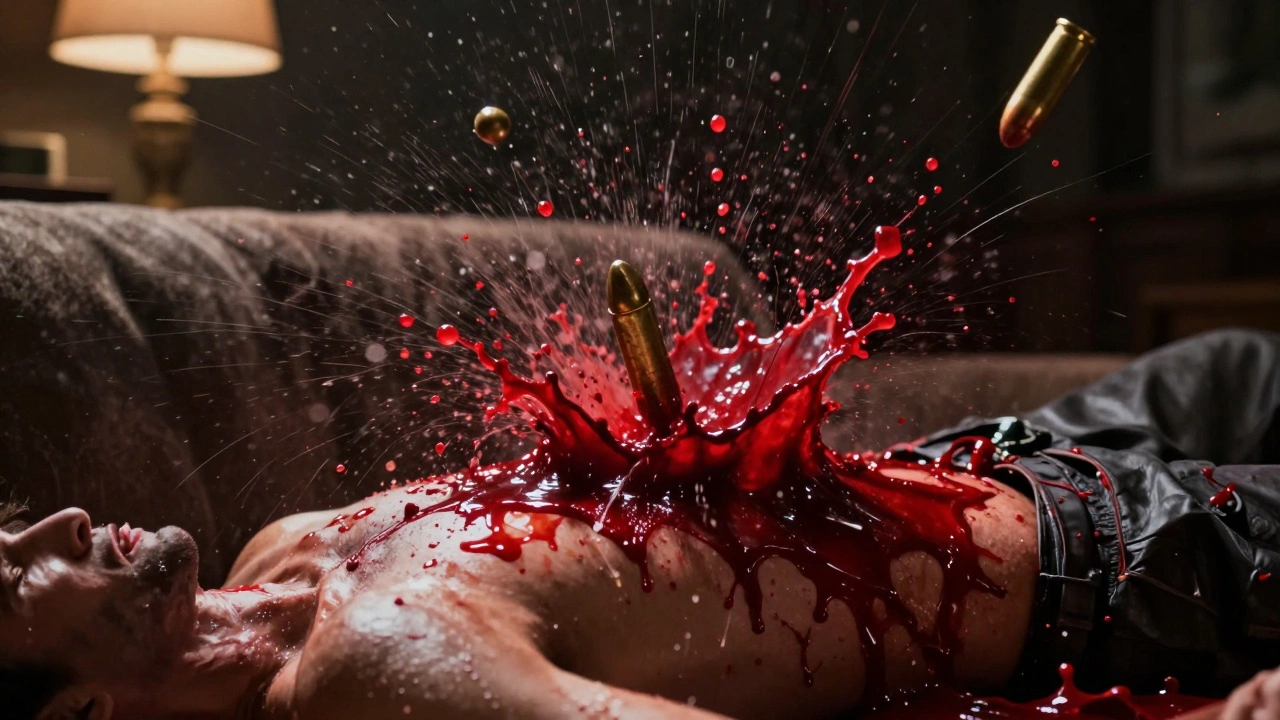
When a bullet tears through flesh, or a hammer strikes a skull, blood doesn’t just drip-it explodes. That explosion leaves behind a pattern, one that tells investigators exactly what happened in the seconds after violence erupted. This is impact spatter, and it’s one of the most telling forms of blood evidence at a crime scene.
What Is Impact Spatter?
Impact spatter is blood that’s projected outward from a forceful event-like a gunshot, a blunt-force blow, or a stabbing. Unlike passive stains (drips, pools, or smears), impact spatter happens in milliseconds. It’s not the result of gravity; it’s the result of energy transfer. The force breaks the blood into tiny droplets, and those droplets fly in all directions, often at speeds over 100 miles per hour.
Not all spatter is the same. Forensic experts break it into three categories based on velocity:
- Low-velocity spatter (under 5 feet per second): Usually from dripping or gravity. Droplets are large, over 4 mm, and look like rounded drops.
- Moderate-velocity spatter (5 to 25 feet per second): Often from beatings or stabbings. Droplets range from 1 to 4 mm, with a misty, scattered pattern.
- High-velocity spatter (over 100 feet per second): Almost always from gunshots. Droplets are tiny-under 1 mm-and form a fine, mist-like cloud.
High-velocity impact spatter is the most complex and most valuable. It’s the kind that shows up in mass shootings, homicides with firearms, or explosions. These patterns are so small they can be missed by untrained eyes. But under the right lighting and magnification, they tell a story no witness can.
How Impact Spatter Forms
Think of blood like a balloon filled with water. When you poke it gently, it leaks. When you shoot it? It shatters. The same thing happens inside the body. A bullet doesn’t just pass through-it creates a temporary cavity, a shockwave that rips blood vessels apart. The blood doesn’t just flow out. It’s ejected as a mist.
That mist doesn’t fly randomly. It follows physics. The angle, speed, and direction of the force determine where each droplet lands. A bullet fired at 90 degrees to a wall creates a circular stain. A bullet fired at an angle? The stain becomes elongated, like a teardrop. The wider end of the teardrop points toward the source.
Each droplet leaves behind a trail of clues:
- Size: Smaller droplets mean higher energy. If most stains are under 0.5 mm, you’re likely looking at a high-velocity event.
- Shape: Round stains usually mean the blood hit perpendicular to the surface. Elongated stains show direction.
- Distribution: High-velocity spatter often covers large areas-walls, ceilings, even furniture across the room. It can travel 10 feet or more.
- Backspatter: This is blood that flies back toward the shooter. It’s rare, but when found on the weapon or the shooter’s clothing, it’s damning evidence.
Where It Shows Up
High-velocity impact spatter doesn’t stay where you’d expect. In a typical shooting, you’ll find it on surfaces you wouldn’t think of as blood-soaked.
Consider this real case from a Portland homicide in 2023: A man was shot at close range in his living room. The bullet entered his chest and exited his back. Blood spatter wasn’t just on the wall behind him. It was on the ceiling light fixture, the back of the couch, the edge of a coffee table, and even inside a nearby shoe. Why? Because the force of the exit wound turned his body into a spray nozzle.
Common locations for high-velocity spatter:
- Ceiling and upper walls
- Doorknobs and light switches
- Shoes and socks
- Inside vehicles
- Behind the shooter (backspatter)
These aren’t accidents. They’re physical records. And if you know how to read them, you can reconstruct the entire sequence of events.
Tools of the Trade
Forensic analysts don’t guess. They measure. They photograph. They map.
At the scene, they use:
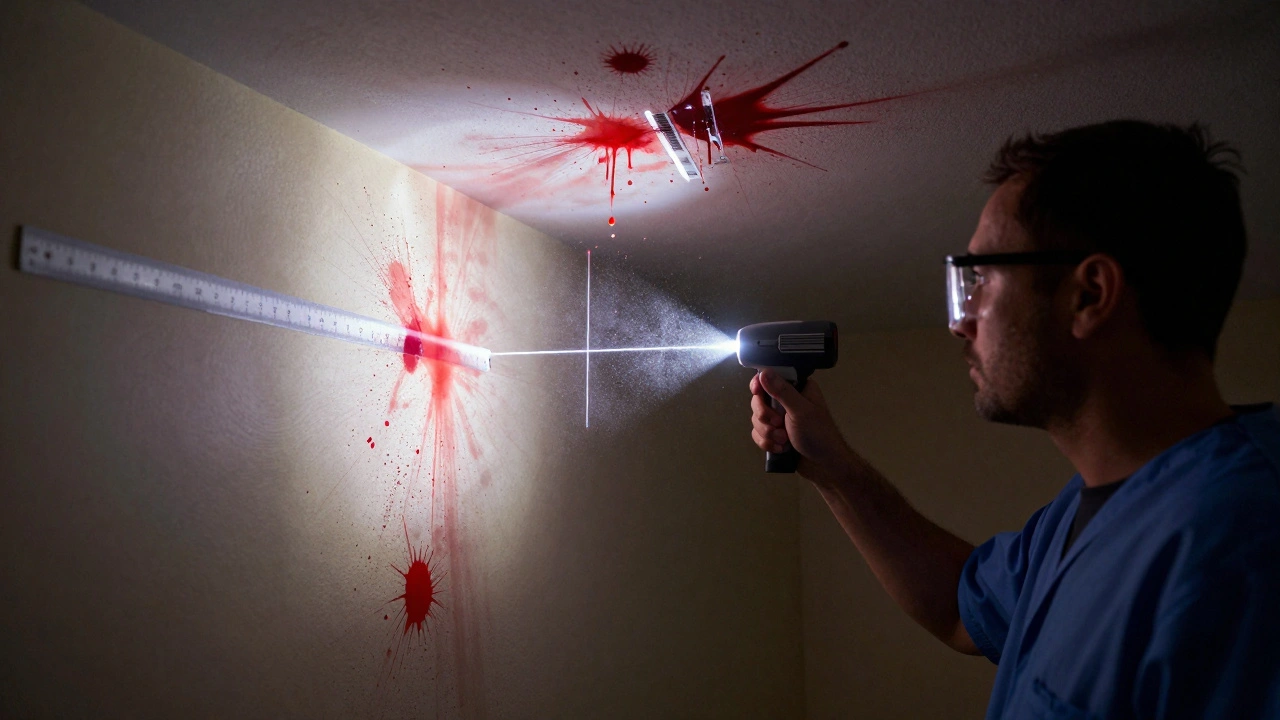
- Photography with scale markers: Every stain is photographed with a ruler or a color chart next to it. Size matters.
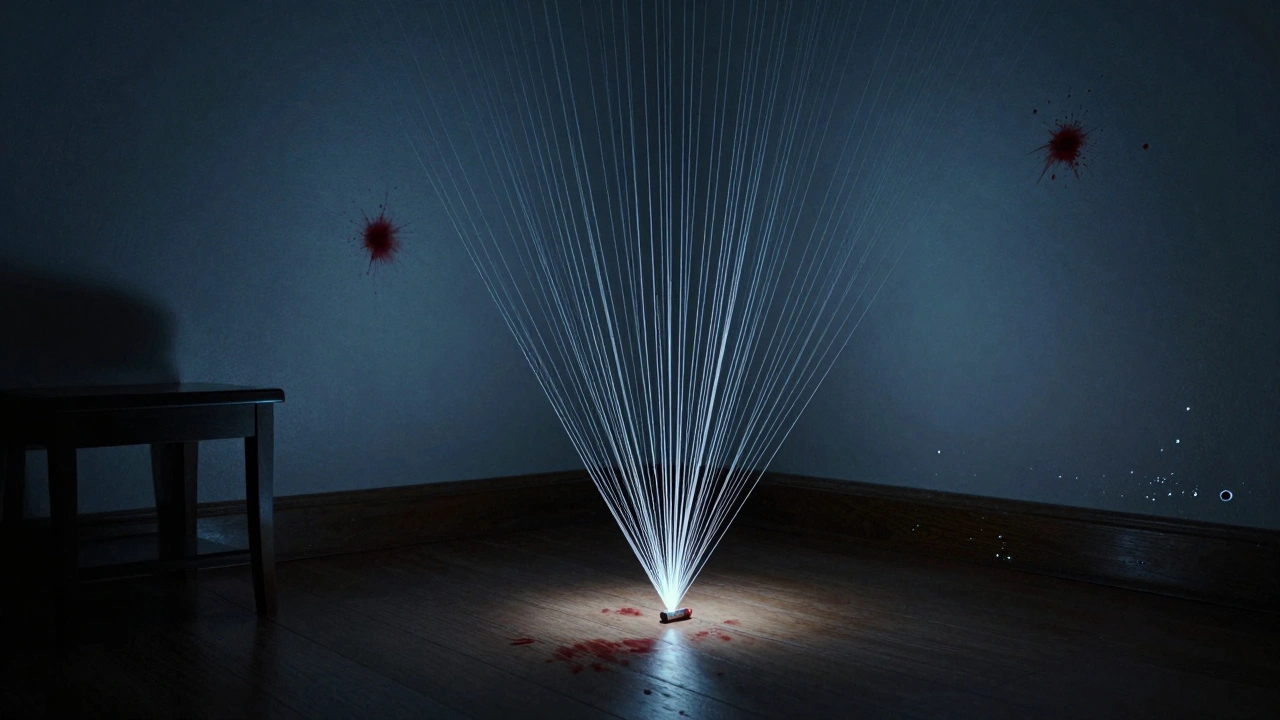
- Stringing techniques: Thin strings are stretched from the edge of each stain back toward its point of origin. Where they intersect? That’s likely where the force happened.
- 3D laser scanning: Modern labs use scanners to create digital models of the scene. They can rotate the bloodstain pattern in 3D and analyze angles with millimeter precision.
- Chemical testing: Blood is confirmed with luminol or presumptive tests. But DNA and blood type analysis come later-pattern analysis happens first.
One of the most powerful tools is the angle of impact calculator. It’s a simple formula: the width of the stain divided by its length gives you the sine of the angle. From there, you use trigonometry to find the exact angle the blood hit the surface. This isn’t guesswork. It’s math.
Common Mistakes and Pitfalls
Even experienced investigators can misread spatter. Here’s what goes wrong:
- Confusing transfer patterns with spatter: A bloody handprint on a wall isn’t spatter. It’s a transfer. Mixing them up leads to false conclusions.
- Ignoring secondary spatter: Blood that hits a surface and then splashes again can look like high-velocity spatter. It’s not. It’s a secondary event.
- Overlooking environmental factors: Wind, rain, or fans running after the crime can move droplets. You can’t assume the pattern stayed perfectly still.
- Assuming one source: If there are two victims, two weapons, or two angles of impact, the patterns overlap. Experts must separate them.
One of the most famous errors happened in a 2018 Texas case. Detectives thought a small, fine spatter pattern on the ceiling meant the victim was shot while standing. Later, a 3D reconstruction showed the victim was slumped over a table when shot. The spatter pattern had been misinterpreted because the angle of the ceiling wasn’t accounted for. The conviction was overturned.
Why It Matters in Court
Impact spatter doesn’t just help solve crimes-it can change the outcome of a trial.
In a 2022 murder trial in Oregon, the defendant claimed he shot in self-defense. But the blood evidence told another story. High-velocity spatter was found on the inside of the victim’s jacket, meaning the victim was facing the shooter when shot. There was no backspatter on the defendant’s shirt. That meant he wasn’t standing close to the victim when the shot fired. The jury convicted him of second-degree murder.
Forensic analysts don’t testify about what happened. They testify about what the blood says. And in court, that’s often enough.
What High-Velocity Spatter Can’t Tell You
It’s important to know what spatter doesn’t do.
It won’t tell you:
- Who pulled the trigger
- Why the shooting happened
- Whether it was intentional or accidental
It can tell you how the blood got there. Not why. That’s why it’s always paired with witness statements, ballistics, and digital evidence.
But when you combine impact spatter with a 9mm casing found 6 feet away, a video showing the victim’s last movement, and a gun with no fingerprints-suddenly, the blood pattern becomes the anchor. The rest of the story fits around it.
Real-World Applications
Impact spatter analysis isn’t just for homicides. It’s used in:
- Vehicle accidents: Was a driver shot before the crash? Spatter on the dashboard can confirm it.
- Domestic violence: Was the victim struck with a pipe or a fist? The spatter pattern differs.
- Arson investigations: Blood on a burning floor can reveal if someone was alive during the fire.
- Wildlife forensics: Poachers who use high-powered rifles leave spatter on trees and rocks. It’s used to prove illegal hunting.
In Portland, the Multnomah County Crime Lab processes about 80 cases a year involving impact spatter. Most are gun-related. The lab’s lead analyst, Dr. Lena Ruiz, says: “We don’t need to see the gun. We don’t need to see the shooter. We just need to see the blood. And it always talks.”
Training and Expertise
Becoming a bloodstain pattern analyst takes years. You don’t just learn from books. You train with fake crime scenes-simulated shootings, staged stabbings, even live fire drills using synthetic blood.
The International Association for Identification (IAI) offers certification. To qualify, analysts must:
- Complete 120 hours of classroom training
- Pass a written exam
- Present 5 real case analyses
- Have 3 years of field experience
Even then, they’re not infallible. That’s why every major case is reviewed by two analysts independently. If they disagree, a third is brought in.
The Future of Bloodstain Analysis
Artificial intelligence is starting to help. Labs now use machine learning to compare spatter patterns against databases of thousands of known cases. A new algorithm developed at the University of Oregon can predict the type of weapon used with 89% accuracy based solely on droplet size and distribution.
But the human eye is still unmatched. No algorithm can spot the faintest smear on a curtain, or notice that one droplet is missing because it hit a pocket. That’s why analysts still walk every scene, measure every stain, and ask: What does this tell us?
Can high-velocity spatter be mistaken for low-velocity spatter?
Yes, but it’s rare if proper methods are used. High-velocity spatter droplets are under 1 mm and form a fine mist. Low-velocity droplets are larger, over 4 mm, and look like individual drops. Under magnification, the difference is clear. Mistakes happen when analysts don’t use proper lighting, scale, or magnification tools.
Can blood spatter prove the weapon used?
Not directly, but it can strongly suggest it. High-velocity spatter almost always means a firearm. Moderate spatter suggests a blunt or sharp object. The size, shape, and distribution of droplets give clues. For example, a shotgun blast creates a wide, diffuse pattern, while a rifle produces tighter, more linear spatter. Ballistics and lab testing confirm the weapon.
How long does blood spatter analysis take?
At the scene, it takes hours to photograph and map. Full analysis-measuring angles, comparing patterns, reconstructing events-can take days to weeks. In complex cases, analysts may spend over 100 hours on a single scene. It’s meticulous work.
Can impact spatter be cleaned up?
Yes, but not completely. Even after cleaning, traces remain. Luminol can detect blood even after it’s been washed. Advanced forensic lighting and chemical swabs can still recover microscopic droplets. In one case, a suspect cleaned a room with bleach-yet analysts found 17 micro-droplets on the baseboard that matched the victim’s DNA.
Is high-velocity spatter always from a gunshot?
Almost always, but not exclusively. High-energy explosions, industrial accidents, or even high-speed collisions can create similar patterns. However, in criminal investigations, if you see fine, mist-like spatter covering walls and ceilings, you assume it’s from a firearm until proven otherwise. Ballistics evidence confirms it.