You landed your first job as a forensic scientist. You’re excited. You’ve got the degree, maybe even a certification from the American Board of Criminalistics, and you’re ready to process evidence. But here’s the hard truth most professors won’t tell you: if you stay exactly where you are, your career might stall before it really starts. Forensic science is a niche field. Unlike nursing or accounting, there isn’t a crime lab on every corner. If you want to move up-from technician to supervisor, or from DNA analyst to lab director-you often have to move out.
Mobility in forensics isn’t just about packing boxes; it’s about strategic positioning. It’s understanding that the highest-paying jobs, the most advanced technology, and the best mentorship opportunities aren’t evenly distributed across the map. They cluster in specific regions, driven by population density, funding models, and legal infrastructure. This article breaks down why geographic flexibility is arguably the single biggest lever you can pull for salary growth and professional satisfaction in this field.
The Geography of Forensic Jobs
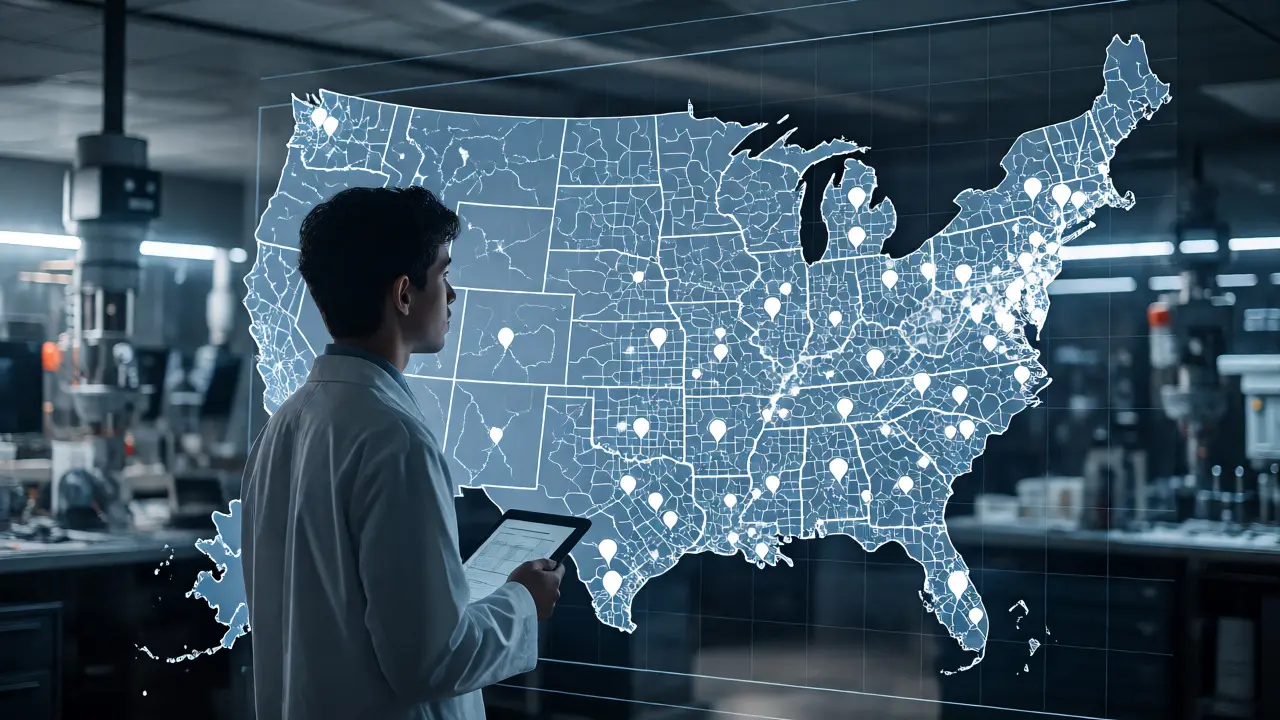
Let’s look at the data. The distribution of forensic work mirrors urbanization. Big cities need big labs. Los Angeles, New York, Chicago, and Houston handle massive caseloads. These hubs offer volume, which means more experience with complex cases, but they also come with high costs of living and intense competition. On the flip side, rural areas often struggle to recruit qualified staff. A county sheriff’s office in a less populated region might pay surprisingly well because they are desperate for someone who can actually run a GC-MS (Gas Chromatography-Mass Spectrometry) without breaking it.
This creates a paradox. The "prestige" jobs are in the expensive cities. The "opportunity" jobs are often in the middle of nowhere. If you refuse to leave your hometown, you limit yourself to whatever local agency exists. Maybe it’s a small police department with one part-time toxicologist. You’ll learn a lot, sure, but you’ll hit a ceiling quickly. There’s no one above you to promote you into. To advance, you eventually have to look elsewhere.
| Region Type | Job Availability | Salary Potential | Cost of Living | Career Growth Path |
|---|---|---|---|---|
| Major Metropolitan Hubs | High Volume | High (but adjusted for COL) | Very High | Specialization & Management |
| Mid-Sized Cities | Moderate | Moderate to High | Moderate | Balanced Technical/Supervisory |
| Rural/County Agencies | Low Volume / High Vacancy | Variable (Often Higher than expected) | Low | Generalist Roles |
| Federal/National Labs | Competitive | Standardized Federal Pay | Location Dependent | Research & Policy Impact |
Why Specialization Demands Movement
Early in your career, you might be a generalist. You collect evidence, you run some presumptive tests, maybe you help with fingerprints. But as you aim for advancement, you need to specialize. Do you want to focus on DNA analysis? Toxicology? Fire debris? Digital forensics?
Here’s the catch: not every lab has every section. A small municipal lab might only do serology and latent prints. If you want to become an expert in next-generation sequencing, you might need to move to a state lab or a larger regional center that has the budget for those instruments. You can’t build a resume around skills you don’t get to practice daily. Staying put in a lab that doesn’t support your desired specialty is like trying to become a cardiologist while working in a podiatry clinic. You’re missing the core exposure.
Mobility allows you to chase these technical niches. For example, the demand for digital forensics experts has exploded due to the rise of smartphones and cloud storage. Many traditional physical evidence labs are still catching up. If you’re passionate about extracting data from encrypted devices, you might find better training and case variety in tech-forward jurisdictions like Silicon Valley or Seattle, rather than sticking with a traditional rural sheriff’s office that barely uses computers for their reports.

The Salary vs. Cost of Living Equation
Everyone wants a raise. In forensics, salaries are often tied to union contracts, civil service scales, or state budgets. These structures are rigid. You rarely get large merit increases for doing great work. Your pay goes up when you get promoted or when you change jobs. And changing jobs often means changing locations.
But a higher salary in San Francisco might mean less disposable income than a lower salary in Portland, Oregon, or Austin, Texas. You have to do the math. Look at the gross annual salary, subtract taxes, then subtract rent/mortgage and utilities. Compare that to what you’d save in a cheaper city. Sometimes, moving to a mid-sized city with a strong industrial base offers the best net gain. You avoid the crushing housing costs of coastal megacities while still accessing a robust job market.
Also, consider benefits. Some states offer excellent pension plans that vest after 10 years. Moving frequently can disrupt this. However, other agencies offer signing bonuses or relocation packages to attract talent to hard-to-fill positions. Always ask about relocation assistance. It’s common for state labs to cover moving expenses for qualified candidates willing to relocate. Don’t assume it’s not available just because it’s not listed in the ad.
Overcoming the Personal Barriers
It’s easy to say "just move." It’s harder to actually do it. You might have a spouse with a job, kids in school, or aging parents nearby. These are real constraints. So how do you balance family life with career ambition?
- Partner Alignment: Have honest conversations early. If your partner’s career is portable (remote work, teaching, healthcare), make a joint plan. If theirs isn’t, you might need to compromise on location for a few years, aiming for roles within commuting distance of their workplace.
- Remote Work Reality: Can you do forensic work remotely? Mostly, no. Evidence handling requires physical presence. However, report writing, peer review, and consultation can sometimes be hybrid. Some private consulting firms allow more flexibility than government labs. If remote work is non-negotiable, look into private sector forensics or academic research roles.
- Short-Term Contracts: Consider taking a 1-2 year contract position in a different state. This lets you test drive a new location without permanently uprooting your life. It also looks great on a resume-it shows adaptability and willingness to tackle backlog issues.
Don’t underestimate the mental toll of isolation. Moving to a new state means leaving your support network. Build community through professional organizations like the American Academy of Forensic Sciences (AAFS). Attending conferences is a great way to meet people in your new area before you even move. It turns strangers into colleagues.

Navigating Certification and Licensing Across States
A major hurdle in mobility is credential portability. Unlike nurses, who have the NCLEX-RN recognized nationwide, forensic certifications vary. The ABC (American Board of Criminalistics) certification is widely respected, but state-specific licenses differ. Some states require individual licensure for forensic examiners; others rely solely on employer accreditation under ISO 17025 standards.
If you move from California to Texas, you might face different regulatory requirements. Check the specific state’s Department of Public Safety or equivalent agency guidelines before applying. Sometimes, you need to take additional exams or submit to background checks that are stricter than your previous state. Plan for a 3-6 month transition period where you might be working under supervision until fully licensed. Factor this into your financial planning-you might not hit full salary immediately upon arrival.
Strategic Moves: When to Stay and When to Go
Not every move is beneficial. Here’s a quick decision framework:
- Stay if: You are gaining unique, hands-on experience with rare case types; you have a strong mentor who is grooming you for leadership; the cost of living is low enough that you’re saving aggressively; or you are in a specialized unit (like Cold Case Review) that doesn’t exist elsewhere.
- Go if: You’ve been in the same role for 3+ years with no promotion path; your current lab lacks the technology for your desired specialization; you’ve hit the salary cap for your grade level; or you’re experiencing burnout due to chronic understaffing that management refuses to address.
Remember, the goal isn’t just to move geographically; it’s to move professionally. Use relocation as a tool to accelerate that professional shift. Document everything you learn in your current role so you can sell yourself effectively in interviews elsewhere. Highlight your proficiency with specific instruments (e.g., Agilent GC-MS, Thermo Fisher Orbitrap) and your compliance with quality standards. These details prove you’re ready for the next step, regardless of where that step is located.
Is it hard to transfer forensic certifications between states?
It depends on the state. While national certifications like ABC are recognized broadly, many states have their own licensing boards. You may need to apply for a new license, undergo additional background checks, or complete state-specific training modules. Always check with the receiving state's forensic authority before relocating.
Do forensic labs offer relocation packages?
Yes, especially for hard-to-fill positions or highly specialized roles. State and federal agencies often have policies covering moving expenses, temporary housing, and travel costs for interviewees. Private labs may offer signing bonuses instead. Always negotiate this during the offer stage.
Can I work remotely as a forensic scientist?
Fully remote roles are rare because evidence handling must happen in person. However, hybrid roles are becoming more common for tasks like report writing, peer review, and digital forensics analysis. Some private consulting firms offer more flexibility than government crime labs.
Which regions have the highest demand for forensic scientists?
High-demand areas include major metropolitan hubs with large populations (NYC, LA, Chicago) and regions with significant industrial activity requiring toxicology expertise. Additionally, states with strict independent crime lab mandates often have higher staffing needs compared to states where labs remain under police control.
How does moving affect my pension or retirement benefits?
Pension systems are usually state-specific. Moving to a new state typically resets your vesting period for that state's pension. Some states allow buy-ins or transfers, but this varies. Research the retirement package carefully, as it can significantly impact long-term earnings compared to a higher immediate salary.