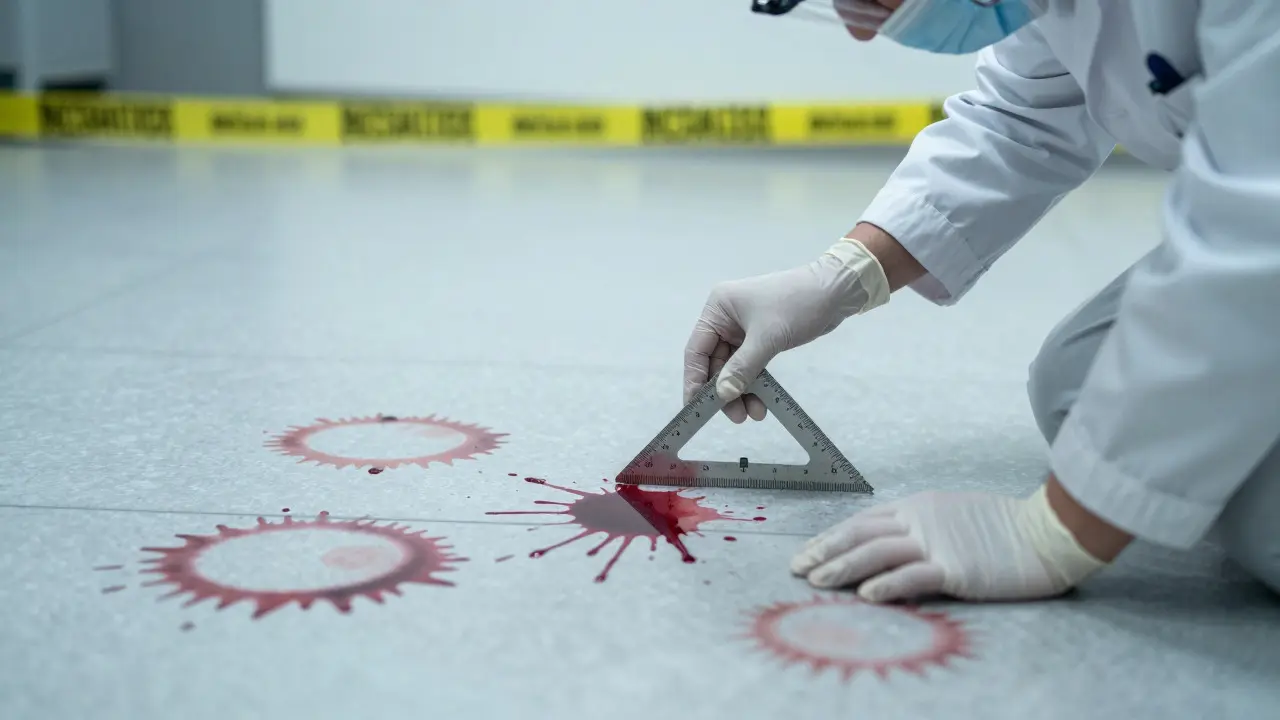
You know that feeling when you walk into a room and instantly "know" what happened before you even look closely? In Bloodstain Pattern Analysis is the scientific discipline used to interpret the size, shape, distribution, and location of bloodstains to reconstruct events at a crime scene. It’s powerful. But it’s also dangerously subjective if the analyst isn’t careful. The biggest threat isn’t bad science; it’s your own brain playing tricks on you.
We all do it. We see a smudge on the wall and our minds jump to a story: "He hit her here." Or we see a drip and think, "She was standing still." This is where Cognitive Bias is a systematic error in thinking that affects the decisions and judgments people make. In forensics, this isn’t just a philosophical problem. It can lead to wrongful convictions or let guilty parties walk free. Let’s break down exactly how these mental shortcuts mess up forensic reconstruction and how to keep them in check.
The Trap of Confirmation Bias
This is the big one. Confirmation Bias is the tendency to search for, interpret, favor, and recall information in a way that confirms one's preexisting beliefs. Imagine you’re an investigator who already believes the suspect attacked the victim from behind. You walk into the scene. You see a spatter pattern on the floor. Your brain whispers, "That looks like a back-blown impact." Do you measure the angle of the stains objectively? Or do you glance, nod, and move on because it fits your theory?
In a real case in Oregon last year, a defense attorney pointed out that the BPA (Bloodstain Pattern Analyst) had noted a specific directionality in their report that matched the prosecution's narrative perfectly. However, when an independent expert re-measured the same stains using standard trigonometric methods, the angles were slightly different-enough to suggest the victim might have been facing forward, not backward. The initial analyst didn't lie; they just saw what they expected to see. That’s the danger. If your hypothesis forms before your data collection, your data is already compromised.
Anchoring and the Power of First Impressions
Another sneaky pitfall is Anchoring Bias is a cognitive bias that occurs when people rely too heavily on the first piece of information offered (the "anchor") when making decisions. When you arrive at a crime scene, the first thing you hear often sets the anchor. Maybe the responding officer says, "It looks like a struggle near the door." Now, every stain you analyze gets filtered through that lens. You start looking for signs of a struggle. You might ignore subtle passive drips that suggest the body was moved later, because they don't fit the "struggle" anchor.
To fight this, experienced analysts often use a "blind analysis" protocol. This means analyzing the blood patterns without knowing the full police report or the suspect's confession. You look at the stains as if they are just geometry and physics. Only after you’ve documented your findings do you cross-reference them with the narrative. It feels slower, but it’s safer.
How Narrative Drives Perception
Humans are storytelling animals. We hate ambiguity. A chaotic crime scene is full of ambiguous marks. Is that a wipe mark from a hand dragging a body, or a swipe from a towel cleaning a counter? Without a clear story, the brain tries to create one. This is known as Narrative Fallacy is the human tendency to impose a coherent story on random or complex events to make sense of them.
Consider the difference between a "passive transfer" and an "impact spatter." They can look similar if the blood source is small. If the detective tells you, "The victim was stabbed while sitting," you’ll likely classify the stains as passive transfers from a seated position. If they tell you, "The victim was punched while standing," you might reinterpret those same stains as low-velocity impact spatter. The physical reality hasn’t changed, but your interpretation has shifted entirely based on the story you were handed.
Practical Strategies to Stay Objective
So, how do you stop your brain from hijacking your analysis? It’s not about being emotionless; it’s about process. Here are three concrete steps used by top-tier labs:
- Document Before Interpreting: Take photos and videos of the scene exactly as it is. Measure angles and distances immediately. Don’t write "consistent with X" until you’ve recorded the raw data. Raw data doesn’t have opinions.
- Peer Review is Non-Negotiable: Have another analyst review your notes before you finalize the report. Fresh eyes catch the biases that become invisible to you after hours of staring at the same wall.
- Question Your Own Hypothesis: Actively ask yourself, "What would I see if my current theory were wrong?" Look for evidence that contradicts your conclusion. If you find none, ask why. Is it really absent, or did you stop looking?
Comparing Biases in Forensic Contexts
Not all biases hit the same way. Understanding the difference helps you target your defenses. Here’s a quick comparison of how common biases manifest in bloodstain work:
| Bias Type | How It Manifests | Risk Level | Mitigation Strategy |
|---|---|---|---|
| Confirmation Bias | Seeing expected patterns in ambiguous stains | High | Blind analysis protocols |
| Anchoring Bias | Relying on first witness statements | Medium | Delay narrative review until documentation is complete |
| Hindsight Bias | Believing the outcome was obvious after the fact | Medium | Record initial impressions before seeing final results |
| Availability Heuristic | Focusing on dramatic spatter over subtle drips | Low | Systematic grid-based photography |

Why This Matters Beyond the Lab
When Crime Scene Investigation is the process of gathering physical evidence and documenting the scene to support legal proceedings, accuracy is everything. A biased BPA report can sway a jury. Jurors trust scientists. They assume that if a lab coat is involved, the answer is objective. When that assumption is wrong, justice suffers. But when we acknowledge our biases and build systems to counter them, we turn a subjective art into a rigorous science. It’s not about eliminating human error-it’s about managing it so it doesn’t define the outcome.
Frequently Asked Questions
Is Bloodstain Pattern Analysis purely scientific?
No, it is a hybrid of physical science and interpretive judgment. While the physics of blood droplets is objective, the classification of patterns (e.g., distinguishing a wipe from a swipe) requires human interpretation, which makes it vulnerable to cognitive bias.
What is the most dangerous bias for a forensic analyst?
Confirmation bias is widely considered the most dangerous because it operates subconsciously. An analyst may genuinely believe they are being objective while actually filtering out data that contradicts their pre-formed hypothesis.
How can investigators reduce bias in the field?
Investigators should document the scene systematically using grids and scales before forming theories. They should also limit communication with other team members regarding the "story" of the crime until all physical evidence is secured and photographed.
Does experience help or hurt objectivity?
Experience helps with speed and pattern recognition but can increase anchoring bias. Veteran analysts must be trained to consciously question their instincts rather than relying on gut feelings developed over years of cases.
What role does peer review play in preventing errors?
Peer review acts as a second layer of defense. A fresh set of eyes is less likely to be anchored by the initial narrative and more likely to spot inconsistencies in measurements or classifications that the primary analyst missed due to fatigue or bias.