Imagine walking into a crime scene where the victim was killed with surgical precision. No struggle marks. No panic. Just a calm, cold execution. To an untrained eye, it might look like a random act of violence. But to a profiler, it screams a specific personality architecture. Psychopathy is not just a movie trope; it is a measurable cluster of traits that significantly alters how offenders plan, commit, and conceal crimes. Understanding these traits doesn't just help catch the culprit faster-it helps predict what they will do next.
The core challenge for investigators is distinguishing between a truly psychopathic offender and someone who is merely impulsive or angry. A hooligan throwing a punch in a bar is violent, but rarely psychopathic. A serial killer who dismembers a body over three days while listening to jazz is operating from a different psychological baseline. This distinction changes everything about how you interview suspects, how you analyze evidence, and how you manage risk during custody.
The Diagnostic Framework: Hare PCL-R
You can’t identify psychopathy by guessing. You need a standardized tool. The gold standard here is the Hare Psychopathy Checklist-Revised (PCL-R), developed by Dr. Robert Hare. It’s a 20-item rating scale that assesses both clinical symptoms and social behavior. Each item is scored from 0 to 2, giving a total score out of 40. Generally, a score of 30 or higher indicates high psychopathy, particularly in men.
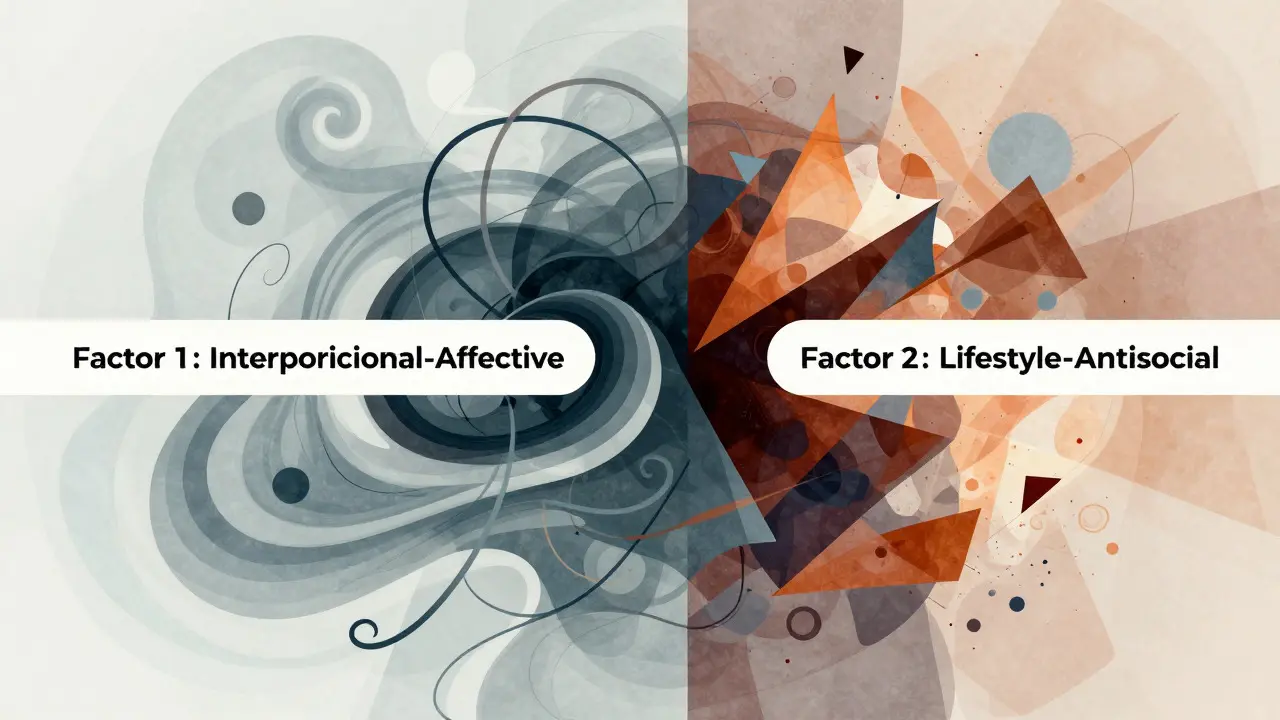
The checklist divides into two main factors:
- Factor 1 (Interpersonal-Affective): Covers superficial charm, grandiose self-worth, pathological lying, manipulativeness, lack of remorse, and shallow affect. These are the "mask" traits.
- Factor 2 (Lifestyle-Antisocial): Covers parasitic lifestyle, poor behavioral controls, early behavioral problems, lack of realistic long-term goals, impulsivity, and revocability of marital commitments. These are the "behavioral" traits.
In criminal profiling, Factor 1 is often more useful for understanding the *motive* and *method*, while Factor 2 helps explain the *pattern* of offenses. An offender high in Factor 1 might be charming enough to lure victims voluntarily. An offender high in Factor 2 might commit crimes due to boredom or immediate need, leading to messier scenes.
Behavioral Markers at the Crime Scene
How does this translate to physical evidence? Profilers look for specific anomalies that deviate from typical emotional responses to crime.
- Low Arousal Signatures: Victims of psychopathic killers often show fewer signs of prolonged struggle. Why? Because the killer may have used surprise, authority, or charisma to neutralize resistance before violence escalated. If a victim died quickly without defensive wounds, consider if the offender had the capacity to control the situation calmly.
- Instrumental Violence: Unlike reactive violence (which is messy and emotional), instrumental violence is calculated. Look for precise stab wounds, efficient use of weapons, and minimal collateral damage. The goal is the kill, not the destruction.
- Staging and Organization: While not all psychopaths are organized offenders, many exhibit a level of planning that reflects their cognitive dominance. Bodies might be hidden in ways that suggest a desire to avoid detection rather than just disposal. However, beware: some low-functioning psychopaths create chaotic scenes due to poor impulse control (high Factor 2).
- Lack of Emotional Artifact: Scenes lacking personal tokens left behind (like jewelry or photos) can indicate a lack of attachment or empathy toward the victim. Conversely, excessive staging might be a form of manipulation aimed at confusing investigators.

Interview Dynamics: Reading the Mask
Interviewing a potential psychopath is a game of chess against someone who doesn’t follow the rules. They know you’re looking for clues, so they give you exactly what they think you want to hear.
Here is what to watch for during structured interviews:
- Superficial Charm: They engage easily, make strong eye contact, and appear confident. But listen closely-is there depth? Or is it just performance?
- Pathological Lying: Lies are told effortlessly, even when unnecessary. They lie to maintain control, not just to hide facts. If a suspect corrects a minor detail that doesn’t affect their alibi, they might be practicing the lie.
- Lack of Remorse: When confronted with evidence, a non-psychopathic offender might show shame or fear. A psychopath shows indifference or rationalization. "They deserved it" or "It was an accident" are common deflections that lack genuine emotion.
- Cognitive Empathy vs. Affective Empathy: They understand *how* you feel (cognitive empathy) but don’t *feel* it themselves (affective empathy). They can mimic sadness or anger perfectly. Watch for micro-expressions that don’t match the words.
A pro tip: Don’t ask yes/no questions. Open-ended questions force them to construct narratives, which increases the cognitive load and makes inconsistencies harder to hide.
Comparing Profiles: Psychopathy vs. Other Disorders
Not every dangerous offender is a psychopath. Confusing psychopathy with other conditions leads to misdirected resources. Here’s a quick comparison to help clarify:
| Feature | Psychopathy (High PCL-R) | Sociopathy | Narcissistic Personality Disorder |
|---|---|---|---|
| Origin | Bio-psycho-social (genetic + environmental) | Primarily environmental (trauma/neglect) | Environmental (excessive praise/criticism) |
| Impulsivity | Low (planned actions) | High (reactive actions) | Moderate (ego-driven) |
| Charm | High, calculated | Low, erratic | High, fragile |
| Crime Scene | Organized, clean, efficient | Disorganized, messy, emotional | Variation, often symbolic |
| Interview Style | Confident, evasive, controlled | Anxious, defensive, volatile | Grandiose, demanding attention |
Note that "sociopathy" is not a formal DSM diagnosis but is often used colloquially to describe Antisocial Personality Disorder (ASPD) with a stronger environmental component. Psychopaths are a subset of ASPD, but not all ASPD individuals are psychopaths.
Common Pitfalls in Profiling
Even experienced profilers make mistakes. Here are the traps to avoid:
- The Halo Effect: Assuming a charming suspect is innocent because they seem normal. Psychopaths excel at appearing normal. Their competence is part of the disorder.
- Over-reliance on Stereotypes: Thinking psychopaths must be white-collar criminals or serial killers. They can be anyone-from a corrupt politician to a neighborhood arsonist.
- Ignoring Context: A high PCL-R score doesn’t guarantee future violence. It predicts *risk*. You must combine the profile with specific case facts. A psychopath in a stable job might never offend again; one under stress might escalate rapidly.
- Confirmation Bias: Once you decide someone is a psychopath, you start seeing psychopathic traits in every answer. Stay objective. Use the PCL-R scoring criteria strictly.
Practical Application for Investigators
So, how do you use this in the field? Start by building a behavioral timeline. Map out the offender’s actions before, during, and after the crime. Did they plan? Did they improvise? Did they interact with witnesses? If the offender showed no fear of capture, no remorse, and displayed a calm demeanor despite overwhelming evidence, flag them for a PCL-R assessment. If the scene was chaotic and emotional, look closer at trauma history or substance abuse rather than pure psychopathy. Remember, profiling is not mind-reading. It is pattern recognition based on data. The more data points you have-interview transcripts, scene photos, witness statements-the more accurate your trait identification becomes. Treat psychopathy as one variable in a complex equation, not the whole picture.
Is psychopathy the same as being a sociopath?
No. While both terms are often used interchangeably in pop culture, they refer to different concepts. Psychopathy is a specific personality trait cluster measured by tools like the Hare PCL-R, characterized by shallow emotions and planned behavior. Sociopathy usually refers to Antisocial Personality Disorder driven more by environmental factors like childhood neglect, often resulting in more impulsive and reactive behavior.
Can you tell if someone is a psychopath just by looking at them?
No. There is no single physical feature that identifies a psychopath. In fact, many psychopaths are physically attractive and charismatic. Identification requires behavioral analysis, interview dynamics, and standardized testing. Relying on appearance leads to false positives and negatives.
What is the most reliable sign of psychopathy in a crime scene?
There is no single sign, but a combination of low-arousal indicators is telling. This includes a lack of defensive wounds on the victim, precise and efficient use of weapons, and an absence of emotional artifacts like personal items left behind. These suggest a calculated, detached approach rather than an emotional outburst.
How does psychopathy affect interrogation strategies?
Standard pressure tactics often fail with psychopaths because they don’t experience anxiety or guilt in the same way. Instead, use logical consistency checks and open-ended questions. Force them to narrate details repeatedly; inconsistencies in their story reveal lies more effectively than emotional confrontation.
Are women psychopaths different from men?
Yes. Women with high psychopathic traits tend to use more relational aggression and manipulation rather than physical violence. They may be less likely to fit the stereotypical "cold-blooded killer" image but can be equally dangerous through social engineering and emotional exploitation. Profilers must adjust expectations for female offenders.