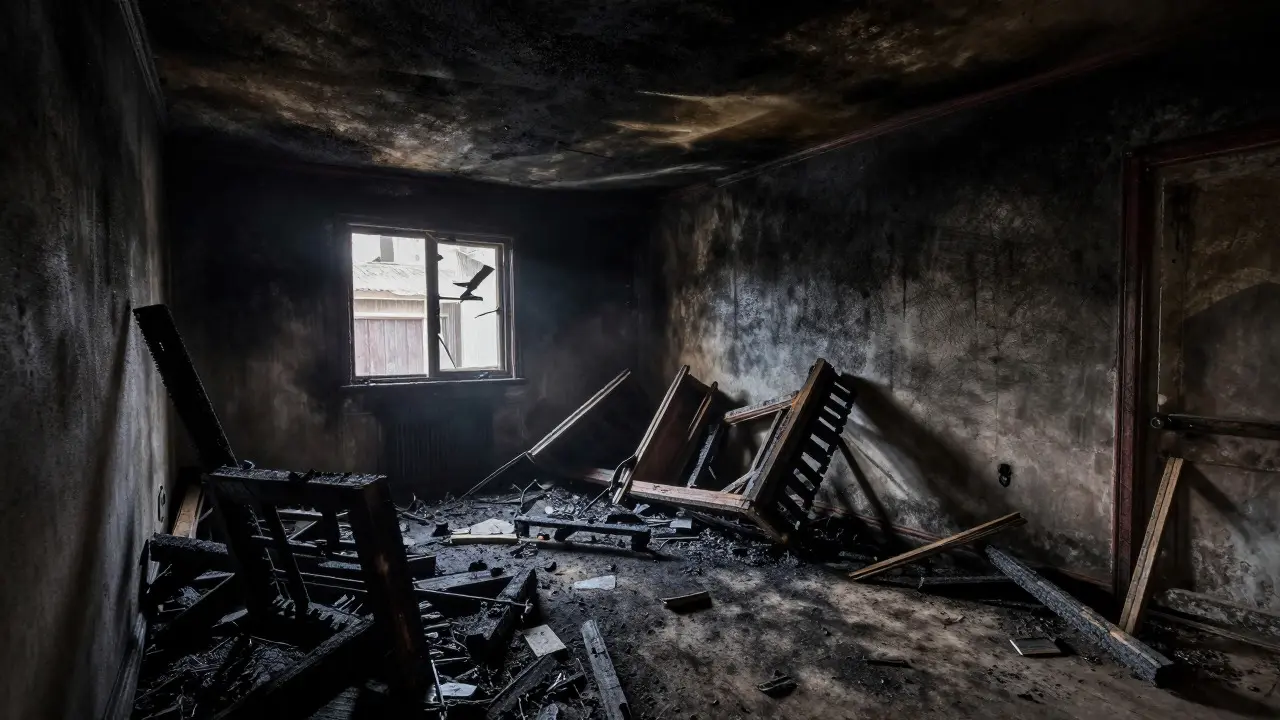
Walk into a room that has experienced flashover is a rapid transition in a compartment fire where all exposed surfaces ignite almost simultaneously. The scene looks chaotic. Walls are blackened to the floor, furniture is reduced to ash, and the ceiling is sagging with soot. To an untrained eye, it might look like the fire started everywhere at once. But for a fire investigator, this visual noise hides a critical truth: flashover destroys the very evidence needed to find the true point of origin.
The core problem here isn't just about finding what started the fire; it's about avoiding false conclusions caused by the physics of the event itself. If you rely on standard burn pattern analysis without accounting for the specific conditions of a flashover, you risk identifying the wrong room or even the wrong fuel source. This guide breaks down why post-flashover scenes are so tricky, the physical limits of your observations, and the practical cautions you need to apply before you write your report.
Why Flashover Changes Everything
To understand the limitations, you first have to understand the mechanism. A flashover doesn't happen randomly. It requires specific thermal conditions inside a closed space. When the heat release rate from a growing fire becomes high enough, the hot gases under the ceiling reach a temperature where they can ignite anything below them. This usually happens when the average gas temperature reaches approximately 600°C (1,100°F) and the floor-level radiation flux exceeds 44 kW/m².
Once this threshold is crossed, the entire room ignites within seconds. The result is a uniform layer of soot on vertical surfaces and a complete destruction of most organic materials. Because the ignition is near-simultaneous across the room, the "V-pattern"-the classic indicator of fire spread direction-is often obliterated or severely distorted. You aren't looking at a fire that spread from one corner to another; you're looking at a room that exploded into flames as a single unit.
The Myth of the 'Origin' Room
One of the biggest pitfalls in post-flashover investigations is assuming the room with the most damage is the origin room. In reality, the room where the flashover occurred often shows less distinct origin indicators than adjacent rooms. Why? Because the energy was released so quickly that there wasn't time for differential burning to occur within that specific space.
Consider a hallway connecting two bedrooms. If the fire started in Bedroom A, spread to the hallway, and then caused a flashover in the hallway, the hallway will be completely blackened. However, Bedroom B, which might have been cooler and further from the initial heat source, could show clearer signs of fire spread *into* it from the hallway. Investigators sometimes mistake the heavily damaged hallway for the origin, when in fact, it was merely the conduit for the flashover event. The true origin might be in a room that suffered less total destruction because the fire hadn't fully developed there before the compartment pressurized.
Limitations of Burn Pattern Analysis
Burn patterns are your primary tool for determining direction of travel, but their reliability drops significantly after a flashover. Here is where the limitations bite hardest:
- Destruction of Vertical Surfaces: Soot deposition is uniform on walls and ceilings. Without clear gradients, you cannot trace the path of flame front movement along vertical planes.
- Floor Evidence Loss: Flashover temperatures are high enough to char or consume floor coverings entirely. Any subtle charring patterns indicating early spread are often gone.
- Distorted V-Patterns: While V-patterns may still exist on structural elements like beams or joists, they can be inverted or skewed due to convection currents during the rapid heating phase. A V pointing up might actually indicate a downward flow if interpreted without context.
- Metal Deformation Confusion: Metals expand when heated. In a flashover, rapid and intense heating causes significant expansion and potential buckling. This deformation is often mistaken for melting, leading investigators to assume temperatures were higher than they actually were, or that the metal was closer to the flame source than it really was.
You must treat every burn pattern in a flashover-affected area with skepticism. Ask yourself: "Did this pattern form before the flashover, or did it get overwritten by the global ignition event?" If you can't answer that clearly, the pattern is unreliable for determining origin.
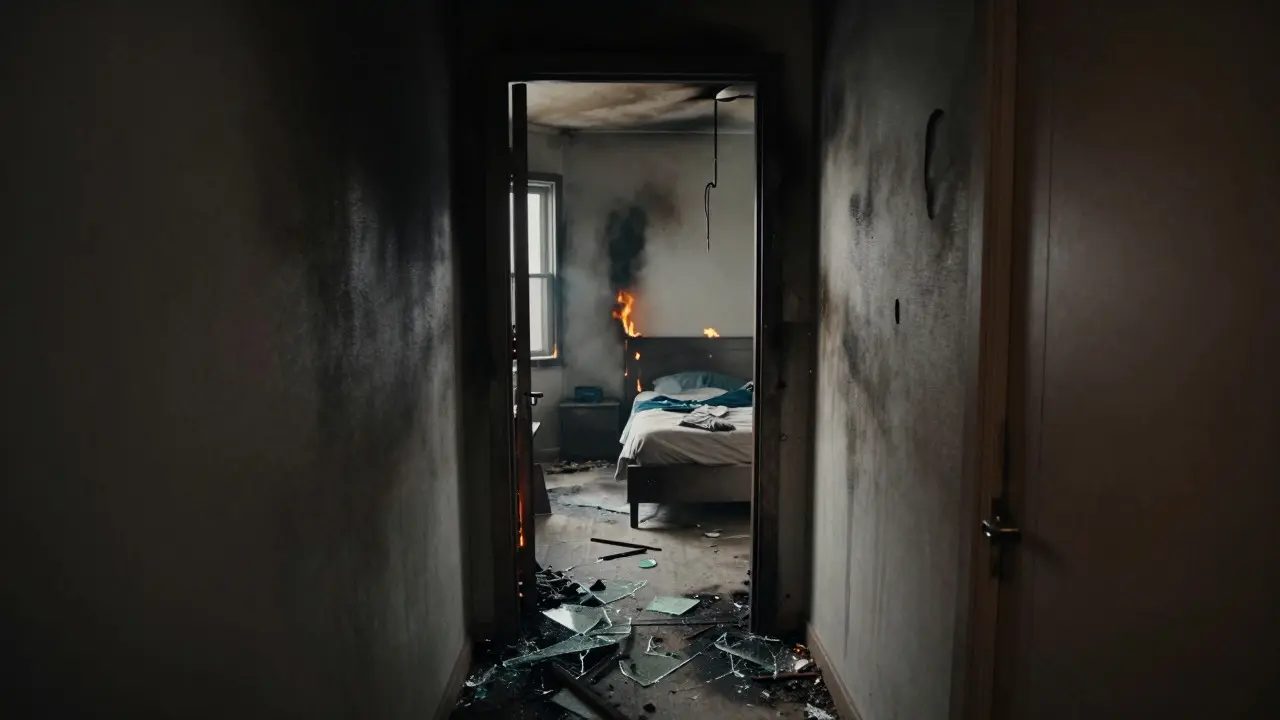
Cautions for Field Investigators
Working in these environments requires a different mindset than investigating a contained kitchen fire. You need to shift from "finding the spark" to "reconstructing the timeline." Here are the key cautions to keep in mind:
- Document Before You Touch: The moment you enter a flashover scene, take photos from multiple angles. Capture the soot lines, the extent of glass breakage, and any remaining structural integrity. Once you start moving debris, you lose the spatial relationship between objects.
- Look Outside the Compartment: Since the interior evidence is compromised, focus on the exterior. Check windows for outward blowout patterns. Look for soot deposits on the outside of the building that might indicate where the fire vented. These external clues often provide a clearer picture of the fire's progression than the internal chaos.
- Interview Witnesses for Timing: The exact time of flashover relative to the fire's start is crucial. Did neighbors see smoke before flames? Did the occupants hear a roar? Witness statements can help establish whether the fire grew slowly (allowing for pre-flashover patterns) or erupted suddenly.
- Check for Multiple Ignitions: Sometimes, what looks like a flashover is actually two separate fires merging. If the scene shows two distinct areas of heavy damage separated by a relatively undamaged zone, consider the possibility of dual origins rather than a single flashover event.
Comparing Pre- and Post-Flashover Evidence
To make the differences concrete, let's compare what you might expect to find in a standard residential fire versus a post-flashover scenario. This table highlights the key discrepancies that should trigger caution in your interpretation.
This comparison underscores why relying solely on internal visual cues is dangerous. In a standard fire, the "least damage" rule works well. In a flashover, the "most damage" rule is often misleading. You need to integrate external data points to compensate for the loss of internal clarity.
Reconstructing the Timeline
Since the static evidence is limited, dynamic reconstruction becomes your best friend. You need to build a timeline of events leading up to the flashover. Start with the estimated time of ignition. How long did it take for the fire to grow? Was there ventilation? Ventilation plays a huge role in flashover timing. An open door or window can accelerate the process by providing fresh oxygen, lowering the time to flashover from several minutes to just over a minute.
Use tools like computer fire modeling software if available. These models can simulate how a specific fuel load would behave in a given room size. By inputting the dimensions of the room and the type of furniture present, you can estimate when the gas temperature would have reached the flashover threshold. This helps you determine if the observed damage is consistent with a single rapid event or if there were earlier phases of burning that were wiped out.
Common Pitfalls to Avoid
Even experienced investigators make mistakes in these scenarios. Here are the most common errors:
- Over-interpreting Glass Breakage: Glass breaks due to thermal stress. In a flashover, nearly all glass in the affected room will break. Don't use the pattern of broken panes to determine origin unless you can distinguish between thermal breakage and impact breakage from falling debris.
- Ignoring Ventilation Paths: Forgetting to account for doors and windows that were open during the fire can lead to incorrect assumptions about air flow and heat distribution.
- Assuming Uniform Fuel Load: Rooms rarely have uniform fuel loads. A pile of newspapers in one corner burns differently than a wooden chair in another. Flashover affects everything, but the pre-flashover growth depends on local fuel availability.
Avoid these traps by maintaining a healthy dose of doubt. If the evidence seems too clean or too obvious in a flashover scene, question it. The complexity of the event means the evidence is rarely simple.
Next Steps for Complex Cases
If you've applied these cautions and still feel stuck, consider bringing in additional resources. Thermal imaging cameras, if used during the initial response, can provide data on residual heat distribution, though this is rare in post-scene investigations. Consulting with a fire dynamics expert who specializes in computational fluid dynamics (CFD) can provide objective validation of your hypotheses.
Finally, document your reasoning process thoroughly. In court, you won't just be asked "where did the fire start?" You'll be asked "how do you know it wasn't somewhere else?" Your notes on why certain patterns were deemed unreliable due to flashover effects will be your strongest defense against challenges to your findings.