You’re looking at a white powder. It tests positive for methamphetamine. But here’s the catch that trips up even experienced analysts: not all meth is created equal. The molecule has a mirror-image twin, and depending on which version you have, the legal implications, physiological effects, and synthesis origin can change drastically. If your lab reports "positive for meth" without specifying the isomer, you’re leaving out half the story.
This isn't just academic nitpicking. In many jurisdictions, d-methamphetamine (the psychoactive form) carries different penalties or scheduling than l-methamphetamine (often found in over-the-counter nasal decongestants like Vicks Vaporin). Worse, if you're trying to trace a batch back to a specific clandestine laboratory, the ratio of these isomers-known as the enantiomeric excess-can act like a fingerprint. So, how do you actually separate and quantify these twins? And why does standard GC-MS often fail you right out of the box?
The Chemistry Behind the Mirror Image
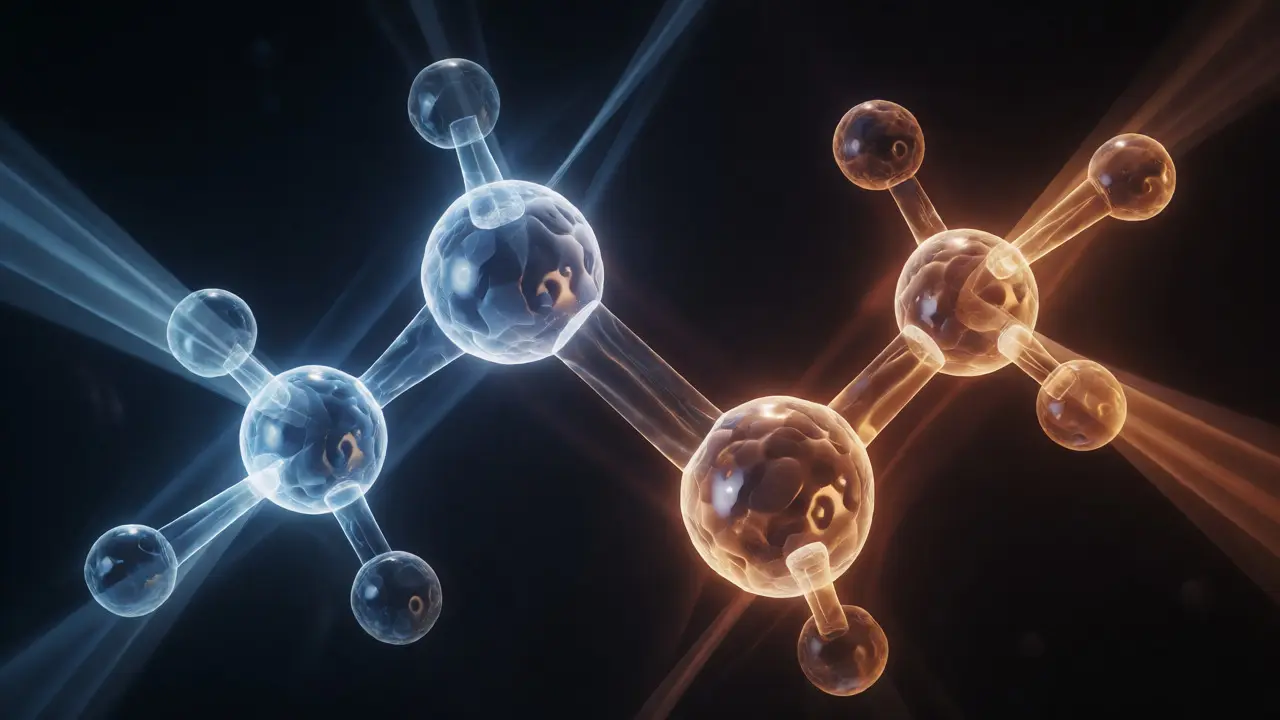
To understand detection, you first need to grasp what you're detecting. Methamphetamine is a chiral molecule. This means it lacks an internal plane of symmetry and exists as two non-superimposable mirror images called enantiomers. Think of them as left-handed and right-handed gloves. They look identical, weigh exactly the same, and have the same boiling point. Under normal conditions, they behave identically in most chemical reactions.
The two forms are designated by their optical rotation: d-methamphetamine (dextrorotatory) rotates polarized light to the right, while l-methamphetamine (levorotatory) rotates it to the left. Modern nomenclature uses R/S notation based on atomic priority, where d-meth corresponds to (S)-methamphetamine and l-meth to (R)-methamphetamine. Why does this matter? Because the human body's receptors are also chiral. They fit one "hand" much better than the other. d-meth binds tightly to dopamine transporters, causing the intense euphoria and stimulation associated with illicit use. l-meth fits poorly, resulting in minimal central nervous system activity but significant peripheral vasoconstriction-which is why it works as a nose spray.
Why Standard Methods Fail
If you run a crude sample through a standard Gas Chromatography-Mass Spectrometry (GC-MS) instrument using a common non-chiral column like DB-5ms, you will see one peak. Just one. The mass spectrometer sees the same fragmentation pattern for both isomers because their molecular weights and bond energies are identical. You get a hit for "methamphetamine," but you don't know if it's the street drug or the leftover from a cold remedy.
This is a critical failure point in forensic reporting. A suspect might argue, "I bought that powder legally; it was just nasal decongestant." If your method cannot distinguish the isomers, you cannot refute that claim scientifically. To solve this, you need a separation mechanism that interacts differently with each enantiomer. Enter chiral stationary phases.
Techniques for Isomer Separation
There are three primary ways labs tackle this problem, ranging from simple derivatization to advanced instrumentation. Each has trade-offs regarding cost, time, and resolution.
1. Chiral GC Columns
The most direct approach is swapping the column. Instead of a standard dimethylpolysiloxane phase, you install a column coated with a chiral selector, such as cyclodextrin derivatives (e.g., Chirasil-Dex CB). These selectors create transient diastereomeric complexes with the analytes. One enantiomer interacts more strongly with the selector and moves slower through the column, while the other elutes faster.
- Pros: High resolution; compatible with existing GC hardware; robust for volatile compounds.
- Cons: Lower temperature limits; columns are expensive and fragile; requires careful oven programming to achieve baseline separation.
2. Derivatization followed by Achiral GC
If you don't have a chiral column, you can chemically modify the sample. By reacting methamphetamine with a chiral reagent (like Marfey's reagent or N-acetyl-L-cysteine), you convert the enantiomers into diastereomers. Unlike enantiomers, diastereomers have different physical properties, including different retention times on standard achiral columns.
- Pros: Uses standard columns; often higher sensitivity due to improved volatility/stability of derivatives.
- Cons: Adds manual steps (increasing error risk); reaction yield must be consistent; extra time per sample.
3. Capillary Electrophoresis (CE) with Chiral Additives
CE separates ions based on charge-to-size ratio. By adding a chiral selector (like cyclodextrins) to the background electrolyte, the free base or salt forms interact differently with the selector, altering their migration speed.
- Pros: Excellent for non-volatile or thermally unstable compounds; low solvent consumption.
- Cons: Lower throughput; less robust for routine high-volume screening; matrix effects can be severe.
| Method | Resolution Capability | Throughput | Complexity | Best For |
|---|---|---|---|---|
| Chiral GC Column | High | Moderate | Low (Hardware swap) | Routine confirmation |
| Derivatization + Achiral GC | High | Low | High (Manual prep) | Labs without chiral columns |
| Chiral CE | Very High | Low | Moderate | Trace analysis / Non-volatiles |
| Polarimetry | Low (Bulk only) | High | Low | Initial screening only |
Interpreting the Enantiomeric Ratio
Once you've separated the peaks, you integrate the areas to calculate the ratio. This number tells a story about the synthesis route. Most illicit methamphetamine produced via the Nagai/Nagai reduction or Birch reduction methods results in a racemic mixture (50:50 d:l ratio) or slight excess of d-meth. However, newer synthetic routes, particularly those involving asymmetric hydrogenation or biocatalysis, can produce highly enriched d-meth (>90% d).
Conversely, if you find a sample with a high proportion of l-meth (say, 70:30 l:d), it raises red flags. It could indicate cutting with pharmaceutical-grade l-meth, or perhaps the sample is actually a mixture of legitimate OTC products. In some cases, specific precursor sources lead to characteristic ratios. For example, meth derived from pseudoephedrine (which is naturally occurring and chiral) tends to retain stereochemical integrity, leading to high d-enrichment, whereas ephedrine-derived batches might show different profiles depending on the reduction chemistry used.
Quality Control and Validation Pitfalls
Don't assume your chiral column will work perfectly forever. Cyclodextrin-based phases degrade over time, especially if exposed to water or strong acids/bases in the sample matrix. Water is the enemy of chiral GC. Even small amounts of moisture in your injection port can destroy the hydrogen-bonding interactions necessary for separation, causing the peaks to co-elute again.
Here are three validation checks every analyst should perform:
- Linearity Check: Prepare standards with known ratios (100:0, 50:50, 0:100). Ensure your integration software accurately calculates the area percentages. If your 50:50 standard reads 48:52, you have a bias issue.
- Cross-Contamination: Run blanks between samples. Meth residues stick to glassware. If your previous sample was 90% d-meth and your blank shows 5% d-meth, your next sample's data is compromised.
- Matrix Interference: Cut agents like caffeine, lidocaine, or sugars can co-elute or alter the retention time. Always verify purity using MS fragmentation patterns, not just retention time.
Legal and Practical Implications
In the United States, federal law generally treats both isomers under Schedule II controls, but state laws vary. Some states explicitly differentiate between d- and l-methamphetamine in their statutes. For instance, possession of pure l-meth might be treated as a lesser offense or even exempt if proven to be from an OTC source. Therefore, failing to report the isomer ratio could lead to incorrect sentencing recommendations.
From an intelligence perspective, tracking the d:l ratio across seizures helps map trafficking routes. If a series of busts in Portland all show a 60:40 d:l ratio, while a cluster in Seattle shows 95:5, you're likely dealing with two different manufacturing sources or supply chains. This granular data turns a simple "positive" test into actionable investigative intelligence.
Can standard GC-MS detect methamphetamine isomers?
No, standard GC-MS using non-chiral columns cannot separate enantiomers. They co-elute and produce identical mass spectra. You must use a chiral column, derivatization, or a technique like Capillary Electrophoresis to distinguish them.
Is l-methamphetamine illegal?
It depends on jurisdiction and context. Federally in the US, both isomers are controlled substances. However, l-methamphetamine is the active ingredient in some over-the-counter nasal inhalers. Possession of pure l-meth may be defended as legitimate medical use, whereas d-meth is almost exclusively illicit.
What is the typical isomer ratio in street meth?
Most illicitly manufactured methamphetamine is enriched in the d-isomer, often ranging from 50% to 90% d-meth. Ratios closer to 50:50 suggest racemic synthesis, while very high d-ratios suggest stereospecific synthesis or purification steps.
How does humidity affect chiral GC analysis?
Water competes for binding sites on the chiral stationary phase (usually cyclodextrin), reducing resolution. Samples must be dried thoroughly, and solvents like dichloromethane or ethyl acetate are preferred over alcohols or aqueous solutions to maintain separation efficiency.
Can impurities interfere with isomer quantification?
Yes. Common cutting agents like caffeine or levamisole can co-elute near the meth peaks or cause tailing, skewing area calculations. Using MS detection allows you to confirm peak identity and exclude interferences before integrating.