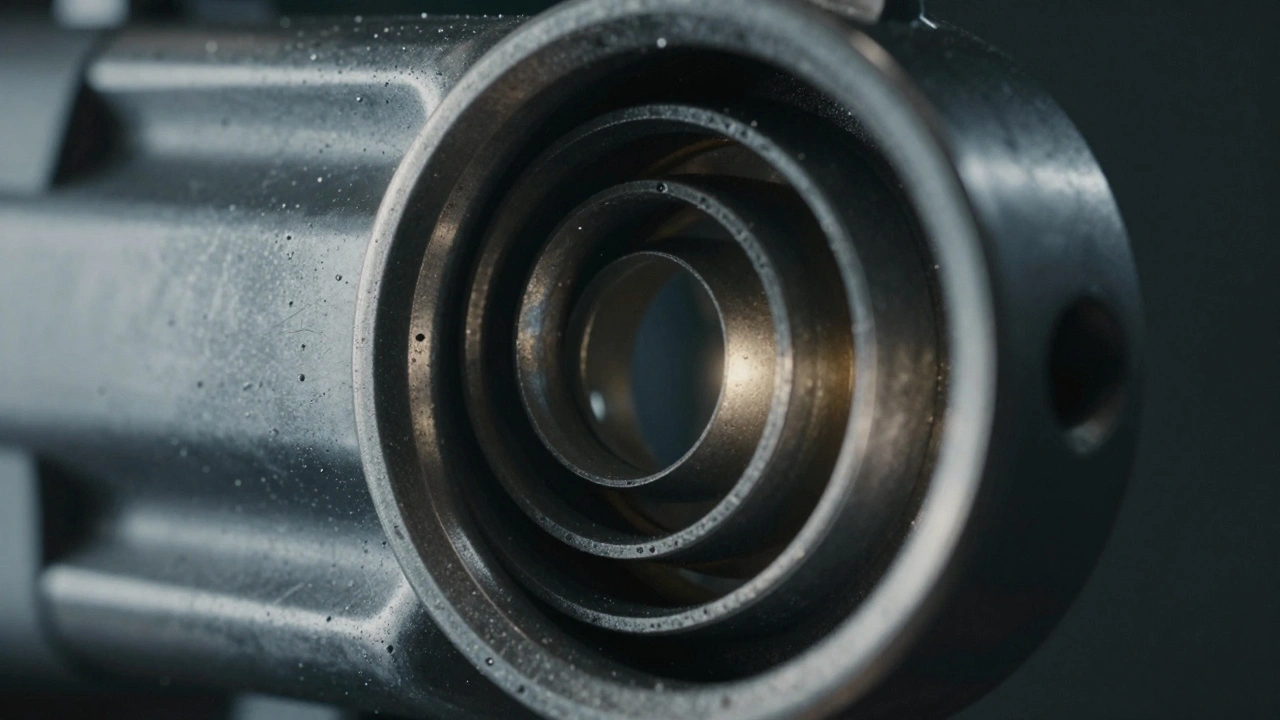
Imagine two guns from the same assembly line, same model, same caliber. To the naked eye, their barrels are identical. But under a microscope, they are as different as two fingerprints. This is the core of forensic ballistics. When a bullet is fired, it doesn't just fly through a tube; it is violently scraped and molded by the interior of the barrel, picking up microscopic signatures that can link a specific piece of lead to a specific trigger pull. Mastering the identification of individual characteristics is what allows investigators to move from saying "a 9mm gun did this" to "this specific gun did this."
The Science of Ballistic Fingerprints
To understand how we match a bullet to a gun, we first have to look at how guns are made. Barrels aren't smooth; they have Rifling, which consists of spiral grooves cut into the bore to spin the bullet for stability and accuracy. While the general pattern of these grooves is a design choice by the manufacturer, the actual process of cutting them leaves behind tiny, random imperfections.
These imperfections-microscopic scratches, burrs, and irregularities-are what we call individual characteristics. As a bullet travels down the barrel, the harder metal of the lands (the raised ridges) digs into the softer metal of the bullet. This creates a series of striations, or scratches, that are unique to that specific barrel. Because no two tools cut metal in exactly the same way, and no two barrels wear down identically over time, these marks act as a permanent, unique record of the weapon.
Class vs. Individual Characteristics
Before an examiner even looks for unique scratches, they start with a broader filter called class characteristics. Think of this as narrowing down the suspect pool. If a bullet has a .45 caliber and a right-hand twist with five grooves, the examiner can immediately rule out every gun that doesn't fit those specs.
| Feature | Class Characteristics | Individual Characteristics |
|---|---|---|
| Definition | General design features shared by a group | Unique marks specific to one single weapon |
| Examples | Caliber, number of lands/grooves, twist direction | Microscopic striations, tool marks, corrosion pits |
| Purpose | Elimination of incompatible weapons | Positive identification of a specific weapon |
| Consistency | Consistent across the same model line | Unique to one individual barrel |
If the class characteristics match, the examiner moves to the detailed work. A match in class characteristics tells you the bullet could have been fired from that gun. A match in individual characteristics tells you it was fired from that gun.
The Recovery and Comparison Process
You can't just fire a test round into a cardboard box and hope for the best. To get a clean "known" sample, examiners use a Water Recovery Tank. By firing the suspect weapon into a tank of water, the bullet is slowed down instantly upon impact. This prevents the projectile from hitting a hard backstop and distorting the very striations the examiner needs to see.
Once the examiner has the evidence bullet (from the crime scene) and the exemplar bullet (from the tank), they use a Comparison Microscope. This device allows the examiner to view two bullets side-by-side in a single eyepiece. They rotate the bullets until the striations line up. If they find a series of consecutive matching lines that align perfectly between the two samples, they have a potential match.
The "Sufficient Agreement" Standard
One of the biggest points of contention in the courtroom is how many lines actually make a "match." Unlike DNA, where there are mathematical probabilities, traditional ballistics relies on the expertise of the examiner. In the industry, the term used is "sufficient agreement."
There isn't a magic number (like "10 matching lines") that guarantees a match. Instead, examiners look for a pattern of agreement that is so distinct that it's unlikely to happen by chance. Because this is subjective, these findings are often challenged by defense attorneys. The examiner's training and years of experience are what give the testimony its weight, but the lack of a hard numerical value has led to a push for more scientific, data-driven methods.

Moving Toward Digital Precision: The CMC Method
To fix the subjectivity of the human eye, researchers at the National Institute of Standards and Technology (NIST) introduced the Congruent Matching Cells (CMC) algorithm. Instead of looking at a bullet through a lens, this method uses 3D surface scans of the breech face impressions on cartridge cases.
The CMC algorithm works by dividing the scanned surface into a grid of tiny cells and comparing them. If two surfaces have a high number of matching cells, the probability that they came from different guns becomes incredibly low. In NIST testing, matching pairs consistently showed at least 18 matching cells, while non-matching pairs almost always had zero. This brings ballistics closer to the statistical certainty of DNA evidence, allowing experts to provide a numerical likelihood of a match rather than just an opinion.
Challenges: Wear, Tear, and Time
Individual characteristics aren't static. Every time a gun is fired, the barrel undergoes microscopic changes. Heat, friction, and the chemicals in gunpowder slowly erode the metal. This means a bullet fired today might look slightly different from a bullet fired from the same gun five years ago.
Corrosion is another factor. If a gun is left in a damp environment, rust can create new pits and scratches in the barrel. While this adds more "character" to the barrel, it can make matching old evidence bullets to a recently cleaned or refurbished weapon difficult. This dynamic nature is why forensic examiners must be careful to document the condition of the weapon at the time of seizure.
Can two different guns produce the same striations?
While theoretically possible, it is practically improbable. Because the marks are caused by random imperfections during manufacturing and subsequent use, the chance of two barrels having the exact same microscopic landscape is nearly zero. This is why they are referred to as "ballistic fingerprints."
What happens if the bullet is too deformed to examine?
If a bullet is severely fragmented or flattened upon impact, the examiner may not find enough intact striations to make a positive identification. In these cases, the examiner may only be able to identify the class characteristics (like caliber) or declare the evidence inconclusive.
Does the type of ammunition affect the marks?
Yes. Harder projectiles (like full metal jacket) may not pick up as many fine details as softer lead bullets. The material of the bullet determines how well it "records" the imperfections of the barrel.
How does the CMC method differ from a comparison microscope?
The comparison microscope relies on the human eye and expert judgment to find "sufficient agreement." The CMC method uses 3D scanning and an algorithm to count matching cells, providing a statistical probability of a match rather than a subjective opinion.
Can a gun be "smoothed out" to hide its identity?
Some people attempt to file or polish the inside of a barrel to remove identifying marks. However, this often creates new, distinct irregularities that can still be identified or makes the gun's performance so poor that it becomes a clue in itself.
Next Steps for Identification
If you are dealing with a forensic case, the path to a match usually follows this logic: First, confirm the caliber and rifling pattern (Class Characteristics). If those align, procure test fires using a water tank. Finally, use a comparison microscope or CMC analysis to verify the unique striations (Individual Characteristics). If any of these steps fail, the weapon can be ruled out, significantly narrowing the investigation.