Imagine standing in a silent room where the only clues are dark splatters on the wall. To an untrained eye, it’s just a mess. To a forensic scientist, those stains are a map. They tell you exactly how someone moved, where they stood, and what weapon they used. This process is called Directional Analysis, which is a forensic technique used to determine the path of a blood droplet to reconstruct events at a crime scene. It is the backbone of understanding the "attack vector" in physical violence-essentially, the direction and angle from which force was applied.
In this guide, we will break down how experts read these patterns. You’ll learn how to identify the direction of travel, calculate angles of impact, and use triangulation to pinpoint the source of the blood. This isn’t just theory; it’s practical science that helps investigators separate fact from fiction.
What Is Directional Analysis?
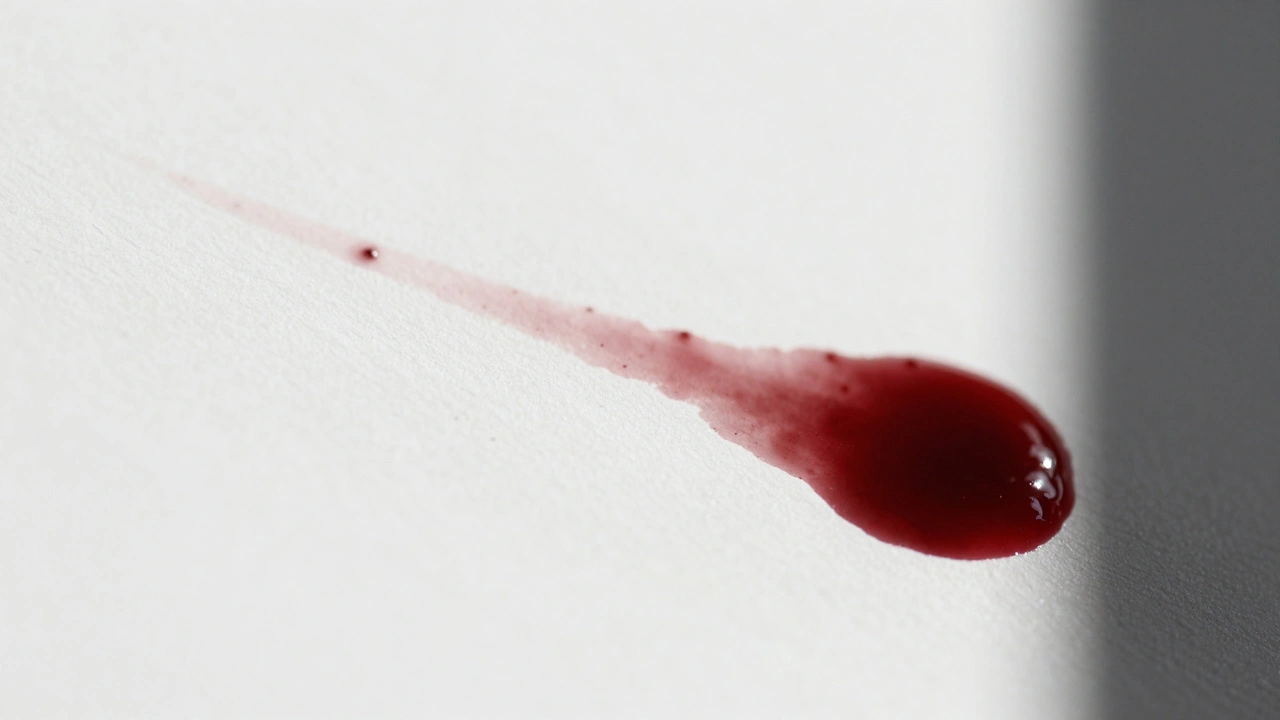
At its core, directional analysis answers one simple question: Which way was the blood moving when it hit the surface? When a drop of blood falls straight down, it creates a perfect circle. But if it hits at an angle, it stretches into an oval or teardrop shape. The key to reading this lies in the tail of the stain.
Blood has surface tension, meaning it holds together as it flies through the air. When it strikes a surface at an angle, the front of the drop hits first and stops, while the back continues forward for a split second before collapsing. This creates a tail that points in the direction of travel. If you see a long, thin stain with a pointed end, that point indicates the direction the blood was moving. If the tails all point toward the left side of the wall, the victim or attacker was likely moving from right to left.
| Stain Shape | Impact Angle | Direction Indicator |
|---|---|---|
| Circular | 90 degrees (vertical) | No specific direction |
| Oval/Elliptical | Oblique (angled) | Tail points in direction of travel |
| Satellite Spatter | Variable | Points away from main impact |
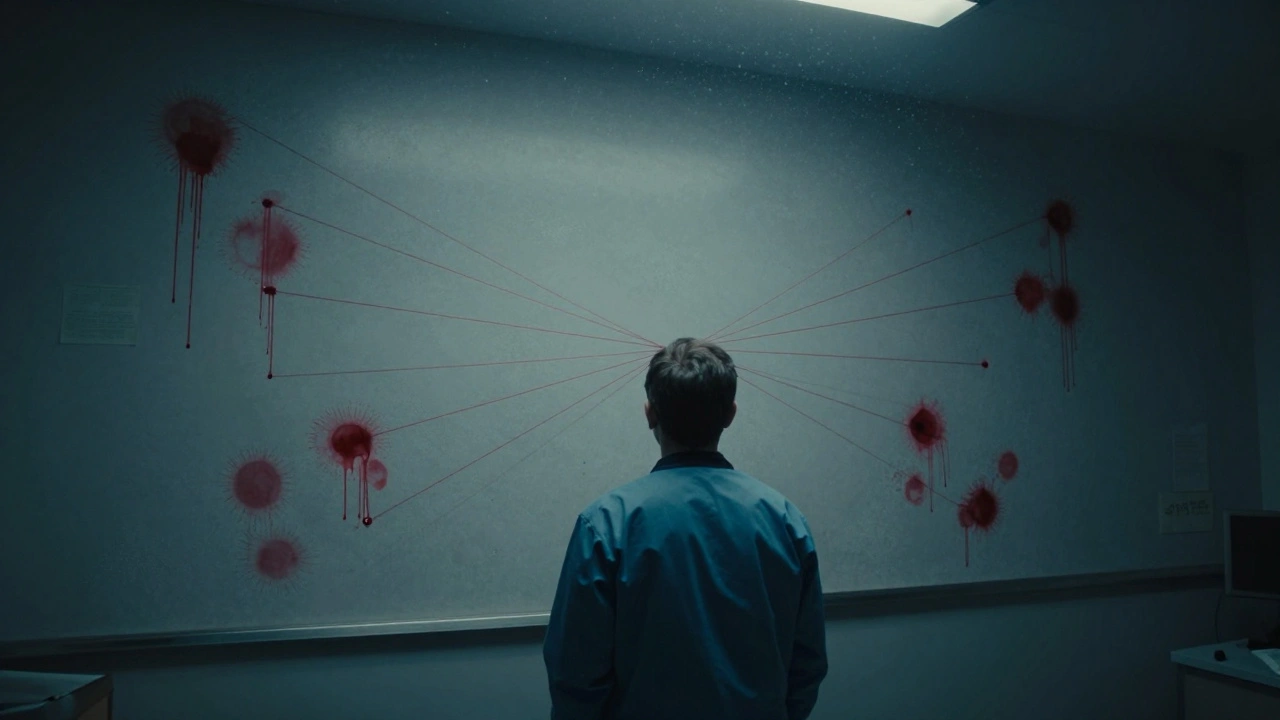
Understanding this basic principle allows investigators to draw lines through the center of each stain, pointing in the direction indicated by the tail. These lines are not random; they converge at a specific point in space, known as the area of origin.
Determining the Angle of Impact
Knowing the direction is half the battle. The other half is knowing the steepness of the angle. Did the blood hit the wall head-on, or did it skim across the floor? This is determined by calculating the Angle of Impact, which is the angle at which a blood droplet strikes a surface relative to the perpendicular plane.
The formula is surprisingly simple. You measure the width and length of the elongated stain. Then you divide the width by the length. Finally, you take the arcsine (inverse sine) of that number. For example, if a stain is 1 millimeter wide and 2 millimeters long, the ratio is 0.5. The arcsine of 0.5 is 30 degrees. This means the blood hit the surface at a 30-degree angle from the horizontal plane.
Why does this matter? A low angle (close to 0 degrees) suggests the blood traveled horizontally, perhaps from a struggle at waist height. A high angle (close to 90 degrees) suggests the blood fell vertically, possibly from a wound above the victim’s head or from a standing attacker. By calculating multiple angles, you can build a three-dimensional picture of the event.
Triangulation: Finding the Source
Once you have the direction and the angle for several stains, you can use a method called Triangulation, which is a geometric technique used to locate the precise point in space from which blood originated.. In practice, this often involves stringing. Investigators attach strings to the base of each stain, pulling them tight along the line of direction. They adjust the height of the strings to match the calculated angle of impact.
Where the strings intersect in mid-air is the estimated area of origin. This doesn’t mean the weapon was there, but it tells you where the blood was when it started traveling. If the intersection point is at chest height, the injury likely occurred at chest height. If it’s near the floor, the victim may have been lying down.
This technique requires precision. Small errors in measuring the width or length of a stain can shift the intersection point significantly. That’s why modern labs often use digital photography and specialized software to automate this calculation, reducing human error.
Types of Patterns and Their Meanings
Not all blood moves the same way. The type of force applied changes the pattern entirely. Recognizing these types helps narrow down the sequence of events.
- Passive Stains: These include drops falling under gravity alone, such as dripping from a wound. They usually create circular stains unless disturbed.
- Projected Stains: High-velocity spatter, like mist, indicates a beating or gunshot. Low-velocity spatter looks like larger drops, suggesting a blunt force swing.
- Transfer Patterns: These occur when a bloody object touches a clean surface, leaving a wipe or swipe mark. The direction of the smear shows the movement of the object.
- Cast-off Patterns: Arcs of blood created when a wet object is swung. The gaps between the arcs indicate the speed and rhythm of the swing.
Each pattern provides different clues. Cast-off patterns, for instance, can reveal the number of blows struck. Transfer patterns can show if a victim tried to wipe blood off their hands or clothes. By combining these observations, you build a timeline of the attack.
Common Mistakes in Directional Analysis
Even experienced analysts can make errors. One common mistake is confusing the direction of the tail with the direction of the source. Remember: the tail points in the direction the blood was *traveling*, not necessarily where it came from. If blood is cast off from a weapon, the tail points away from the weapon’s path.
Another pitfall is ignoring secondary disturbances. If a body is moved after death, blood can drip onto new surfaces, creating false trails. Investigators must distinguish between primary stains (created during the event) and secondary stains (created later). Context is everything. A stain on a chair might look like it came from a standing victim, but if the chair was moved, that assumption is wrong.
Environmental factors also play a role. Wind, rain, or cleaning agents can alter stain shapes. Outdoor scenes require extra caution because wind can blow droplets sideways, skewing the directional analysis.

Tools of the Trade
You don’t need fancy equipment to start. Basic tools include:
- Rulers and Calipers: For precise measurement of stain dimensions.
- String and Pins: For manual triangulation.
- Protractors: To verify angles visually.
- Photography Gear: To document the scene before any disturbance.
Applying Directional Analysis in Real Cases
Consider a scenario where a victim is found on the floor with blood splattered on the wall behind them. The stains are elongated, with tails pointing upward and to the left. Calculations show an average impact angle of 45 degrees. Triangulation places the origin at shoulder height, two feet to the right of the victim.
This suggests the victim was struck while standing, facing left. The attacker was likely positioned to the victim’s right. The upward direction of the tails implies the blood was projected upward, perhaps from a high-impact blow to the head. This reconstruction contradicts a claim that the victim fell backward accidentally. Instead, it supports an assault narrative.
Directional analysis turns static evidence into dynamic storytelling. It doesn’t prove guilt on its own, but it validates or invalidates witness statements and suspect accounts. When the physics of the blood doesn’t match the story, something is wrong.
How do you determine the direction of a bloodstain?
Look at the shape of the stain. If it is elongated, the narrow end or tail points in the direction the blood was traveling. Draw a line through the center of the stain following this tail to establish the path.
What is the formula for calculating the angle of impact?
Divide the width of the stain by its length, then take the arcsine (inverse sine) of the result. For example, if width is 1mm and length is 2mm, arcsin(0.5) equals 30 degrees.
Can directional analysis work outdoors?
Yes, but it is more challenging. Wind, rain, and uneven surfaces can distort stains. Analysts must account for environmental factors and rely heavily on context and multiple data points to ensure accuracy.
What is triangulation in bloodstain analysis?
Triangulation is the process of using strings or software to connect the paths of multiple bloodstains. Where these paths intersect in three-dimensional space is the estimated area of origin, indicating where the blood source was located.
Why is directional analysis important in criminal investigations?
It provides objective physical evidence that can confirm or refute witness testimonies. By reconstructing the movement and position of victims and attackers, it helps investigators understand the sequence of violent events accurately.