Imagine a medical lab delivering a test result that tells a doctor a patient is healthy when they are actually sick, or a forensics lab submitting evidence that gets thrown out of court because the equipment wasn't calibrated. In the world of scientific testing, a tiny error isn't just a mistake-it's a liability. That is why Quality Assurance Programs are the heartbeat of any credible lab. They aren't just about following rules; they are about proving that every single result produced is accurate, repeatable, and defensible.
The Big Difference Between QA and QC
People often use "QA" and "QC" interchangeably, but they are two different tools in the same kit. If you're running a lab, you need both, but you need to know where one ends and the other begins.
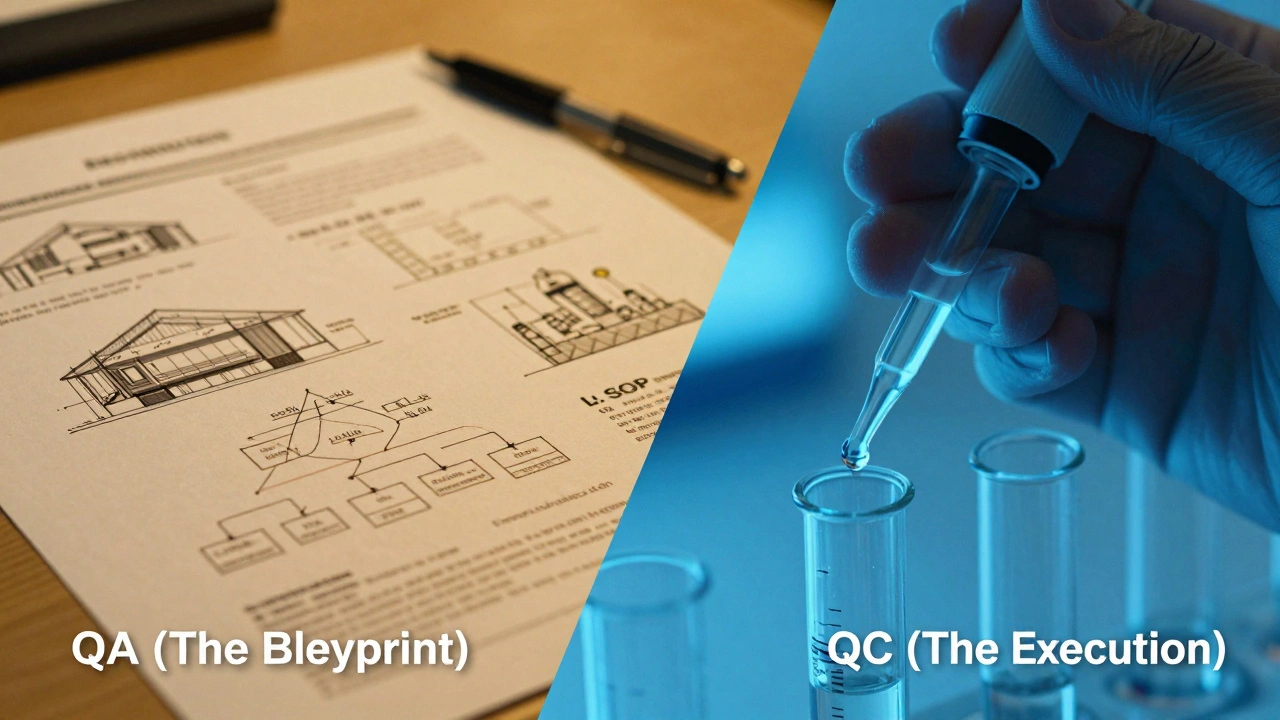
Quality Assurance is the broad, strategic side. It's the management review, the planning, and the high-level oversight. Think of QA as the "blueprint"-it defines how the lab should operate, who is trained, and how the overall system is audited. It’s about preventing mistakes from happening in the first place.
On the other hand, Quality Control (QC) is the tactical, day-to-day execution. QC is what happens during the actual sample preparation and analysis. It's the act of running a "blank" sample or a known standard to see if the machine is reading correctly. If QA is the blueprint, QC is the inspection of the bricks as they are laid.
Building Your Quality System Elements
To build a program that actually works, you can't just wing it. You need Quality System Elements (QSEs). These are the fundamental building blocks that define scientific operations. For example, the FDA's Center for Food Safety and Applied Nutrition (CFSAN) uses a Laboratory Quality Manual (LQM) to set these expectations.
A solid QSE framework ensures that research practices follow established guidelines and that there is enough documentation to replicate a study years later. If a different scientist can't look at your records and produce the exact same result, your QA has failed. This requires authentic records and a strict audit trail for every single piece of data.
| Feature | Quality Assurance (QA) | Quality Control (QC) |
|---|---|---|
| Focus | Process-oriented (Prevention) | Product-oriented (Detection) |
| Goal | Improve development processes | Identify defects in final results |
| Example | Staff training and SOP development | Running a blind sample/replicate |
| Scope | Entire organization/workflow | Specific test or batch |
Essential Components of a QA Plan
Whether you are working with soil samples or human blood, your Quality Assurance Project Plan (QAPP) needs to be concrete. A vague plan is a useless plan. A professional QA program should include these specific elements:
- Mission Statement and Objectives: Clearly define what the lab does and what "quality" looks like for your specific niche.
- Organizational Chart: Who is responsible for what? There must be a clear line of authority so that the person performing the test isn't the only one reviewing it.
- Standard Operating Procedures (SOPs): Step-by-step instructions for every process. If it isn't written down, it didn't happen.
- Training and Certification: Documentation proving that the technician is actually qualified to use the equipment.
- Code of Ethics: Guidelines to prevent data manipulation or "cherry-picking" results to fit a desired outcome.
Managing Data Quality with Warning and Control Limits
In a high-functioning lab, you don't just accept a result; you measure its precision and accuracy. This is where warning and control limits come in. These are numerical boundaries that tell you when your data is starting to drift.
A warning limit is like a yellow light. It tells the reviewer that the data quality might be questionable. You don't necessarily have to stop the analysis, but you do need to flag the result. A control limit is a red light. If a result hits this limit, the data is typically considered invalid, and the analysis must be investigated or repeated.
For chemistry labs, this involves calculating the Method Detection Limit (MDL) and using surrogate standards to ensure the machine hasn't lost sensitivity over time. Using laboratory fortified blanks helps determine if the reagents themselves are contaminated, which would skew every single result in a batch.
Internal vs. External Assessments
You can't grade your own homework. That's why the World Health Organization emphasizes a two-pronged approach to quality: internal and external.
Internal quality control is your day-to-day monitoring. It's the checks and balances you perform every hour or every batch. External quality assessment, however, involves an independent agency. This is where you participate in a "blind" test-an outside organization sends you a sample with a known value, and you have to guess what it is. This cross-compares your lab's performance against other labs globally to ensure consistency.

Who Sets the Standards?
Depending on your field, different organizations provide the "gold standard" for accreditation. You aren't alone in this; there are massive networks designed to help labs improve.
NIST (National Institute of Standards and Technology) is a powerhouse for measurement challenges. They provide reference materials that allow labs to assess their in-house measurements. While NIST programs aren't always strict "pass/fail" proficiency tests, they are essential for improving data comparability over time.
For those in the healthcare sector, the CDC (Centers for Disease Control and Prevention) offers voluntary standardization programs. They focus on critical areas like newborn screening and chronic disease testing, providing the reference materials and consultations needed to keep public health data reliable.
Then there is the CLSI (Clinical and Laboratory Standards Institute), which focuses on the practical application of standards. They help labs move from "knowing the rule" to "implementing the rule" through workshops and mentoring on how to build a QA manual from scratch.
Common Pitfalls and How to Avoid Them
Many labs fail their audits not because they are bad at science, but because they are bad at paperwork. The most common mistake is having an SOP that doesn't match the actual practice. If your manual says you calibrate the pipette every Monday, but you actually do it every two weeks, an auditor will find that gap instantly.
Another trap is ignoring the "drift." Instruments don't just break; they degrade slowly. If you only check your standards at the beginning of the month, you might miss a slow decline in accuracy that makes a week's worth of data useless. Frequent, documented checks are the only way to ensure validity.
Is lab accreditation the same as Quality Assurance?
No. Quality Assurance is the set of internal processes and systems you use to ensure your results are correct. Accreditation is the formal recognition by an external body (like ISO or CAP) that your QA programs meet specific international or industry standards. QA is what you do; accreditation is the proof that you're doing it right.
What happens if a warning limit is exceeded?
Exceeding a warning limit doesn't automatically invalidate the data, but it triggers a review. The data reviewer looks for patterns-perhaps a reagent is aging or a technician is slightly off in their pipetting. The result may be reported but "qualified" with a note indicating the potential for slight variability.
How often should proficiency testing be conducted?
This depends on the regulatory body, but generally, proficiency testing is done on a quarterly or semi-annual basis. However, internal QC should be done daily or with every batch to ensure that you aren't waiting months to find out your equipment is out of calibration.
What is a laboratory fortified blank?
A fortified blank is a sample that contains no actual analyte (the substance you are measuring) but has a known amount of that substance added to it. This allows the lab to see if the analytical process is recovering the full amount of the substance or if something in the process is causing it to disappear.
Why is documentation so critical in QA?
In science and law, if there is no record, the event never happened. Documentation provides the "chain of custody" for a result. It proves that the sample wasn't contaminated, the machine was calibrated at the time of the test, and the person operating it was trained. This is what makes data "defensible" in court or during a regulatory audit.
Next Steps for Lab Managers
If you're just starting to tighten up your standards, don't try to overhaul everything in one day. Start with a gap analysis: compare your current practices to the LQM or ISO standards. Identify where your documentation is thin and focus there first.
For those already in a system, look into external comparisons. Reach out to organizations like NIST or the CDC to find a reference material or a proficiency program that fits your specific niche. Moving from internal confidence to external validation is the final step in achieving true laboratory excellence.