You snap a photo of a crime scene. It looks perfect. But when you hand that JPEG to the judge, how do they know it hasn’t been tweaked? Maybe someone brightened the shadows to hide a clue. Or maybe they cropped out a witness standing just off-frame. In the courtroom, "looks right" isn't good enough. You need proof. That’s where image hashing comes in. It’s not about hiding data; it’s about locking down integrity. Think of it as a digital fingerprint for pixels. If even one pixel changes, the fingerprint shifts. This simple concept is changing how we handle digital evidence.
What Is Image Hashing and Why Should You Care?
Most people confuse image hashing with cryptographic hashing (like SHA-256). They are cousins, but they behave very differently. Cryptographic hashing is brittle. Change one bit in a text file, and the hash completely changes. That’s great for verifying if a document was tampered with byte-for-byte. But images? Images are messy. Cameras compress them. Software resizes them. Color profiles get adjusted. A standard cryptographic hash would flag every minor adjustment as a potential forgery, which makes it useless for practical forensic work.
Perceptual image hashing solves this. It generates a value based on the visual content of the image, not its binary code. Algorithms like pHash or dHash look at the structure, gradients, and frequencies within the picture. If you resize an image from 4000x3000 to 1920x1080, the perceptual hash stays nearly identical. But if someone clones out a gun in the corner? The hash changes significantly. This resilience to benign edits while remaining sensitive to malicious manipulation is exactly what courts need.
The Forensic Workflow: From Camera to Courtroom
How does this actually play out in a case? Let’s walk through a realistic scenario. Imagine a detective photographs a burglary scene. The camera saves the RAW file and a JPEG preview. The detective uploads these to a secure evidence management system. Immediately, the system calculates two things:
- A cryptographic hash (SHA-256) of the original file bytes.
- A perceptual hash (pHash) of the visual content.
These hashes are stored in a database alongside the metadata (EXIF data). Later, during discovery, the defense attorney receives a copy of the photo. They might convert it to PNG for easier viewing or adjust the contrast for clarity. When the prosecutor re-uploads the defense’s version, the system checks the hashes. The cryptographic hash will differ (because the file format changed), but the perceptual hash should match closely. If the perceptual hash diverges beyond a set threshold, the system flags it. Now you have a specific reason to question the image's integrity.
Choosing the Right Algorithm: pHash vs. dHash vs. MD5
Not all hashes are created equal. Choosing the wrong one can lead to false positives or missed manipulations. Here’s a breakdown of the common tools used in digital forensics today.
| Algorithm | Type | Sensitivity to Edits | Best For | Weaknesses |
|---|---|---|---|---|
| MD5 / SHA-256 | Cryptographic | Extreme (Any change breaks it) | Verifying exact file transfer integrity | Fails if image is resized or compressed |
| pHash | Perceptual | Moderate (Ignores resizing/color) | Detecting content manipulation (cloning, cropping) | Can struggle with heavy compression artifacts |
| dHash | Perceptual | Moderate-High | Fast duplicate detection | Less robust against rotation than pHash |
| Average Hash | Perceptual | Low | Simple near-duplicate checks | High collision rate; poor precision |
In most legal contexts, you use a hybrid approach. You rely on SHA-256 to prove the file wasn't corrupted during upload. You use pHash to prove the *visual content* remains consistent despite legitimate formatting changes. If a suspect claims they only rotated the image, the pHash might shift slightly depending on the algorithm, but it won't look like a new image. If they erased a license plate, the pHash distance increases noticeably.
Admissibility: Getting Past the Judge
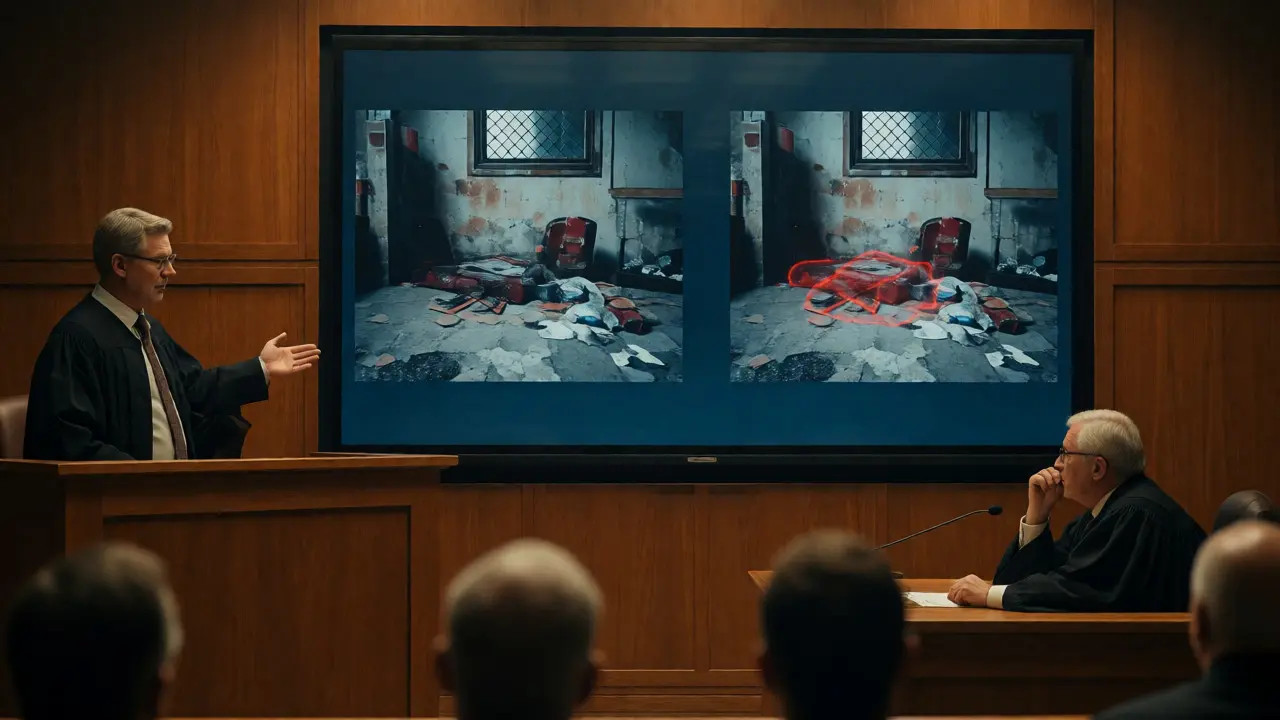
Just because you have a hash doesn't mean the judge accepts it. You need to establish the reliability of your method. Under the Daubert standard (used in federal courts and many states), scientific evidence must be testable, peer-reviewed, and generally accepted. Perceptual hashing fits this bill well. It’s grounded in signal processing theory-specifically Fourier transforms and discrete cosine transforms (DCT).
To strengthen admissibility, document your chain of custody meticulously. Show that the hashing algorithm was applied automatically by trusted software, not manually by a biased party. Mention the specific library used, such as OpenCV or Python Imaging Library (PIL). Courts love reproducibility. If another expert can run the same algorithm on the same file and get the same hash, your evidence holds up.
Also, be ready to explain "hash collisions." Two different images can theoretically produce similar hashes, though it’s rare with modern algorithms like pHash. Acknowledge this limitation upfront. It shows you understand the science, not just the tool.
Common Pitfalls and How to Avoid Them
Forensic analysts often trip up on a few key issues when presenting hashed evidence. First, don't ignore EXIF data. Hashing verifies the pixels, but EXIF tells you who took the photo, when, and with what device. If the hash matches but the EXIF says the photo was taken by an iPhone 15 while the crime scene occurred in 2010, you have a problem. Always cross-reference hashes with metadata.
Second, beware of recompression. Every time you save a JPEG, you lose data. If an investigator opens a photo in Photoshop, adds a layer, and saves it again, the file size drops and quality degrades. This can subtly alter the perceptual hash. To mitigate this, always work with lossless formats (TIFF, PNG) during analysis. Only generate hashes from the final, certified evidence copies.
Third, consider the context of "benign" edits. Cropping is tricky. If you crop out 10% of the edge, pHash usually tolerates it. But if you crop out a critical piece of evidence, the hash might still look close enough to pass automated checks but fail human scrutiny. Never rely solely on automated hash comparisons for critical evidence. Use them as flags for further manual review.
Future Trends: AI and Deepfakes
We’re entering an era where deepfakes and AI-generated images flood the digital space. Traditional hashing struggles here. An AI can generate an image that looks visually identical to a real photo but has completely different underlying noise patterns. Perceptual hashes might miss subtle AI artifacts.
This is where newer techniques come in. Researchers are developing "robust hashes" that detect statistical anomalies typical of generative models. These aren't mainstream in courts yet, but they’re coming. For now, combining perceptual hashing with metadata analysis and expert testimony remains the gold standard. Keep an eye on developments in digital watermarking, which embeds invisible signatures directly into the pixel data, offering another layer of verification.
Practical Checklist for Legal Teams
If you’re preparing digital photos for trial, follow this quick checklist:
- Preserve Originals: Never edit the original file. Work on copies.
- Generate Dual Hashes: Create both a cryptographic hash (for file integrity) and a perceptual hash (for visual consistency).
- Document the Tool: Record the software version and algorithm used for hashing.
- Check Metadata: Ensure EXIF data aligns with the timeline and devices involved.
- Prepare for Questions: Have a plain-language explanation ready for why hashes change with editing.
Does image hashing prove a photo is authentic?
No, it proves consistency. It shows that the image presented in court is visually consistent with the original captured image. It does not prove the original capture itself wasn't staged or manipulated before hashing.
Can I change the brightness of a photo without breaking the hash?
Yes, with perceptual hashing algorithms like pHash. Minor adjustments to brightness, contrast, or color balance usually result in a very small change in the hash value, which falls within acceptable tolerance limits. Major edits, however, will trigger a mismatch.
What happens if the hash values don't match?
A significant mismatch suggests the image content has been altered. This doesn't automatically mean fraud-it could be a different crop or resolution-but it requires investigation. The analyst must determine if the change is benign (e.g., resizing) or malicious (e.g., object removal).
Is cryptographic hashing better than perceptual hashing for court?
Neither is strictly "better"; they serve different purposes. Cryptographic hashing verifies the exact file hasn't changed since upload. Perceptual hashing verifies the visual content remains consistent despite format changes. Best practice is to use both together.
Can hackers fake an image hash?
For cryptographic hashes, yes, but it's computationally expensive. For perceptual hashes, it's easier to create a visually different image with a similar hash, but creating an image that looks identical but has a completely different hash is difficult. Attackers typically try to find collisions, but forensic thresholds make this hard in practice.