Imagine a courtroom where two scientists stand side by side. One is a PhD with twenty years in the lab; the other is a self-taught technician with a strong portfolio but no formal degrees. Which one gets to tell the jury what really happened? In many cases, it isn’t just about who knows more-it’s about whether they meet the expert witness qualifications set by law. If you’re hiring an expert or preparing for trial, understanding these requirements can mean the difference between your testimony being heard and your entire case crumbling on a technicality.
The rules governing who can speak as an expert have evolved significantly over the last few decades. What used to be a loose "general acceptance" test has tightened into specific frameworks that judges must apply before allowing specialized opinions onto the record. This guide breaks down those frameworks, the practical steps to verify them, and the common pitfalls that lead to exclusion.
The Core Legal Frameworks: Daubert vs. Frye
To understand why some experts get cut and others don’t, you need to know the two main tests courts use. The landscape is split geographically and jurisdictionally, which makes this the first thing any legal team needs to confirm.
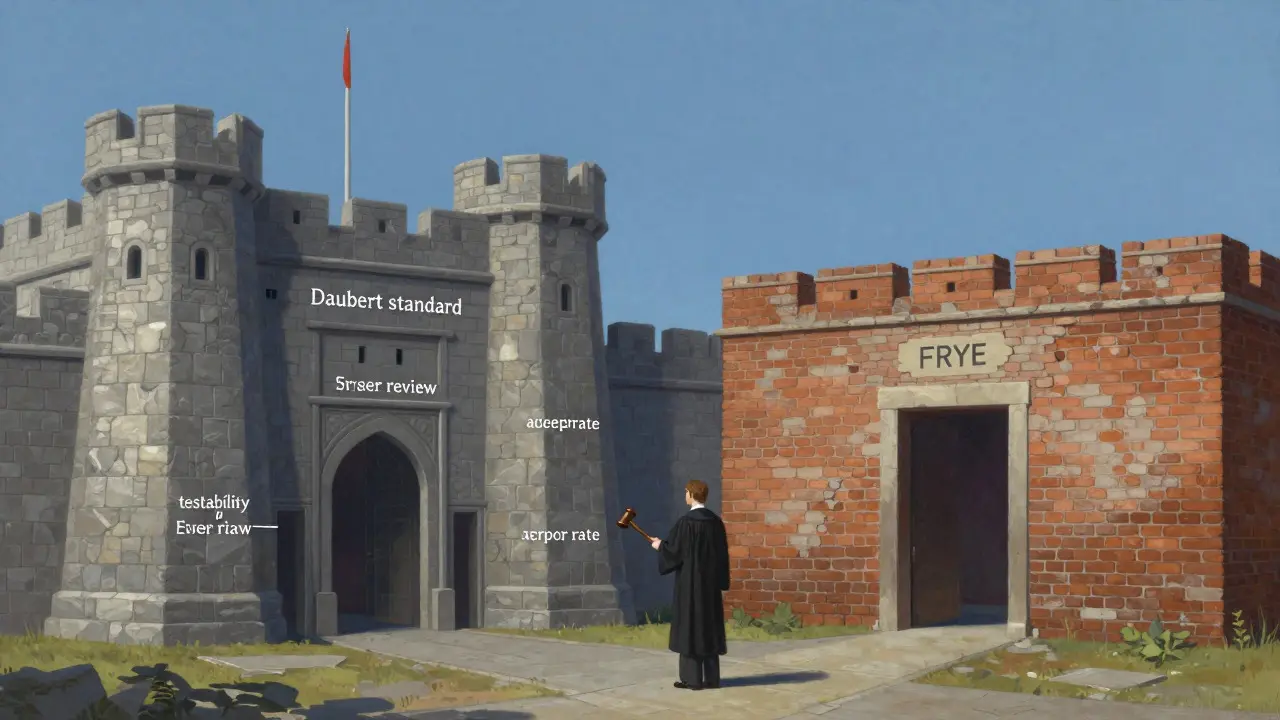
Daubert Standard is the federal rule and the standard adopted by most U.S. states, requiring judges to act as gatekeepers who ensure expert testimony is both relevant and reliable. It stems from the 1993 Supreme Court case Daubert v. Merrell Dow Pharmaceuticals. Under this standard, a judge looks at four non-exclusive factors:
- Testability: Can the theory be tested? Is it falsifiable?
- Peer Review: Has the method been subjected to scrutiny by other professionals in the field?
- Error Rate: Do we know how often the method is wrong? (A known error rate is crucial.)
- General Acceptance: Is the technique widely accepted in the relevant scientific community?
Frye Standard, named after the 1923 D.C. Circuit case Frye v. United States, is a stricter, older test still used in a minority of jurisdictions like New York and Pennsylvania, focusing solely on whether the scientific technique is generally accepted in its particular field. Unlike Daubert, Frye doesn't explicitly require the judge to evaluate the specific methodology's reliability in the current case, only its standing in the broader community. However, even in Frye states, if the technique is novel or controversial, the court will likely dig deeper than just asking "is everyone using this?"
| Feature | Daubert Standard | Frye Standard |
|---|---|---|
| Origin | U.S. Supreme Court (1993) | D.C. Circuit Court (1923) |
| Jurisdiction Scope | Federal Courts & ~70% of States | New York, Pennsylvania, & a few others |
| Primary Focus | Reliability of the specific method used | General acceptance in the scientific community |
| Judge's Role | Active Gatekeeper (evaluates data/methodology) | Passive Arbiter (checks community consensus) |
| Error Rate Requirement | Highly relevant factor | Not explicitly required |
Anatomy of a Qualified Expert: Beyond the Degree
A PhD on the wall doesn’t automatically qualify someone. Courts look at the totality of the individual’s background. When evaluating potential witnesses, lawyers and clients should look for a combination of academic training, practical experience, and professional recognition.
- Education: Formal degrees in the relevant field (e.g., a Master’s in Forensic Accounting for financial fraud cases). While not always mandatory, higher education provides a baseline of theoretical knowledge.
- Experience: The number of years spent applying the specific technique. A software engineer with 15 years of database recovery experience may be better qualified to testify on data integrity than a computer science professor who has never worked in IT operations.
- Publications: Peer-reviewed articles, books, or white papers demonstrate that the expert’s views are grounded in research, not just opinion.
- Certifications: Industry-specific credentials (like ABFN for forensic nursing or CFE for accounting) signal adherence to professional standards.
- Prior Testimony: A history of successful cross-examination without being discredited adds weight. Conversely, a pattern of exclusions is a red flag.
It’s also worth noting the distinction between a fact witness and an expert witness. A fact witness testifies to what they saw or did (e.g., "I drove the car"). An expert witness testifies to what their expertise allows them to conclude (e.g., "Based on the skid marks, the car was traveling at 45 mph"). Mixing these roles up is a common error that leads to objections.
The Disclosure Process: Where Cases Are Won or Lost
Qualifications aren’t just about what the expert says in court; they’re established long before trial through discovery. Federal Rule of Civil Procedure 26(a)(2) and similar state rules require parties to disclose their expert witnesses early in the litigation process.
This disclosure usually takes the form of a written report signed by the expert. It must include:
- A complete statement of all opinions the expert will express and the basis for them.
- The facts or data considered in forming those opinions.
- Any exhibits used to summarize or support the opinions.
- The expert’s qualifications, including a list of all publications in the preceding ten years.
- A list of all other cases in which the expert testified during the past four years.
- The fee structure (hourly rate, flat fee, etc.).
If an expert fails to disclose a new opinion or a change in their view, they might be barred from testifying on that topic at trial. This is why the initial consultation between the attorney and the expert is critical. You need to align on the scope of work so the final report matches the testimony exactly.
Common Pitfalls That Lead to Exclusion
Even highly credentialed experts get thrown out of cases. Here are the most frequent reasons why:
1. Speculation Masquerading as Science If an expert uses a method that hasn’t been validated in real-world scenarios, or if they extrapolate far beyond the data they have, the opposing counsel will attack the reliability. For example, using a statistical model designed for large populations to analyze a single small dataset might fail the Daubert test for error rates.
2. Lack of Independence While experts are hired by one side, they are officers of the court. If an expert appears to be tailoring their opinion to please the client rather than the truth, credibility evaporates. Judges look for bias indicators, such as consulting fees paid directly by the party versus neutral retainer agreements.
3. Ignoring Alternative Explanations A robust expert analysis considers competing hypotheses. If an expert ignores a plausible alternative explanation simply because it favors the other side, their objectivity is called into question.
4. Outdated Methods Science moves fast. Using a testing protocol that was abandoned five years ago because of high error rates can be fatal to admissibility. Always ensure the methodology reflects current best practices.
How to Vet an Expert Before Retention
Don’t just hire the first name you find online. Use this checklist to screen potential witnesses:
- Request a CV: Look for consistency in their field. Frequent job changes across unrelated industries can raise questions about depth.
- Check Prior Depositions: If available, read transcripts of their previous depositions. Did they hold firm under pressure? Did they admit to errors honestly?
- Ask About Error Rates: If they can’t cite a known error rate for their method, ask why. Silence here is dangerous.
- Verify Certifications: Ensure their licenses are current and in good standing with the relevant state board or professional body.
- Conduct a Mock Cross-Examination: Have a colleague role-play the opposing counsel. See how the expert handles aggressive questioning about their assumptions.
Specialized Fields and Specific Standards
Some fields have additional layers of qualification due to the high stakes involved.
In Forensic DNA Analysis, for instance, the National Academy of Sciences has issued reports highlighting issues with interpretation. Experts in this field are increasingly expected to use probabilistic genotyping software and understand the limitations of mixed profiles. A simple "match