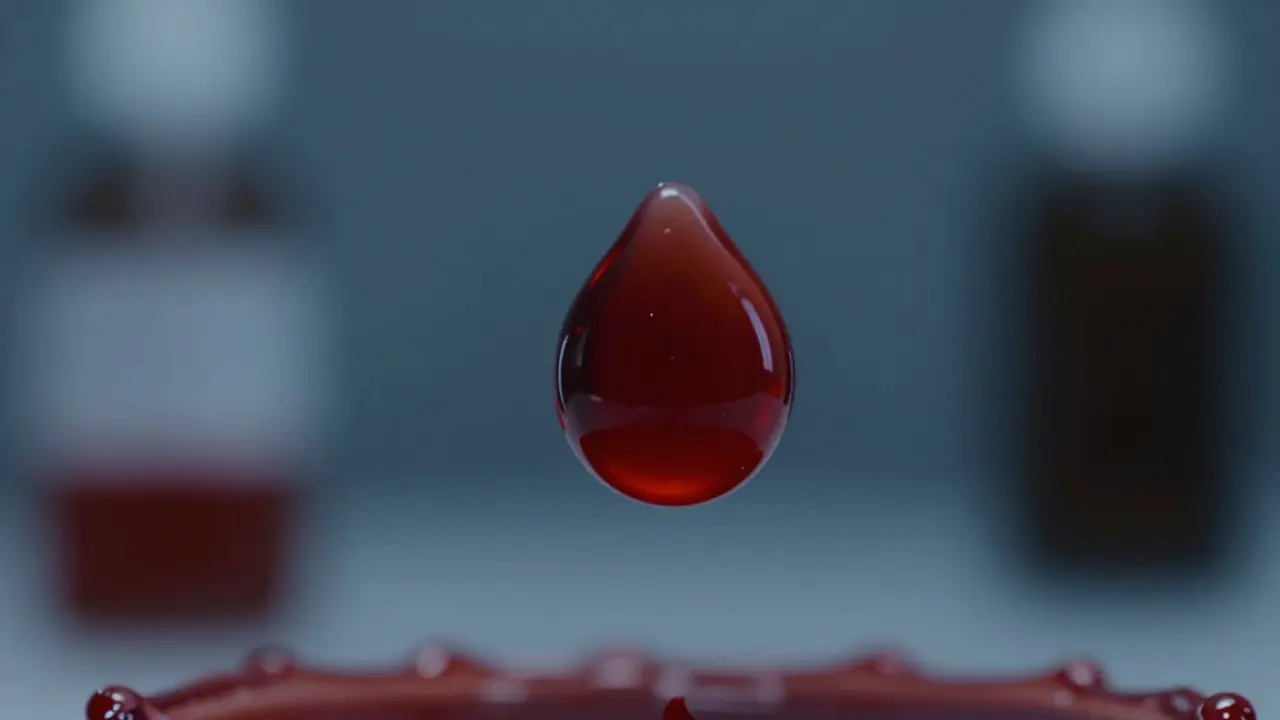
Have you ever watched a drop of water hit a tile floor? It splatters. Now imagine that drop is blood. It’s wetter, heavier, and it has to interact with your body’s chemistry before it even touches the ground. Understanding how bloodstain patterns form requires looking at two distinct forces working together: the physical laws of fluid dynamics and the biological processes of human physiology.
When investigators reconstruct a crime scene, they aren't just guessing. They are reading a story written in physics. A single stain can tell you where a victim was standing, how fast an object moved, and whether the injury happened while the person was alive or after death. This guide breaks down the mechanics behind those marks, moving from the moment a vessel ruptures to the final shape on the wall.
The Biological Trigger: Hemolysis and Coagulation
Blood isn't just a liquid; it's a complex suspension. Before we talk about how it moves, we need to understand what happens when it leaves the body. The primary biological event is hemolysis, which is the rupture of red blood cells that releases hemoglobin into the plasma. In a living person, this triggers the clotting cascade almost immediately.
This process involves several key proteins. Fibrinogen is a soluble plasma protein converted by thrombin into insoluble fibrin strands during clot formation. These strands create a mesh that traps platelets and red blood cells, forming a stable clot. If you look at a fresh wound, you see this happening in real-time. However, if the blood is sprayed onto a surface, there isn't enough time for a full clot to form before the droplets land. Instead, you get partial coagulation, which affects the viscosity of the individual droplets.
Viscosity matters. Whole blood has a viscosity roughly four times higher than water. This means it resists flow more strongly. When a high-velocity force hits arterial blood, the pressure can be as high as 100 mmHg (millimeters of mercury). This pressure doesn't just push blood out; it atomizes it. The biological composition determines the size of the resulting particles, which directly dictates the pattern type you will see later.
The Physics of Impact: Surface Tension and Velocity
Once blood leaves the body, biology takes a back seat, and physics takes the wheel. The most critical concept here is surface tension, which is the property of a liquid's surface that allows it to resist an external force due to cohesive forces between molecules. For blood, this tension helps hold droplets together until they hit a target.
When a droplet strikes a surface, its kinetic energy must overcome this surface tension. If the energy is low, the droplet stays round. If the energy is high, it shatters into secondary droplets. This is known as satellite spatter. The relationship between velocity and stain size is inverse: faster impacts create smaller stains.
- Low Velocity (<5 ft/s): Produces large drops (greater than 4mm diameter). Think of a dripping faucet or a passive bleed.
- Medium Velocity (5-25 ft/s): Creates medium-sized drops (1-4mm). This is typical of blunt force trauma, like a punch or a swing with a baseball bat.
- High Velocity (>25 ft/s): Results in fine mist-like stains (less than 1mm). This usually indicates gunshot wounds or heavy beating with a rigid object.
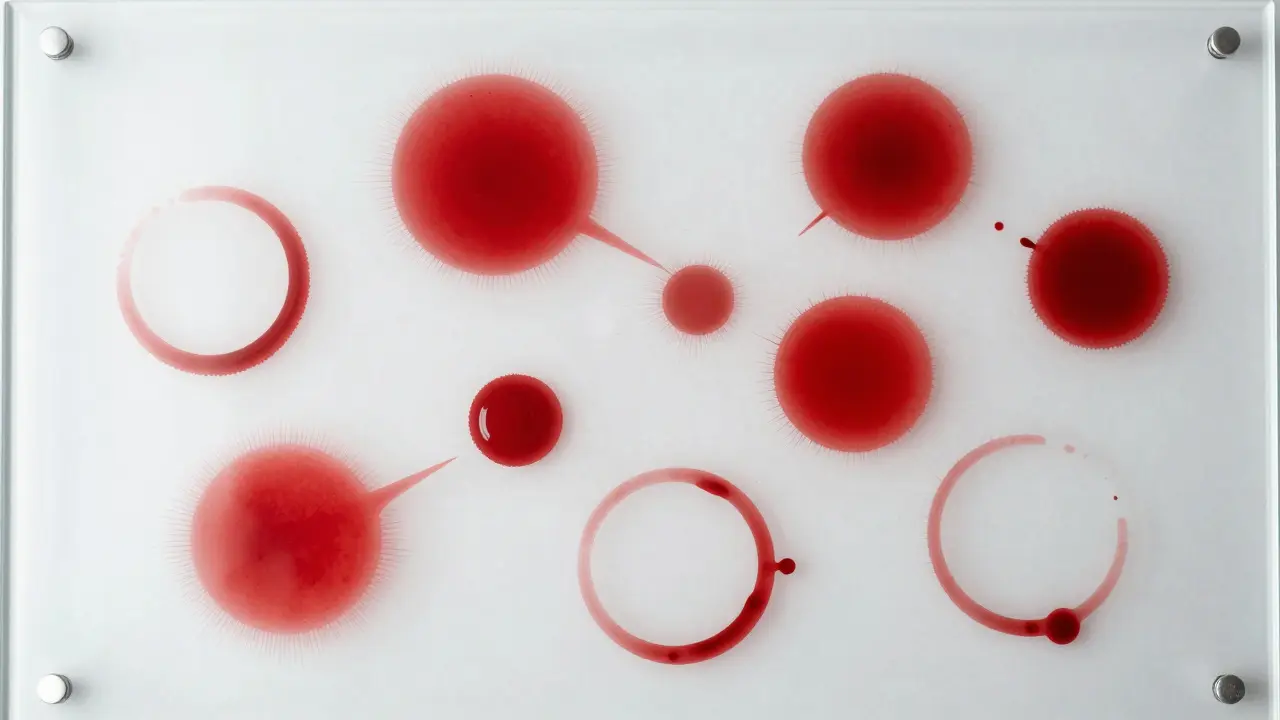
Another crucial physical factor is the angle of impact. When a droplet hits a surface straight on (90 degrees), it forms a perfect circle. But if it hits at a shallow angle, say 30 degrees, it stretches into an ellipse. By measuring the width and length of this ellipse, experts can calculate the exact angle using trigonometry. Specifically, the sine of the angle equals the ratio of the minor axis (width) to the major axis (length).
Pattern Formation: From Droplet to Evidence
Individual droplets don't exist in isolation; they form groups called patterns. The three main categories are passive, impact, and transfer patterns. Each tells a different part of the story.
Passive patterns occur when gravity pulls blood downward. This includes drips, pools, and flows. If you see a series of drops getting larger as they move down a wall, you're looking at a drip trail. The distance between drops increases because the blood accelerates under gravity. This is simple physics: $d = \frac{1}{2}gt^2$. Investigators use these trails to determine how long a victim stood in one spot or how they moved through a room.
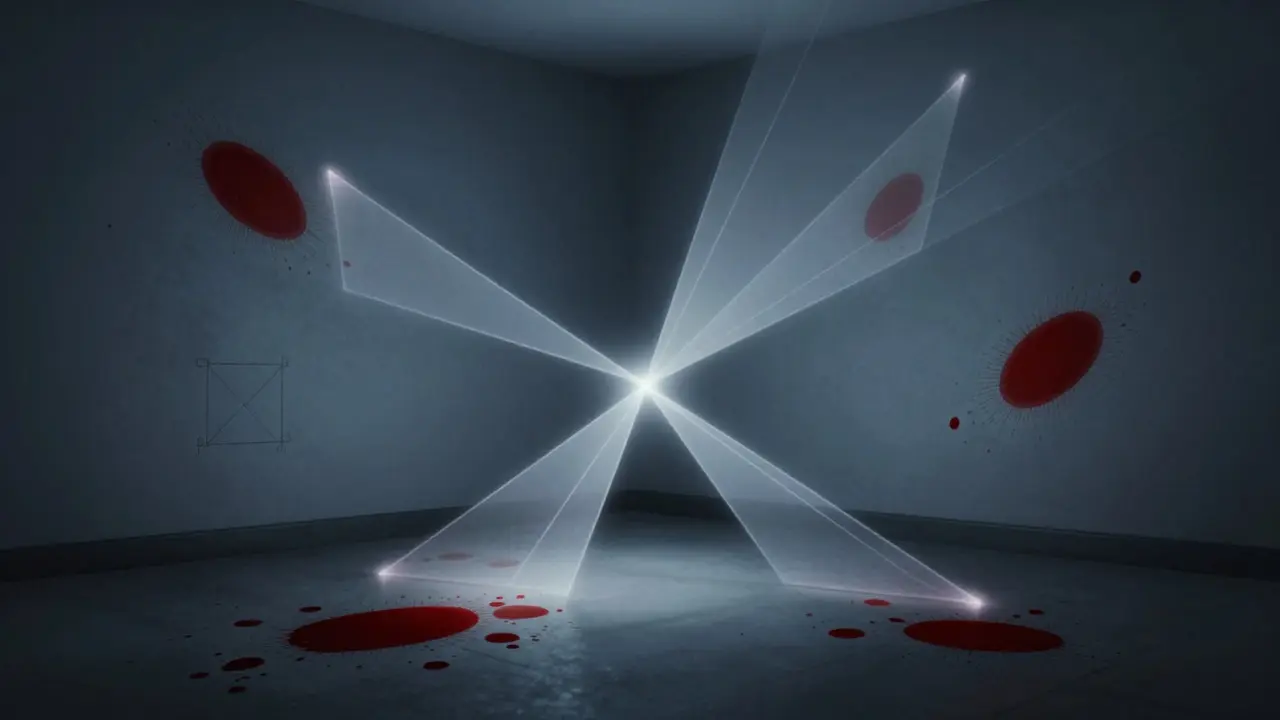
Impact patterns are created by force. This is where the velocity classifications come into play. An impact spatter pattern radiates outward from the source. By drawing lines along the long axes of elliptical stains and finding where they converge in 3D space, you locate the area of convergence. Combining this with the angle calculations gives you the area of origin-the exact point in space where the blood was generated.
Transfer patterns happen when a bloody object touches a clean surface. This creates a print, similar to a fingerprint but with blood. You might see a shoe print, a handprint, or the edge of a weapon. Unlike impact spatter, transfer patterns retain the specific shape of the object that made them. They are often found on clothing, floors, or walls near where a struggle occurred.
Surface Interaction: How Materials Change Stains
The surface itself plays a massive role in how a stain looks. Not all surfaces are created equal. A drop of blood hitting concrete behaves very differently than one hitting carpet or glass.
| Surface Type | Texture Characteristic | Stain Appearance | Forensic Implication |
|---|---|---|---|
| Porous (Carpet/Fabric) | Absorptive, fibrous | Rounded, feathered edges | Harder to measure angles; capillary action spreads stain |
| Non-Porous (Glass/Metal) | Slick, non-absorptive | Sharp, defined edges | Ideal for precise angle and direction analysis |
| Rough (Concrete/Brick) | Uneven, granular | Irregular, broken shapes | Distorts true shape; requires careful interpretation |
On porous surfaces like carpet, capillary action wicks the blood into the fibers. This causes the stain to spread out and lose its original shape. The edges become fuzzy or "feathered." On non-porous surfaces like glass or polished metal, the blood sits on top. The surface tension holds the droplet together, preserving the elliptical shape needed for accurate angle calculations. This is why investigators often look for spatter on walls or windows first-they offer the clearest data.
Temperature also plays a subtle role. Cold blood has higher viscosity than warm blood. If a victim is killed in winter, the initial spatter might be slightly different than in summer, though this effect is minor compared to velocity and surface texture. More importantly, environmental conditions affect preservation. High humidity can slow drying, allowing secondary movement of the stain, while dry air fixes the stain quickly.
Interpreting the Scene: Putting It All Together
So, how do you actually use this information? You start by documenting everything. Photographs, measurements, and sketches are essential. Then, you classify each stain. Is it passive, impact, or transfer? Once classified, you group them into patterns. Next, you perform the math. You measure the dimensions of the elliptical stains, calculate the angles, and project the lines back in 3D space to find the origin.
Consider a scenario where a victim is struck with a hammer. You would expect medium-velocity impact spatter radiating from the head area. If the blow was severe, you might see high-velocity mist on the ceiling. If the victim fell, you'd see passive drips leading away from the point of impact. By mapping these patterns, you can reconstruct the sequence of events: the strike, the fall, and the final position.
It’s not just about where the blood went; it’s about where it didn’t go. Missing patterns can indicate that something was moved or cleaned. A lack of spatter on a wall where you expect it suggests the victim wasn't facing that direction, or the area was wiped clean. Negative evidence is just as powerful as positive evidence in forensic reconstruction.
Frequently Asked Questions
What is the difference between active and passive bloodstains?
Active bloodstains are formed when blood is expelled from the body under pressure, such as from a pulsing artery. Passive bloodstains are formed when blood falls or flows due to gravity alone, like a drip from a wound. Active stains tend to be smaller and more numerous, while passive stains are larger and follow vertical paths.
How does the angle of impact affect the shape of a bloodstain?
The angle of impact determines the elongation of the stain. A direct hit (90 degrees) creates a circular stain. As the angle becomes shallower, the stain stretches into an ellipse. The lower the angle, the more elongated the ellipse becomes. Forensic scientists use the ratio of the width to the length to calculate the exact angle.
Can bloodstain patterns prove guilt in court?
Bloodstain pattern analysis is rarely used as sole proof of guilt. Instead, it is used to corroborate other evidence. It can confirm or contradict witness statements, verify the location of a victim, and establish the mechanism of injury. Its value lies in its ability to reconstruct the physical dynamics of an event objectively.
What role does viscosity play in bloodstain formation?
Viscosity is the resistance of a fluid to flow. Higher viscosity makes it harder for blood to break apart into small droplets. Since whole blood is more viscous than water, it forms larger droplets at the same velocity. Changes in viscosity due to temperature or dilution can alter the size and distribution of the resulting pattern.
Why do some bloodstains have tails?
Tails on bloodstains indicate the direction of travel. The tail points in the direction the droplet was moving when it hit the surface. This is particularly useful in determining the path of a projectile or the direction of a swing. The tail forms because the rear of the droplet continues to move forward after the front has impacted the surface.