When a forensic pathologist walks into an exam room to investigate a death by neck compression, the clock starts ticking immediately. The difference between Hanging, defined as death caused by the gravitational drag of the body weight on a ligature, and Ligature Strangulation, where external force tightens the cord without suspension, is often a matter of life and legal consequence. One is typically classified as suicide; the other, homicide. Misclassifying them isn't just an academic error-it can mean sending an innocent person to prison or letting a killer walk free.
You might think the presence of a rope around the neck makes the cause obvious, but the mechanics are deceptively complex. Both involve Mechanical Asphyxia, a broad category of death resulting from physical obstruction of breathing or blood flow. However, the source of that force-gravity versus human hands-leaves distinct biological signatures. In this guide, we break down exactly what you look for in the ligature mark, internal injuries, and scene context to tell these two apart with confidence.
The Physics of Force: Gravity vs. External Pressure
Before you even touch the body, you have to understand the physics at play. In a typical suicidal Hanging, the victim’s own body weight provides the constricting force. This creates a specific vector of pressure: downward and upward toward the point of suspension. Whether it is complete hanging (no part of the body touches the ground) or incomplete hanging (feet or knees touch the surface), the tension is generated by gravity pulling against a fixed anchor point like a beam or door handle.
In contrast, Ligature Strangulation involves no suspension. The force comes from an assailant pulling, twisting, or wrapping the ligature tighter. Sometimes machinery is involved in accidental cases, but in forensic practice, this usually means another person applied manual force. Because there is no single point of suspension pulling the knot up, the pressure is distributed differently around the neck. This fundamental mechanical difference dictates every subsequent finding you will see in the autopsy suite.
Analyzing the Ligature Mark: The First Clue
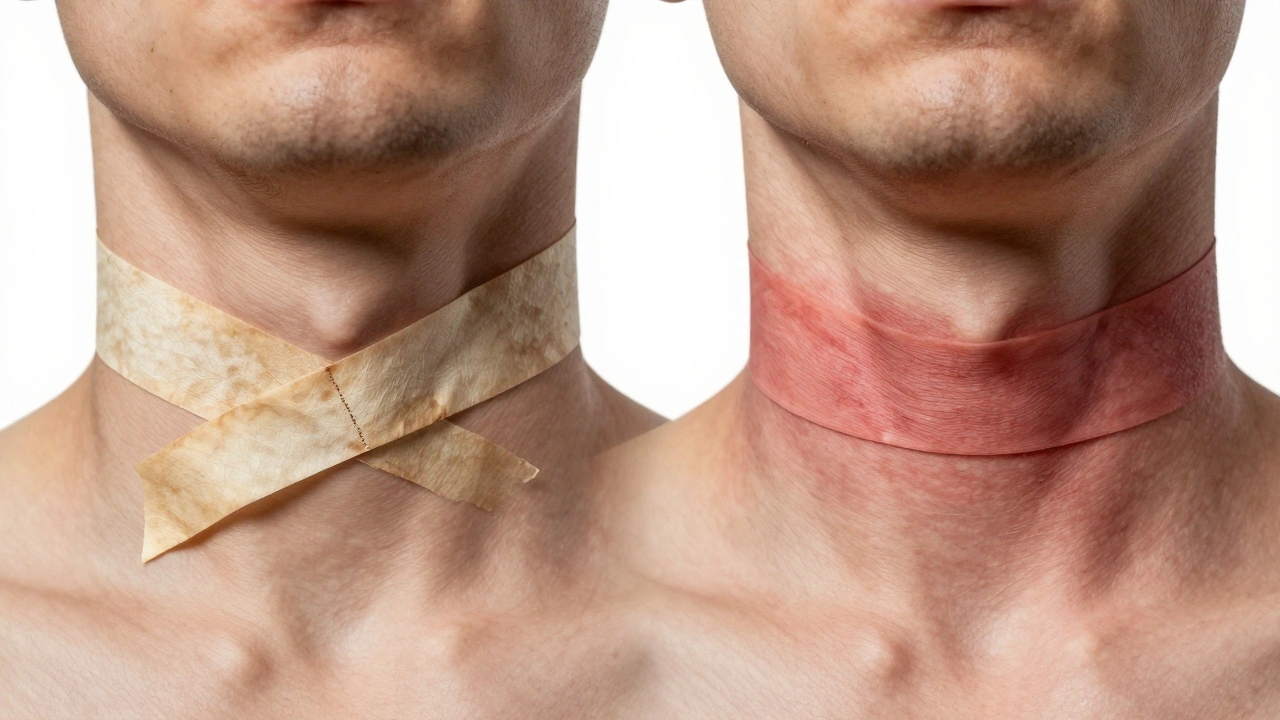
The external ligature mark is your most immediate evidence. It tells a story about how the rope sat on the skin while the victim was alive. In Hanging, the mark is rarely a perfect circle. Why? Because the body swings slightly after suspension, or the knot pulls one side higher than the other. You will typically find an oblique, slanted mark that runs upward toward the knot. There is often a gap in the mark at the site of suspension where the rope didn't press directly into the flesh.
- Position: High on the neck, usually above the laryngeal prominence (Adam's apple).
- Appearance: Parchment-like, dry, and abraded. It looks brownish and leathery because the skin dries out under tension.
- Continuity: Often incomplete due to the gap near the knot.
Now look at Ligature Strangulation. Here, the mark is almost always horizontal and transverse, circling the entire neck evenly. Since the assailant pulls from multiple angles or wraps the cord completely, there is no "gap." The mark sits lower, often at or below the level of the thyroid cartilage. Unlike the dry, parchment-like groove of hanging, the strangulation mark is deeper, bruised, and shows significant subcutaneous hemorrhage. If you see a full ring of deep bruising low on the neck, your suspicion for homicide should skyrocket.
| Feature | Hanging (Suicidal) | Ligature Strangulation (Homicidal) |
|---|---|---|
| Orientation | Oblique, slanting upward to the knot | Horizontal, transverse around the neck |
| Position | High, above the thyroid cartilage | Low, at or below the thyroid cartilage |
| Continuity | Often incomplete (gap at suspension point) | Continuous, encircling the neck fully |
| Skin Texture | Parchment-like, dry, abraded | Bruised, hemorrhagic, moist |
| Depth | Superficial groove | Deep, well-defined groove |

Internal Neck Injuries: Depth Matters
Once you document the external marks, you move to the dissection. This is where the truth often hides. In many suicidal hangings, especially among younger victims, the internal damage is surprisingly minimal. The rapid loss of consciousness due to carotid artery occlusion means the victim doesn't struggle long enough to cause massive tissue tearing. You might find some strap muscle hemorrhages, but fractures of the Hyoid Bone or Thyroid Cartilage are less common unless the victim is elderly and their laryngeal skeleton has calcified.
In homicidal Ligature Strangulation, the story changes drastically. An attacker applies sustained, crushing force. This results in extensive deep tissue damage. You will frequently encounter severe hemorrhaging in the neck muscles (sternocleidomastoid and strap muscles). More importantly, fractures of the hyoid bone and thyroid cartilage are hallmark signs of adult strangulation. A study published in the journal *Insight* found that combining these internal findings with ligature mark patterns could distinguish hanging from strangulation with 97% sensitivity. If you see shattered cartilage and deep muscle tears, you are likely looking at a violent assault, not a peaceful suicide.
Facial Appearance and Petechiae
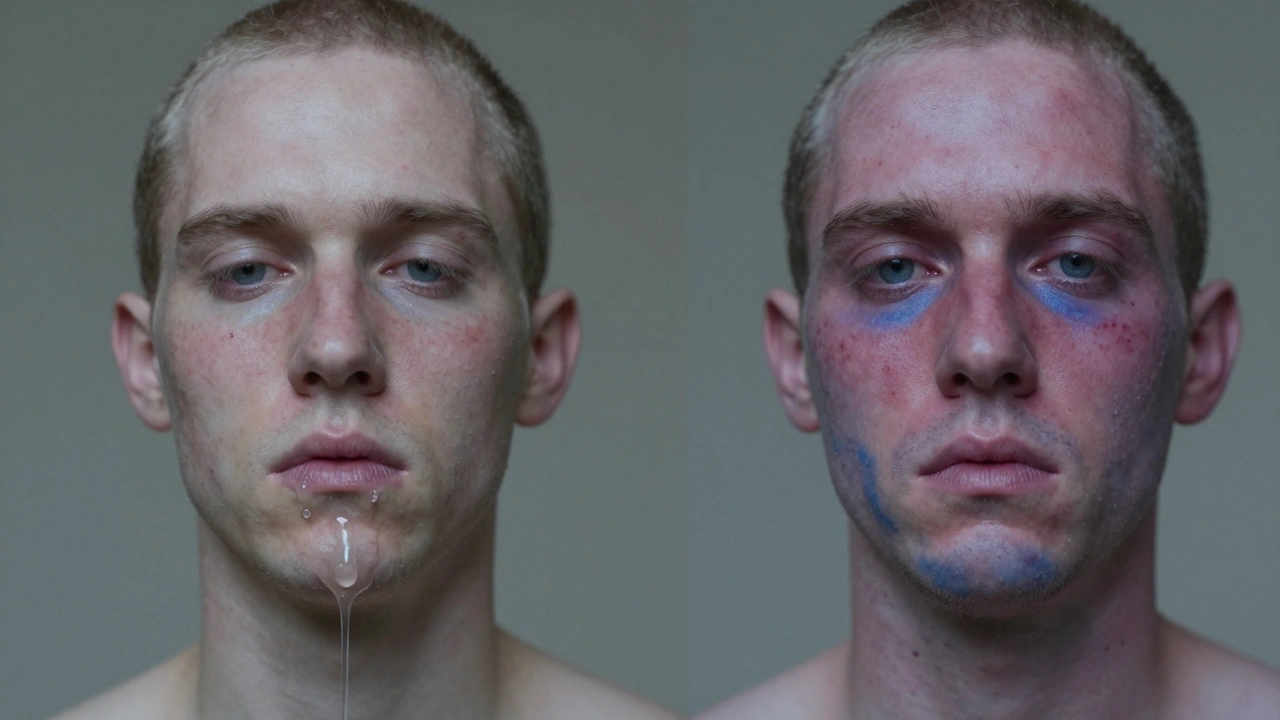
Look at the face. In hanging, the face is often pale. Why? Because the carotid arteries are compressed quickly, cutting off blood supply to the brain and face before venous congestion can build up significantly. You might also notice a trickle of saliva dribbling from the corner of the mouth-a classic sign of antemortem hanging caused by relaxation of facial muscles and gravity.
Strangulation presents a different picture. The compression often obstructs the jugular veins first, trapping blood in the head. This leads to a congested, swollen, cyanotic (blue/purple) face. You will see prominent Petechial Hemorrhages-tiny red dots-in the conjunctivae of the eyes, the facial skin, and the oral mucosa. These petechiae result from the rupture of small capillaries due to high venous pressure. While petechiae can appear in hanging, they are far more consistent and pronounced in strangulation. Their absence, combined with minimal muscle hemorrhage, strongly supports a diagnosis of suicide.
Scene Context and Defensive Injuries
Autopsy findings don't exist in a vacuum. You must correlate them with the crime scene. In hanging, you look for a point of suspension. Is there a beam, a fan, or a window grille? Are there footprints or objects used to elevate the victim? Crucially, you check for defensive injuries. In straightforward suicides, there are none. The victim does not fight themselves.
In Ligature Strangulation cases, the scene often tells a story of struggle. Look for scratches on the victim's neck or hands, broken fingernails, or bruises on the upper limbs. These indicate the victim tried to pull the ligature away or fend off the attacker. Additionally, toxicology plays a role. Homicidal strangulations sometimes involve sedatives or alcohol to incapacitate the victim beforehand, whereas suicidal hangings may show intoxication but rarely the specific pattern of forced sedation seen in assaults. Always remember: presumptions are starting points, not rules. Accidental hangings happen, and staged scenes occur. But the combination of horizontal marks, deep internal trauma, petechiae, and defensive wounds paints a clear picture of homicide.
Can a hyoid bone fracture occur in hanging?
Yes, but it is less common than in strangulation. Hyoid fractures in hanging are typically seen in older adults whose laryngeal structures have ossified (hardened) with age. In younger victims, hanging rarely causes hyoid fractures unless the drop was extremely high (judicial hanging), which is distinct from typical suicidal suspension.
What is the significance of the 'parchment-like' ligature mark?
A parchment-like mark is a dried, brownish, abraded appearance of the skin within the ligature groove. It is highly characteristic of hanging. It forms because the ligature compresses the skin tightly against underlying structures, causing the epidermis to dry out and separate from the dermis during the period of suspension. This feature is rarely seen in strangulation, where the mark is usually bruised and hemorrhagic.
How do petechiae help distinguish between hanging and strangulation?
Petechiae are tiny bleeding spots caused by ruptured capillaries due to venous congestion. They are very common in ligature strangulation because the jugular veins are often compressed before arterial flow stops, trapping blood in the head. In hanging, arterial flow is cut off rapidly, so significant congestion and petechiae are often absent or mild. Their presence strongly favors strangulation.
Is it possible for a hanging to be homicidal?
Yes. While hanging is predominantly suicidal, homicidal hangings do occur. Perpetrators may stage a scene to look like suicide. However, these staged scenes often lack the precise biomechanical consistency of true hanging, such as appropriate suspension points or natural ligature mark gaps. Forensic pathologists must look for inconsistencies, such as defensive wounds or drug-induced incapacitation, to identify these rare cases.
Why is the position of the ligature mark important?
The position indicates the direction of force. In hanging, the body weight pulls the ligature upward toward the point of suspension, placing the mark high on the neck, above the Adam's apple. In strangulation, the force is applied horizontally or from below, often pushing the ligature down onto the thyroid cartilage or lower. A high, oblique mark suggests hanging; a low, horizontal mark suggests strangulation.