When a body is found with a rope or cord around the neck, the immediate question isn't just "how did they die?" but "what kind of force killed them?" In forensic pathology, this distinction is critical. We are looking at two specific mechanisms: Hanging, defined as asphyxia caused by the gravitational weight of the body tightening a constricting band, and Ligature Strangulation, where external pressure is applied to the neck by something other than the body's own weight. Getting this right matters because it often points directly to whether a death was a suicide, a homicide, or an accident. You cannot rely on a single clue; you have to look at the whole picture.
The difference comes down to physics and anatomy. In a typical suicidal hanging, gravity pulls the body down, which pulls the ligature up and tight. This creates a specific vector of force. In ligature strangulation, usually inflicted by another person, the force is applied horizontally and circumferentially, squeezing the neck from all sides. These different forces leave very different marks on the skin and inside the neck structures. As forensic pathologists, we act as detectives, reading these physical clues to reconstruct the final moments of a victim's life.
The Ligature Mark: Position and Orientation
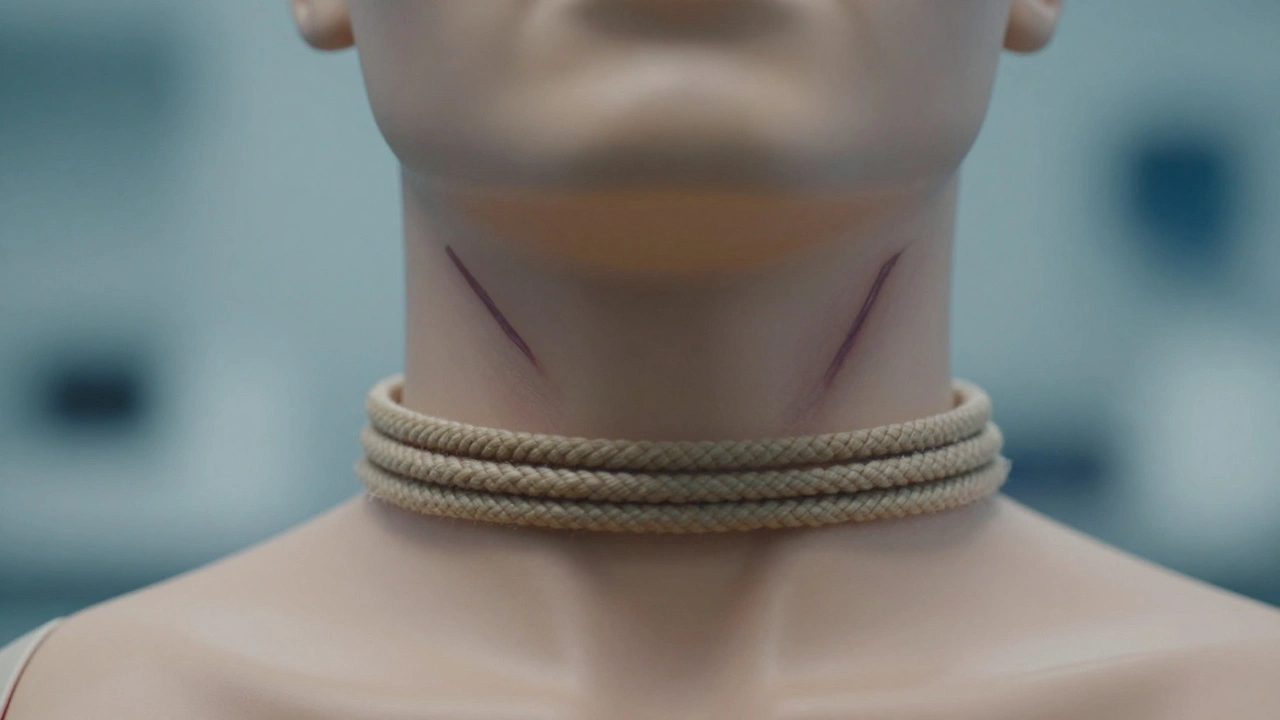
The most visible clue during an external examination is the ligature mark-the groove or abrasion left by the cord on the skin. Where this mark sits on the neck tells us a lot about how the force was applied. In classic suicidal hangings, the knot is usually high, often behind the ear or at the top of the head. This means the ligature rides up toward the suspension point. Studies, including a significant 2015 autopsy series, show that in about 80% of hanging cases, the ligature mark is located above the thyroid cartilage (the laryngeal prominence, or Adam's apple).
In contrast, ligature strangulation typically leaves a mark below the thyroid cartilage. In that same 2015 study, 100% of the ligature strangulation cases had marks situated below the thyroid cartilage. Why? Because when someone strangles another person, they usually wrap the ligature around the lower part of the neck for better leverage and control. So, if you see a high, upper-neck mark, think hanging. If you see a low, mid-to-lower neck mark, suspect ligature strangulation.
But position isn't the only factor. The angle of the mark-its obliquity-is equally important. In hanging, the mark is rarely perfectly horizontal. It slants upward toward the knot. This oblique pattern reflects the pull of gravity lifting the ligature. In ligature strangulation, the mark tends to be transverse, running horizontally around the neck at roughly the same level. A high, oblique mark strongly favors hanging. A low, horizontal mark strongly favors strangulation.
Continuity and Skin Changes
Look closely at the continuity of the mark. In many hanging cases, the ligature mark is discontinuous. There is often a gap at the point where the knot rests against the skin or where the suspension point lifts the ligature away from the neck. This break in the groove is highly suggestive of hanging. However, don't rule out hanging just because the mark is continuous; partial hangings or certain knot types can create continuous marks.
Ligature strangulation marks are more likely to be continuous and encircling. They may also appear multiple times if the attacker adjusted the grip or pulled repeatedly. While single marks are common in both (93% of strangulation cases in the 2015 study had single marks), multiple marks almost always point to strangulation.
Skin texture changes also offer clues. In hanging, you might see parchmentization-a dry, stiff, yellow-brown abrasion caused by the friction and pressure of the ligature during suspension. This is less common in strangulation. Instead, strangulation victims often show more prominent petechial hemorrhages (tiny red spots) on the face and eyes. This happens because the horizontal squeezing cuts off venous blood flow from the brain while arterial blood continues to pump in, causing small vessels to burst. In many typical hangings, especially those involving rapid unconsciousness, these facial signs are less severe or absent.
| Feature | Hanging (Typical Suicidal) | Ligature Strangulation (Typical Homicidal) |
|---|---|---|
| Mark Position | Above thyroid cartilage (80%) | Below thyroid cartilage (100% in studies) |
| Orientation | Oblique (slanting up to knot) | Horizontal (transverse) |
| Continuity | Often discontinuous (gap at knot) | Usually continuous and encircling |
| Petechiae | Frequent absence or mild | Frequent and prominent |
| Skin Texture | Parchmentization common | Less parchmentization, more bruising |
Internal Neck Injuries: Hemorrhage and Fractures
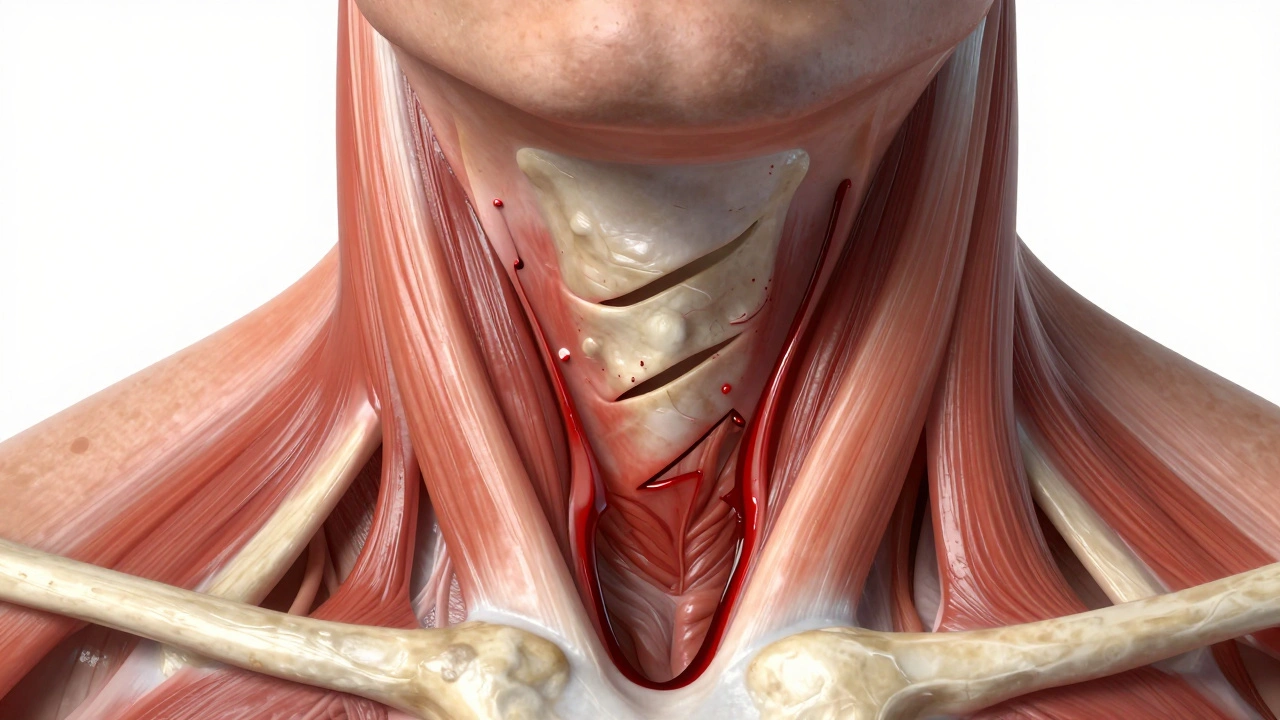
Once the external exam is done, we move to the internal dissection. This is where we look for damage deep inside the neck. The intensity of the force differs greatly between the two mechanisms. Ligature strangulation involves active, sustained squeezing, often resulting in significant soft-tissue trauma. You will frequently find extensive hemorrhages in the strap muscles and the sternocleidomastoid muscles. In contrast, suicidal hanging often shows minimal or no deep muscle hemorrhage. The force is distributed differently, and unconsciousness can occur before severe tissue damage happens.
Fractures are another major indicator. The hyoid bone and the thyroid cartilage are fragile structures in the neck. In older adults, these bones become more brittle. A study comparing suicidal hangings and homicidal strangulations found that fractures of the hyoid bone and laryngeal cartilages were much more common in ligature strangulation cases. The direct, concentrated pressure of a strangulation attack is more likely to snap these bones than the pulling force of a typical hanging. If you find a fractured hyoid bone combined with a horizontal ligature mark and deep muscle bleeding, the evidence strongly supports ligature strangulation.
Vascular injuries, such as intimal tears in the carotid arteries, can occur in both scenarios due to stretching or compression. However, these are harder to detect without specialized dissection techniques and are not always present. Therefore, while valuable, they are not the primary tool for differentiation in routine autopsies.

Contextual Clues: Toxicology and Defensive Injuries
An autopsy doesn't happen in a vacuum. We must integrate findings with the scene investigation and toxicology results. One of the strongest indicators of homicidal ligature strangulation is the presence of defensive injuries. Victims who are being strangled often fight back. Look for bruises, abrasions, or scratches on the hands, forearms, and arms. These suggest the victim tried to grab the attacker or remove the ligature. Suicidal hangings almost never feature defensive wounds.
Toxicology plays a surprising role here too. In some homicide cases, perpetrators use sedatives to subdue the victim before applying the ligature. A comparative study noted that sedative drugs were detected exclusively in their homicide cases (ligature strangulation) and not in the suicidal hangings. While not every strangulation involves drugging, finding unexpected levels of tranquilizers or alcohol in a case suspected of being a simple hanging should raise red flags and prompt a deeper investigation into potential foul play.
The Danger of Overlap and Staged Scenes
We have to be careful. Nature is messy, and criminals try to hide their tracks. There is significant overlap in findings. Partial hangings, where the feet touch the ground, can produce horizontal marks at mid-neck levels, mimicking strangulation. Conversely, a murderer might suspend a body after strangling it to make it look like a suicide. This staging can confuse the picture.
Decomplication also obscures evidence. As a body decomposes, ligature marks fade, and internal hemorrhages break down. In these cases, relying on a single sign is dangerous. Forensic consensus emphasizes that no single finding is pathognomonic (absolutely diagnostic). You need the totality of evidence. A high, oblique mark with no defensive injuries and no deep neck hemorrhage points to hanging. A low, horizontal mark with petechiae, hyoid fracture, and defensive wounds points to strangulation. When the signs conflict, the scene context becomes king.
Can a ligature mark alone determine if a death was hanging or strangulation?
No. While the position and orientation of the ligature mark are strong indicators, they are not definitive on their own. For example, a partial hanging can mimic the horizontal mark of strangulation. Forensic pathologists must combine ligature mark analysis with internal neck findings, toxicology results, and scene investigation to reach a conclusion.
Why are hyoid bone fractures more common in ligature strangulation?
Ligature strangulation involves direct, circumferential squeezing pressure on the neck, often at the level of the hyoid bone and larynx. This concentrated force is more likely to fracture these delicate structures than the upward-pulling gravitational force typical of suicidal hanging, especially in younger individuals with more flexible bones.
What is the significance of petechial hemorrhages in neck compression deaths?
Petechiae are tiny broken blood vessels caused by increased pressure in the veins of the head and neck. They are more frequent and prominent in ligature strangulation because the horizontal compression obstructs venous return while arterial inflow continues. In many hangings, unconsciousness occurs rapidly, sometimes preventing the buildup of pressure needed to cause widespread petechiae.
How does toxicology help distinguish between hanging and strangulation?
Toxicology can reveal if the victim was incapacitated before death. Studies have shown that sedatives or tranquilizers are more likely to be found in cases of homicidal ligature strangulation, suggesting the perpetrator subdued the victim. Their absence doesn't prove suicide, but their presence in a suspected hanging case warrants further investigation into potential homicide.
What are defensive injuries, and why do they matter?
Defensive injuries are wounds on the hands, arms, or forearms caused by a victim trying to protect themselves or remove a weapon/ligature. They are highly indicative of a struggle. Since suicidal hangings involve self-inflicted restraint without resistance, the presence of defensive injuries strongly supports a diagnosis of homicidal ligature strangulation.