Imagine a crime scene where a few drops of blood on a wall are the only clues to where a struggle took place. Forensic analysts use these stains to backtrack the trajectory of the blood, aiming to find the exact spot-the point of origin-where the impact occurred. It sounds like a precise science, but here is the problem: a tiny error in measuring a single bloodstain can shift the calculated origin by several inches, or even feet. This is where measurement uncertainty comes into play. It isn't just about a shaky hand with a ruler; it is a complex mix of physics, biology, and human perception that can make or break a legal case.
For years, the field has relied on the idea that bloodstains are basically ellipses. By measuring the width and length, you can use trigonometry to find the angle of impact. But as reports from the National Research Council and the President's Council of Advisors on Science and Technology (PCAST) have pointed out, the uncertainties in this process are often enormous. If the math is based on flawed measurements, the resulting "scientific" conclusion is more of an opinion than a fact.
The Ripple Effect of Measurement Errors
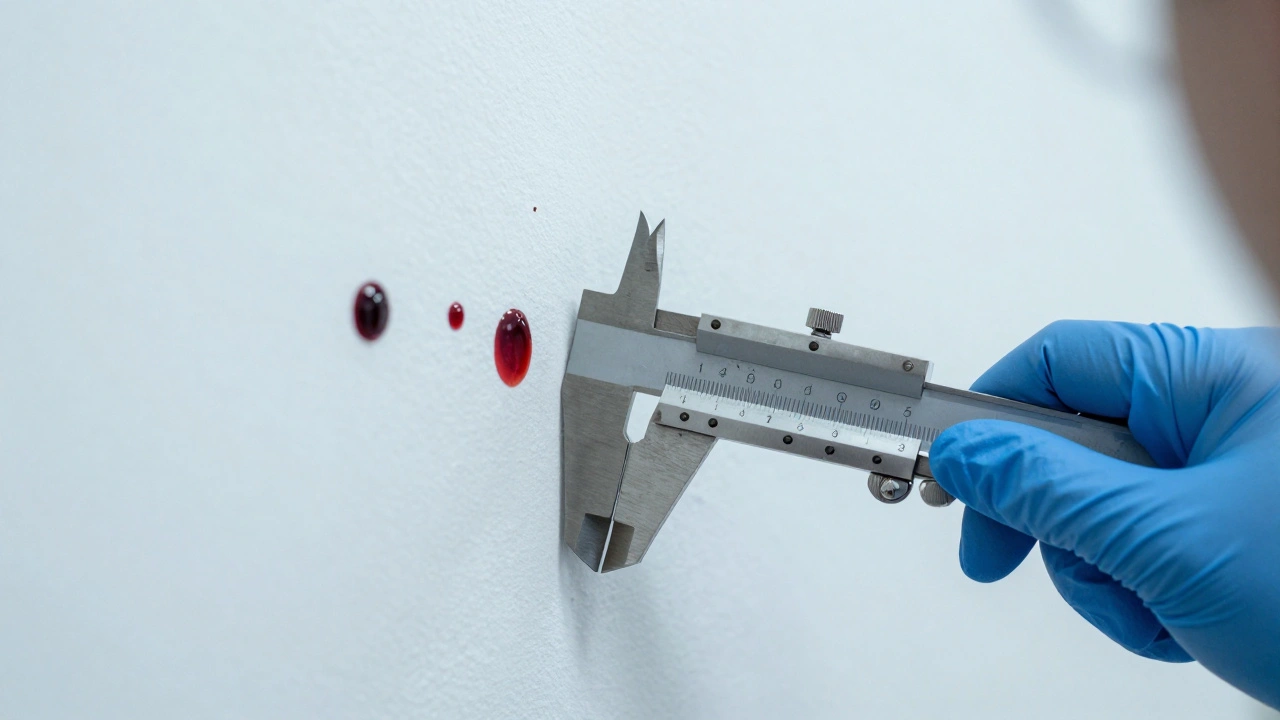
Most uncertainty starts at the very beginning: the measurement of the stain itself. In a real-world field setting, analysts typically aim for a precision of 1/10 millimeter. While that sounds tight, even these tiny deviations create a ripple effect. For instance, a study comparing the traditional Tangent Method with HemoSpat a specialized software for bloodstain pattern analysis showed that measurement errors can lead to deviations of about 5.94% in the X coordinate of the area of origin.
When you look at the actual numbers, it's easy to see how this happens. An average decrease in stain width of just 0.08 millimeters or an increase in length of 0.09 millimeters might seem irrelevant, but when these numbers are plugged into a trigonometric formula and projected back across a room, the differences add up. In some cases, the gap between different calculation methods for the X coordinate reached as high as 5.04 inches. While some argue these shifts don't change the overall interpretation of a scene, they certainly complicate the ability to say exactly where a victim was standing.
Why the Angle of Impact Changes Everything
Not all bloodstains are created equal. The amount of error you encounter depends heavily on the angle at which the blood hit the surface. When blood hits a wall at a shallow angle (below 60 degrees), it creates a distinct elongated ellipse. These are actually the easiest to measure, with most errors staying within 2 degrees of the actual angle.
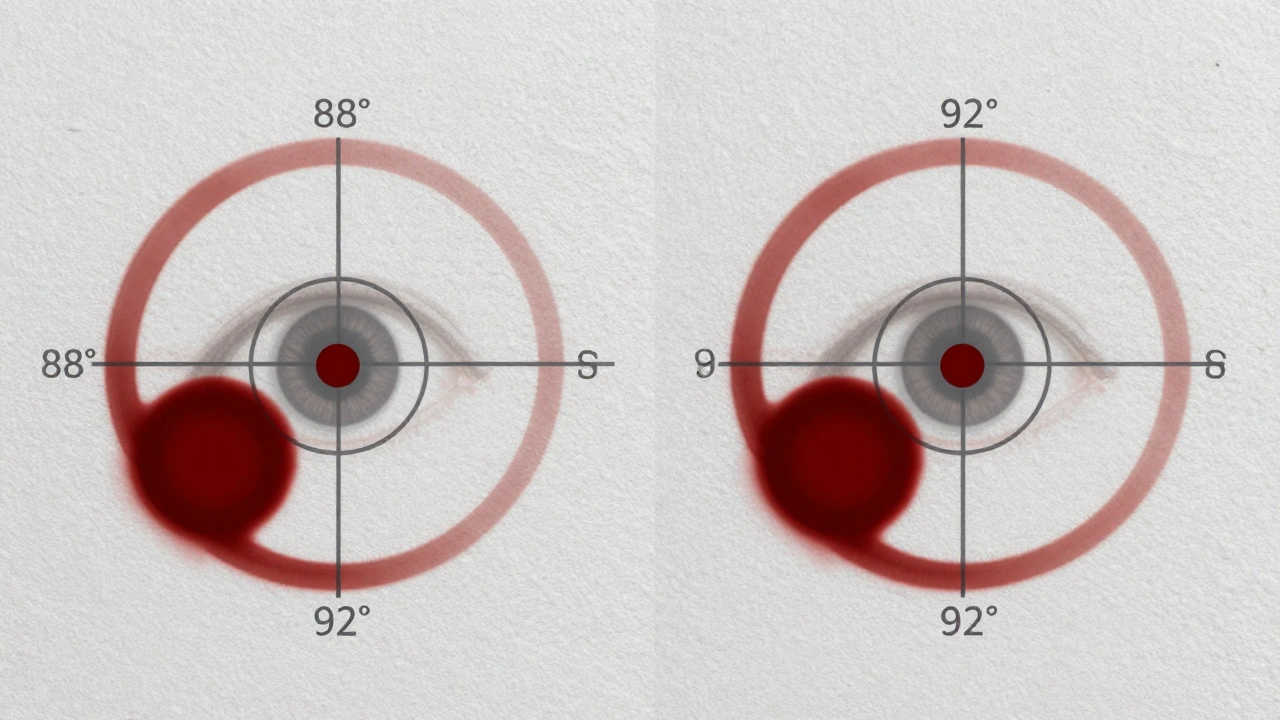
The real trouble starts as the angle gets steeper. When blood hits a surface at nearly 90 degrees, the stain looks like a circle. It is incredibly hard for the human eye to distinguish a perfect circle from an ellipse that is just slightly off. A blind study of 101 people showed that for these high-angle stains, errors often exceeded 7 degrees. Because the risk of outliers spikes as you move toward 90 degrees, you can't just apply one standard "error margin" to every stain. The uncertainty is dynamic; it changes based on the shape of the drop.
| Impact Angle | Stain Shape | Typical Error Margin | Reliability Level |
|---|---|---|---|
| Below 60° | Elongated Ellipse | Within 2° | High |
| 60° to 89° | Oval/Circular | Variable / Increasing | Moderate |
| ~90° | Circular | Can exceed 7° | Low |
Straight Lines vs. Real-World Physics
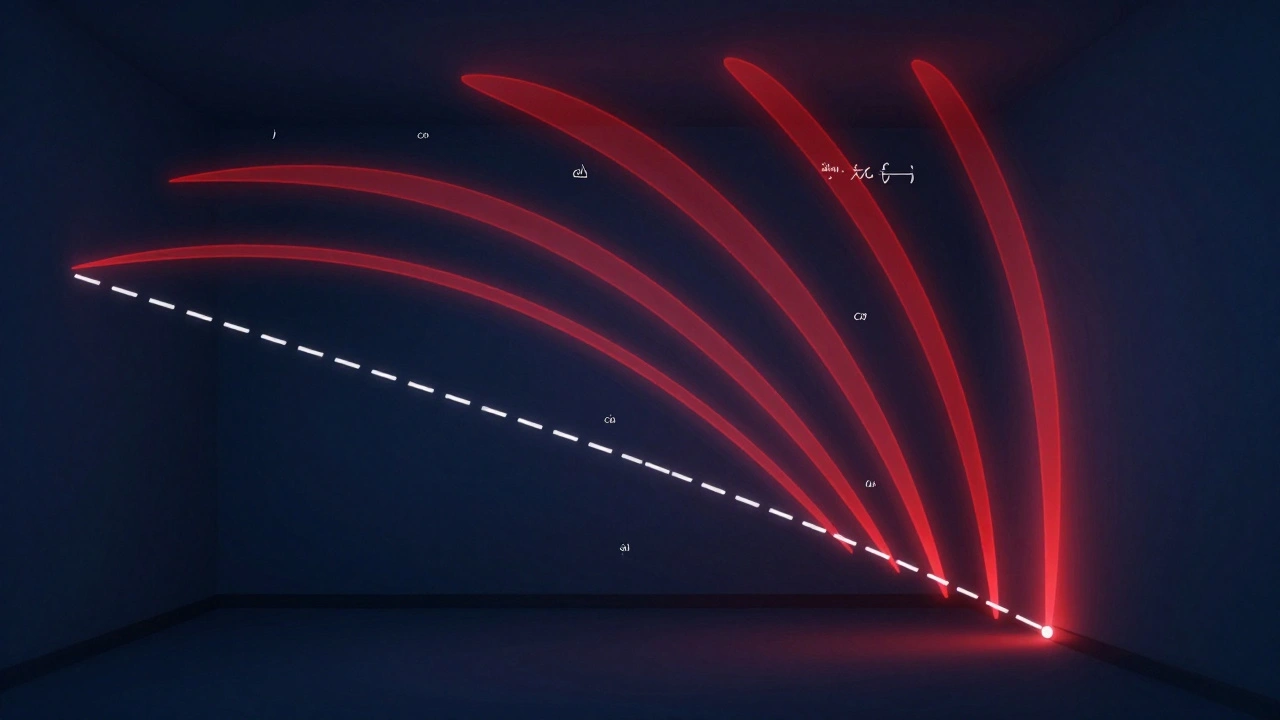
For a long time, analysts used the "straight-line approximation," assuming blood travels in a perfectly straight path from the source to the wall. It's simple math, but it ignores two massive factors: gravity and air drag. When you ignore these, you get results that are precise (meaning you get the same answer every time) but inaccurate (meaning that answer is wrong).
Consider a scenario where the actual origin height was 58.5 centimeters. The straight-line method calculated it at 91.1 centimeters-an overestimation of over 27 centimeters. However, when analysts used a model that included gravity, the calculated height was 58.5 centimeters, missing the mark by only 5.2 centimeters. That is a massive jump in accuracy. Interestingly, the more complex gravity-based models can actually have a larger standard deviation because they are more sensitive to the initial measurements of width and volume. But that's a trade-off worth making, because the true origin actually falls within the margin of error for these complex models, whereas it's completely outside the range for the straight-line method.
The Hidden Variables: Volume and Biology
Measuring the length and width of a stain is only half the battle. To calculate the velocity of the impact, you need to know the volume of the blood drop. But bloodstains dry, and as they dry, they shrink. This introduces a new layer of uncertainty.
To fix this, researchers use a calibrated drying ratio a mathematical constant used to estimate the original volume of a blood droplet from its dried state. Even with a perfect 3D scan of a dried stain, there is a biological wildcard: hematocrit. This is the proportion of red blood cells in the blood. Since hematocrit varies from person to person, the way blood dries also varies. This means that even if your measurements are perfect, the biological difference between two people can introduce uncertainty into your velocity calculations.
The Human Factor and Reproducibility
If the math and biology were the only problems, we could solve them with better software. But the most concerning part of measurement uncertainty is how different analysts interpret the same data. In a "black box" study, it was found that analysts' conclusions didn't match the known cause of a stain about 11% of the time. More worrying is that about 8% of the time, two different analysts looking at the same evidence came to contradictory conclusions.
What's truly startling is the rate of corroborated error. When an analyst got the answer wrong, a second analyst agreed with that wrong answer 18% to 34% of the time. This suggests that some errors aren't just random accidents-they are systematic. If two experts agree on a wrong conclusion, it's much harder to challenge in court, which creates a significant risk for the legal system.
Moving Toward Standardization
The forensic community is finally moving toward a more honest accounting of these errors. The OSAC Organization of Scientific Area Committees, which develops standards for forensic science has introduced the "Method for Measuring a Spatter Stain" (document OSAC 2024-S-0020). This isn't just a how-to guide; it specifically addresses measurement uncertainty and limitations.
One of the key factors now recognized is surface texture. A blood drop on smooth glass behaves very differently than one on a porous carpet. By acknowledging that the surface affects the stain's dimensions, OSAC is helping the field move away from "gut feeling" interpretations and toward a quantifiable, scientific approach. The goal is to ensure that when an expert stands in front of a jury, they can say not just "the origin was here," but "the origin was here, with a calculated uncertainty of X centimeters."
Why is the 90-degree impact angle so difficult to measure?
At 90 degrees, bloodstains are nearly perfect circles. Because the human eye and standard measuring tools struggle to differentiate between a perfect circle and a very slight ellipse, a small error in marking the edges can lead to a significant error (sometimes over 7 degrees) in the calculated angle of impact.
What is the difference between the Tangent Method and HemoSpat?
The Tangent Method is a traditional trigonometric approach to find the point of origin. HemoSpat is a software tool that can process multiple stains and incorporate more complex data. Studies show that while both can be affected by measurement error, software-assisted analysis can help quantify the deviations in X, Y, and Z coordinates more precisely.
How does gravity affect bloodstain calculations?
Blood does not travel in a straight line; it follows a parabolic arc due to gravity. The "straight-line approximation" ignores this, often overestimating the height of the origin (sometimes by 20-30 cm). Models that include gravity are significantly more accurate, bringing the calculated height much closer to the actual origin.
Does a person's blood type or health affect measurement uncertainty?
Yes, specifically through the hematocrit value (the concentration of red blood cells). Because different people have different hematocrit levels, the drying ratio of the blood changes. This introduces biological uncertainty when trying to estimate the original volume of a droplet from a dried stain.
What is the OSAC 2024-S-0020 document?
It is a standardized method for measuring spatter stains developed by the Organization of Scientific Area Committees. It provides guidelines on how to handle measurements and explicitly requires analysts to consider the limitations and uncertainties associated with different surface textures and porosities.