When a structure burns down or explodes, the aftermath looks chaotic. Debris is scattered, walls are charred, and the air smells like smoke and something else-often sulfur or rotten eggs. For most fires, investigators look for accelerants like gasoline. But when gas and propane fires are involved, the rules change completely. These incidents aren't just about what burned; they are about what leaked, where it accumulated, and why it ignited. Getting this wrong can mean blaming arson when it was actually a faulty regulator, or missing a criminal act because the evidence was destroyed by an explosion.
Investigating these specific types of fires requires a blend of traditional fire scene analysis and specialized forensic engineering. You cannot rely solely on visual cues because gas behaves differently than liquid fuels. It expands, it sinks or rises depending on density, and it can explode before a fire even fully develops. This article breaks down the specific methods used to determine the origin and cause of methane and liquefied petroleum gas (LPG) incidents, ensuring you understand how professionals separate accident from negligence or intent.
The Science of Gas Behavior in Fires
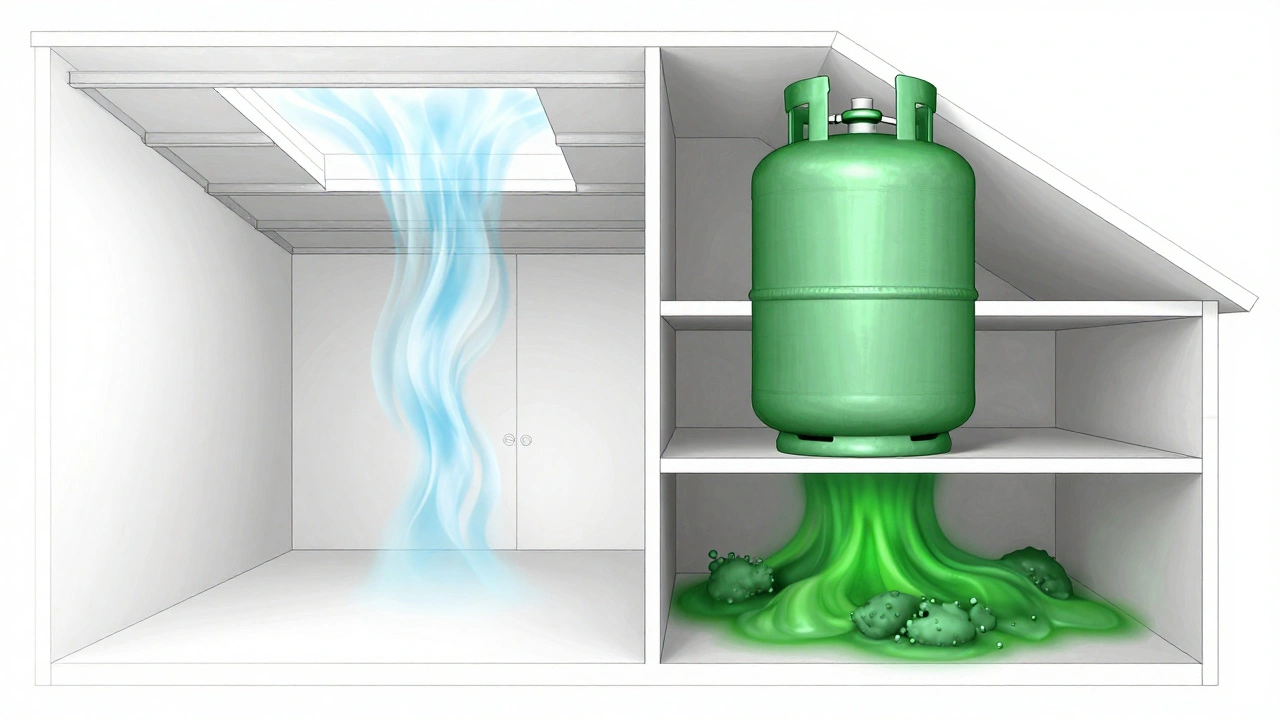
Before stepping onto a scene, an investigator must understand the physics of the fuel. Natural gas is primarily methane, which is lighter than air. When it leaks, it rises toward the ceiling, attic spaces, or roof voids. Propane, part of liquefied petroleum gas (LPG), is heavier than air. It pools low, settling into basements, crawl spaces, and floor drains. This fundamental difference dictates where you look for the source and where the damage will be most severe.
In many cases, these gases do not burn immediately upon leaking. Instead, they mix with oxygen to form a combustible cloud. If this mixture reaches its flammable range-between the lower explosive limit (LEL) and upper explosive limit (UEL)-and encounters an ignition source, a diffuse-phase explosion occurs. Unlike a fire that grows slowly, consuming furniture and drywall, a diffuse explosion happens in milliseconds. The result is often massive structural damage with surprisingly little charring near the leak source. Investigators frequently find windows blown out and walls pushed outward, while the interior remains relatively clean compared to a flashover fire. Recognizing this pattern is the first step in identifying a gas-related incident.
Scene Safety and Atmospheric Monitoring
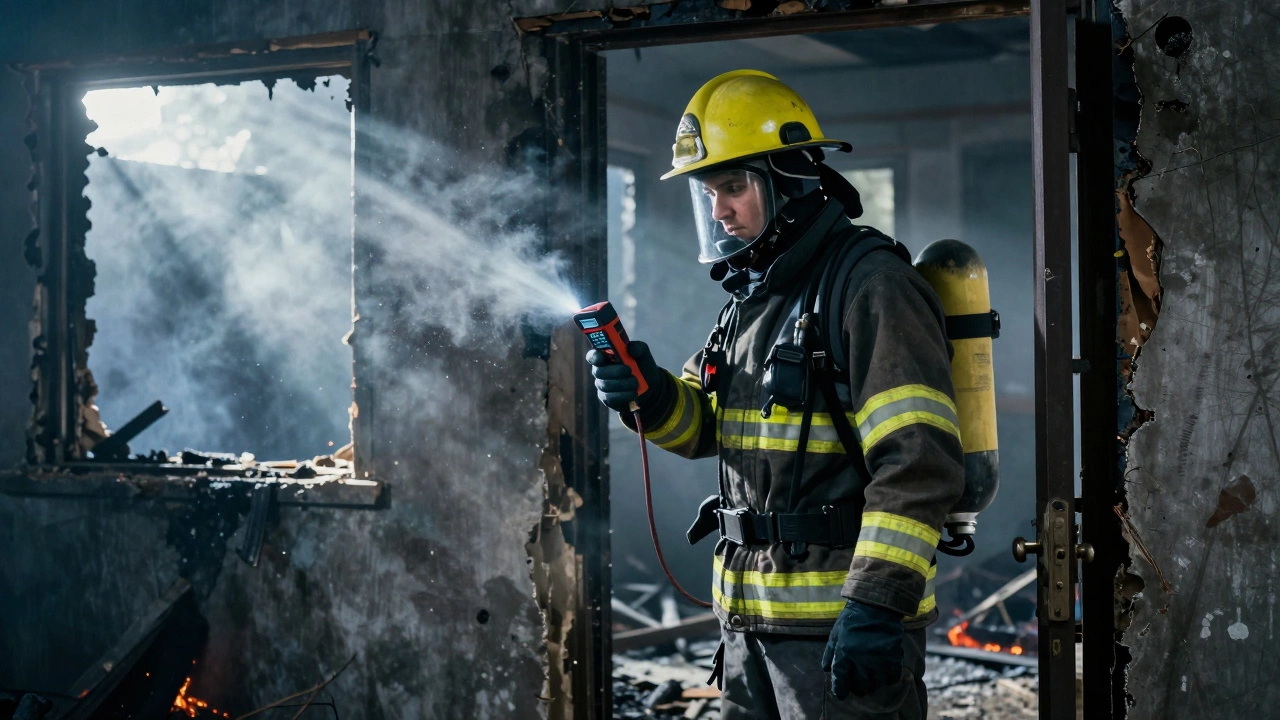
Safety is not just a protocol; it is the foundation of the investigation. Entering a structure with residual gas can turn an investigator into a victim. The International Association of Fire Chiefs (IAFC) mandates strict procedures for these scenarios. Before anyone enters, structures must be evacuated, and isolation zones established based on wind direction. Responders wear full personal protective equipment (PPE) and self-contained breathing apparatus (SCBA).
The critical tool here is the combustible gas indicator (CGI). However, using one correctly requires technical knowledge. Most CGIs are calibrated to detect methane. If you are investigating a propane leak, the meter’s reading will be inaccurate unless you apply the manufacturer’s conversion factor. Propane has a different molecular weight and combustion characteristic than methane. Failing to adjust for this can lead to false negatives, giving investigators a dangerous sense of security. Air monitoring starts from the exterior safe zone and progresses inward, checking every room, closet, and utility space until the atmosphere is confirmed safe or the source is located.
| Characteristic | Methane (Natural Gas) | Propane (LPG) |
|---|---|---|
| Air Density | Lighter than air (rises) | Heavier than air (sinks) |
| Accumulation Zone | Ceilings, attics, roof voids | Floors, basements, crawl spaces |
| Common Leak Sources | Pipe joints, service lines, meters | Regulators, flexible hoses, tank valves |
| Detection Calibration | Standard CGI calibration | Requires conversion factor adjustment |
| Odorant Fade Risk | Low | High (especially in confined spaces) |
Pattern Analysis: Distinguishing Gas from Liquid Accelerants
Visual inspection remains a core skill, but gas fires create unique signatures that differ significantly from ordinary combustibles or liquid accelerants. The NIST Handbook 134 provides guidelines on interpreting these patterns. In a typical wood-frame fire, you see V-shaped patterns on walls, indicating heat flow upward from a point source. A narrow, sharp V-pattern suggests a fast, hot fire, while a wide, diffuse V indicates slower development.
However, gas explosions disrupt these classic patterns. Because the pressure wave travels faster than the flame front, you may see widespread blast damage with limited burning near the origin. Conversely, if the gas ignites without exploding, it creates a "flash fire" that burns rapidly across surfaces. Investigators must distinguish this from pool fires caused by liquid accelerants. Flammable liquids leave oval or irregular burn patterns on floors, often with deep char rings. Gas fires, particularly those involving propane in confined spaces, can cause spalling in concrete-a phenomenon where the surface layers of concrete pop off due to intense, rapid heating. This is a key indicator of high-heat events associated with gas deflagrations rather than standard structural fires.
Forensic Testing of Gas Systems
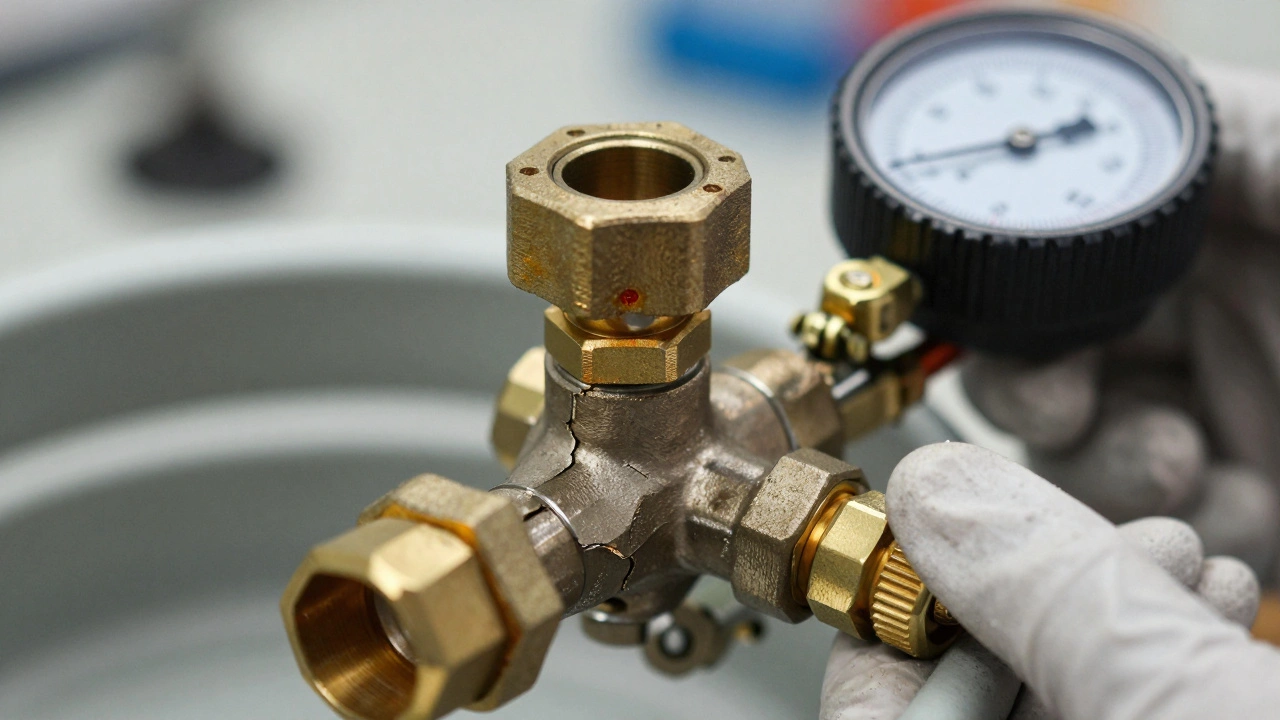
Once the area of origin is identified, the focus shifts to the fuel delivery system. This phase involves rigorous forensic engineering techniques. Investigators examine piping, hoses, regulators, valves, and appliance connections. Common failure points include cracked rubber hoses, improperly crimped fittings, and failed regulator diaphragms. Thread sealants applied incorrectly can also degrade over time, leading to slow leaks.
Testing goes beyond visual inspection. Pressure testing checks for integrity under load, while flow testing ensures components operate within design parameters. In complex cases, firms like AEI Corporation and Bison Engineering perform bench examinations, removing components to test them in controlled environments. They may attempt to duplicate the incident scenario by recreating gas flow rates and ignition sequences. This scientific approach helps validate or refute hypotheses about mechanical failure versus external tampering.
Appliance Combustion Analysis
Not all gas fires start with a leak. Sometimes, the issue lies within the appliance itself. Furnaces, water heaters, and stoves require proper combustion to operate safely. Improper mixing of air and fuel can lead to incomplete combustion, producing carbon monoxide and unburned hydrocarbons. Over time, this can ignite nearby combustibles or create conditions for a backdraft.
Post-incident analysis often includes flue gas analysis. Technicians use electronic analyzers to measure stack gas composition, looking for levels of carbon monoxide, oxygen, and unburned hydrocarbons. High CO levels indicate poor combustion efficiency. Additionally, inspectors check heat exchangers for cracks, which allow exhaust gases to escape into the living space. Draft and venting evaluations ensure that combustion products are properly expelled. These tests help determine if the fire originated from internal equipment malfunction or an external gas leak.
Hypothesis Testing and the Scientific Method
The gold standard for fire investigation is adherence to the scientific method, as outlined in NFPA 921. This guide emphasizes hypothesis testing and the elimination of alternatives. Investigators cannot simply guess the cause; they must prove it through evidence.
In gas and propane cases, this means systematically ruling out other possibilities. If a diffuse explosion occurred, investigators must first evaluate all potential natural gas or LPG sources. Only after exhausting these possibilities can they consider volatile liquid accelerants. This process prevents premature conclusions. Witness interviews play a crucial role here, providing context about recent repairs, odors detected, or unusual appliance behavior. Cross-referencing testimony with physical testing ensures that the final determination is robust and defensible in court.
Special Considerations: Odorant Fade and Confined Spaces
One deceptive aspect of propane investigations is odorant fade. Propane is naturally odorless, so ethyl mercaptan is added to give it that distinct rotten egg smell. However, in certain conditions-such as long pipeline transport or soil contact-the odorant can degrade or "scrub" away. Occupants may fail to smell the gas, allowing dangerous concentrations to accumulate unnoticed. Investigators must explore this possibility, especially in cases where residents report no smell despite significant damage.
Confined spaces, like food trucks or small kitchens, exacerbate these risks. The National Association of Fire Investigators (NAFI) highlights that mobile LPG systems in food trucks involve cylinders, regulators, and flexible hoses in tight quarters. A minor leak can quickly fill the space, leading to catastrophic ignition. Pre-incident planning and regular maintenance checks are vital in these environments to prevent such tragedies.
What is the primary difference between investigating a natural gas fire and a propane fire?
The main difference lies in the gas density. Natural gas (methane) is lighter than air and accumulates in upper areas like ceilings and attics. Propane is heavier than air and settles in low areas like basements and floor drains. This dictates where investigators search for the leak source and where atmospheric monitoring is most critical.
Why is NFPA 921 important in gas fire investigations?
NFPA 921 establishes the scientific method as the benchmark for fire and explosion investigations. It requires investigators to form hypotheses and eliminate alternative causes based on physical evidence. In gas cases, this means rigorously testing for gas leaks and system failures before considering arson or accelerants.
How do investigators detect residual gas at a fire scene?
Investigators use combustible gas indicators (CGIs) and multi-gas meters. They start monitoring from a safe exterior position and move inward. Crucially, if detecting propane, they must apply a conversion factor to the meter reading since most devices are calibrated for methane. Photoionization detectors (PIDs) may also be used to screen for trace hydrocarbons.
What does a diffuse-phase explosion look like compared to a standard fire?
A diffuse-phase explosion typically causes extensive structural damage, such as blown-out windows and displaced walls, with relatively limited localized burning near the source. In contrast, a standard fire shows progressive charring, V-patterns on walls, and heavy smoke staining. The explosion’s pressure wave travels faster than the flame, disrupting typical burn patterns.
What is odorant fade, and why does it matter?
Odorant fade is the loss of the added smell (ethyl mercaptan) in propane due to chemical reactions during transport or storage. It matters because occupants may not smell a leak, allowing gas to accumulate to explosive levels without warning. Investigators must consider this when residents claim they smelled nothing.
Can appliance malfunctions cause gas fires without a leak?
Yes. Issues like cracked heat exchangers, improper air-fuel ratios, or blocked vents can lead to incomplete combustion and overheating. This can ignite nearby materials or release toxic gases. Flue gas analysis helps determine if the appliance was operating within safe parameters.