You’ve got a degree in chemistry or biology, you love true crime podcasts, and you’re staring at two job listings. One is for a Crime Lab Analyst at your city’s police department, paying $55,000 with decent hours. The other is for a Forensic Scientist at the FBI Laboratory, offering $70,000 to start but requiring a Top Secret clearance and a relocation to Quantico. Which one do you actually want?
It’s not just about the paycheck. Federal and local forensic careers are two different worlds. They operate under different chains of command, handle different types of evidence, and demand completely different lifestyle commitments. If you pick wrong, you might spend five years hating your job because you wanted fieldwork but got stuck doing data entry, or you wanted stability but got deployed to a disaster zone on three days' notice.
The Core Difference: Jurisdiction and Case Volume
The biggest divider between these two career tracks is jurisdiction. This dictates what cases land on your desk.
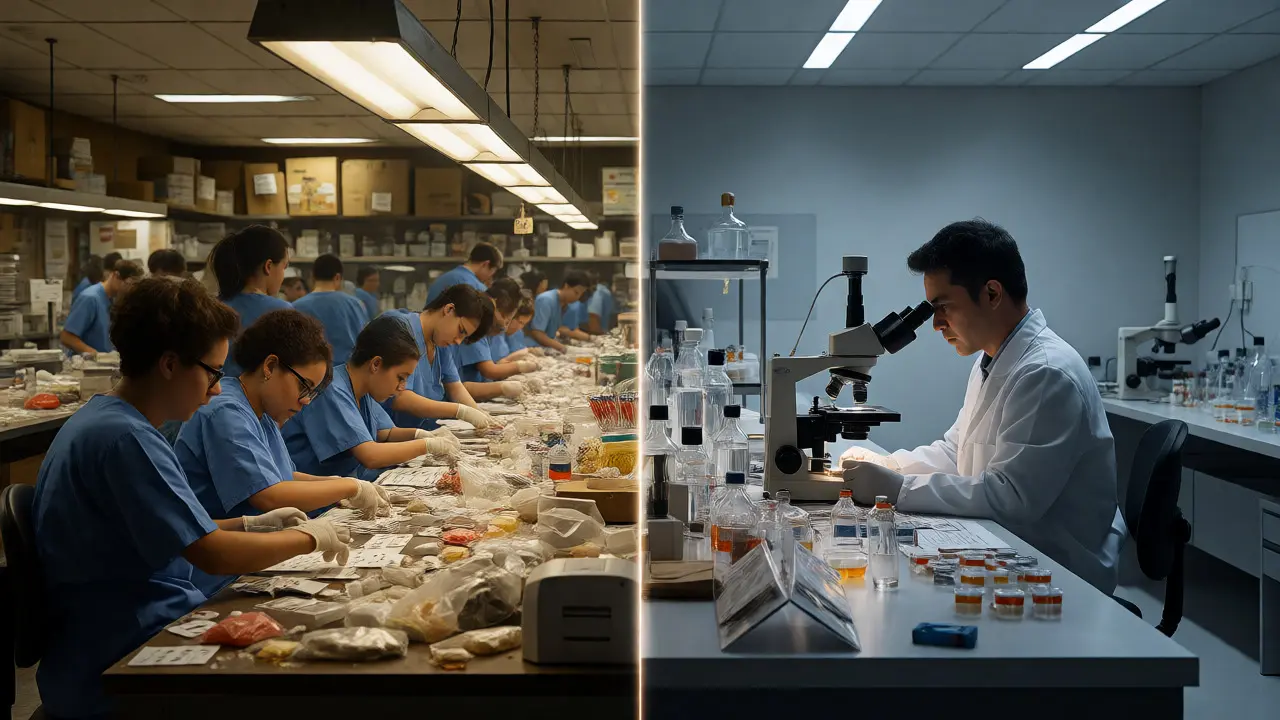
Local and State Labs handle the vast majority of criminal cases. Think burglaries, assaults, DUIs, and homicides that happen within city or county limits. If someone gets shot in Portland, Oregon, the local medical examiner and police crime lab own that case. You’ll see a high volume of routine evidence: blood swabs, fingerprint cards, drug seizures, and DNA from sexual assault kits. The work is repetitive but critical. You become a master of efficiency because you might process 300 drug cases a month.
Federal Agencies like the FBI, DEA, ATF, and DHS step in when a crime crosses state lines, involves federal property, or hits specific statutes like terrorism, organized crime, or large-scale fraud. An FBI chemist isn’t testing baggies of meth from a corner dealer; they’re analyzing complex synthetic compounds seized from international trafficking rings. A federal digital forensics expert might be pulling data from servers used by a cybercrime ring operating out of Russia and Brazil simultaneously. The volume is lower, but the complexity is sky-high.
| Feature | Local/State Crime Lab | Federal Agency (e.g., FBI, DEA) |
|---|---|---|
| Primary Cases | Homicide, burglary, DUI, domestic violence | Terrorism, cybercrime, narcotics trafficking, white-collar fraud |
| Evidence Type | High volume, routine (DNA, ballistics, drugs) | Complex, novel (chemical synthesis, encrypted data, exotic materials) |
| Court Testimony | Frequent (often multiple times a week) | Rare (high stakes, often via video conference) |
| Security Clearance | Usually none required | Top Secret or Secret mandatory |
| Work Location | Fixed city/county location | National HQ (Quantico, DC) or specialized regional offices |
Education and Entry Barriers
Let’s talk about getting in the door. This is where many candidates get tripped up.
For local labs, a bachelor’s degree in forensic science, chemistry, biology, or physics is usually the minimum. Some counties will hire technicians with an associate’s degree if they have prior experience. Accreditation matters here. Look for programs accredited by the Forensic Science Education Programs Accreditation Commission (FEPAC). While not strictly required for every local job, it signals that your curriculum met rigorous standards. Experience trumps prestige locally. Two years working as a technician in a county coroner’s office often beats a fresh master’s degree with zero hands-on time.
Federal agencies raise the bar significantly. The FBI Laboratory, for instance, typically requires a bachelor’s degree from an accredited college with coursework in natural sciences. But here’s the kicker: you need specialized experience. For most scientist positions, this means 18 months of full-time experience in a relevant forensic discipline, or a graduate degree in a related field. And you must pass a background investigation for a security clearance. That means no significant financial debt issues, no undisclosed drug use, and a clean criminal record. The hiring process can take six to twelve months. It’s slow, painful, and bureaucratic.
If you’re eyeing the DEA, they specifically look for candidates who understand controlled substances and their precursors. The ATF focuses on firearms, explosives, and arson. Matching your academic focus to the agency’s mission increases your chances dramatically.
Daily Life and Work Culture
What does Tuesday morning actually look like?
In a local lab, you’re likely working in a team environment. You might share bench space with colleagues processing similar evidence types. There’s camaraderie, but also pressure. Detectives call constantly asking, "Did you find anything?" Prosecutors breathe down your neck because trial dates are approaching. You test, you document, you upload results to the Laboratory Information Management System (LIMS), and you move to the next sample. The pace is relentless. Errors are costly, but the system is designed for throughput.
In a federal lab, the culture is more solitary and research-oriented. You might spend weeks developing a new method for detecting fentanyl analogs before you ever touch a real case sample. You’re expected to publish papers, attend conferences, and stay on the cutting edge of scientific literature. The hierarchy is steeper. You report to supervisors who report to managers who answer to Washington D.C. bureaucracy. Innovation is valued, but so is strict adherence to protocol. One deviation in chain-of-custody documentation can sink a multi-million dollar prosecution.
Fieldwork varies too. Local analysts rarely leave the lab except to testify. Federal agents and scientists might deploy to crime scenes, especially after terrorist attacks or major disasters. If you join the National Disaster Medical System or FEMA’s forensic teams, you could be identifying remains in mudslides or hurricanes. That’s not for everyone.
Salary, Benefits, and Job Security
Money isn’t everything, but it keeps the lights on. According to the U.S. Bureau of Labor Statistics, the median annual wage for forensic science technicians was around $64,940 in recent reports, but this average hides huge disparities.
Local salaries depend entirely on your location. In rural counties, you might start at $40,000. In major metropolitan areas like Los Angeles or New York City, experienced analysts can earn over $90,000. Union membership is common in local government jobs, which means predictable raises, pension plans, and strong job security. Layoffs are rare unless the entire department is defunded.
Federal salaries follow the General Schedule (GS) pay scale. Entry-level GS-7 or GS-9 positions in the Washington D.C. area (where locality pay is high) can start above $70,000. Senior scientists reach GS-12 or GS-13, earning well over $100,000. However, cost of living near federal hubs like Quantico or Arlington can eat into those gains. Benefits are excellent-comprehensive health insurance, Thrift Savings Plan (TSP) matching, and generous leave policies. Job security is ironclad. Federal employees are hard to fire, even during budget cuts.
Career Growth and Specialization
Where do you go after five years?
In the local sector, growth is vertical within the department. You might move from Technician to Analyst to Senior Analyst to Lab Supervisor. Eventually, you could become a Director of Forensic Services. Specialization happens naturally based on need. You might become the go-to person for latent prints or toxicology. Moving laterally to another county is possible, but you often restart at a lower level due to differing protocols.
In the federal sector, specialization is deeper and more prestigious. You can become a subject matter expert in a niche like questioned documents, trace evidence, or bioinformatics. Federal scientists often consult on cases worldwide. Promotion follows the GS ladder, moving from GS-9 to GS-11 to GS-12. Advancement requires performance reviews and competitive selection processes. Many federal scientists transition into management, policy-making, or academia after 10-15 years. The network you build here opens doors to consulting firms and private practice.
Which Path Fits Your Personality?
Be honest with yourself. Do you thrive on speed and variety, or depth and precision?
Choose local forensics if:
- You want to stay close to home and avoid relocation.
- You enjoy seeing immediate impact on community safety.
- You prefer teamwork and frequent interaction with law enforcement.
- You don’t mind repetitive tasks if they serve justice.
Choose federal forensics if:
- You crave intellectual challenges and complex problem-solving.
- You’re willing to undergo extensive background checks and security clearances.
- You value long-term stability and comprehensive benefits over quick promotions.
- You’re interested in national or international cases rather than neighborhood crimes.
Neither path is superior. They’re complementary parts of the justice system. Local labs keep cities safe day-to-day. Federal labs tackle the threats that cross borders. Your choice should align with your tolerance for bureaucracy, your desire for geographic flexibility, and your scientific interests.
Do I need a master's degree to work in federal forensics?
Not always, but it helps. Most federal scientist positions require a bachelor's degree plus 18 months of specialized experience, OR a graduate degree in a relevant field. A master's degree can substitute for the experience requirement, making you a more competitive candidate right out of school.
Is it harder to get a security clearance than a job?
The job offer comes first, then the clearance. Getting the job is competitive, but the clearance process is lengthy (6-12 months) and stressful. Common disqualifiers include excessive debt, undisclosed drug use, or criminal history. You can't control the timeline, only your preparation.
Can I switch from local to federal forensics later?
Yes, and it's a common path. Many federal hires are experienced local analysts. Your hands-on experience with casework is valuable. However, you'll still need to meet federal education requirements and pass the background check. Starting in a local lab is a great way to build the resume federal recruiters look for.
Which pays better: local or federal?
Federal positions generally offer higher starting salaries and better long-term earnings potential, especially with locality pay in high-cost areas. However, top-tier local labs in major cities can match or exceed federal pay for senior roles. Consider total compensation, including pensions, healthcare, and cost of living.
Do federal forensic scientists carry guns?
Most federal forensic scientists do not carry firearms. They are civilian employees focused on laboratory analysis. Exceptions exist for special agents who have forensic backgrounds, but typical lab technicians and scientists are unarmed.