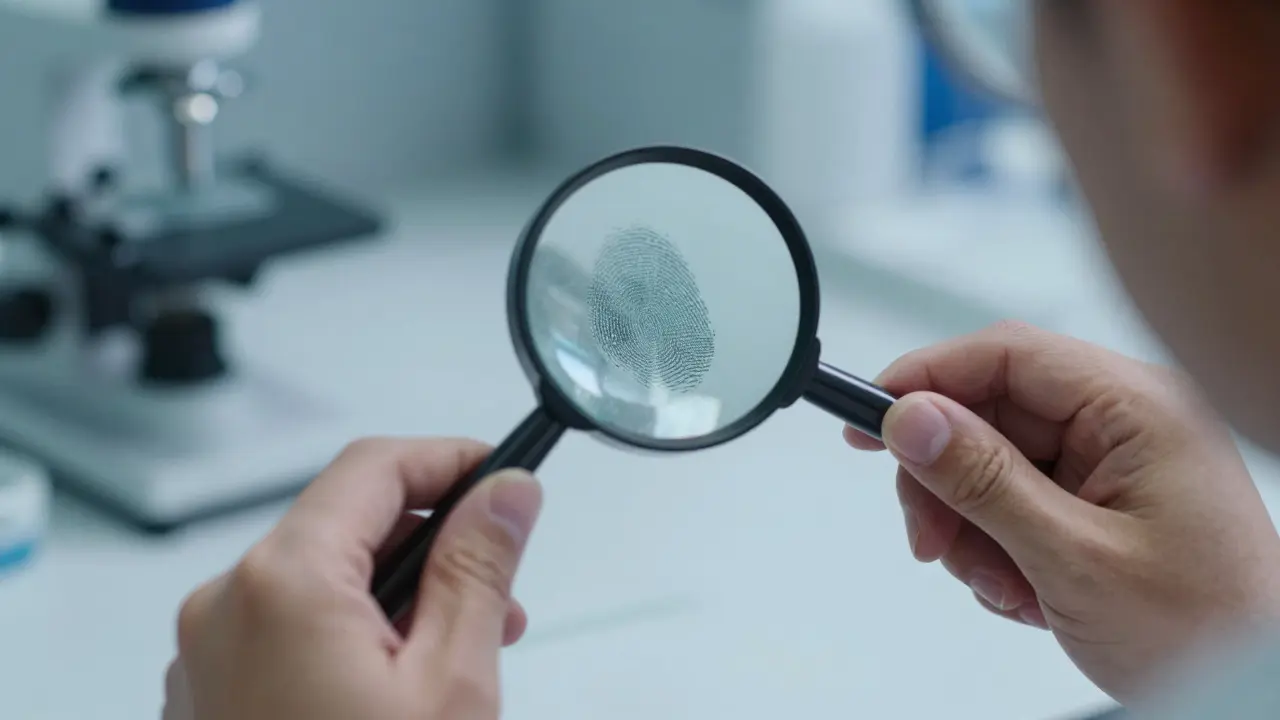
Imagine you are a senior examiner staring at a smudged lift from a crime scene. You know the suspect's name. You know they have a prior record for burglary. Now, look at the ridge detail. Does that small break in the whorl match the suspect’s left thumb, or is it just noise? If you let your brain fill in the gaps based on what you *expect* to see, you aren’t just analyzing evidence; you’re constructing a narrative. This is the core ethical challenge in Latent Print Examination is the scientific comparison of friction ridge impressions found at crime scenes with known exemplars to identify individuals. It relies heavily on human judgment, making it vulnerable to subtle psychological traps that can lead to wrongful convictions.
The goal here isn’t to say fingerprints are useless. They remain one of the most reliable forms of identification when done correctly. But "correctly" has changed. In the past, examiners often worked in silos, trusting their gut. Today, ethical practice demands strict adherence to protocols that minimize the influence of external information. We need to talk about how we get there, why old habits die hard, and what specific controls actually work in a modern lab.
Why Cognitive Bias Is a Silent Threat in Forensic Labs
Cognitive bias isn’t malice. It’s not an examiner lying on purpose. It’s the brain trying to be efficient. When we process information, our brains use shortcuts called heuristics. In a high-pressure environment like a homicide investigation, these shortcuts can become dangerous. The most common issue in fingerprint analysis is confirmation bias. Once an examiner believes a print matches a suspect, they tend to see more similarities and ignore differences. Conversely, if they believe it doesn't match, they might overlook a partial match because they’ve already decided the answer.
This isn’t just theoretical. The National Academy of Sciences (NAS) report in 2009 highlighted this exact flaw, noting that many forensic disciplines, including latent prints, lacked standardized validation studies. Since then, the field has shifted from a purely subjective art to a more structured science. The ethical imperative is clear: if a method is influenced by who the suspect is, it is no longer objective evidence. It becomes advocacy disguised as science.
Consider the case of Serrano v. State, where testimony revealed that the examiner was told the suspect had been seen near the scene before receiving the prints. That context leaked into the decision-making process. Ethical standards now require us to ask: Did the examiner know who the suspect was before starting the comparison? If yes, how did we control for that knowledge?
The Four-Stage Decision Process and Where Bias Creeps In
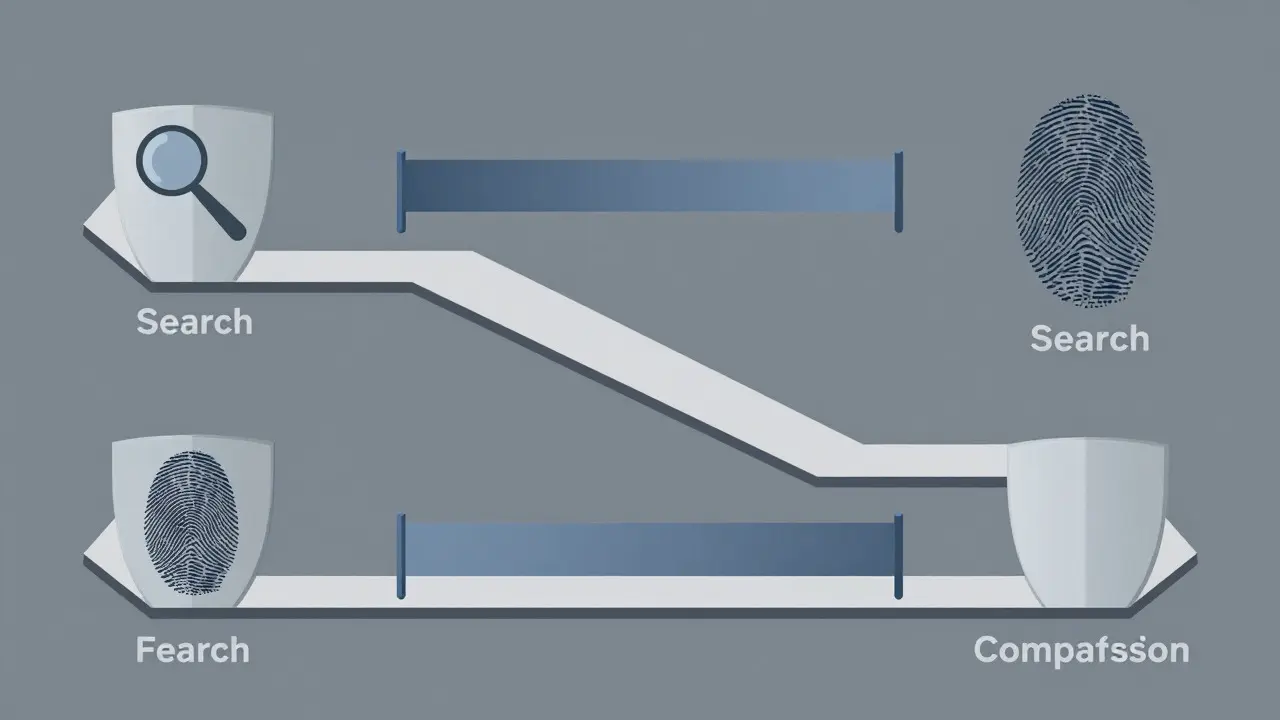
To understand where ethics fail, we need to look at the standard workflow. Most labs follow a four-stage process: Search, Examination, Comparison, and Verification. Each stage has its own risk profile.
- Search: Examiners pull candidate exemplars from databases like AFIS (Automated Fingerprint Identification System). Here, bias can creep in if the investigator suggests which files to pull first. If you only look at the top five candidates suggested by police, you’re limiting your search space artificially.
- Examination: The examiner assesses the quality of the latent print. A poor-quality print requires more caution. If an examiner assumes a match is likely, they might spend less time evaluating the clarity of the ridges, leading to overconfidence.
- Comparison: This is the heart of the job. The examiner compares minutiae points (ridge endings, bifurcations). This is where confirmation bias hits hardest. If you expect a match, you’ll find enough points to call one. If you don’t, you’ll focus on every tiny discrepancy.
- Verification: A second examiner reviews the work. Traditionally, this was meant to catch errors. But if the verifier knows the original examiner’s conclusion, they are likely to agree due to social pressure or anchoring. True verification requires independence.
Ethically, each stage must be insulated from the others. The searcher shouldn’t know the final result. The comparator should ideally not know the suspect’s identity until after the initial assessment. The verifier should be blind to the first examiner’s opinion. This structure isn’t just bureaucratic red tape; it’s the primary defense against error.
Implementing Effective Cognitive Bias Controls
So, how do we actually implement these controls without slowing down justice? The Scientific Working Group on Friction Ridge Analysis, Study, and Technology (SWGFAST) has outlined best practices that many accredited labs now follow. These aren’t optional extras; they are the baseline for defensible testimony.
- Blind Verification: The verifying examiner receives the latent print and the exemplar but not the first examiner’s conclusion. They perform the comparison independently. Only after they reach their own verdict do they compare notes. If both agree, confidence is high. If they disagree, a third party steps in. This breaks the chain of social influence.
- Context Management: Investigators should provide minimal context. Instead of saying, "This is John Doe, a repeat offender," they should say, "Here is a print from the door handle. Here are ten exemplars from potential suspects." The examiner selects the candidates based on the database search, not the investigator’s hunch. This reduces the "halo effect" where a suspect’s reputation colors the evidence.
- Structured Decision Making: Use checklists that force the examiner to document their reasoning at each step. For example, before declaring a match, the checklist might ask: "Did you examine all available ridge details? Did you consider alternative hypotheses?" Writing things down makes biases visible and easier to correct.
- Training on Bias Awareness: Annual training isn’t enough. Examiners need regular workshops where they analyze case studies specifically designed to trigger bias. By practicing in low-stakes environments, they build mental muscle memory for objectivity.
These steps take time. Yes, blind verification doubles the workload for some cases. But the cost of a wrongful conviction is infinitely higher than the cost of an extra hour in the lab. Ethics in forensics means prioritizing accuracy over speed when the two conflict.
Technology vs. Human Judgment: Finding the Balance
You might wonder if technology can solve this. Can AI replace the human eye? Not yet. Algorithms like those used in AFIS are excellent at searching millions of records quickly, but they still rely on human interpretation for the final match. In fact, early studies showed that when examiners saw the algorithm’s top candidates, they were more likely to confirm those picks, even when the algorithm was wrong. This is known as automation bias.
Therefore, technology should be used for search and organization, not for final determination. The human examiner remains the ultimate arbiter. But that role comes with heavy responsibility. The ethical standard is that the human must be able to explain *why* they made a call, not just *that* they made it. This is why documentation is so critical. If you can’t articulate your reasoning clearly, your conclusion is fragile.
Moreover, digital tools can help track bias patterns. Some labs now use software that logs how long an examiner spends on each print and whether they viewed contextual information. Over time, this data can reveal systemic issues in a lab’s workflow. It turns ethics from a vague concept into measurable performance metrics.
The Role of Accreditation and Standards
Who enforces these rules? In the United States, accreditation bodies like the American Society of Crime Laboratory Directors/Laboratory Accreditation Board (ASCLD/LAB) set the tone. Their standards require documented procedures for bias control. If a lab wants to maintain accreditation, it must prove it has systems in place to mitigate cognitive bias.
However, accreditation is a floor, not a ceiling. Many progressive labs go beyond the minimum requirements. They publish their error rates. They invite peer review. They treat their methods as living documents that evolve with new research. This transparency builds public trust. When citizens see that forensic labs are actively working to eliminate bias, they are more likely to accept the results, even when those results exonerate someone rather than convict them.
The legal system also plays a role. Courts increasingly scrutinize forensic testimony. Judges are asking harder questions about validation and bias. This judicial pressure pushes labs to adopt better practices. It’s a positive feedback loop: better courts demand better science, which leads to more reliable outcomes.
Practical Checklist for Ethical Practice
If you are an examiner, a lab manager, or even a lawyer reviewing forensic reports, here is a practical checklist to ensure ethical integrity in latent print examinations:
| Stage | Action Item | Ethical Rationale |
|---|---|---|
| Intake | Log all contextual information provided by investigators. | Create an audit trail to detect later influence. |
| Search | Use automated search algorithms without manual filtering by investigators. | Prevent narrowing of the candidate pool based on prejudice. |
| Comparison | Document the number of matching and non-matching features separately. | Force consideration of disconfirming evidence. |
| Verification | Ensure the verifier is blinded to the initial conclusion. | Break social anchoring and increase independence. |
| Reporting | State the level of uncertainty clearly (e.g., "consistent with" vs. "match"). | Avoid overstating certainty to the jury. |
This checklist isn’t just for big federal labs. Even small municipal agencies can adapt these principles. The key is consistency. Do it every time, not just when you feel unsure.
Frequently Asked Questions
Is fingerprint analysis considered a hard science?
It is often described as a hybrid discipline. The collection of friction ridge impressions is physical, but the interpretation relies on trained human judgment. Because of this reliance on judgment, it is highly susceptible to cognitive bias if proper controls are not in place. Recent reforms aim to bring it closer to hard science through standardized protocols and statistical validation.
What is the difference between a 'match' and a 'candidate' in AFIS?
AFIS generates 'candidates'-a list of possible matches based on algorithmic similarity. A 'match' is a formal declaration by a human examiner after comparing the latent print to the exemplar. The candidate list is a starting point, not a conclusion. Examiners must verify each candidate manually to confirm a true match.
How does blind verification work in practice?
The verifying examiner receives the same materials as the primary examiner but is not told what the primary examiner concluded. They perform the comparison independently. If both examiners reach the same conclusion, the result is confirmed. If they differ, a third examiner or a panel reviews the case. This process takes longer but significantly reduces the chance of shared error.
Can cognitive bias be completely eliminated?
No, it cannot be completely eliminated because humans are inherently biased. However, it can be minimized to an acceptable level through structural controls like blinding, structured decision-making, and rigorous training. The goal is not perfection, but reliability and defensibility in court.
What role does SWGFAST play in setting these standards?
SWGFAST (Scientific Working Group on Friction Ridge Analysis, Study, and Technology) develops consensus guidelines for the fingerprint community. While not a regulatory body itself, its recommendations are widely adopted by accreditation agencies and courts. Its guidance on bias control is considered a gold standard in the industry.