You see a news story about a "Jane Doe" found in a river ten years ago. The police have her face reconstructed, but no one claims her. For decades, these cases sat in cold files because traditional fingerprinting failed and the victim had no dental records. Then, something changed. Investigators started using DNA matching to find distant cousins of the deceased, building family trees backward until they identified the body. This isn't science fiction; it is standard procedure now for solving the most stubborn cases of unidentified remains.
The Shift from Direct Matches to Genetic Genealogy
For a long time, DNA work in forensics relied on short tandem repeats (STRs). Think of STRs as a barcode with just a few stripes. It’s great for ruling people out or confirming a suspect if you already have their DNA on file. But if you don’t know who the victim is, an STR profile is useless on its own unless it hits the Combined DNA Index System (CODIS). If the victim wasn’t arrested before death, they aren’t in CODIS. That’s where the breakthrough happened. Investigators moved toward Single Nucleotide Polymorphism (SNP) testing, which looks at hundreds of thousands of markers across the genome. This detailed map allows scientists to compare a sample against public genealogy databases like GEDmatch or FamilyTreeDNA, finding relatives up to six generations removed.
| Method | Best Used For | Data Required | Success Rate Context |
|---|---|---|---|
| STR Analysis | Direct matches to known suspects or CODIS entries | 13-24 specific loci | Low for unknown victims without prior criminal record |
| Mitochondrial DNA | Maternal lineage tracing when nuclear DNA is degraded | Hair shafts, old bones | High for maternal lines, low for unique identification |
| Forensic Genetic Genealogy | Finding distant relatives to build family trees | High-density SNP data | High for recent ancestry, requires public database uploads |
How the Process Actually Works
It starts with the bone or tissue. In Portland, where I live, we deal with damp climates that degrade DNA quickly. Forensic anthropologists first assess the skeletal remains to estimate age, sex, and ancestry. This helps narrow the search field. Once they extract viable DNA, they sequence the SNPs. This step is expensive and technical, often outsourced to specialized labs like Parabon NanoLabs or Othram Inc. These companies specialize in extracting genetic material from difficult samples, such as charred bones or hair roots that have been exposed to weather for years.
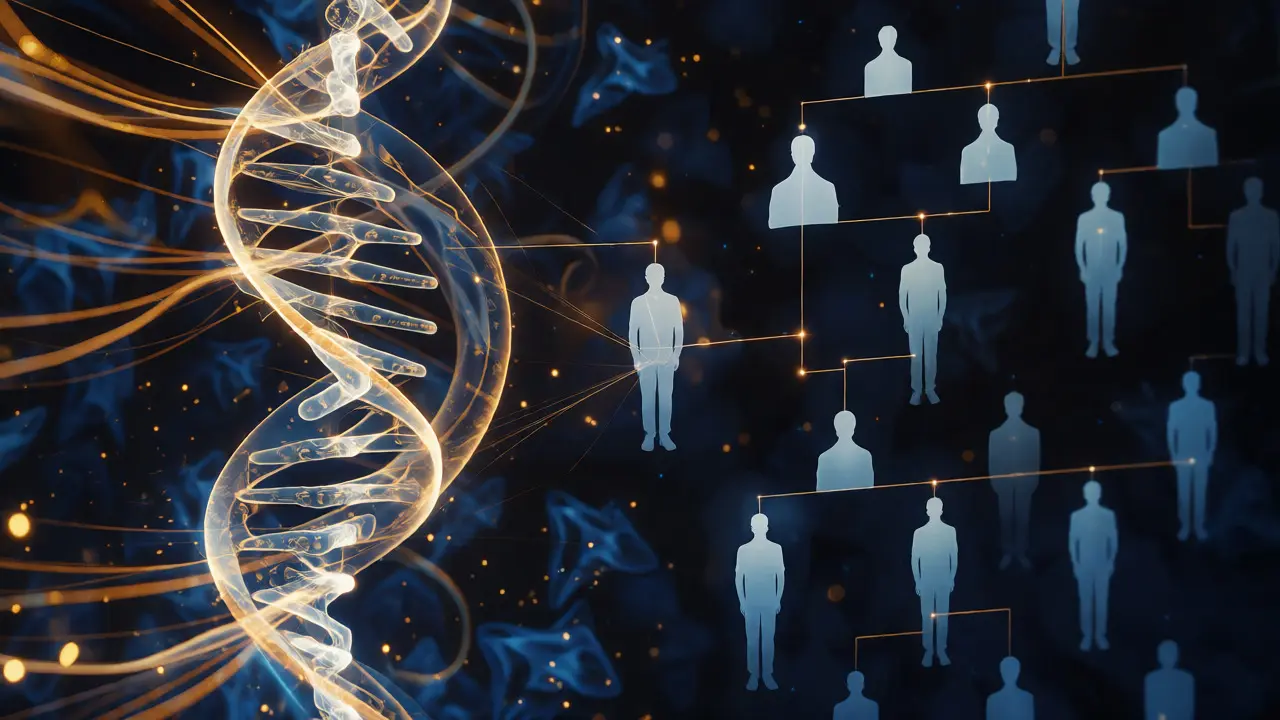
Once the genotype is generated, investigators upload it to open-access genealogy databases. They aren't looking for an exact match. They are looking for third or fourth cousins-people who share about 1% to 6% of their DNA. Using shared segments, researchers construct a pedigree chart. They connect these distant relatives to common ancestors. From there, they build down the family tree until they find a person who fits the physical description of the victim and was reported missing around the time of death. It’s essentially reverse-engineering a family history.
Key Challenges and Limitations
This method isn't magic. It has hard limits. First, it relies on participation. If your family hasn't uploaded their DNA to a public database, you can't be found through this method. As of 2026, millions of profiles exist, but coverage is uneven. Populations with lower rates of recreational DNA testing, such as certain African American or Indigenous communities, may still face hurdles in identification compared to those with higher European ancestry representation in these databases.
Another major issue is privacy and consent. Many users uploaded their DNA for health insights, not expecting law enforcement to use it. While policies have tightened, the ethical debate continues. Some states now require warrants for police access to genealogy databases, while others allow open searching. This legal patchwork means an investigator in Oregon might have different tools than one in Texas.
Real-World Impact on Missing Persons Cases
Consider the case of the "Golden State Killer," solved via genealogy in 2018. That success paved the way for applying the same logic to unidentified bodies. Since then, hundreds of Jane Does and John Does have been named. For families, this closure is profound. Imagine living for thirty years wondering if your brother is alive or dead, only to get a call saying his remains were found under a bridge three miles from home, identified because a second cousin took a saliva test for fun.
However, false positives happen. A DNA match doesn't prove identity; it proves relatedness. Investigators must verify the genealogical link with traditional detective work-checking birth records, interviewing neighbors, and comparing medical history. If the family tree has errors, the identification fails. Garbage in, garbage out applies strictly here.
What Families Should Do Now
If you have a missing relative, waiting for police action might not be enough anymore. You can take proactive steps. Submitting your own DNA to major genealogy platforms increases the chances of a match if your relative's remains are found. Even if you aren't the closest kin, being in the database creates a node that could help triangulate the location of your missing family member.
- Upload to Multiple Platforms: Don't rely on just one site. Use GEDmatch, FamilyTreeDNA, and others to maximize visibility.
- Verify Your Own Tree: Ensure your online family tree is accurate. Errors in your generation can break the chain of evidence.
- Contact Local Task Forces: Ask if your jurisdiction uses forensic genealogy. Some agencies have dedicated units for unidentified remains.
The Future of Identification
We are moving toward more comprehensive biobanks. Instead of relying solely on voluntary consumer uploads, some jurisdictions are exploring state-mandated DNA collection for all citizens upon death or arrest. This would create a closed-loop system where every unidentified body can be matched against a complete population registry. Until then, forensic genetic genealogy remains our best tool for giving names back to the forgotten.
Can DNA identify a body if the person has no living relatives?
Yes, but it is harder. Investigators look for distant cousins, potentially sixth-degree relatives. If the person has no known living relatives within six generations, identification becomes extremely difficult unless they appear in a criminal database or have previously donated DNA to a research study.
Is forensic genealogy legal everywhere in the US?
No. Laws vary by state. Some states require a warrant for police to access genealogy databases, while others allow open searching. Federal guidelines generally permit the use of open-source data, but privacy laws are evolving rapidly to address concerns about genetic surveillance.
How much does it cost to use DNA matching for unidentified bodies?
The initial sequencing can cost between $500 and $1,500 per sample, depending on the quality of the remains. However, many organizations offer pro bono services for unidentified human remains cases. Grants and non-profit foundations often cover these costs for families and law enforcement agencies.
What is the difference between CODIS and genealogy databases?
CODIS is a government-run database containing DNA profiles from convicted criminals, arrestees, and crime scene samples. Genealogy databases are private, user-uploaded collections used for ancestry tracking. CODIS uses STR markers for direct matching, while genealogy sites use SNP data to find familial relationships.
How long does the DNA identification process take?
Sequencing takes several weeks. Building the family tree and verifying the identity can take months or even years, depending on the complexity of the genealogy and the availability of historical records. There is no fixed timeline, so patience is essential.