Photos capture what a crime scene looks like. Sketches capture where everything is. Without accurate spatial data, a photograph is just a picture with no context for the jury. Crime scene sketching turns raw measurements into scaled diagrams that serve as permanent, objective records of evidence placement and spatial relationships. These diagrams don't just supplement photos; they prove how far apart two bloodstains were or exactly where a weapon fell relative to a body. If you get the scale wrong, the entire investigation loses its geometric integrity.
The process isn't about artistic talent. It's about math, precision, and choosing the right orientation method for the environment. Whether you are working in a cramped bedroom or an open field, the goal remains the same: create a reproducible map that holds up in court.
The Two-Stage Documentation Process
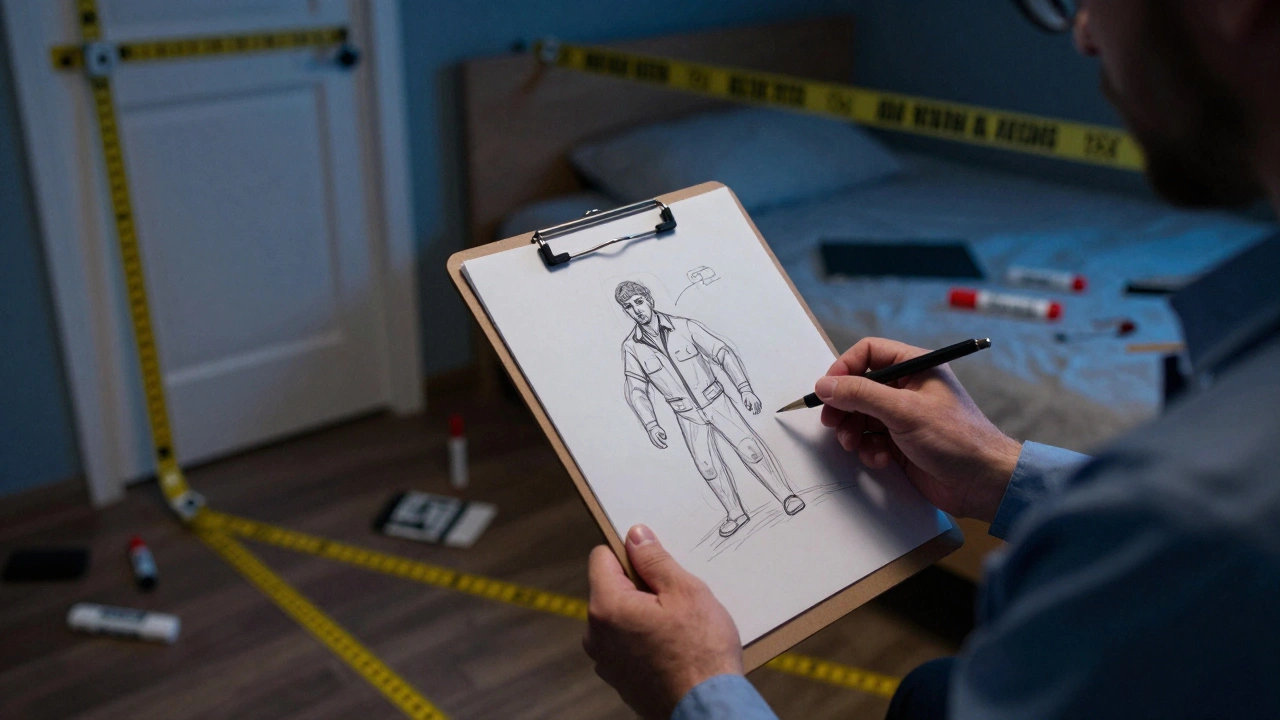
You cannot jump straight to the final drawing. Professional forensic documentation follows a strict two-stage workflow. First, you create a rough sketch at the scene. This is your working document. It includes all raw measurements, notes, and observations. It does not need to be pretty, but it must be complete. Second, you produce a finished, to-scale diagram later, usually using computer-aided design (CAD) software.
The rough sketch is critical because it captures the immediate context. You measure every item depicted. If you forget to measure something now, you can't add it later without compromising the chain of custody or accuracy. The finished diagram is derived solely from this rough sketch. Agencies like the Tacoma Police Department require these CAD drawings to be completed within four weeks, ensuring the data is preserved while fresh. The scale factor-dividing real-world inches by a number to fit the page-must be handwritten on the back of the final printout. This transparency allows defense attorneys to verify your math.
Choosing the Right Orientation Method
Not every scene fits the same grid. You have five primary methods to locate evidence. Picking the wrong one wastes time and introduces error. Here is how to decide which tool to use based on the scene's geometry.
| Method | Best For | Key Mechanism | Accuracy Level |
|---|---|---|---|
| Triangulation | Indoor scenes, fixed points | Two fixed points (A & B) to evidence | High |
| Baseline | Outdoor scenes, long distances | Straight line reference + perpendicular offsets | Moderate to High |
| Polar Coordinate | Irregular outdoor areas | Distance and angle from one fixed point | Moderate |
| Rectangular Coordinate | Rooms with perpendicular walls | X/Y axis from two walls | Good (if walls are square) |
| Cross-Projection | Walls, windows, doors | Folding walls flat onto floor plan | High (for vertical surfaces) |
Triangulation Method
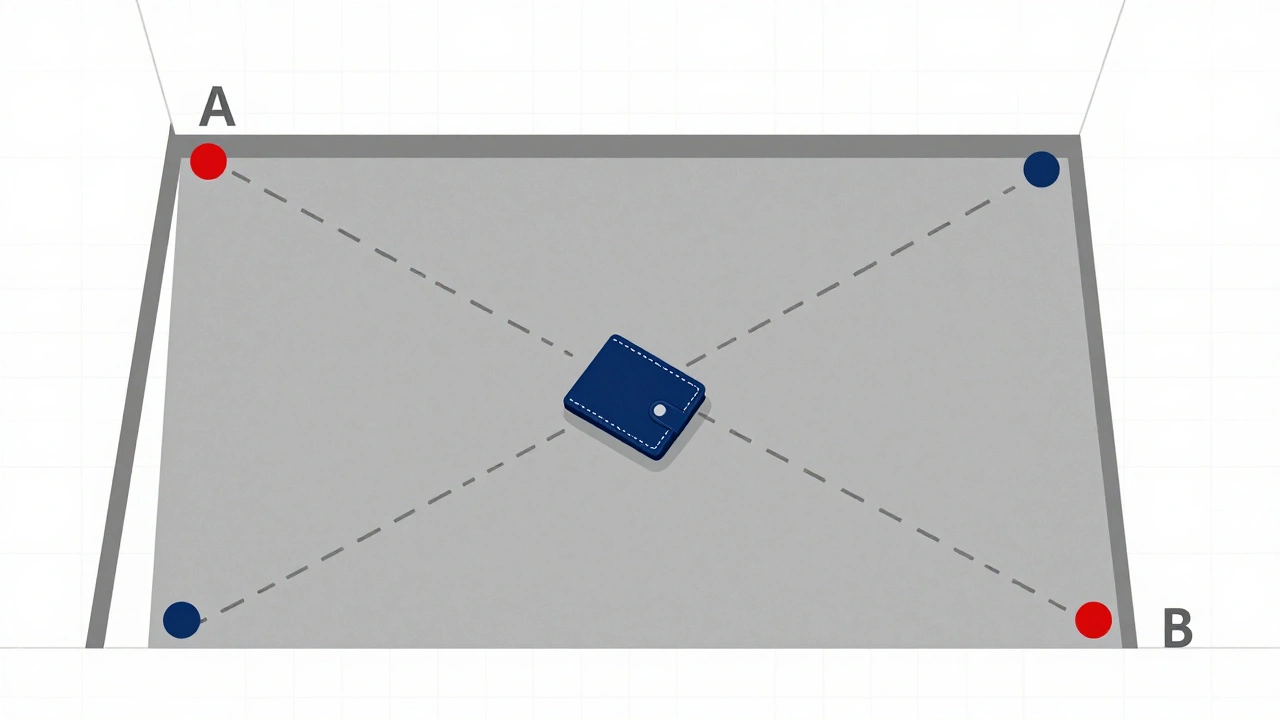
Triangulation is often the gold standard for indoor scenes. You identify two fixed points-let’s call them A and B-that do not move. These could be corners of a room, door frames, or heavy furniture. You then measure the distance from Point A to the evidence and from Point B to the evidence. These three points form a triangle. When you plot these lengths on paper, the position of the evidence is locked in place. It is highly accurate because it doesn't rely on the assumption that walls are perfectly straight or square.
Imagine a robbery scene. A wallet lies on the carpet. You measure from the northwest corner of the room (Point A) to the wallet: 12 feet. Then from the southeast corner (Point B): 8 feet. Plotting these two arcs on your sketch reveals the exact spot. This method works brilliantly when you have clear, immovable reference points.
Baseline Method
When you are outdoors, finding two perfect fixed points for triangulation can be hard. Instead, use the baseline method. You establish a straight line between two distant objects, like two trees or lamp posts. This is your baseline. You then measure along this line to find a point directly parallel to the evidence, and then measure the perpendicular distance from the baseline to the evidence.
This is quick and effective for large areas. If you are documenting an assault in a park, set a baseline between two sturdy trees. Measure 50 feet along the baseline, then step 3 feet perpendicular to mark the location of a dropped knife. It simplifies complex outdoor spaces into manageable linear data.
Polar Coordinate Method
Sometimes you only have one solid reference point, like a large tree or a utility pole in an open field. The polar coordinate method uses this single point. You measure the straight-line distance to the evidence and the angle from North (using a compass or transit). For example, "15 feet away at 40 degrees Northeast." This is ideal for scattered evidence in irregular terrain where establishing a straight baseline is impractical.
Rectangular Coordinate Method
If you are in a room with clear, perpendicular walls, the rectangular coordinate system is intuitive. You treat the corner of the room as the origin (0,0). You measure the X-axis (distance from one wall) and the Y-axis (distance from the adjacent wall). However, be careful: if the walls aren't perfectly square, your angles will be off. Triangulation is generally safer indoors because it bypasses the need for perfect right angles.
Cross-Projection Method
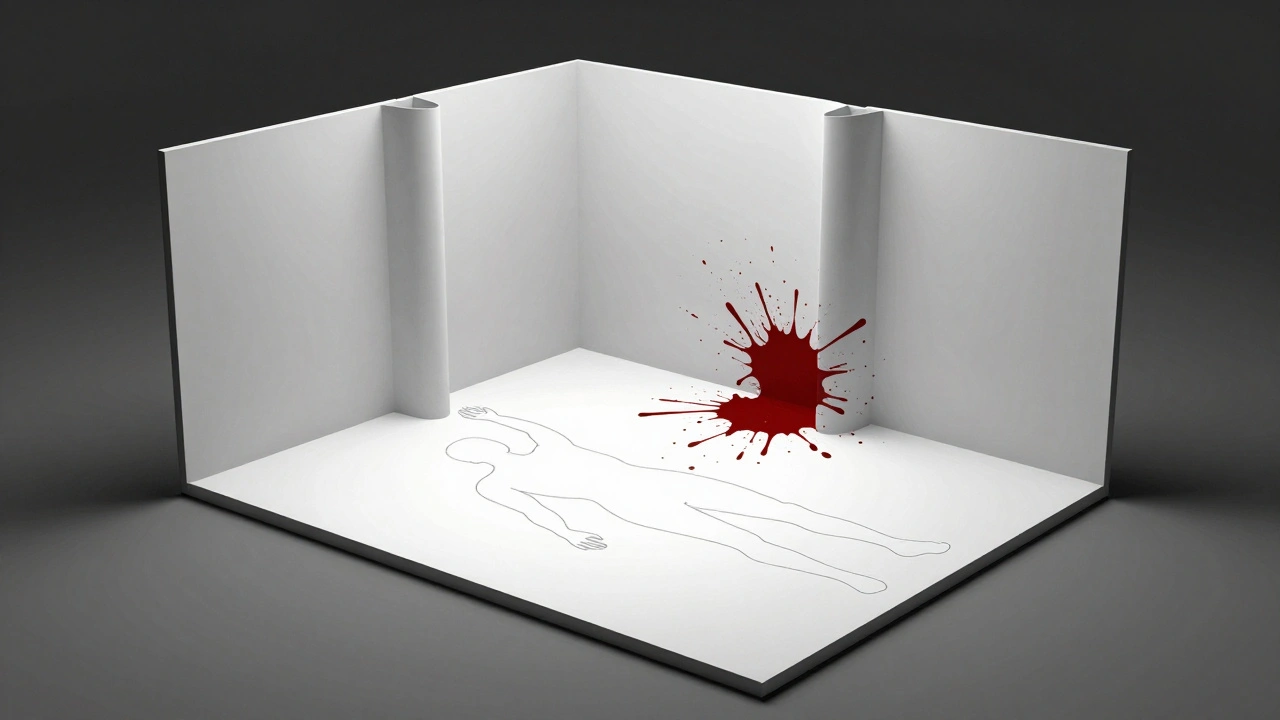
Standard floor plans ignore vertical space. But what if there is blood spatter on the wall or bullet holes in a window? The cross-projection method solves this. Imagine folding the walls of the room down flat onto the floor. You draw the floor plan, then attach the unfolded walls around the perimeter. This allows you to show the relationship between a body on the floor and a stain on the north wall in a single, continuous diagram. It is essential for reconstructing events that involved movement across vertical and horizontal planes.
Scaling and Digital Integration
Once you have your rough sketch, you must convert it to a scale diagram. This is where spreadsheet tools help. You divide every measurement by your chosen scale factor. If your scene is 20 feet wide and you want it to fit on an 8.5-inch page, you calculate the ratio carefully. Inconsistent scaling distorts reality. A foot might look like an inch, changing the perceived reach of a suspect or the trajectory of a bullet.
Modern teams use CAD software to finalize these diagrams. This ensures clean lines and professional presentation for court. However, the digital file is only as good as the raw data entered. The rough sketch remains the legal source of truth. Always retain the original notes and measurements as part of the discovery process. They cannot be substituted by the polished CAD image.
Common Pitfalls to Avoid
- Skipping the rough sketch: Never go straight to the final drawing. You will miss details and lack a verifiable record of your measurements.
- Ignoring vertical dimensions: Flat sketches fail when evidence is on walls or ceilings. Use elevation diagrams or cross-projections for these cases.
- Using unstable reference points: Don't measure from movable furniture unless it is bolted down. Use structural elements like walls, floors, or fixed landmarks.
- Inconsistent scaling: Ensure every measurement is converted using the same scale factor. Mixing scales creates geometric impossibilities.
Why Precision Matters in Court
A judge or jury doesn't just want to see a photo. They need to understand the story of the scene. Did the victim fall backward or forward? How far was the weapon from their hand? Scaled diagrams provide the dimensional proof. They transform subjective observations into objective data. When done correctly, your sketch becomes an undeniable fact in the case file, standing alongside DNA results and witness testimony.
What is the difference between a rough sketch and a finished diagram?
A rough sketch is created at the scene and contains raw measurements, notes, and unrefined drawings. It is not necessarily to scale. A finished diagram is a clean, scaled representation created later, often using CAD software, based strictly on the data from the rough sketch. The rough sketch is the source document; the finished diagram is the presentation tool.
Which sketching method is best for indoor crime scenes?
The triangulation method is typically best for indoor scenes because it uses two fixed points (like room corners) to precisely locate evidence without relying on walls being perfectly square. The rectangular coordinate method is also common but carries higher risk if the architecture is not perfectly perpendicular.
How do you handle evidence on walls or windows?
Use the cross-projection method. This involves drawing the floor plan and then 'folding' the walls down flat around the perimeter. This allows you to show vertical evidence, like blood spatter or bullet holes, in relation to floor-based evidence in a single continuous view.
Is it okay to use CAD software for the initial sketch?
No. You should always start with a physical rough sketch at the scene to capture raw data immediately. CAD software is used later to create the final, scaled diagram. Relying solely on digital tools at the scene risks losing data if technology fails and lacks the tactile verification of manual measurement.
What is the polar coordinate method used for?
The polar coordinate method is used when you have only one fixed reference point, such as a tree or pole in an open area. You measure the distance and the angle (from North) to the evidence. It is ideal for irregular outdoor scenes where establishing a straight baseline is difficult.
Why is scaling important in crime scene diagrams?
Scaling ensures that the diagram accurately reflects real-world distances. Incorrect scaling can distort the spatial relationship between evidence items, leading to misleading conclusions about events, such as the reach of a suspect or the trajectory of a projectile. Consistent scaling is vital for courtroom credibility.