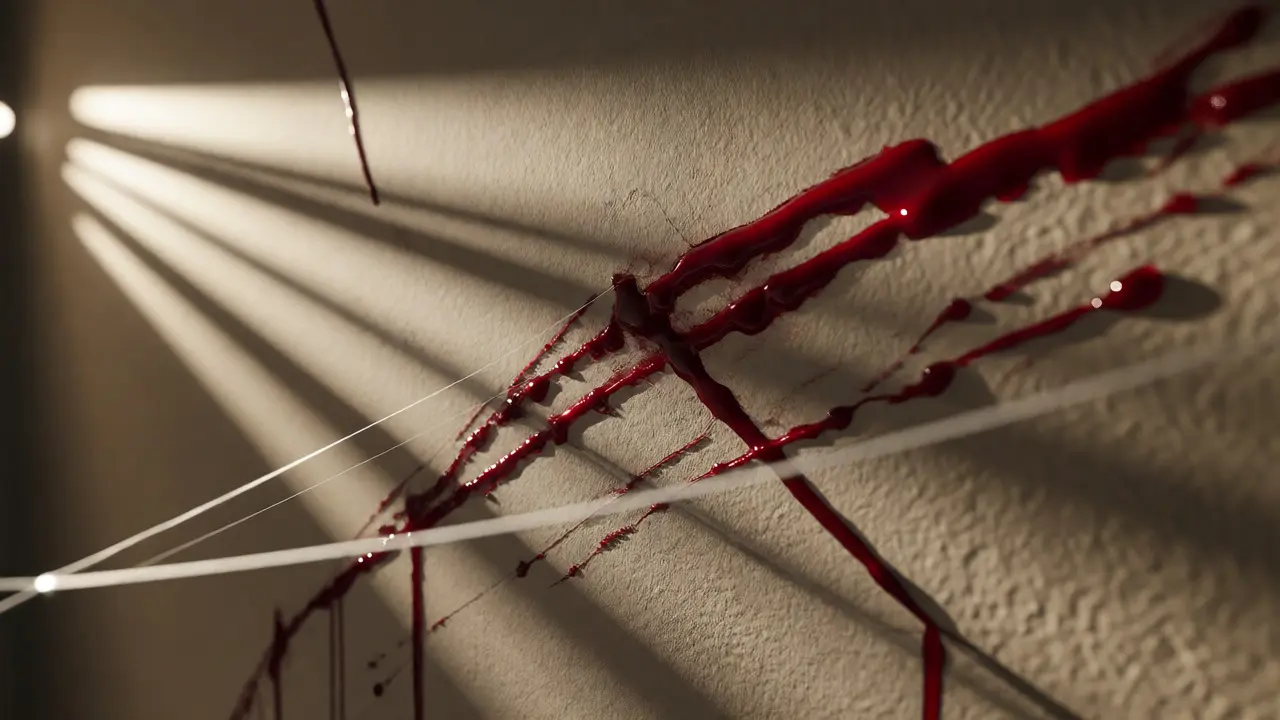
You’re standing in a living room. The carpet is soaked with dark red pools. But look closer at the walls. You see thin, elongated streaks of blood radiating outward like rays from a sun. These aren’t drips. They aren’t splashes from a fall. These are cast-off patterns, and they tell you exactly how many times a weapon was swung.
Most people think blood evidence is just about who died. In reality, it’s a physics lesson written in plasma and cells. When a bloody object moves through the air, centrifugal force throws droplets off the edge. This creates distinct lines that point back to the source. If you can read these lines, you can reconstruct the fight before the body even hits the floor.
What Exactly Is a Cast-Off Pattern?
A cast-off pattern forms when blood adheres to a moving object-usually a weapon-and is flung off due to inertia and centripetal acceleration. Unlike impact spatter, which happens when a force strikes a stationary or slow-moving target, cast-off requires motion. Think of shaking a wet umbrella. The water flies off in straight lines away from your hand. Now imagine that umbrella is a baseball bat covered in blood, and you’re swinging it at someone.
The key difference lies in the directionality. Impact spatter often shows directionality based on tail shapes (the little comet tails pointing the way the blood traveled). Cast-off patterns, however, show directionality based on their origin point. The lines converge toward the position of the assailant’s hand at the moment of release. If you draw imaginary lines backward along each streak, they will meet at a single point in space. That point is where the weapon was when the blood flew off.
The Physics Behind the Flings
To understand why these patterns look the way they do, you need to grasp two simple concepts: adhesion and velocity. Blood sticks to surfaces because of cohesion and adhesion forces. As long as the stickiness holds, the blood stays on the weapon. But once the speed of the swing generates enough force to overcome that stickiness, the blood detaches.
Here is the rule of thumb: the faster the swing, the further the droplets travel. A slow, lazy wave might throw drops only a few feet. A violent, full-speed swing can spray blood across an entire room, hitting walls ten or twelve feet away. The size of the droplets also matters. Smaller droplets require less force to detach but are more affected by air resistance, so they might not travel as far as larger ones if the swing isn’t powerful enough.
| Feature | Cast-Off Pattern | Impact Spatter |
|---|---|---|
| Cause | Motion of a bloody object | Force applied to a blood source |
| Shape | Elongated, linear streaks | Round to oval stains with tails |
| Directionality | Lines converge to weapon path | Tails indicate angle of impact |
| Count | Number of swings = number of lines | Not directly tied to action count |
Reading the Story: Counting Swings
This is the part that makes investigators lean in close. Each distinct line or group of lines on a wall usually corresponds to one swing of the weapon. If you see three separate sets of parallel streaks, you likely have three swings. It’s not always perfect-sometimes a double-tap looks like one continuous arc-but generally, the pattern mirrors the action.
Consider a knife attack. The first stab pulls blood onto the blade. The second swing throws that blood off. If the attacker swings left, then right, then left again, you’ll see alternating arcs on the surrounding surfaces. By mapping these arcs, you can determine the sequence of events. Did the victim fall after the first hit? Or did they stand through five blows? The height of the cast-off marks helps answer this. High marks suggest the weapon was raised high; low marks suggest the attacker was bent over or the victim was already down.
Distinguishing Cast-Off from Other Patterns
It’s easy to confuse cast-off with other types of bloodstain analysis. Mistaking one for the other can ruin a case theory.
Medium Velocity Impact Spatter: This comes from blunt force trauma, like a hammer strike. The stains are smaller (1-4 mm) and tend to be rounder. They don’t form long, directional lines unless the surface was wet and sloped. Cast-off stains are often larger and more elongated because they were traveling faster and farther.
Transfer Stains: If a bloody hand grabs a doorframe, you get a smear. That’s transfer. It has no directionality related to flight. Cast-off flies through the air. If the stain looks like a finger dragged across paper, it’s transfer. If it looks like a bullet hole in the paint, it’s cast-off.
Pulse Spurt: This happens when an artery is cut. Blood pumps out in rhythm with the heart, creating wavy lines. Pulse spurt changes color as oxygen mixes with the blood (bright red to dark purple). Cast-off remains consistent in color because it’s not pumping; it’s being thrown.
Real-World Application: The Portland Case Study
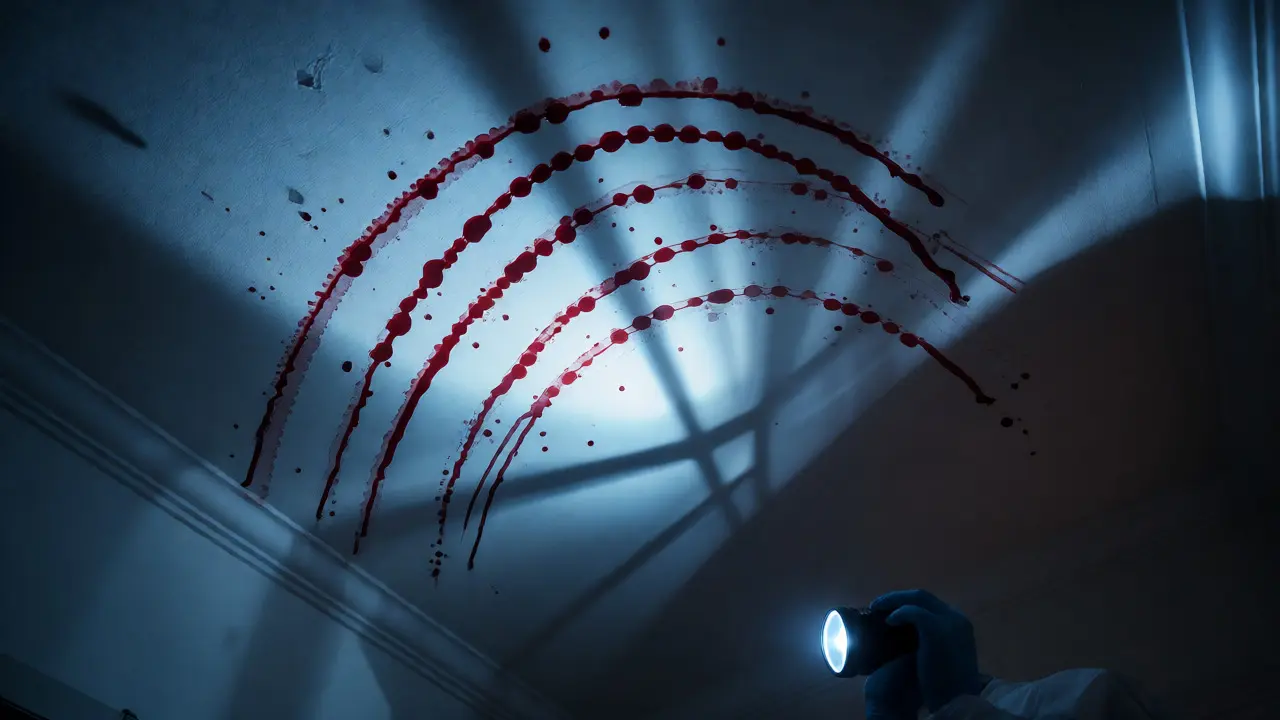
Imagine a domestic dispute in a small apartment here in Portland. The suspect claims self-defense, saying he only pushed the victim. The victim suffered multiple lacerations to the head. If it were just a push, you’d expect drip patterns and maybe some contact stains. Instead, the forensics team finds six distinct cast-off lines on the bedroom ceiling.
Why the ceiling? Because the suspect swung the object upward. The lines converge above the bed. Six lines mean six swings. The claim of a single push falls apart. The physics doesn’t lie. Even if the suspect says, “I lost my grip,” the consistency of the spacing between the lines suggests deliberate, repeated motion rather than a chaotic fumble.

Common Pitfalls in Analysis
Don’t let the drama of the scene cloud your judgment. Here are traps that catch rookie analysts:
- Ignoring Surface Texture: Blood behaves differently on drywall versus brick. Brick absorbs blood, making edges fuzzy. Drywall keeps them sharp. Always account for the substrate.
- Assuming One-to-One Mapping: Sometimes, one swing releases a cluster of drops that land together. Don’t count every single dot as a new swing. Look for the primary vector-the main line of travel.
- Forgetting Air Resistance: Very fine mist-like cast-off can drift. If the room had fans running or windows open, the lines might curve. Check environmental conditions before drawing conclusions.
How to Document Cast-Off Patterns
If you’re the first person on the scene, your job is preservation. Do not touch the walls. Use non-destructive lighting techniques. Oblique lighting (shining a flashlight at a shallow angle) reveals the texture of the stain, helping you distinguish raised dried blood from painted-on smears.
- Photograph First: Take wide shots showing the relationship between the body and the walls. Then take close-ups with a scale ruler.
- Map the Vectors: Use string or digital software to draw lines back from the center of each stain. See where they intersect.
- Note Height and Angle: Measure the distance from the floor to the center of the stain. Calculate the angle of impact using trigonometry if necessary.
- Collect Samples: If the pattern is critical, swab a representative area for DNA testing to confirm whose blood it is.
Why This Matters in Court
Juries love visual proof. A diagram showing six converging lines is easier to explain than a complex medical report. It turns abstract violence into concrete geometry. When an expert witness explains that “these lines prove the defendant swung the bat four times while standing over the victim,” the jury sees the logic. It removes ambiguity.
However, testimony must be cautious. Cast-off analysis is probabilistic, not absolute. Variables like clothing interference, weapon shape, and blood viscosity affect the outcome. Always present findings as “consistent with” rather than “proof of.” Science supports the narrative; it doesn’t replace it.
Can cast-off patterns form from objects other than weapons?
Yes. Any bloody object in motion can create cast-off. This includes hands, hair, jewelry, or even a victim’s limb flailing during a struggle. For example, if a person runs with a bleeding arm, they may leave a trail of cast-off drops behind them.
How does wind affect cast-off patterns?
Wind can distort the trajectory of smaller droplets. Heavy droplets are less affected. If there was strong airflow from a fan or open window, the lines might appear curved or displaced. Analysts must consider ventilation sources when reconstructing the event.
Is cast-off always indicative of a stabbing or slashing?
No. While common in stabbing cases, cast-off occurs with any bloody object in motion. Blunt force weapons like hammers or bats can also produce cast-off if they become coated in blood and are swung repeatedly. The key factor is motion, not the type of injury caused.
Can cleaning attempts hide cast-off patterns?
Cleaning can obscure patterns, especially on porous surfaces. However, cast-off often reaches high areas or corners that are hard to reach. Luminol or other chemical reagents can reveal latent blood traces that were wiped away, allowing analysts to still identify the original pattern geometry.
Do all swings create visible cast-off?
Not necessarily. If the weapon is too clean, or the swing is too slow, insufficient blood may be released to form a visible pattern. Additionally, if the blood has started to clot, it may not fling off easily. Analysts look for the absence of expected patterns as well as their presence.