Imagine a crash scene at 2 AM. The driver is unconscious, and you need to know if alcohol or drugs played a role. Do you draw blood immediately? Or wait for the hospital to collect urine? The choice isn't just about convenience; it determines whether you can prove impairment at the exact moment of the incident or just that the person used substances sometime in the last few days.
In forensic toxicology is the branch of medicine and science that applies chemistry and pharmacology to legal matters, specifically determining the presence and effects of drugs and poisons in biological samples. The two most common biological matrices are blood and urine. While both contain metabolites, they tell very different stories about timing, concentration, and legal admissibility.
Why the Sample Type Matters More Than You Think
Many people assume that if a drug shows up in the system, it doesn't matter which fluid we test. That’s a dangerous misconception. Blood reflects what is currently circulating through the body, offering a snapshot of physiological state. Urine, on the other hand, is a waste product that accumulates over time. It tells you history, not necessarily current status.
For a traffic stop where the officer smells alcohol, blood alcohol concentration (BAC) is a measurement of the amount of alcohol in a person's bloodstream, typically expressed as grams of alcohol per 100 milliliters of blood. This value correlates directly with impairment levels. However, BAC changes rapidly after consumption stops. If you wait too long to draw blood, the level drops, potentially falling below the legal limit of 0.08% even if the driver was impaired an hour prior.
Conversely, if you are investigating a death where the cause is unclear, urine might reveal chronic use patterns that blood would miss because the drug has already been metabolized and excreted from the circulation. The right sample depends entirely on the question you are trying to answer.
Blood Testing: The Gold Standard for Acute Events
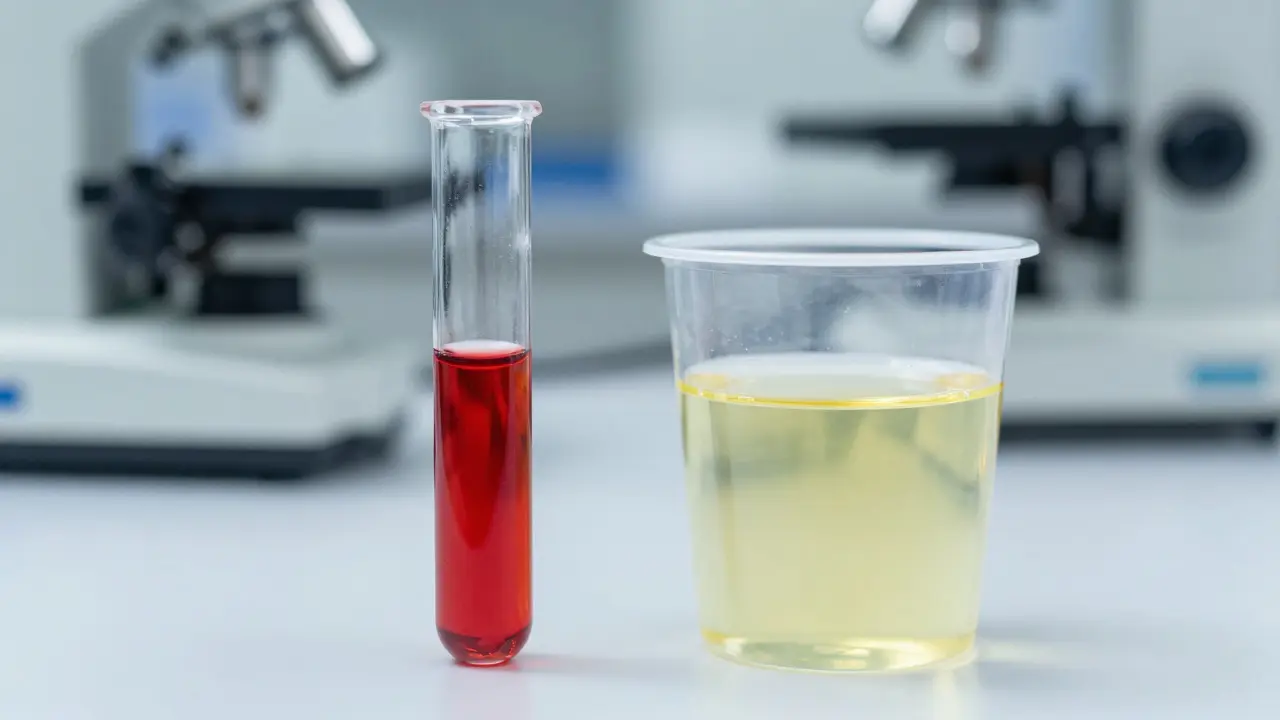
Blood samples are biological fluids drawn from veins that provide direct evidence of drug concentrations at the time of collection. In forensic contexts, blood is often considered the gold standard for establishing causation in acute events like car accidents, workplace injuries, or sudden deaths.
Here’s why blood wins in these scenarios:
- Direct Correlation to Impairment: Drugs must pass through the blood to reach the brain. High blood levels generally indicate recent intake and active physiological effect.
- Short Detection Window: Most drugs leave the bloodstream within hours to a couple of days. This precision helps pinpoint when exposure occurred.
- Legal Clarity: Courts prefer blood evidence in DUI cases because it minimizes speculation about when the substance was consumed.
However, blood drawing has downsides. It requires a trained phlebotomist, sterile equipment, and immediate processing to prevent degradation. If a suspect dies at the scene, post-mortem blood sampling is possible but complicated by putrefaction and redistribution of chemicals in the body, a phenomenon known as post-mortem redistribution is the movement of chemicals between tissues and blood after death, which can artificially elevate or lower drug concentrations in post-mortem samples.
Urine Testing: The Workhorse for Screening and History
Urine samples are waste products filtered by the kidneys that contain metabolites of drugs and toxins, serving as a non-invasive method for detecting past substance use. Because urine is less invasive and easier to collect than blood, it remains the primary tool for workplace drug screening and probation monitoring.
The strength of urine lies in its extended detection window. Since kidneys filter drugs slowly, metabolites can linger in the bladder for days or even weeks depending on the substance and the individual’s metabolism.
Consider THC-COOH, which is the primary metabolite of tetrahydrocannabinol (THC), the psychoactive component of cannabis, detectable in urine for up to 30 days in heavy users. If a worker tests positive for THC-COOH, it proves they used cannabis recently, but it does not prove they were high at work that morning. This distinction is critical in employment law versus criminal law.
Urine testing also has limitations. Hydration levels can dilute the sample, leading to false negatives or inconclusive results. Furthermore, because it measures metabolites rather than parent drugs, it offers little insight into current impairment levels.
Comparing Detection Windows and Legal Implications
To make the right choice, you need to understand how long different substances stay in each matrix. The table below highlights key differences for common substances of abuse.
| Substance | Blood Detection Window | Urine Detection Window | Primary Use Case |
|---|---|---|---|
| Ethanol (Alcohol) | Hours (rapid elimination) | 12-24 hours | DUI enforcement, acute intoxication |
| Cocaine | 6-24 hours | 2-4 days | Recent use verification, workplace screening |
| Marijuana (THC) | 1-2 days (heavy users longer) | 3-30 days | Chronic use monitoring, historical detection |
| Opioids (Heroin) | 6-12 hours | 2-4 days | Overdose investigation, short-term compliance |
| Amphetamines | 12-24 hours | 1-3 days | Stimulant abuse screening |
Notice the pattern: Blood is precise but fleeting. Urine is broad but vague. In a fatal overdose case, you might find trace amounts of heroin in the blood, indicating recent injection, while the urine confirms regular use over the past week. Both pieces of data together build a complete narrative.
Practical Considerations for Collection and Chain of Custody
Choosing the sample is only half the battle. How you handle it determines its admissibility. For blood, the chain of custody must be unbroken from the needle stick to the lab analyzer. Any gap can lead to exclusion of evidence in court. This requires specialized kits, proper anticoagulants (like sodium fluoride/potassium oxalate to prevent fermentation), and temperature control.
Urine collection is simpler but has its own pitfalls. Split specimens are standard practice, allowing the subject to keep a portion for confirmatory testing if the initial screen is positive. This transparency builds trust and reduces disputes. However, if you suspect tampering, such as adding water or bleach, you need to check specific gravity and pH levels immediately upon receipt.
In remote areas or emergency scenes, dried blood spots (DBS) are gaining traction. These involve applying blood to a filter card and letting it dry. They are stable at room temperature and don’t require cold chains, making them ideal for field triage before sending to a central lab.
When to Choose One Over the Other: A Decision Framework
You don’t always have to pick one. Often, the best approach is to collect both. But if resources are limited, use this logic:
- If the event was recent (less than 24 hours ago): Prioritize blood. You need to correlate substance levels with the incident time. Urine will show presence but not peak levels.
- If the event was older or the subject is deceased: Prioritize urine. Blood may have degraded or redistributed, while urine retains metabolites longer.
- If the goal is workplace compliance: Use urine. It’s non-invasive, cost-effective, and accepted by OSHA guidelines for routine screening.
- If the goal is proving impairment at a specific moment: Use blood. Courts rarely accept urine alone as proof of impairment during an accident.
Remember, context is king. A positive urine test for benzodiazepines in a patient taking prescribed Xanax is not evidence of misuse. But a high blood level of an unprescribed benzodiazepine in a driver involved in a collision is highly probative.
Emerging Trends: Hair and Saliva
While blood and urine dominate, other matrices are filling gaps. Hair analysis is a forensic technique that examines hair shafts for drug incorporation, providing a timeline of usage over months rather than days. A 3 cm segment of hair represents roughly one month of growth. This is invaluable for distinguishing chronic abusers from occasional users.
Saliva testing is a non-invasive oral fluid test that detects parent drugs present in the mouth shortly after ingestion or smoking, useful for verifying recent use without needles. It’s great for roadside checks but lacks the quantitative precision of blood for calculating impairment.
As technology advances, multiplex assays allow labs to screen for dozens of substances simultaneously in a single drop of blood or urine. This speed is crucial in emergency rooms where treatment decisions depend on knowing if a patient took acetaminophen or aspirin.
Frequently Asked Questions
Which sample is more accurate for determining drug impairment?
Blood is more accurate for determining current impairment because it reflects the concentration of the drug reaching the brain at the time of collection. Urine indicates past use but does not correlate directly with current physiological state.
Can urine tests detect synthetic cannabinoids?
Yes, but it requires specific immunoassay panels or LC-MS/MS confirmation. Standard five-panel urine screens often miss newer synthetic cannabinoids because their metabolites differ from traditional THC. Custom panels are necessary for comprehensive detection.
How long does it take to get results for blood vs. urine?
Urine screening results can be available in minutes to hours using point-of-care devices. Confirmatory testing takes 1-3 days. Blood testing usually requires laboratory analysis via GC-MS or LC-MS/MS, taking 2-5 business days for full quantification, though preliminary alcohol results can be faster.
Is blood testing required for all DUI cases?
Not always. Breathalyzers are common for alcohol, but blood is preferred for drug-impaired driving (DUID) because breath cannot detect most drugs. For alcohol, blood is often requested if the BAC is near the legal limit or if there are concerns about breathalyzer accuracy.
What happens if a blood sample degrades before testing?
Degradation can lead to inaccurate results, particularly for volatile compounds like ethanol. Proper preservation with anticoagulant and refrigeration is critical. If degradation is suspected, labs may note it in the report, potentially weakening the evidentiary value in court.