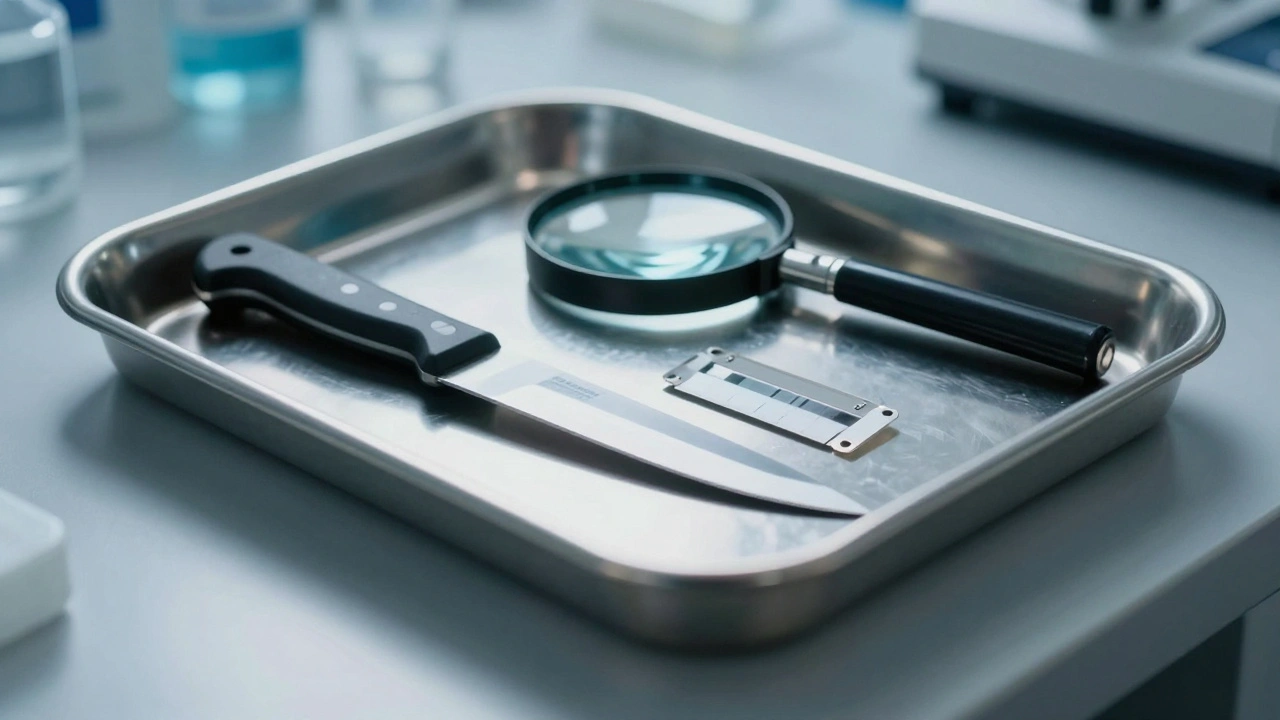
A clean cut through the skin might look simple, but to a forensic pathologist, it is a map of a violent event. Unlike a blunt impact that crushes tissue, Sharp Force Trauma is physical injury caused by objects with sharp edges or pointed ends that slice or penetrate the body's tissues. Whether it is a kitchen knife, a razor blade, or a screwdriver, these injuries leave specific signatures that tell investigators exactly what happened in those final moments.
| Feature | Incised Wounds (Cuts) | Stab Wounds (Punctures) |
|---|---|---|
| Primary Dimension | Longer than they are deep | Deeper than they are wide |
| Mechanism | Slicing/Tangential motion | Penetrating/Direct force |
| Edge Appearance | Smooth, clean edges | Clean cuts or hilt bruising |
| Tissue Bridging | Absent | Absent |
The Difference Between a Cut and a Stab
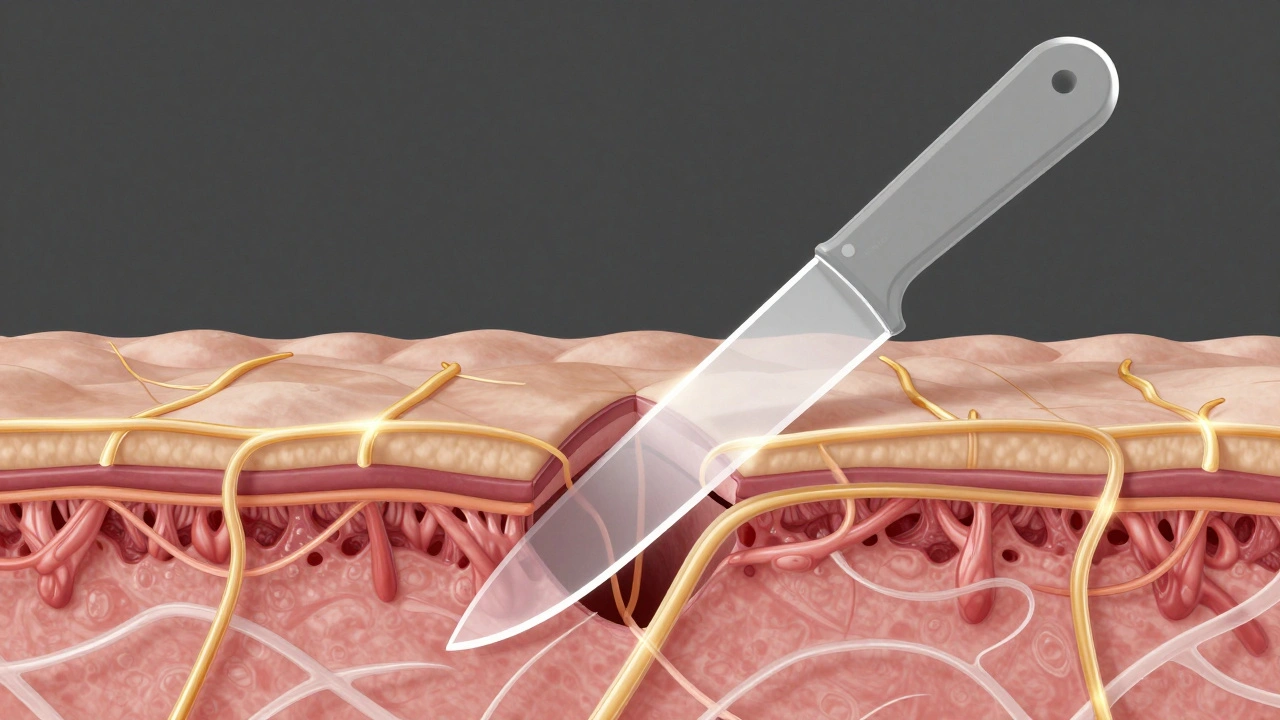
When looking at a wound, the first thing a professional checks for is "tissue bridging." In blunt force trauma, like a punch or a fall, you'll see small threads of nerves and vessels stretching across the gap of the wound. In Incised Wounds is a type of sharp force injury where the cutting edge runs tangentially to the skin, creating a smooth slice that is typically longer than it is deep ], those bridges are gone. The blade cuts through everything in its path cleanly.
On the other hand, Stab Wounds are penetrating injuries caused by pointed objects where the depth of the wound exceeds its surface width ]. These are far more dangerous because they can reach vital organs with very little applied force. A small entry point on the skin can hide a devastating internal track that destroys a lung or punctures the heart.
Decoding the Weapon from the Wound
You don't always need the weapon at the scene to know what was used. The skin acts as a recording device. For instance, if both ends of a stab wound are tapered (pointed), it usually points to a double-edged blade. If one end is blunt and the other is tapered, you're likely dealing with a single-edged knife.
Forensic examiners also look for the "fishtail appearance." This happens when a single-edged blade is twisted or shifted during the attack, splitting the non-pointed edge. If there is a V-shaped notch in the center of the wound, it suggests a specific dynamic of movement between the attacker and the victim. Sometimes, the hilt of the knife hits the skin with such force that it leaves a bruise or a patterned abrasion around the entry point, giving a clue about the handle's design.
The Hidden Danger: Internal Damage and Skin Elasticity
Measuring a wound is trickier than it looks. The human body isn't a static piece of plastic; it has Langer's Lines, which are natural orientations of collagen fibers in the dermis that dictate how skin stretches ]. Because of these lines, a knife wound can gap open or pull tight depending on the angle of the cut. A pathologist must often re-approximate the edges-basically pushing them back together-to get an accurate measurement of the blade's width.
Inside the body, the damage is tracked carefully. Pathologists use X-rays before the autopsy to find broken knife tips that might have snapped off inside the victim. This not only preserves evidence but prevents the medical examiner from accidentally cutting themselves on a hidden blade fragment during the internal examination.
Identifying Defensive Wounds
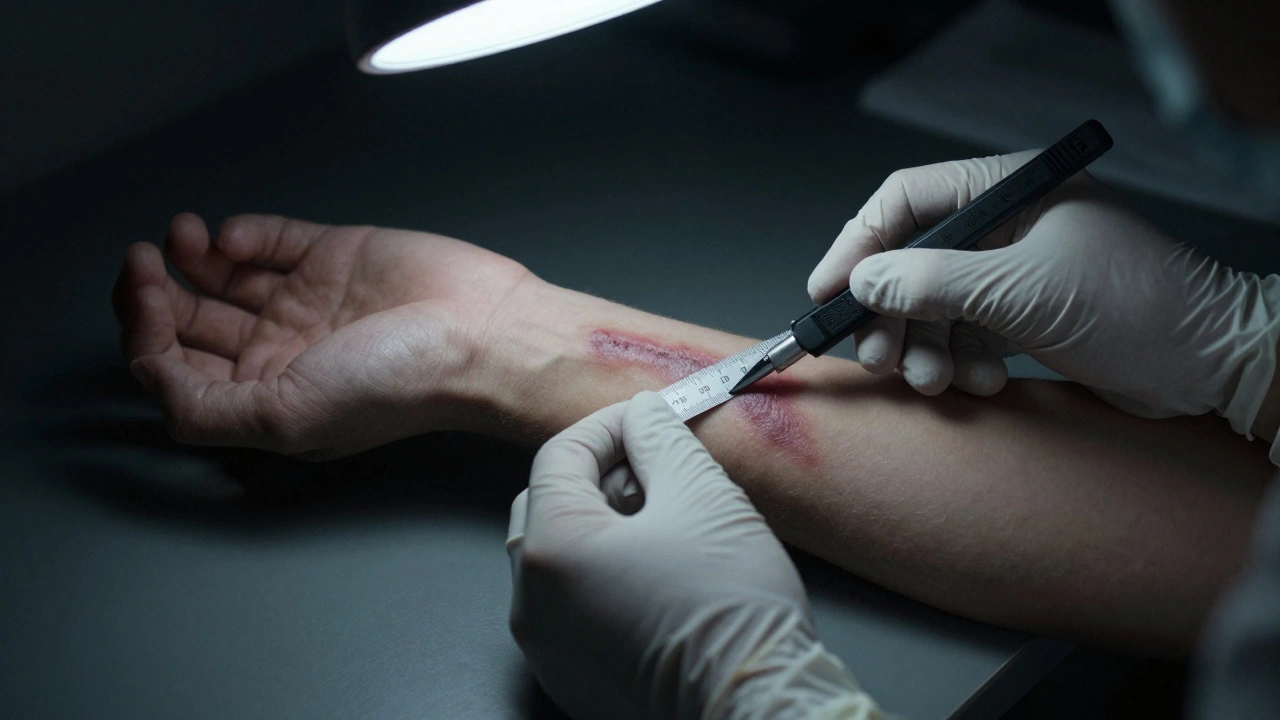
When someone fights for their life, they instinctively put their hands up. This creates a specific pattern of Defensive Injuries, which are wounds found on the ulnar border of the forearms, the backs of the hands, and the palms ]. If you see deep cuts between the thumb and index finger or across the palms, it's a strong sign the victim tried to grab the blade to stop the attack.
The number of these wounds is a huge red flag. The more knife wounds present on the body, the more likely it is that the victim attempted to defend themselves. If a body has multiple deep chest wounds but zero defensive marks on the hands, it might suggest the victim was restrained or caught completely by surprise.
Accidents, Suicide, or Homicide?
Distinguishing between a tragic accident and a crime comes down to the distribution and severity of the marks. In a home or work accident, you'll often find "skipping" injuries. This happens when a blade slides across the body, jumping over bony ridges or natural contours of the skin, leaving a discontinuous line of cuts.
Occupational accidents have their own patterns too. For example, someone cutting a piece of wood or fabric on their lap might slip and sustain a deep wound to the groin or femoral region. In contrast, homicidal attacks often target the face, neck, and chest with single, deep strikes. While a cut-throat wound from behind can look like a suicide attempt, the absence of "hesitation marks"-small, shallow trial cuts-usually indicates a homicide.
How can you tell a stab wound from a laceration?
The key is tissue bridging. Lacerations are caused by blunt force that tears the skin, leaving small bridges of connective tissue and nerves across the wound. Stab wounds are created by a sharp edge that severs everything cleanly, leaving no bridges at all.
What are hesitation marks?
Hesitation marks are shallow, superficial cuts found near a deeper, fatal wound. They are common in suicidal injuries and indicate a person "testing" the blade or struggling with the decision before delivering the final blow.
Can a screwdriver cause a stab wound?
Yes. Any object with a pointed end can create a stab wound. While it doesn't have a cutting edge like a knife, it still penetrates the tissue. The resulting wound will have different characteristics, such as a more rounded or squared-off entry, depending on the tool's tip.
Why are X-rays necessary before a sharp force autopsy?
X-rays are used to locate foreign objects, such as broken blade tips, that may have remained in the body. This is critical for evidence collection and for the safety of the pathologist, who needs to know where sharp metal fragments are located before making incisions.
Where are defensive wounds most commonly found?
They are typically found on the ulnar border (the pinky side) of the forearms, the backs of the hands, and the webbed space between the thumb and index finger, as people naturally raise their arms to protect their face and chest.
What to Look For Next
If you're analyzing a scene or a case, start by mapping the wound locations. Are they clustered in one area, or scattered? Check the palms and forearms for those defensive signatures. If you're dealing with a suspected suicide, look for the trial marks. If the injuries are discontinuous, consider the possibility of an accidental slip. The physical evidence in the skin almost always tells a story, provided you know how to read the signs.