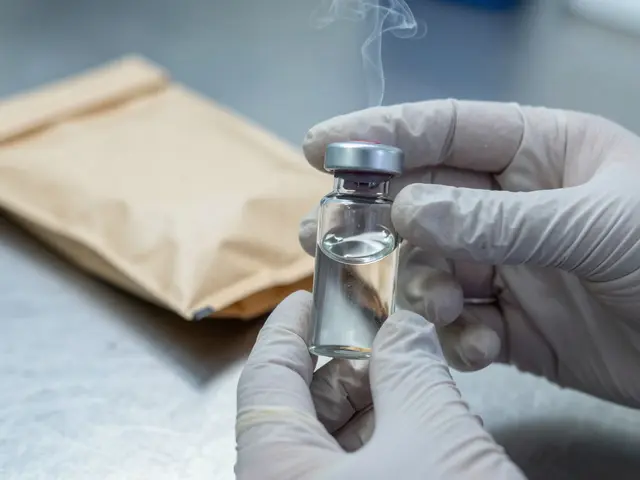
When a crime happens, fingerprints are often the quietest witnesses. They don’t speak, but they leave behind something real - oils, sweat, dead skin cells - that can tie a person to a surface. But here’s the problem: most of the time, those prints are invisible. Not smudged. Not gone. Just invisible to the naked eye. That’s where alternate light sources (ALS) change everything.
Before ALS, investigators relied on powder. Black powder. Red powder. Brushing, dusting, lifting. It worked fine on smooth surfaces - glass, metal, polished wood. But try it on a plastic bag, a brick wall, or a glossy magazine page? The powder just clumps, smears, or doesn’t stick at all. And if the surface is dark? Forget about it. That’s why ALS wasn’t just an upgrade - it was a revolution.
How ALS Makes the Invisible Visible
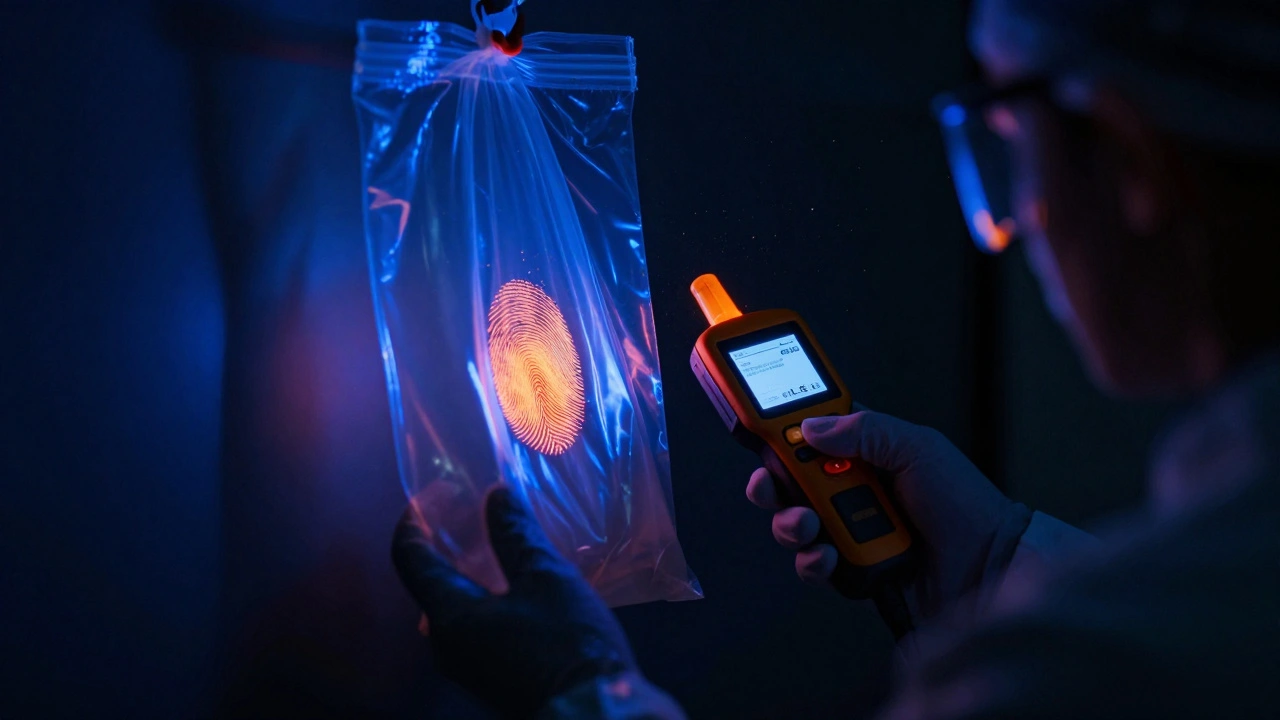
Alternate light sources don’t shine white light like a flashlight. They shine specific colors - blue, green, UV - each tuned to trigger a reaction in the organic material left behind by a fingerprint. Think of it like this: your fingerprint residue is made of proteins, salts, and fatty acids. When hit with the right wavelength of light, those compounds absorb energy and re-emit it as a glow. That glow? That’s fluorescence.
For example, under blue light (around 450nm), fingerprint residue often glows yellow or orange. But if the background - say, a red fabric or dark plastic - also glows, you won’t see the print. That’s where filters come in. An orange barrier filter blocks the blue light and lets only the yellow fluorescence pass through. Suddenly, the print pops like a neon sign against a dark backdrop.
It’s not magic. It’s physics. And it works on surfaces that powder never could.
What ALS Can Find - Beyond Fingerprints
ALS doesn’t just find fingerprints. It finds what most people don’t even think to look for.
- Body fluids: Semen, saliva, urine, and vaginal secretions all fluoresce under specific wavelengths. A drop of semen on a dark carpet? Invisible to the eye. Glows bright under blue light.
- Blood: Even dried blood, especially on dark clothing, becomes visible under infrared or green light. It doesn’t always fluoresce - sometimes it absorbs light, making it look darker than the background.
- Bruises and bite marks: These show up under UV or blue light long before they’re visible on skin. That’s critical in assault cases where timing matters.
- Hair and fibers: A single strand on a floor, a thread caught on a doorknob - ALS can pick them out with oblique lighting and the right filter.
- Superglue-developed prints: After cyanoacrylate fuming, prints are treated with fluorescent dyes like Rhodamine 6G. Under ALS, they glow like fireflies.
One crime scene might reveal a print on a duct tape seal, a semen stain on a pillow, and a bite mark on an arm - all found with the same device, just by switching wavelengths.
Modern ALS Devices: Power in Your Hand
Early ALS systems were bulky, lab-only machines. Think argon ion lasers the size of a microwave. Today? You can hold one in your palm.
The Forensic Alternate LED Light Source (Model OR-GSS300) is a standard now. It weighs just 1.1kg, runs on a rechargeable Li-ion battery, and offers six wavelengths in one device:
- White light (6500K and 4500K)
- Green light (520-532nm)
- Blue light (440-460nm)
- UV-A (390-400nm)
- UV-A (360-370nm)
One button cycles through them. No fiddling with filters mid-scene. The light panel delivers uniform illumination over a 55cm diameter at one meter - enough to scan a whole countertop in seconds. It even has a tripod mount for photographing prints without shaking.
What makes this better than old systems? Efficiency. A 9W blue LED can outperform a 100W incandescent bulb. Battery life? Over an hour of continuous use. No more swapping batteries between rooms.
Fluorescent Enhancers: The Secret Weapon
ALS alone is powerful. But paired with fluorescent chemicals? It’s unstoppable.
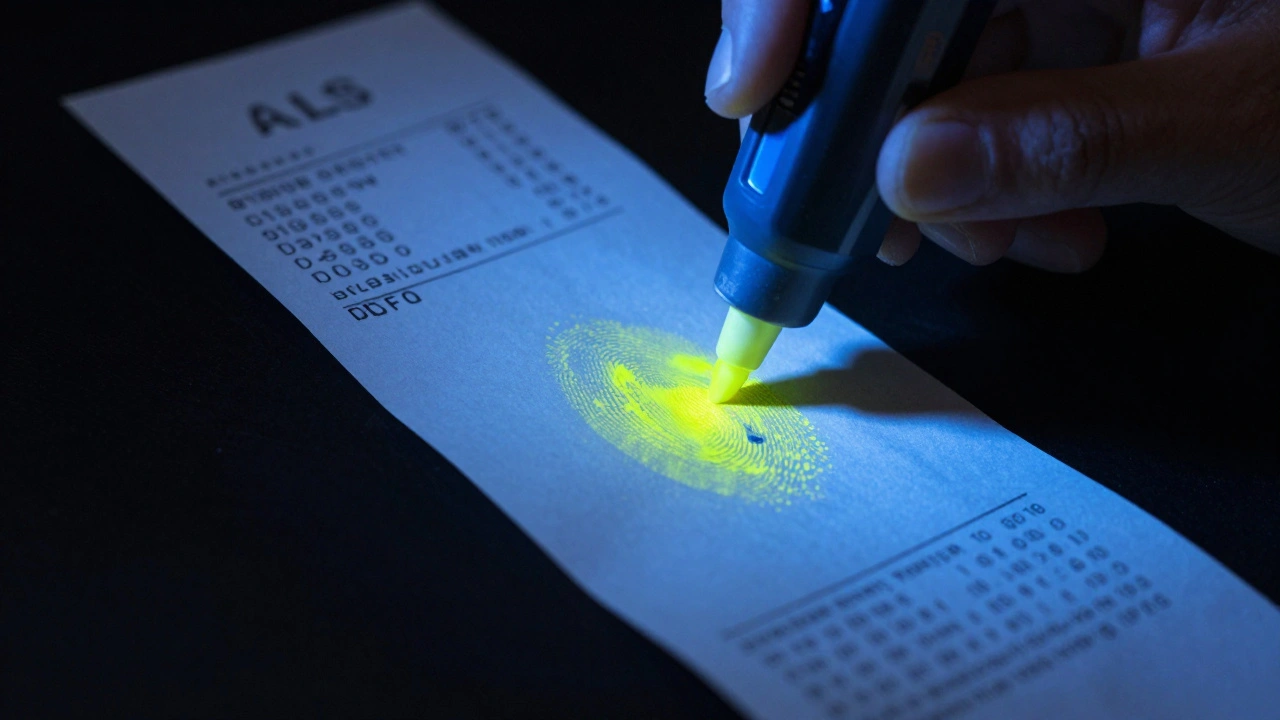
On porous surfaces - paper, cardboard, fabric - you can’t dust. So you spray. DFO (1,8-diazafluoren-9-one) is the go-to. It reacts with amino acids in sweat and makes prints glow bright under blue light. Rhodamine 6G? Used after superglue fuming. It sticks to the polymerized cyanoacrylate and turns prints into glowing outlines.
These dyes aren’t just for labs. Crime scene teams carry portable spray kits. A quick mist, wait five minutes, switch to blue light - and suddenly, a print on a crumpled receipt is clear as day.
And the colors? Red, green, orange, gold. Each dye glows differently, so you can match the color to the background. A yellow print on a yellow wall? Use a red dye. It won’t blend in.
Why ALS Beats Traditional Powder - Every Time
Let’s be blunt: powder has limits.
It fails on:
- Thin plastic bags (powder seeps through)
- Aluminum foil (too smooth, no grip)
- Rigid duct tape (texture traps powder)
- Brick and concrete (too rough)
- Glossy magazine pages (powder just slides off)
With ALS? All of these surfaces become viable. A fingerprint on a plastic bag from a drug deal? Found under UV. A print on a foil wrapper? Glows under green light. A print on a brick wall from a burglary? Use blue light with an orange filter.
And on metal? Guns, knives, doorknobs - under room light, they’re blank. Shine green light on them, slip on an orange filter, and suddenly, ridge details are visible. No brushing. No lifting. Just light and a filter.
What You Need to Know Before Using ALS
It’s not plug-and-play. There’s skill involved.
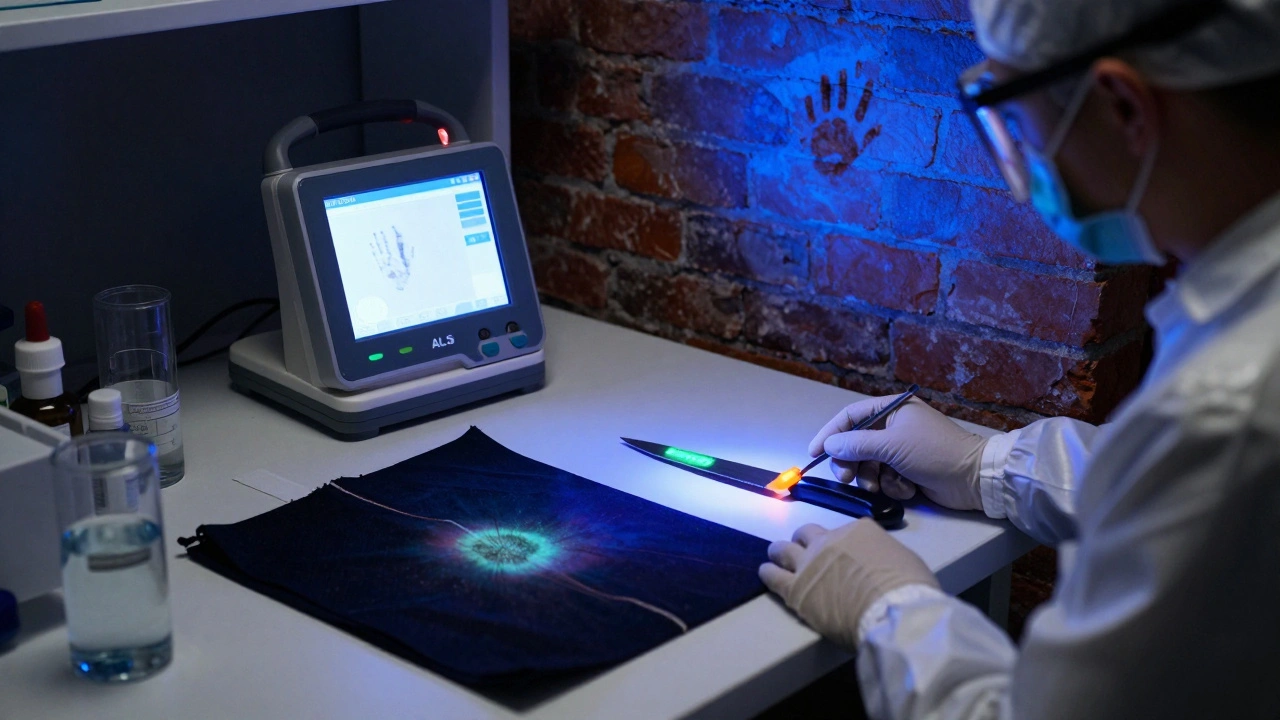
- Wavelength matters: Blood doesn’t fluoresce under blue light - it absorbs it. So you need infrared or oblique white light. Fingerprint residue? Blue or UV. You need to know which to use.
- Filters are non-negotiable: You can’t see fluorescence without the right barrier filter. Orange for blue light. Yellow for UV. Skip it, and you’ll see nothing.
- Background interference: A patterned wallpaper or colored carpet can glow on its own. That’s why testing multiple wavelengths is key. What glows on one surface might disappear on another.
- Safety first: UV and blue light can damage eyes. Always wear protective goggles. Never look directly into the beam. Even a few seconds of exposure can cause lasting harm.
Training isn’t optional. You can’t just pick up a device and start. Crime scene techs spend weeks learning which wavelengths match which evidence. That’s why the best teams have dedicated ALS operators - not just anyone with a flashlight.
The Future of ALS
ALS tech is still evolving.
New dyes are being developed to target specific body fluids with less background noise. Lasers are getting smaller, more powerful, and cheaper. Some prototypes now use AI-assisted filters that auto-select the best wavelength based on surface type.
But the core hasn’t changed: if you can’t see it, you can’t document it. And if you can’t document it, you can’t prove it.
ALS doesn’t just find prints. It finds truth.
Can ALS detect fingerprints on any surface?
ALS works on most surfaces - even those traditional powder can’t touch. It excels on porous materials like paper and cardboard, textured surfaces like brick and wood, and reflective surfaces like plastic, foil, and glass. However, success depends on matching the right wavelength and filter to the surface and residue type. Some extremely dark or highly reflective surfaces may still require additional chemical treatments.
Is ALS better than fingerprint powder?
For many surfaces, yes. Powder works well on smooth, non-porous items like glass or metal. But ALS outperforms it on porous, textured, or reflective surfaces. It’s also non-destructive - you don’t brush or lift, so you preserve the print for further analysis. ALS is faster, more versatile, and often reveals prints that powder completely misses.
Do you need special training to use ALS?
Absolutely. Choosing the wrong wavelength or filter can mean missing evidence. Training covers how different organic materials react to light, how to interpret fluorescence, how to use filters correctly, and how to avoid eye injury. Most forensic units require certification before allowing officers to use ALS in the field.
Can ALS find fingerprints that are days or weeks old?
Yes. Latent prints can remain detectable for weeks, even months, depending on the environment. Humidity, heat, and surface type affect longevity. ALS can still detect prints that have dried out or degraded, especially when paired with fluorescent dyes like DFO or Rhodamine 6G, which react with residual amino acids.
Are there risks to using ALS?
Yes. UV and high-intensity blue light can cause corneal damage or skin burns with direct exposure. Always wear certified protective eyewear. Never point the device at people or reflective surfaces that could bounce light into someone’s eyes. Most modern ALS units include safety warnings and auto-shutoff features, but user discipline is still critical.