Imagine a body found in a remote area, completely unidentifiable. Now imagine a family waiting for news about their relative who vanished years ago. These two scenarios seem unrelated, but they are the core of a massive, silent crisis. This is the world of recovered unknowns and open missing cases. It’s not just a procedural hurdle; it’s a profound human struggle to connect the dots between a lost identity and a physical presence that has been found but not named.
The scale of this problem is staggering. In the United States alone, tens of thousands of unidentified human remains sit in medical examiner offices, cemeteries, and evidence rooms. Meanwhile, hundreds of thousands of people are reported missing every year. The gap between these two lists-those we know are gone and those we have found but don’t know-is where reconciliation happens. It is a complex process involving forensics, databases, and sheer persistence.
What Are Recovered Unknowns?
To understand reconciliation, you first need to define what you are reconciling. A "recovered unknown" isn't just a deceased person whose name is missing from the file. It can also be a living individual whose identity is uncertain or unknown. Think of an adult with severe dementia wandering into a hospital, unconscious and unable to speak. Or a survivor of trafficking who is too terrified to reveal who they are. In both cases, the person has been "found," but their civil identity is not established. They become a recovered unknown until they are matched to an open missing report.
On the other side of the ledger are "open missing cases." These are registered individuals whose fate and whereabouts remain unresolved. According to data from the FBI’s National Crime Information Center (NCIC), there were over 800,000 missing-person entries recorded in 2001, with several hundred thousand new entries added annually in the following years. The majority involve adults, though children make up a significant portion. When a person goes missing, a case is opened. If they are never found, or if they are found but not identified, that case remains open, often for decades.
| Aspect | Open Missing Case | Recovered Unknown |
|---|---|---|
| Status | Whereabouts unknown; alive/dead unconfirmed | Physically located; identity unknown |
| Data Source | Ante-mortem (before death/disappearance) | Post-mortem (after death) or current observation |
| Primary Goal | Locate the person | Identify the person |
| Database Entry | Missing Person (MP) File | Unidentified Person (UP) File |
The Role of NamUs in Bridging the Gap
For years, these two lists existed in separate silos. Law enforcement tracked missing persons, while medical examiners handled unidentified remains. There was no easy way to cross-reference them. That changed significantly with the launch of NamUs (National Missing and Unidentified Persons System) by the National Institute of Justice (NIJ) in 2007. NamUs was designed as a centralized, searchable database that links missing-person and unidentified-remains cases across state lines.
NamUs consists of integrated modules for Missing Persons (MP), Unidentified Persons (UP), and Unclaimed Persons. It allows law enforcement, medical examiners, coroners, and even family members to search for potential matches. The system flags potential connections based on location, date, biological characteristics, and other criteria. As of recent reports, NamUs had helped resolve over 12,600 missing-person cases. Of those, nearly 76% involved persons found alive, and 24% involved decedents identified as previously missing. But the real power of NamUs lies in its public-facing portal. Unlike NCIC, which is restricted to criminal-justice users, NamUs allows families to search for unidentified remains themselves. This has turned grieving relatives into active participants in the reconciliation process, leading to confirmations via DNA in cases that had been open for more than 20 years.
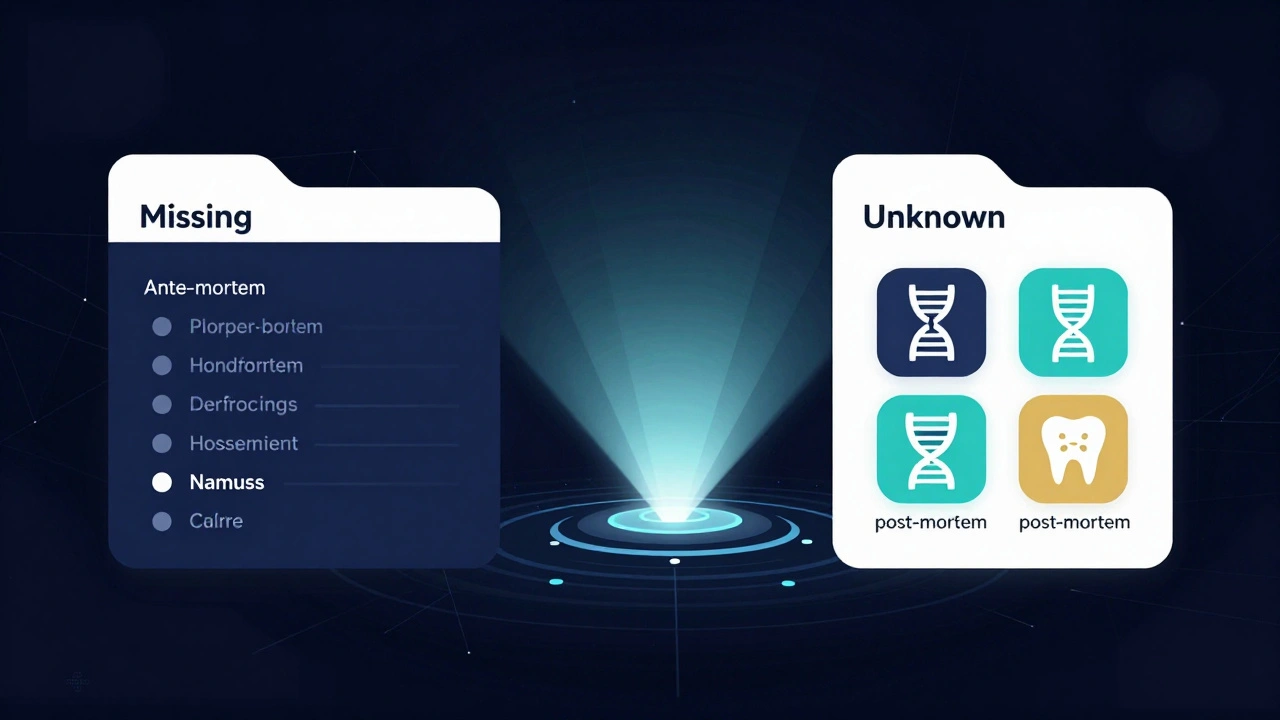
The Technical Workflow of Reconciliation
Reconciliation is not just about clicking a button in a database. It is a rigorous, multi-stage process that mirrors Disaster Victim Identification (DVI) protocols used in large-scale tragedies like the 2004 Indian Ocean tsunami or the 9/11 attacks. The workflow typically unfolds in three interlinked domains:
- Collection of Ante-Mortem Data: Investigators gather information from missing-person reports. This includes demographic details, physical descriptions, dental records, medical history, and DNA samples from relatives.
- Collection of Post-Mortem Data: Forensic experts analyze recovered remains. They create a biological profile (age, sex, ancestry, stature), extract dental charts, lift fingerprints, collect personal effects, and generate DNA profiles.
- Hypothesis Testing and Matching: Investigators formulate hypotheses. For example, "Could these remains belong to one of the five missing hikers in this region?" They then test these hypotheses using increasingly discriminating identifiers. General biological profiling might narrow the pool, dental comparison might narrow it further, and DNA provides the final confirmation.
This structured approach was crucial during the 2004 tsunami response in Thailand, where more than 3,000 victims were identified over two years using Interpol-compliant DVI forms. The same logic applies to everyday missing persons cases, albeit on a smaller scale. The key is moving from general descriptors to specific, scientific identifiers.
Challenges in Data Quality and Interoperability
Even with advanced systems like NamUs, reconciliation faces significant hurdles. One major issue is data quality. A doctoral dissertation from Nova Southeastern University titled "Unsolvable? Assessing the Accuracy of Missing Person Case Data" highlights that missing-person records often suffer from inconsistencies, missing fields, and outdated entries. If a police officer enters a height range of "5'5" to 5'10"" instead of a precise measurement, automated matching tools may miss a valid lead. Some cases are informally labeled "unsolvable" by investigators not because the science fails, but because the initial data entry was poor.
Another challenge is interoperability. While NamUs connects many dots, it does not replace local systems. Many agencies still rely on paper files or legacy digital systems that do not communicate well with national databases. Furthermore, the burden of maintaining accurate data falls on under-resourced local agencies. Without periodic data-cleaning and validation, search results become cluttered with false positives, complicating rather than helping reconciliation efforts.
Humanitarian and Global Perspectives
The problem of recovered unknowns is not limited to domestic law enforcement. In conflict and post-conflict settings, the International Committee of the Red Cross (ICRC) plays a vital role. The ICRC operates tracing services and maintains lists of missing persons, comparing them against information from detention authorities, mortuaries, and exhumation programs. This model has been applied in contexts such as the Balkans conflicts of the 1990s and the genocide in Rwanda, where thousands of victims were gradually identified over periods exceeding ten years.
The ICRC emphasizes a rights-based approach. Families of the missing often live in a state of "ambiguous loss," lacking confirmation of life or death. This uncertainty prevents mourning and blocks legal processes like inheritance or remarriage. Reconciliation, therefore, is not just a technical exercise; it is a humanitarian imperative. In countries like Bosnia and Herzegovina, Kosovo, and Colombia, families have waited more than a decade for identification. When reconciliation finally succeeds, it brings closure, but the frustration with perceived lack of information during the wait is palpable.
The Future of Reconciliation: OSINT and AI
As traditional methods hit their limits, new technologies are emerging. Non-profit organizations like Trace Labs, founded in 2016, have begun partnering with private-sector entities and the U.S. military to apply Open-Source Intelligence (OSINT) methods to unsolved missing-person cases. By leveraging crowd-sourced analysts, Trace Labs discovers new digital traces and corrects official case data. This socio-technical approach complements forensic science by enriching the ante-mortem data that feeds into reconciliation algorithms.
Looking ahead, the future of reconciliation depends on tighter integration between investigative and identification workflows. Experts argue that treating investigation and identification as separate silos leads to missed opportunities. Future systems should continuously update hypotheses as new information arises, drawing on both ante- and post-mortem data in real-time. Additionally, as populations age, issues like dementia-related disappearances will introduce new categories of recovered unknowns, requiring specialized protocols and sustained support for families and investigators alike.
What is the difference between a missing person and a recovered unknown?
A missing person is someone whose whereabouts are unknown and whose status as alive or dead is unconfirmed. A recovered unknown is an individual who has been physically located (either alive or deceased) but whose civil identity has not yet been established. Reconciliation is the process of linking the two.
How does NamUs help solve missing person cases?
NamUs (National Missing and Unidentified Persons System) is a centralized database that links missing-person reports with unidentified remains. It allows law enforcement, medical examiners, and families to search for potential matches based on shared identifiers like location, biology, and dental records, facilitating cross-jurisdictional investigations.
Why are some missing person cases considered "unsolvable"?
Cases may be deemed unsolvable due to poor data quality, such as inconsistent or missing fields in initial reports, outdated entries, or lack of forensic evidence like DNA. Additionally, jurisdictional barriers and limited resources can prevent effective reconciliation between missing person lists and unidentified remains databases.
Can families participate in identifying recovered unknowns?
Yes. Platforms like NamUs offer public-facing portals where families can search for unidentified remains and submit information. This has led to numerous cases being resolved when family members recognized potential matches and provided DNA for confirmation.
What role does the ICRC play in missing persons cases?
The International Committee of the Red Cross (ICRC) operates tracing services in conflict and post-conflict zones. They maintain lists of missing persons and compare them with data from mortuaries and exhumation programs, emphasizing a rights-based approach to ensure families receive information about their loved ones' fates.