
Imagine holding a single hair from a crime scene. In the old days, you might have just looked at it under a microscope and guessed. Today, that hair contains a chaotic soup of DNA from two, three, or even four different people. How do you separate them? This is where probabilistic genotyping changes the game. It moves away from simple matching and into statistical modeling, allowing forensic scientists to calculate the odds that a suspect contributed to that messy sample.
This method isn't just about guessing; it's about math. It uses algorithms to weigh every possible combination of contributors against the actual data observed. If you are working in a lab or studying forensic science, understanding how this works is no longer optional-it’s the standard for handling mixed samples.
Key Takeaways
- Probabilistic genotyping calculates the probability that a specific person contributed to a DNA mixture using statistical models.
- It handles complex mixtures (3+ contributors) far better than traditional binary methods.
- The output is a Likelihood Ratio (LR), not a simple "match" or "no match."
- Software like STRmix™ and TrueAllele™ automates these calculations but requires expert oversight.
- Court admissibility now hinges on transparent reporting of assumptions and prior probabilities.
What Is Probabilistic Genotyping?
Probabilistic genotyping is a statistical approach used in forensic genetics to interpret DNA mixtures by calculating the probability of observing the evidence given competing hypotheses. Unlike classical methods that try to assign peaks to specific individuals based on arbitrary thresholds, this technique treats all alleles as having a certain probability of being present.
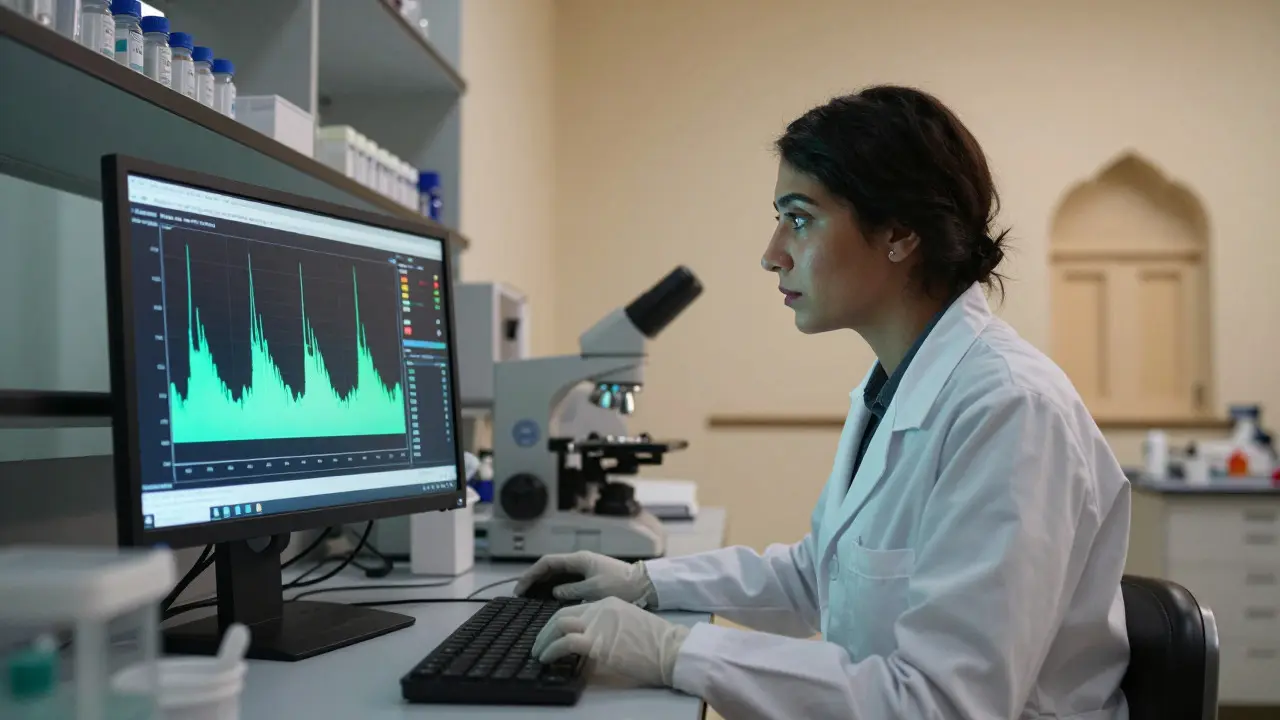
Think of it like noise reduction in audio. Instead of trying to manually pick out one voice in a crowded room, the software analyzes the frequency spectrum and estimates how likely each voice is to be part of the mix. In DNA terms, we look at Short Tandem Repeats (STRs). These are regions of non-coding DNA that vary in length between individuals. When multiple people’s DNA is combined, the resulting electropherogram shows overlapping peaks. Probabilistic genotyping models these overlaps statistically.
The core concept relies on Bayes’ Theorem. We compare two hypotheses:
- H1: The suspect is a contributor to the mixture. 2.H2: The suspect is not a contributor (and someone else is).
Why Traditional Methods Fail with Mixtures
For decades, labs relied on "deconvolution" or manual interpretation. An examiner would look at a peak, decide if it was above a threshold, and assign it to a donor. This worked fine for single-source samples or clear two-person mixtures. But once you add a third contributor, or if one person has very little DNA (low template DNA), the ambiguity explodes.
Traditional approaches often required dropping minor contributors because they were "too small to trust." This meant losing potential leads. A suspect with only 5% of the total DNA might be ignored entirely. With probabilistic genotyping, even tiny contributions can be evaluated statistically. The model doesn't need to "see" the allele clearly; it just needs to know how probable its presence is given the background noise and other contributors.
This shift addresses a major criticism of older methods: subjectivity. Two examiners might disagree on whether a peak is real or stutter artifact. Statistical models remove that human bias by applying consistent mathematical rules to the raw data.

The Math Behind the Model
You don’t need to be a mathematician to use the software, but knowing the basics helps you trust the results. The engine behind these tools is usually a Markov Chain Monte Carlo (MCMC) algorithm. MCMC simulates millions of possible genotype combinations for the unknown contributors and sees which ones best fit the observed data.
Here is what the model considers:
- Peak Heights: How strong is the signal?
- Stutter: Artifacts caused by polymerase slippage during PCR amplification.
- Droplets: Random artifacts from capillary electrophoresis.
- Allele Dropout/Drop-in: Errors where an allele fails to amplify or appears falsely.
- Population Frequencies: How common is this allele in the relevant population database?
Software Tools Changing the Lab
Several commercial platforms dominate the market today. Each has its own quirks, but they all follow the same probabilistic framework.
| Software | Developer | Primary Algorithm | Best For |
|---|---|---|---|
| STRmix™ | Autogen Diagnostics | MCMC / Bayesian | Complex multi-contributor mixtures |
| TrueAllele™ | Veritas Genetics | Bayesian Network | High-throughput labs, standardized workflows |
| Likelihood GENE | Likelihood Ltd | Hybrid Statistical | Flexible hypothesis testing |
STRmix™ is widely adopted in Europe and increasingly in the US. It allows users to define the number of contributors explicitly. TrueAllele™ offers a more automated approach, often determining the number of contributors itself, which speeds up processing but requires careful validation to ensure it isn't overfitting the data.
Interpreting the Likelihood Ratio
This is where most confusion lies. The LR is not a probability that the suspect is guilty. It is a multiplier of evidence. An LR of 100 means the DNA profile is 100 times more likely if the suspect contributed than if they didn't.
How do you translate that to the courtroom? You combine the LR with the prior probability (how likely the suspect was to be there before seeing the DNA). This gives you the posterior probability. However, experts generally avoid giving a final "probability of guilt" in testimony. Instead, they report the LR and let the jury apply the prior context.
Common pitfalls include misinterpreting a high LR as proof of identity. Remember, a high LR only speaks to the DNA evidence. If the suspect had a perfect alibi, the DNA evidence alone doesn't override that. The LR is one piece of the puzzle, not the whole picture.
Challenges and Criticisms
No method is perfect. Critics argue that probabilistic genotyping is a "black box." Since the calculations happen inside complex algorithms, it’s hard for a defense attorney to audit every step without specialized software access.
There is also the issue of sensitivity to input parameters. If you set the wrong number of contributors, the results can skew dramatically. If you assume 2 contributors when there are actually 3, you might miss the third person entirely or force the model to distort the first two to fit the data.
Validation studies are crucial here. Labs must run extensive blind trials to prove their software performs consistently. Recent high-profile cases have seen successful challenges based on poor documentation of these validations, reminding us that the tech is only as good as the process surrounding it.
Best Practices for Implementation
If your lab is adopting or refining probabilistic genotyping, keep these tips in mind:
- Document Everything: Record every assumption made, including the number of contributors and population databases used.
- Use Blind Sets: Regularly test new staff on unknown samples to catch biases early.
- Report Uncertainty: Always provide confidence intervals for the LR, not just a single point estimate.
- Train on Theory: Examiners should understand the underlying statistics, not just how to click buttons.
- Stay Updated: Population databases change. Keep your allele frequency data current to maintain accuracy.
Frequently Asked Questions
Is probabilistic genotyping admissible in court?
Yes, in most jurisdictions. Courts have largely accepted it under Daubert or Frye standards, provided the lab demonstrates rigorous validation and transparent reporting. The key is explaining the method clearly to the judge and jury without jargon.
Can it identify a suspect with zero prior knowledge?
Not directly. It is primarily a confirmation tool. You typically generate a list of candidate contributors or check specific suspects. For unknown searches, you still need database hits, though probabilistic models can help filter false positives in those searches.
How many contributors can it handle?
Theoretically, unlimited. Practically, accuracy drops after 4-5 contributors due to increasing complexity and noise. Most labs aim to resolve up to 3-4 contributors reliably with standard STR kits.
Does it replace traditional DNA typing?
No. Single-source samples are still faster and cheaper to analyze with traditional methods. Probabilistic genotyping shines specifically in mixtures and low-template DNA where traditional methods struggle.
What is the difference between LR and random match probability?
Random Match Probability (RMP) assumes a single source and asks, "What are the odds a random person matches this profile?" LR compares two specific hypotheses about contribution. RMP is a subset of LR logic but lacks the flexibility to handle mixtures or alternative scenarios.