
Imagine a detective in Chicago staring at a case file that looks identical to one sitting on a desk in Denver. Same weapon type, same time of day, same victim demographic. For decades, these files sat in separate silos, waiting for a breakthrough that never came. Today, Homicide Pattern Analysis is a systematic method used by law enforcement to identify recurring behaviors, modus operandi, and victim selection criteria across different geographic areas. This approach doesn't just look at one crime; it connects the dots between jurisdictions to expose serial offenders who move beyond city or state lines.
The shift from isolated investigations to networked intelligence has changed how we solve murders. It’s no longer just about finding a suspect in the immediate neighborhood. It’s about recognizing a signature that spans hundreds of miles. If you’re working in criminal justice, understanding how these links form is critical. You aren't just solving a local case; you're participating in a national web of data that can stop a killer before they strike again.
Why Local Boundaries Fail Serial Offenders
Traditional policing operates within strict jurisdictional limits. A homicide in County A is handled by Sheriff A's office. A homicide in County B is handled by Sheriff B. But criminals don't read maps. They follow highways, take flights, and exploit gaps in communication. When an investigator only looks at their own backyard, they miss the bigger picture.
Serial Homicide is a series of three or more murders committed by the same person over a period of time, often with a cooling-off period between crimes. These offenders frequently change locations to avoid recognition and reset their psychological cycle. Without cross-jurisdictional sharing, each new victim becomes a "new" case to a new team, diluting the evidence trail. The key insight here is simple: the offender’s behavior is consistent, even if the location changes. Pattern analysis exploits this consistency.
The Core Components of Effective Pattern Analysis
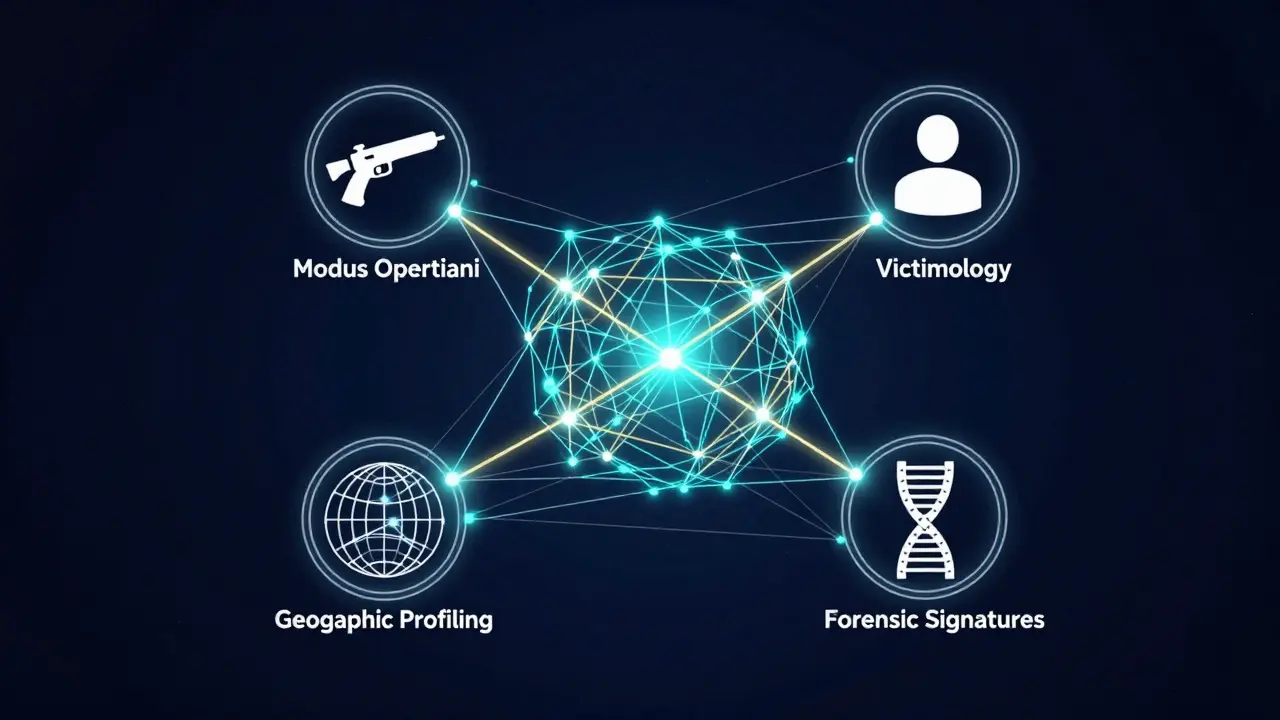
To link cases across jurisdictions, investigators need standardized data. It’s not enough to say "the victim was a woman." You need specific, comparable attributes. Here are the four pillars that make cross-border linkage possible:
- Modus Operandi (MO): How the crime was committed. Did the offender use a ligature? A firearm? Was there staging? MO can evolve as the offender gains confidence, but core elements often remain stable.
- Victimology: Who was targeted? Age, gender, occupation, lifestyle, and relationship to the offender. Serial killers often have a specific "type" they seek out.
- Geographic Profiling: Where did the crimes happen? Are they clustered around the offender's home, work, or travel routes? This helps narrow down the search area across multiple states.
- Forensic Signatures: Unique biological or physical evidence. DNA profiles, fingerprint patterns, or distinctive tool marks that can be matched across databases.
When these four elements align across two or more jurisdictions, the probability of a single offender increases dramatically. It’s not just a hunch; it’s statistical correlation backed by behavioral science.
Bridging the Gap: Data Sharing Mechanisms
How does information actually flow between agencies? It rarely happens automatically. It requires active collaboration through shared databases and task forces. The most effective system in the United States remains the National Crime Information Center (NCIC), which is a computerized index of criminal justice information maintained by the Federal Bureau of Investigation. While NCIC handles warrants and stolen property, its role in homicide linkage is indirect but vital. More direct tools include the ViCAP (Violent Criminal Apprehension Program) database, which specifically catalogs unsolved violent crimes for pattern matching.
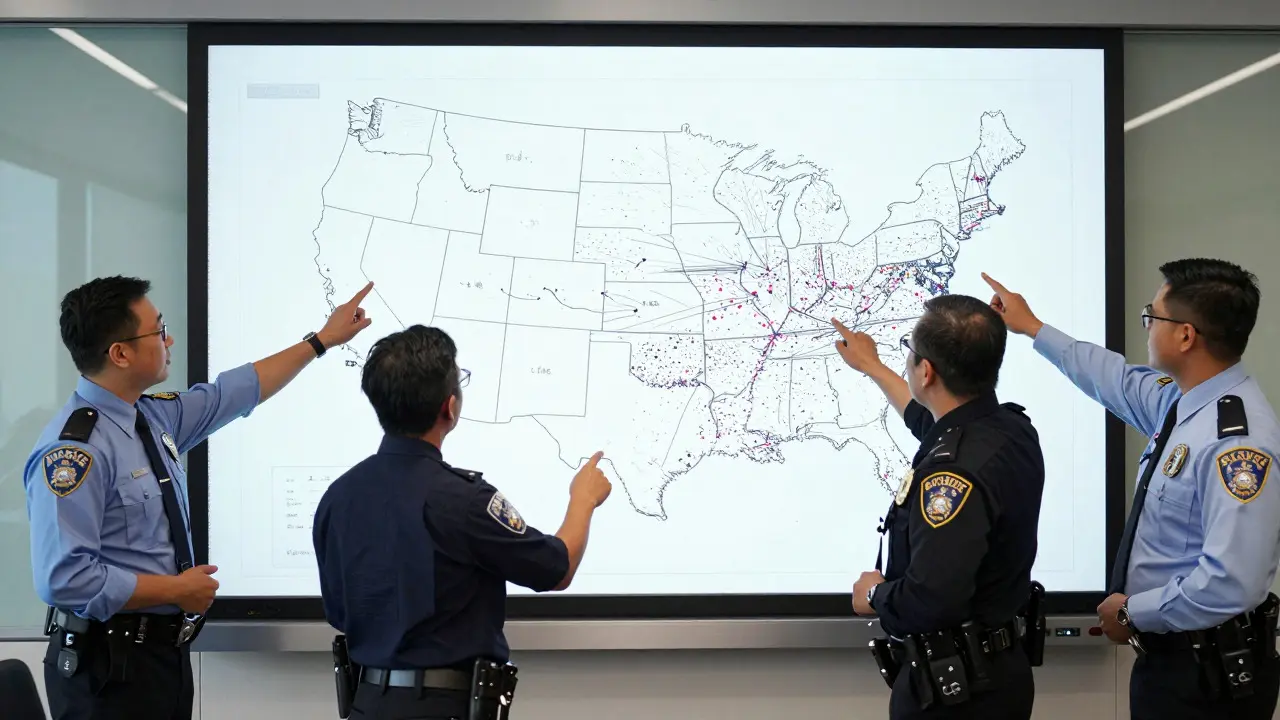
Beyond federal systems, regional task forces play a huge role. For example, when a serial killer operates along a major interstate corridor, states will often form a joint investigative task force. This allows detectives to share raw data, not just summaries. They compare photos, witness statements, and forensic reports in real-time. The barrier isn’t technology; it’s culture. Agencies must agree to share credit and resources, which isn’t always easy. But the alternative-letting a killer roam free because of bureaucratic friction-is worse.
| Feature | Traditional Local Approach | Cross-Jurisdictional Pattern Analysis |
|---|---|---|
| Data Scope | Single county/city records | Multi-state/national database entries |
| Investigator Focus | Immediate suspect pool | Behavioral consistency across regions |
| Response Time | Fast for local leads, slow for distant ones | Slower initial setup, faster identification of serials |
| Resource Allocation | Local budget constraints | Pooled federal/state resources |
| Success Metric | Solving the current case | Preventing future crimes via early detection |
Case Study: The Power of Geographic Linkage
Consider the case of the Golden State Killer, Joseph James DeAngelo. His crimes spanned California over decades. Early on, his MO was distinct: entering homes through windows, using a .38 caliber revolver, and targeting couples. However, he moved across several counties. If investigators had stayed strictly within one county’s boundaries, the pattern would have been fragmented.
It wasn’t until broader geographic profiling and genetic genealogy (a newer tool) were applied that the connections became undeniable. But even before DNA, behavioral analysts noted similarities in his staging habits across different police departments. This highlights a crucial point: pattern analysis works best when combined with modern forensic tools. The behavior provides the hypothesis; the forensics provide the proof.
Challenges and Pitfalls in Cross-Border Analysis
Don’t think this process is flawless. There are significant hurdles. First, data standardization is a nightmare. One agency might code a crime as "assault with a deadly weapon," while another calls it "aggravated assault." If the terminology isn’t aligned, automated pattern matching fails. Second, privacy concerns can slow down sharing. Victims’ families may worry about media exposure if their case is linked to others. Third, confirmation bias is a real risk. Once detectives believe two cases are linked, they may ignore contradictory evidence. To combat this, teams should use blind review processes where analysts compare cases without knowing the suspected link.
Another pitfall is the "cooling-off period." Some serial killers wait months or years between crimes. During this time, memories fade, and evidence degrades. Rapid data entry into national databases is essential. If a case sits in a local cabinet for six months before being uploaded to ViCAP, the window for linkage closes.
Best Practices for Investigators
If you’re leading a homicide investigation, here’s how to maximize your chances of cross-jurisdictional success:
- Upload Immediately: Enter all relevant data into national databases within 48 hours of case acceptance. Don’t wait for the case to go cold.
- Standardize Descriptions: Use precise, objective language for MO and victimology. Avoid subjective terms like "suspicious" or "strange."
- Reach Out Proactively: If your case resembles one in a neighboring state, call them. Don’t wait for a formal request. A quick phone call can save weeks.
- Collaborate on Forensics: Share DNA profiles and fingerprint data early. These are the strongest links.
- Document the Linkage Logic: Keep a clear record of why you believe cases are connected. This helps in court and prevents tunnel vision.
These steps turn individual cases into parts of a larger puzzle. The goal isn’t just to catch the killer for the last crime; it’s to stop the next one.
The Future of Homicide Pattern Analysis
Technology is accelerating this field. Machine learning algorithms are now being tested to scan thousands of case files simultaneously, flagging potential links based on subtle behavioral cues humans might miss. Genetic genealogy has already solved dozens of cold cases by linking offenders to relatives in public databases. As these tools become more accessible, the gap between jurisdictions will shrink further.
However, technology is only as good as the data fed into it. Clean, complete, and timely data remains the foundation. The future of homicide investigation isn’t just about better computers; it’s about better cooperation. When agencies break down walls, justice becomes faster and more accurate. For victims’ families, that speed matters. Every day a killer remains free is another potential life lost. Pattern analysis gives us the map to find them.
What is the minimum number of crimes required to classify a case as a serial homicide?
While definitions can vary slightly by agency, the FBI generally defines a serial homicide as three or more murders committed by the same person over a period of time, with a cooling-off period between each crime. However, pattern analysis can begin with just two similar incidents to prevent escalation.
How long does it take to link cases across different states?
There is no fixed timeline. If data is entered into national databases like ViCAP promptly, automated alerts can trigger within days. However, manual verification and inter-agency communication can take weeks or months. The key variable is the speed of initial data entry and the responsiveness of the involved agencies.
Can Modus Operandi change over time?
Yes. As offenders gain experience and confidence, their MO often evolves to become more efficient or less risky. However, certain core elements, such as the choice of weapon or victim type, tend to remain consistent. Analysts focus on these stable traits to maintain linkage despite superficial changes.
What role does DNA play in cross-jurisdictional linkage?
DNA is the gold standard for definitive linkage. If a DNA profile from a crime scene in one state matches a profile in another state’s database, it confirms the same perpetrator. Even partial matches can guide investigators to related individuals or previous unsolved cases.
Are there legal barriers to sharing homicide data between states?
Generally, no. Most states have mutual aid agreements and participate in federal programs like NCIC and ViCAP. However, privacy laws regarding victim information can sometimes complicate sharing. In practice, law enforcement agencies routinely share investigative details to solve crimes, prioritizing public safety over minor procedural hurdles.