Imagine you are sitting in a courtroom. A detective takes the stand and explains how DNA testing proved the defendant was at the crime scene. The defense attorney jumps up and objects. "This test hasn't been accepted by the general scientific community," they argue. "It's too new." This is where the Frye Standard comes into play. It is a legal rule that determines whether a specific type of scientific evidence is allowed to be heard by a jury. If it fails this test, the evidence might never see the light of day, no matter how accurate the lab results are.
For decades, this standard was the gatekeeper for all scientific proof in American courts. Today, while many states have moved to a different framework, the Frye Standard remains a critical concept for lawyers, forensic scientists, and anyone interested in how justice works. Understanding it helps you see why some cutting-edge tech is banned from courtrooms while older methods are welcomed with open arms.
What Exactly Is the Frye Standard?
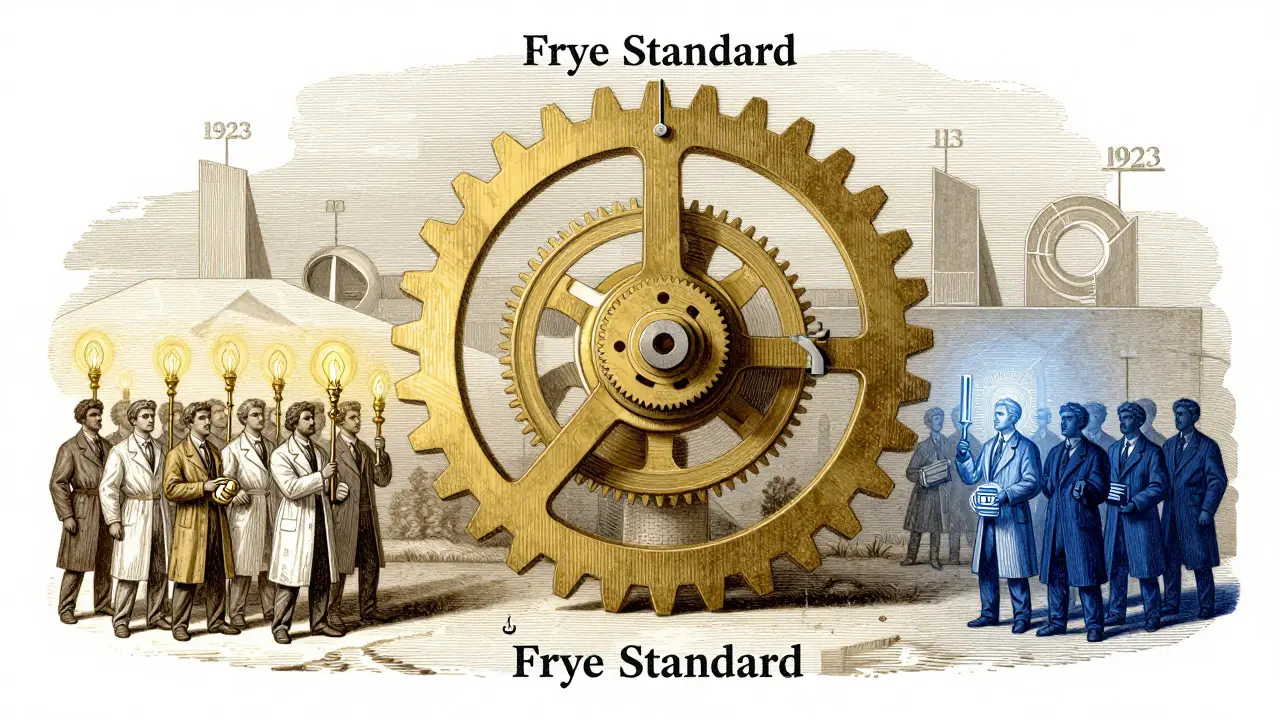
The Frye Standard originates from a 1923 case called Frye v. United States. In that landmark decision, the D.C. Circuit Court ruled that scientific evidence must be generally accepted within its particular field to be admissible. It wasn't enough for the method to work in one instance; it had to be recognized as reliable by the broader scientific community.
This creates a two-part check for judges:
- Relevance: Does the science relate to the facts of the case?
- General Acceptance: Is the technique widely accepted by experts in that specific discipline?
If both boxes are checked, the evidence goes to the jury. If not, the judge excludes it. This places significant power in the hands of the judge, who acts as a filter before the jury ever hears about polygraphs, certain drug tests, or novel fingerprint analysis techniques.
Why Did Courts Need a Gatekeeper?
In the early 20th century, science was advancing rapidly, but legal systems were slower to adapt. Lawyers began introducing dubious "scientific" claims-like lie detector tests or questionable blood spatter theories-to confuse juries. Without a clear rule, any expert could claim their method was valid, leading to potential miscarriages of justice based on pseudoscience.
The Frye ruling solved this by shifting the burden. Instead of asking the jury to decide if the science was good, the judge decided first. This protected juries from being overwhelmed by technical debates they weren't equipped to handle. It ensured that only established, vetted methods reached the deliberation room.
Frye vs. Daubert: The Modern Divide
In 1993, the U.S. Supreme Court issued a decision in Daubert v. Merrell Dow Pharmaceuticals. This shifted the focus from "general acceptance" to "reliability." Under Daubert, judges must evaluate factors like whether the theory has been tested, whether it has been peer-reviewed, and what its known or potential rate of error is.
So, which one do you need to know? It depends on where you are. As of 2026, the United States is split. Federal courts use Daubert. However, roughly 20 to 25 states still adhere strictly to the Frye Standard. Some states use a hybrid approach, requiring both general acceptance and reliability. If you are working in New York, Pennsylvania, or Washington state, you are likely operating under Frye or a Frye-influenced rule.
Here is why this matters practically. Under Frye, a brand-new, highly accurate DNA sequencing method might be excluded simply because it hasn't been around long enough for the entire geneticist community to agree on it. Under Daubert, that same method could be admitted immediately if the proponent can prove its accuracy and low error rate, even if it's still controversial among peers.
How Forensic Science Fits Into This Framework
Forensic science is the most common battleground for these standards. Consider fingerprint analysis. For decades, latent print examination was considered subjective. Critics argued there was no universal standard for declaring a match. In Frye jurisdictions, this subjectivity often led to exclusion unless the examiner could show widespread agreement in the AFIS (Automated Fingerprint Identification System) community.
On the other hand, toxicology tests for alcohol concentration are almost universally accepted. Because the chemical processes are well-understood and standardized across labs, they easily pass the "general acceptance" hurdle. Whether you are in a Frye state or a Daubert state, a breathalyzer result is rarely contested on admissibility grounds-it’s usually contested on calibration or administration errors instead.
Novel areas like gait analysis or facial recognition software face the toughest hurdles. These technologies change quickly. In a Frye jurisdiction, a prosecutor might struggle to admit facial recognition ID unless they can cite multiple studies showing broad adoption by law enforcement agencies and academic researchers. The bar is high: you need consensus, not just one good study.
Practical Implications for Legal Professionals
If you are an attorney preparing a case involving scientific evidence, your first step is checking your jurisdiction's current rule. Do not assume Daubert applies everywhere. In a Frye state, your strategy shifts from proving the *accuracy* of the method to proving its *acceptance*.
- Gather Expert Consensus: Secure declarations from multiple independent experts stating that the method is standard practice in their field.
- Cite Textbooks and Guidelines: Show that major professional organizations (like the American Academy of Forensic Sciences) endorse the technique.
- Avoid Novelty Traps: If the method is less than five years old, expect heavy resistance. Be prepared to demonstrate that despite its age, it has already gained traction in the community.
Conversely, if you are defending against scientific evidence, look for gaps in acceptance. Has the method been criticized in recent journals? Are there competing schools of thought? In a Frye jurisdiction, division within the scientific community is your strongest weapon. You don't need to prove the science is wrong; you just need to prove it isn't *generally* accepted yet.

Common Misconceptions About the Frye Standard
Many people think Frye means "the science must be perfect." That is not true. It means the science must be *settled*. A method can have a 5% error rate and still be admissible if experts agree that 5% is acceptable for the context. The standard is about social and professional validation, not mathematical perfection.
Another misconception is that Frye is obsolete. While Daubert dominates federal law, Frye remains robust in state courts. Because state courts handle the vast majority of criminal cases, Frye continues to influence millions of trials annually. Ignoring it is a mistake for any legal professional practicing in those jurisdictions.
Future Trends and Emerging Challenges
As technology accelerates, the gap between innovation and legal acceptance widens. Digital forensics, blockchain analysis, and AI-driven predictive policing tools are all facing scrutiny. Will courts wait for full consensus, or will they adopt more flexible approaches?
There is a growing movement to update evidentiary codes to reflect modern scientific realities. Some scholars argue that "general acceptance" is too slow for digital crimes, where data formats change every few years. However, until legislatures act, the Frye Standard remains a powerful tool for maintaining judicial control over what counts as truth in the courtroom.
Which states currently use the Frye Standard?
As of 2026, approximately 20 to 25 U.S. states strictly follow the Frye Standard. Notable examples include New York, Pennsylvania, and Washington. Other states may use a hybrid model that incorporates elements of both Frye and Daubert. Always verify with local court rules, as legislative changes can occur.
Is the Frye Standard stricter than Daubert?
Generally, yes. Frye requires a higher threshold of community consensus, making it harder to admit novel or emerging scientific methods. Daubert allows judges to admit newer science if it meets specific reliability criteria, such as peer review and known error rates, without waiting for full community acceptance.
Can a judge exclude evidence under Frye even if it is scientifically accurate?
Yes. Accuracy is not the sole criterion under Frye. If a method is highly accurate but lacks widespread acceptance among experts in that field, a judge can exclude it. The focus is on the status of the method within the scientific community, not just its individual performance in a specific case.
How does the Frye Standard affect forensic DNA testing?
Standard STR DNA profiling is widely accepted and passes Frye easily in all jurisdictions. However, newer techniques like probabilistic genotyping or mitochondrial DNA analysis for degraded samples may face challenges in strict Frye states if the scientific community has not yet reached a unified consensus on their interpretation methods.
Who decides if evidence meets the Frye Standard?
The judge decides. This is a preliminary hearing, often called a Frye hearing, held before the trial begins. The judge listens to arguments from both sides and reviews expert testimony to determine if the scientific method is generally accepted. The jury does not make this initial determination.