You’ve got a swab from a handle. It’s been sitting in the rain for three days. The lab tech looks at you and says, "It’s too chewed up." Standard testing fails. You’re stuck. This is where Mini-STRs come in. They aren't magic, but they are the specific tool designed to rescue evidence that standard methods drop on the floor.
If you work in crime scene investigation or casework, you know the frustration of losing data to degradation. Environmental exposure breaks DNA strands into tiny fragments. Standard Short Tandem Repeat (STR) kits look for larger chunks. If the chunks are smaller than the kit expects, you get nothing. Or worse, you get partial profiles that are hard to interpret. Mini-STR technology changes the target size. It looks for smaller repeats. This simple shift allows analysts to type loci that would otherwise be invisible. Let’s break down how this works, when to use it, and why it saves cases.
Why Standard STR Kits Fail on Old Evidence
To understand Mini-STRs, you first need to grasp what happens to DNA outside the body. DNA is a long molecule. When cells die, enzymes called nucleases start cutting the DNA. Sunlight, heat, moisture, and bacteria accelerate this process. This is hydrolytic and oxidative damage. The result? Fragmentation.
Standard commercial STR kits, like those from Promega or Thermo Fisher, typically amplify amplicons ranging from 100 to 450 base pairs (bp). If your DNA is fragmented into pieces averaging 80 bp, the polymerase chain reaction (PCR) cannot bridge the gap between primers. No product means no signal. You see flat lines on the electropherogram. Case closed, right? Not necessarily. The DNA is still there. It’s just broken.
Think of it like trying to fit a large puzzle piece into a small hole. It won’t go. But if you find a smaller piece from the same picture, it fits. That’s the core concept of Mini-STRs. By redesigning primers to bind closer together, we reduce the amplicon size. We move from targeting 300 bp regions to targeting 60-100 bp regions. Suddenly, the fragmented DNA becomes amplifiable.
What Exactly Are Mini-STRs?
Mini-STRs are short tandem repeat markers with reduced amplicon sizes, specifically engineered to analyze degraded DNA samples. Unlike standard autosomal STRs, which prioritize discrimination power across a wide range of sample qualities, Mini-STRs prioritize sensitivity to fragmentation. They are not a different type of genetic marker; they are the same loci (locations on the chromosome), but amplified with different primer sets.
For example, the locus D13S315 might have a standard amplicon size of 150-250 bp. A Mini-STR assay for D13S315 might target an amplicon size of 70-90 bp. The repeat structure remains identical. The allele calls remain identical. The only difference is the physical distance between the forward and reverse primers. This reduction in size dramatically increases the probability of successful amplification in degraded samples.
| Feature | Standard STR Kits | Mini-STR Assays |
|---|---|---|
| Amplicon Size | 100-450 bp | 60-120 bp |
| Degradation Sensitivity | Low to Moderate | High |
| Discrimination Power | Very High (Full Profile) | Moderate to High (Partial Profile) |
| Interpretation Complexity | Standard Guidelines | Requires Careful Threshold Setting |
| Best Use Case | Fresh blood, saliva, hair roots | Bone, teeth, old touch DNA, wet evidence |
The Science Behind Amplifying Broken Molecules
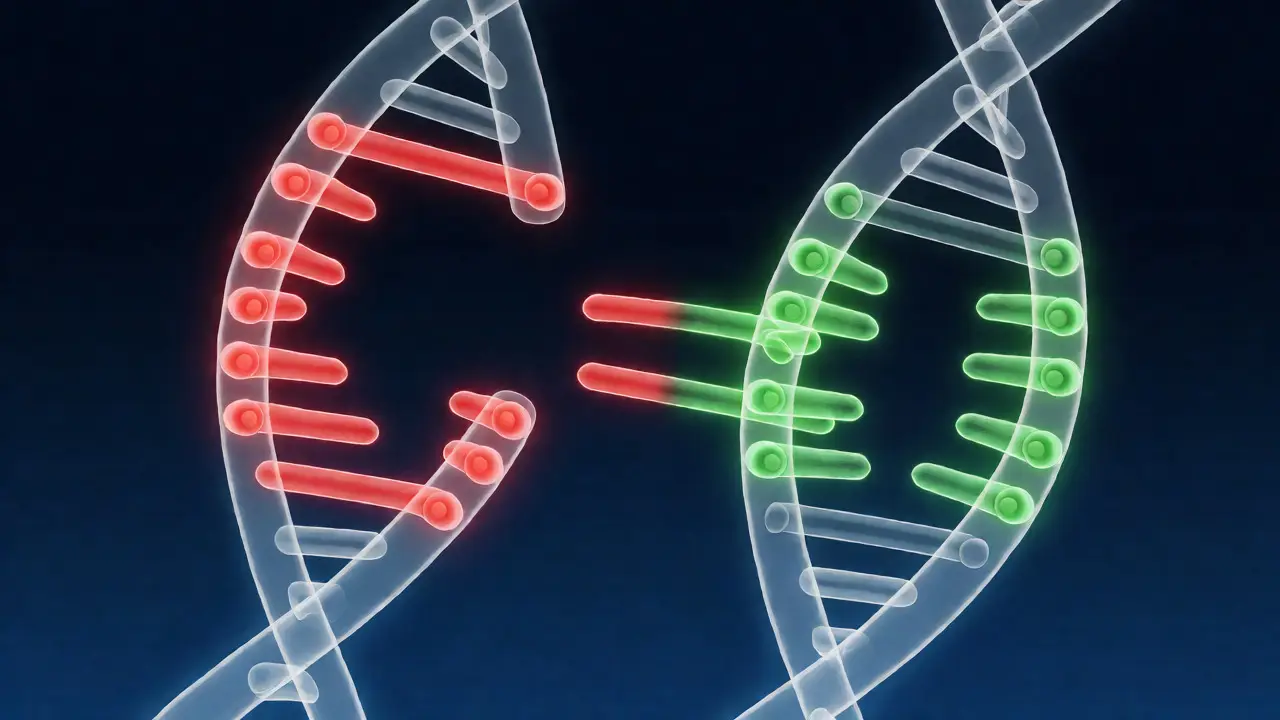
Polymerase Chain Reaction (PCR) requires two things: a template strand and primers that bind to specific sequences flanking the target region. In intact DNA, these binding sites are far apart. In degraded DNA, random cuts occur throughout the genome. Statistically, the further apart the primers are, the higher the chance a cut occurred between them. If a cut occurs between the primers, PCR fails for that specific fragment.
By moving the primers closer, you reduce the "target zone" for potential breaks. If your target is 70 bp long, the likelihood of a random break occurring within that short span is significantly lower than in a 300 bp span. This is basic probability applied to molecular biology. Studies show that as amplicon size decreases, the ratio of successful amplification increases exponentially in highly degraded samples.
However, there is a trade-off. Smaller amplicons often contain fewer repeats. Fewer repeats mean less variation between individuals. This reduces the discriminatory power of each locus. A single Mini-STR locus is not as powerful as a full standard STR profile. But a partial profile is better than no profile. And when you combine multiple Mini-STR loci, you can build a statistical weight sufficient for identification or exclusion.
When Should You Order Mini-STR Testing?
Not every case needs Mini-STRs. In fact, using them unnecessarily wastes resources. Here is a practical decision tree for caseworkers:
- Environmental Exposure: Was the item submerged in water, buried in soil, or exposed to direct sunlight for weeks? If yes, consider Mini-STRs.
- Biological Substrate: Is the sample bone, tooth, or calcified tissue? These materials degrade slowly but eventually become fragmented. Mini-STRs are ideal here.
- Previous Failure: Did standard testing yield a null result or a very poor partial profile? If the quality score was below threshold, re-extraction and Mini-STR analysis are logical next steps.
- Touch DNA: While fresh touch DNA is usually fine, older touch DNA on porous surfaces can degrade rapidly. If the swab looks dirty or has been handled heavily, Mini-STRs might recover more alleles.
Conversely, do not order Mini-STRs for fresh blood stains or buccal swabs collected yesterday. You will lose discrimination power without gaining significant recovery benefits. Save the budget for the tough cases.
Interpreting Mini-STR Data: Pitfalls and Best Practices
Generating data is half the battle. Interpreting it is where mistakes happen. Because Mini-STRs produce shorter products, they are susceptible to different artifacts than standard kits. One major issue is stutter. Stutter peaks are smaller peaks preceding the true allele peak, caused by slippage during replication. In Mini-STRs, stutter patterns can differ due to the shorter repeat counts. Analysts must validate their stutter thresholds specifically for Mini-STR loci.
Another challenge is allele dropout. Even with Mini-STRs, heterozygous samples may appear homozygous if one allele fails to amplify. This is critical in mixture interpretation. If you assume a single-source contributor because you see one peak, you might miss a second contributor entirely. Always consider the possibility of dropout when evaluating low-template or degraded Mini-STR results.
Use probabilistic genotyping software where available. Tools like STRmix or TrueAllele can model the uncertainty inherent in degraded data better than manual inspection. They calculate likelihood ratios that account for the increased noise and dropout rates typical of Mini-STR profiles. Manual interpretation should only be used for clear-cut exclusions or simple matches with high confidence.
Real-World Application: Cold Cases and Mass Disasters
Where does this technology shine brightest? Two areas stand out: cold cases and mass disasters.
In cold cases, evidence often sits in storage for decades. Humidity control varies by facility. Over time, DNA degrades. A rape kit from 1995 might fail standard CODIS upload criteria. Mini-STR analysis can extract usable data from these aged samples, potentially linking a suspect to a crime scene years after the statute of limitations seemed relevant. There have been documented instances where Mini-STRs provided the final link needed to convict in cases previously considered unsolvable.
In mass disasters, such as plane crashes or natural disasters, human remains are often commingled and exposed to extreme conditions. Fire accelerates degradation. Water immersion promotes bacterial growth. Identifying victims requires robust methods. Mini-STRs allow forensic odontologists and anthropologists to type dental pulp or bone powder effectively. Without this capability, many victims might remain unidentified, leaving families without closure.
Limitations and Future Directions
Mini-STRs are not a silver bullet. They require additional validation. Each laboratory must establish its own performance metrics for sensitivity, specificity, and contamination rates. You cannot simply take a standard protocol and tweak the temperatures. Primer design matters. Buffer composition matters. Instrument calibration matters.
Furthermore, Mini-STR databases are not as comprehensive as standard CODIS databases. While the FBI is expanding the inclusion of Mini-STR data, most national databases rely on standard 20-locus profiles. Matching a Mini-STR partial profile against a standard reference sample requires careful statistical comparison. You are comparing apples to slightly smaller apples. Ensure your reporting language reflects this limitation clearly to prosecutors and defense attorneys.
Looking ahead, Next-Generation Sequencing (NGS) is beginning to blur the line between standard and mini approaches. NGS can sequence entire fragments regardless of size, offering even greater flexibility. However, Mini-STRs remain cost-effective and faster for targeted questions. For now, they occupy a vital niche in the forensic toolkit.
Can Mini-STRs replace standard STR testing?
No, they cannot fully replace standard STRs. Standard kits offer higher discrimination power because they analyze more variable loci with longer amplicons. Mini-STRs are a supplementary tool specifically for degraded samples where standard kits fail. Using Mini-STRs on fresh, high-quality DNA would unnecessarily reduce the strength of the match statistics.
How much DNA is needed for Mini-STR analysis?
Mini-STR assays are highly sensitive and can often work with very low quantities of DNA, sometimes less than 50 picograms. However, quantity is not the only factor; quality matters. Highly inhibited samples may still fail despite the small amplicon size. Extraction methods that remove inhibitors while preserving small fragments are crucial for success.
Are Mini-STR profiles admissible in court?
Yes, provided the laboratory validates the method according to accreditation standards (such as ISO 17025 or FBI QAS guidelines). The key is transparency. Experts must explain the limitations, such as reduced discrimination power and potential for allele dropout, to the jury. Proper documentation of validation studies strengthens admissibility.
Do Mini-STRs work on mixed samples?
They can, but interpretation is complex. Mixtures increase the risk of allele overlap and dropout. Probabilistic genotyping software is strongly recommended for analyzing Mini-STR mixtures. Manual interpretation of degraded mixtures is prone to error and should be approached with caution.
Which loci are commonly included in Mini-STR panels?
Common loci include D13S315, D16S539, D18S51, D21S11, TH01, and vWA. These are selected because they have high heterozygosity and well-characterized flanking regions suitable for primer redesign. Some panels also include amelogenin for sex determination, though this is less reliable in severely degraded samples.