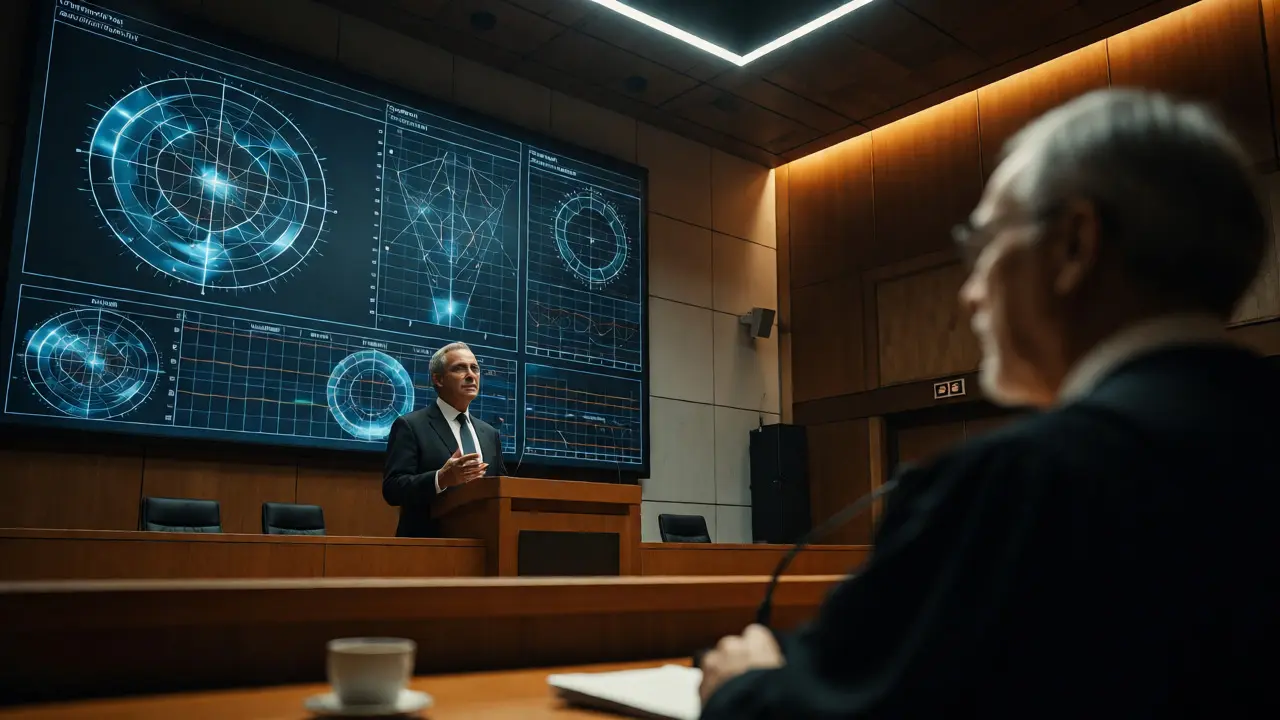
Imagine you are a prosecutor. You have DNA, fingerprints, and witness statements. But the defense is arguing that your defendant didn't act with intent because of a specific mental state. Or perhaps you are a defense attorney trying to prove that a confession was coerced due to high anxiety traits. In both cases, raw facts aren't enough. You need context. That context often comes from psychological evidence presented through expert testimony. This isn't just about labeling someone "crazy" or "sane." It's about translating complex human behavior into data a jury can understand.
But here is the catch: courts are skeptical. They don't want guesswork dressed up as science. If you step onto the stand without a solid framework, you risk being excluded before you even say a word. Whether you are involved in criminal profiling or assessing competency, the way you present this evidence matters as much as the evidence itself.
The Gatekeepers: Why Courts Scrutinize Psychological Claims
Before we talk about how to present evidence, we need to talk about who decides if it gets in. In the United States federal system and many states, the judge acts as a gatekeeper. The primary filter is the Daubert standard, established in the 1993 Supreme Court case *Daubert v. Merrell Dow Pharmaceuticals*. Unlike the older *Frye* standard, which asked if a method was generally accepted, Daubert asks if it is scientifically valid.
Why does this matter for psychology? Because psychology deals with constructs-things like intelligence, personality, or sanity-that aren't tangible objects. You can measure blood alcohol content precisely. Measuring "antisocial personality disorder" involves clinical judgment. Judges worry that juries might blindly trust an expert who uses fancy terminology but lacks empirical backing. Therefore, any psychological evidence must demonstrate reliability and relevance. If your method cannot be tested, peer-reviewed, or has a known error rate, it likely won't make it past the pretrial motion.
Types of Psychological Evidence You Might Present
Not all psychological testimony looks the same. Depending on the legal issue, you will be presenting one of several distinct types of evidence. Understanding the difference helps you tailor your presentation style.
- Competency Evaluations: Can the defendant understand the proceedings and assist their counsel? This is usually a binary yes/no supported by cognitive testing scores.
- Insanity Defenses: Did the defendant know right from wrong at the time of the crime? This requires reconstructing mental state retrospectively, which is notoriously difficult.
- Risk Assessments: Will this person reoffend? Tools like the HCR-20 (Historical, Clinical, Risk Management) provide structured guidelines rather than pure intuition.
- Criminal Profiling: Often used in investigations, but increasingly debated in court. Does the profile fit the suspect’s behavioral patterns?
- Mitigation Evidence: In death penalty cases, showing childhood trauma or intellectual disability to argue against execution.
Each type requires different proof standards. Competency is often based on current functioning. Insanity is based on past mental state. Risk assessment is probabilistic. Mixing these up confuses juries fast.
| Method | Primary Use | Key Attribute | Court Acceptance |
|---|---|---|---|
| MMPI-3 (Minnesota Multiphasic Personality Inventory) | Personality & Psychopathology | Standardized self-report; high validity scales | High (if administered correctly) |
| PCL-R (Psychopathy Checklist-Revised) | Psychopathy/Risk | Requires file review + interview; subjective scoring | Moderate (requires strict adherence to protocol) |
| WAIS-IV (Wechsler Adult Intelligence Scale) | Cognitive Ability | Objective IQ scores; widely normed | Very High |
| Behavioral Analysis Unit Profiles | Investigative Leads | Inductive reasoning; no single standardized metric | Low to Moderate (often excluded as substantive evidence) |
The Foundation: Reliability and Validity
To survive cross-examination, your evidence needs two pillars: reliability and validity. Think of them like a target. Reliability means hitting the same spot every time. Validity means hitting the bullseye. A broken clock is reliable (it shows the same time twice a day) but not valid (it’s rarely correct).
In psychological testing, reliability refers to consistency. If I administer the MMPI-3 today and again next week, should the results be similar? For stable traits, yes. For mood-dependent states, maybe not. You must explain why discrepancies exist. Validity is harder. How do we know a test measures what it claims to measure? If a test claims to detect malingering (faking bad), does it actually distinguish fakers from people with genuine disorders?
Juries don’t care about Cronbach’s alpha coefficients. They care about common sense. Instead of saying, "The internal consistency is .85," say, "This test asks the same questions in different ways. If the answers contradict each other, we know the person might be guessing or lying. This happens less than 5% of the time in honest respondents." Translate the stats into human behavior.

Presenting Criminal Profiling: Science or Art?
This is where things get messy. Criminal profiling is popular in media, but its role in court is limited. Most judges view profiles as investigative tools, not conclusive proof of guilt. Why? Because profiling is often inductive. It says, "Serial killers often exhibit X trait. This suspect exhibits X trait. Therefore, he might be a serial killer." That is weak logic legally.
If you are presenting profiling evidence, avoid claiming certainty. Do not say, "The offender is definitely a white male aged 25-35." Say, "Based on statistical trends in similar cases, offenders with this modus operandi frequently fall within this demographic range." Always cite the base rates. If 60% of arsonists are unemployed males, mention that. If the defendant fits the profile, fine. If he doesn’t, acknowledge it. Overstating the power of a profile invites impeachment.
A common pitfall is the "Barnum Effect." People accept vague personality descriptions as uniquely accurate. "You are critical of yourself but seek validation." Everyone feels that applies to them. Experts must show how the profile is specific to the crime scene evidence, not just generic human traits.
Structuring Your Testimony for Maximum Impact
You have the data. Now, how do you deliver it? Juries are tired. They are confused. They want clarity. Structure your testimony using the "Funnel Method": start broad, then narrow down to the specific conclusion.
- Educate First: Before discussing the defendant, teach the jury what the condition is. If you are talking about PTSD, explain what PTSD is, how it affects memory, and why victims might delay reporting. Do not assume they know.
- Explain the Method: Show them how you gathered information. "I reviewed police reports, medical records, and interviewed the defendant for four hours." Transparency builds trust.
- Apply to Facts: Connect the general knowledge to the specific case. "Dr. Smith noted the defendant exhibited flat affect. In individuals with severe depression, flat affect is a common symptom..."
- State Conclusion Clearly: Avoid hedging too much. "Based on my evaluation, it is more likely than not that the defendant lacked the capacity to form intent."
Use visual aids. Charts showing test scores compared to norms help. A bar graph showing where the defendant falls on the psychopathy scale versus the general population is easier to grasp than a paragraph of text. But keep it simple. One chart per key point.

Navigating Cross-Examination Traps
Defense attorneys love to attack the subjective nature of psychology. Expect questions like: "Isn't psychology just opinion?" or "Two experts reached opposite conclusions. Who is right?"
Your answer should never be defensive. Acknowledge the limits of the field. "Psychology is a science of probabilities, not certainties. We work with incomplete data. However, my conclusions are based on peer-reviewed methods and consistent findings across multiple sources."
Another trap is "testifying beyond your expertise." If you are a psychologist, do not opine on legal definitions unless qualified. You can speak to mental state, but leave the definition of "malice aforethought" to the judge. Stay in your lane. If you drift, you look unprofessional and give the opposition ammunition.
Ethical Boundaries and Bias
Every expert has bias. Yours might be confirmation bias-looking only for evidence that supports your hypothesis. Good experts actively try to disprove themselves. Mention this in your report. "I considered alternative explanations, such as substance abuse, and ruled them out because..."
Also, watch out for "hired gun" accusations. If you are paid by the prosecution, the defense will claim you are biased. Counter this by detailing your methodology. Show that your process would yield the same result regardless of who hired you. Consistency beats persuasion.
Can psychological evidence overturn a conviction?
Yes, but it depends on the jurisdiction and the strength of the evidence. New psychological evaluations can support appeals based on ineffective assistance of counsel or newly discovered evidence regarding mental state. However, appellate courts give deference to trial juries, so overturning a verdict solely on new psychological testimony is rare unless the original expert was clearly incompetent.
What is the difference between a psychologist and a psychiatrist in court?
Both can testify on mental health. Psychiatrists are medical doctors (MDs) and can prescribe medication, making them ideal for cases involving drug interactions or biological causes. Psychologists hold PhDs or PsyDs and specialize in testing and behavioral analysis. Courts often prefer psychologists for detailed personality assessments and psychiatrists for treatment-related questions, though overlap exists.
Is criminal profiling admissible as evidence of guilt?
Generally, no. Most courts admit profiling only to explain investigative procedures or to rebut claims that the investigation was flawed. It is rarely admitted to prove the defendant committed the crime because there is no scientific consensus on its predictive accuracy for individual cases. Using it to assert guilt often leads to exclusion under Daubert.
How do experts handle conflicting opinions?
Conflicting opinions are common. The key is transparency. An expert should acknowledge the opposing view and explain why their methodology or data interpretation differs. For example, "The defense expert relied solely on self-reports, whereas I included collateral interviews with family members, which provided a more complete picture."
What happens if an expert fails the Daubert challenge?
If a judge excludes testimony under Daubert, the expert cannot speak to those specific points during trial. This can severely weaken a side's argument. To prevent this, attorneys should conduct mock Daubert hearings early in litigation and refine the expert's methodology before trial.