
When you hear the word speculation, you might think of stock traders betting on tech stocks or real estate investors flipping houses. But in futures markets, speculation isn’t just about profit-it’s about stability. Too much of it can crack the foundation of entire markets. That’s why federal regulators set hard limits on how many contracts one person or group can hold. These aren’t arbitrary numbers. They’re built on decades of data, market crashes, and hard lessons learned.
Why Speculation Needs Limits
Speculators aren’t the enemy. In fact, they’re essential. They provide liquidity, help set prices, and absorb risk that producers and consumers can’t handle. But when a single trader or group controls 10%, 20%, or even 30% of a market’s open interest, things get dangerous. Prices stop reflecting supply and demand and start reflecting one person’s bet.
The Commodity Futures Trading Commission (CFTC) has seen this happen. In the 2000s, unchecked speculation in oil and grain contracts pushed prices far beyond what actual supply could justify. Farmers couldn’t plan, food processors got crushed, and consumers paid more. The Dodd-Frank Act of 2010 forced the CFTC to act. The result? A structured system of speculative position limits designed to stop runaway price swings before they start.
How the Limits Work
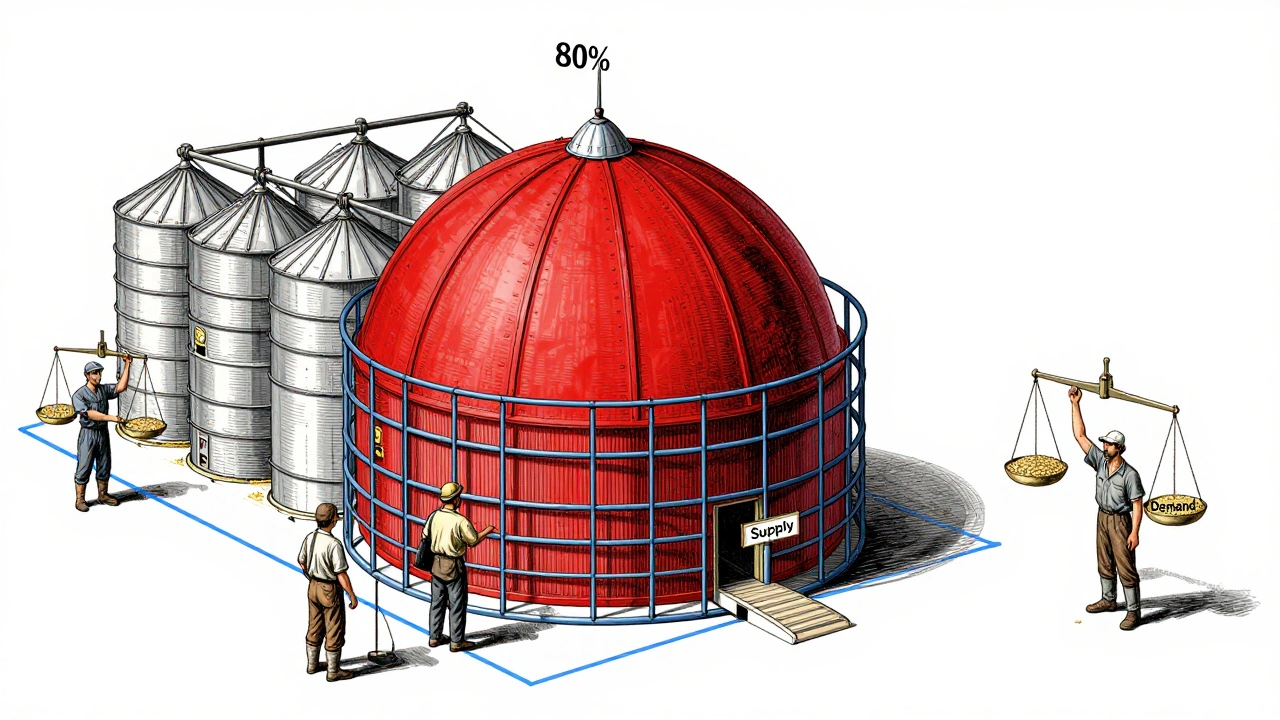
These limits aren’t the same across all markets. They’re tailored to the underlying asset. For physical commodities like corn, wheat, and soybeans-goods that can actually be delivered-the limits are tightest in the spot month, the month when the contract expires and delivery happens. Why? Because that’s when manipulation is easiest. If you control 80% of the available wheat in a delivery hub, you can dictate the price.
The CFTC calculates these spot month limits based on deliverable supply and historical liquidation patterns. For example, if only 5 million bushels of corn are available for delivery in a given month, the limit might cap any single trader at 250,000 contracts (each representing 5,000 bushels). That’s 1.25 billion bushels total-far below the available supply. It’s not about stopping trading. It’s about stopping control.
For financial contracts-like those on major currencies or interest rates-the limits are looser or nonexistent. Why? Because cash markets for these assets are deep and liquid. There’s too much volume for one trader to move the price. No need for a cap.
Hedgers vs. Speculators
The law draws a clear line between hedgers and speculators. A hedger is someone who uses futures to reduce real-world risk. A farmer who sells next year’s crop before planting is hedging. A food processor who locks in soybean prices to protect margins is hedging. These traders are exempt from position limits-but only if they prove it.
To qualify for an exemption, a hedger must file monthly reports with the CFTC showing their cash positions. If you’re selling 10 million bushels of wheat futures, you need to show you have 10 million bushels in storage, or a contract to produce them. No proof? You’re treated like a speculator. The system assumes good faith unless proven otherwise.
Aggregation Rules: No Loopholes
One person can’t outsmart the system by using five different accounts. The CFTC requires aggregation-all positions under common ownership or control are counted as one. If you own 10% or more of a partnership, your personal trades and the partnership’s trades are added together. Same goes for family members, corporations you control, or even trading advisors acting on your behalf.
This isn’t theoretical. In 2018, a major commodities firm was fined $12 million after the CFTC found its hedge fund and proprietary trading desk were operating as a single unit, exceeding wheat position limits by over 300%. The firm claimed they were separate, but the ownership structure proved otherwise. The rules are strict because the risk is real.

What Happens When Limits Are Broken
Exchanges enforce their own limits. If you exceed them, you might get a warning, a trading suspension, or a fine. But if you violate a limit approved by the CFTC, the Commission itself steps in. Penalties can include fines, trading bans, or even criminal referral if manipulation is suspected.
Monitoring is continuous. The CFTC tracks position reports, analyzes trading patterns, and investigates spikes in concentration. In 2024, they launched a new algorithmic surveillance system that flags unusual cluster behavior-like multiple accounts with the same IP address or coordinated trades across exchanges.
The Bottom Line: Balance, Not Ban
The goal isn’t to eliminate speculation. It’s to prevent it from becoming a weapon. The system works because it’s smart. It lets traders take risk, but not control. It protects producers, processors, and consumers. It doesn’t punish liquidity-it channels it.
There’s no perfect number. The limits change as markets evolve. But the principle stays the same: markets function best when prices reflect reality, not one person’s guess. The CFTC’s framework reflects decades of expert consensus: speculation is healthy. Excessive speculation is dangerous. And the line between them? It’s not vague. It’s written in regulation, enforced by data, and backed by history.
What’s the difference between a hedger and a speculator under CFTC rules?
A hedger uses futures contracts to offset real-world price risk in their business-for example, a farmer selling future crop output or a bakery locking in flour prices. A speculator trades purely to profit from price changes, with no underlying physical exposure. Hedgers must prove their positions are tied to actual assets or liabilities, while speculators have no such requirement. Only hedgers qualify for exemptions from speculative position limits.
Are speculative position limits the same for all commodities?
No. Limits vary by commodity type and market structure. For physical delivery commodities like corn, wheat, and cotton, limits are set by the CFTC and are stricter during the spot month. For financial instruments like currencies or Treasury futures, limits are either much higher or nonexistent because cash markets are too deep to manipulate. Exchanges set limits for other markets, but must follow CFTC Acceptable Practices.
Why are spot month limits tighter than other months?
The spot month is when the futures contract matures and delivery occurs. If one trader controls a large share of contracts expiring in that month, they could manipulate the price by controlling supply. Tighter limits prevent this. The CFTC bases these limits on deliverable supply and historical trading patterns to ensure no one can corner the market.
Can a trader avoid limits by using multiple accounts?
No. The CFTC requires aggregation of all positions under common ownership or control. If you own 10% or more of a partnership, your personal trades and the partnership’s trades are combined. The same applies to family members, corporate entities you control, or advisors acting on your behalf. Attempting to evade aggregation is considered a violation and can lead to enforcement action.
Do speculative limits apply to options as well as futures?
Yes. Position limits apply to both futures and options contracts on the same underlying commodity. The CFTC treats options as equivalent to futures for limit purposes because they can be used to achieve the same economic exposure. A trader holding 10,000 futures contracts and 5,000 call options on soybeans may still exceed the combined speculative limit.